
Tailoring Price List: How to Build It in Tiers and Add-Ons
A tailoring price list is built on three tiers plus separately priced add-ons. What each tier actually changes, how add-ons are costed by the minute, and when to review the list.
Author:سامي الحيدري
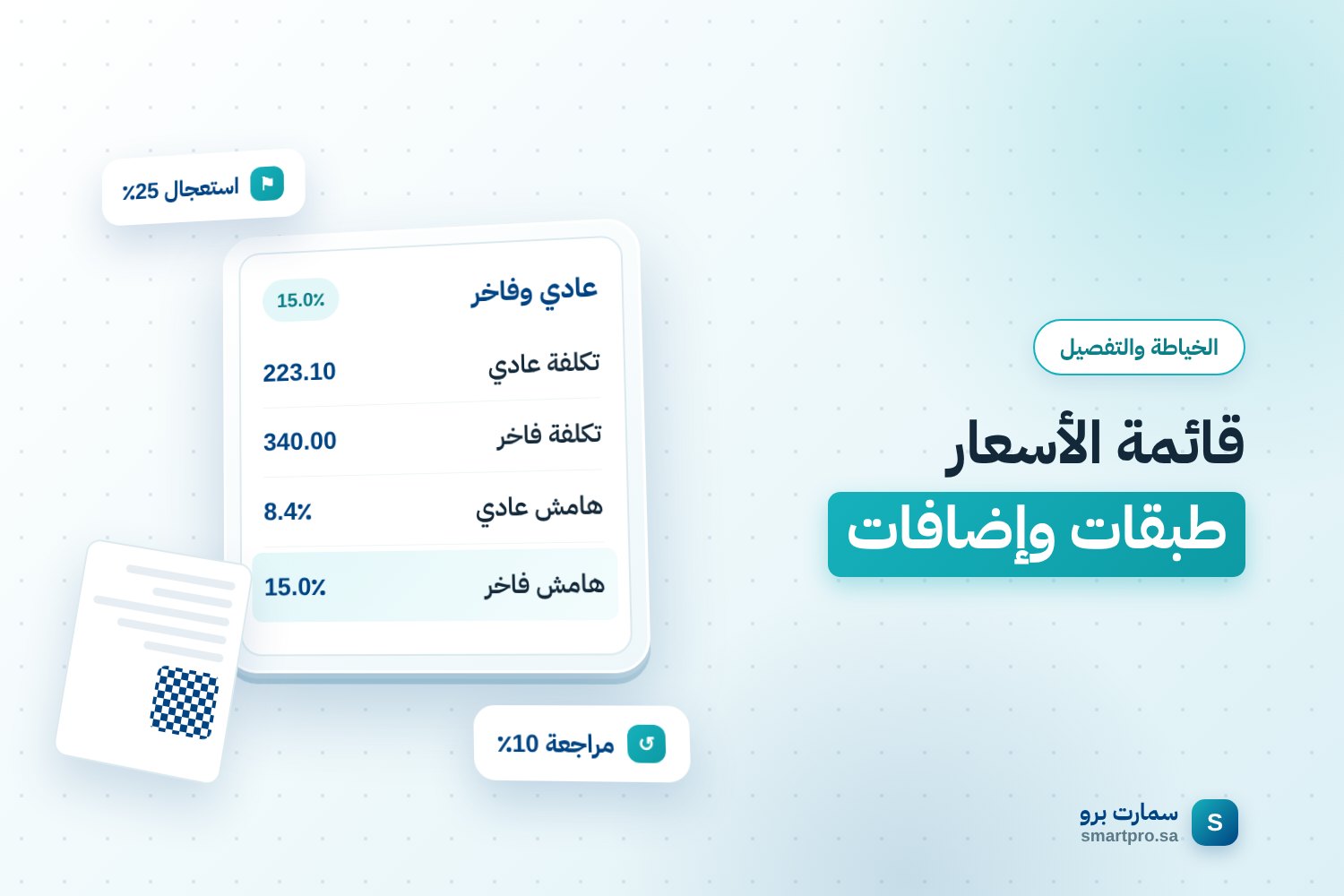
A tailoring price list is not a sheet pinned up at reception. It is a written management decision that defines what you sell, to what specification, by what date and at what price. A practical list has three tiers (standard, premium and rush) plus add-ons priced by the minute and listed separately.
Most tailoring shops work without one, so the price becomes the receptionist's judgement call, shifting with the customer and the mood of the day. The result is that the same order gets quoted at three different prices in a single week.
A regulatory note before we start: the current municipal requirements for tailoring shops do not require you to display a price list. What they do require is working electronic payment methods that you do not refuse, and the unified code displayed on the shop front. So the list is a management tool you choose for your own benefit, not an obligation you fulfil.
Tailoring price list: three tiers, not one
A list with a single price per item forces you either to turn work away or to sell at a loss. The practical structure is three tiers, and each tier changes something specific and measurable:
| Tier | What it actually changes | What it does not change |
|---|---|---|
| Standard | Base-grade fabric, standard finishing, standard delivery date | Measurements and precision |
| Premium | Higher fabric grade, more sewing minutes, hand finishing on collar and cuffs, an extra fitting session | Order stages |
| Rush | Only the order's place in the schedule | Specification, fabric and finishing |
The third row is the one most often misunderstood. Rush is not a higher or lower quality grade; it is buying an earlier place in the queue. The customer does not get a better thobe, only a faster one.
What stays the same across all three tiers is the stages: Received → Cut → Sewn → Pressed → Ready → Delivered. A rush order passes through every one of them; what gets shortened is the waiting between stages, not the stages themselves.
A worked example for the standard and premium tiers
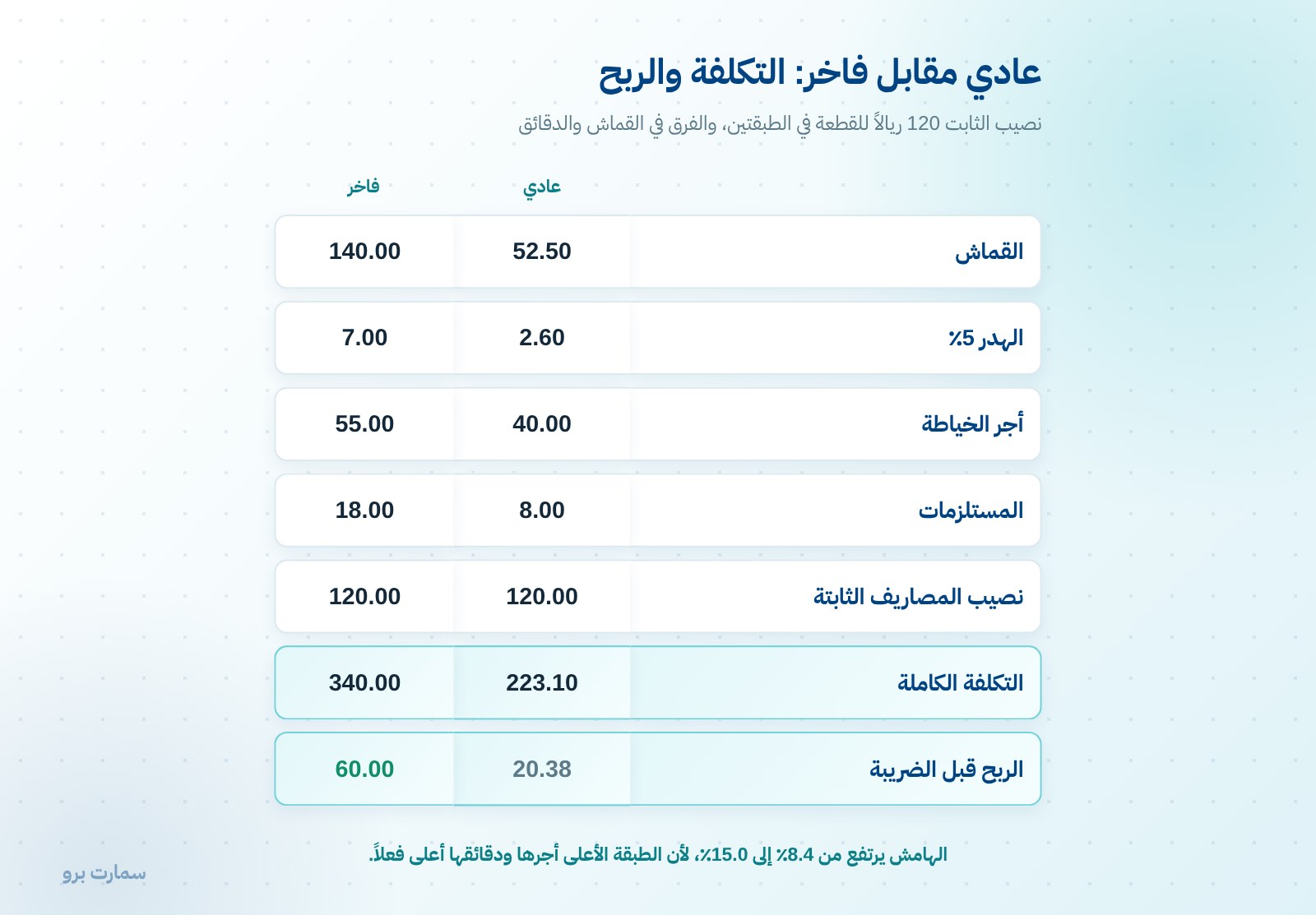
The figures below are hypothetical, used to illustrate the method, and do not represent prevailing market prices. We build on the example in the true cost of tailoring a thobe: fixed costs of SAR 14,400 a month spread over 120 thobes, or SAR 120 per garment.
| Item | Standard | Premium |
|---|---|---|
| Fabric | 3.5 m × 15 = 52.50 | 3.5 m × 40 = 140.00 |
| Waste 5% | 2.60 | 7.00 |
| Sewing labour | 40.00 | 55.00 |
| Trims and supplies | 8.00 | 18.00 |
| Share of fixed costs | 120.00 | 120.00 |
| Full cost | 223.10 | 340.00 |
| Listed price incl. VAT | 280.00 | 460.00 |
| Price before VAT | 243.48 | 400.00 |
| Profit | 20.38 | 60.00 |
| Margin | 8.4% | 15.0% |
The premium tier can carry a higher margin because the customer who chooses it is not comparing riyal for riyal, and because its sewing labour genuinely costs more: more minutes and a more skilled hand. That is the real gain from this approach: you do not profit by raising prices for everyone, but by offering a higher tier to those who want it.
Price add-ons line by line, not inside the garment price
The biggest leak in tailoring shop price lists is buried add-ons. The customer says, "And a little embroidery on the chest," and it gets done for free because it is "something small".
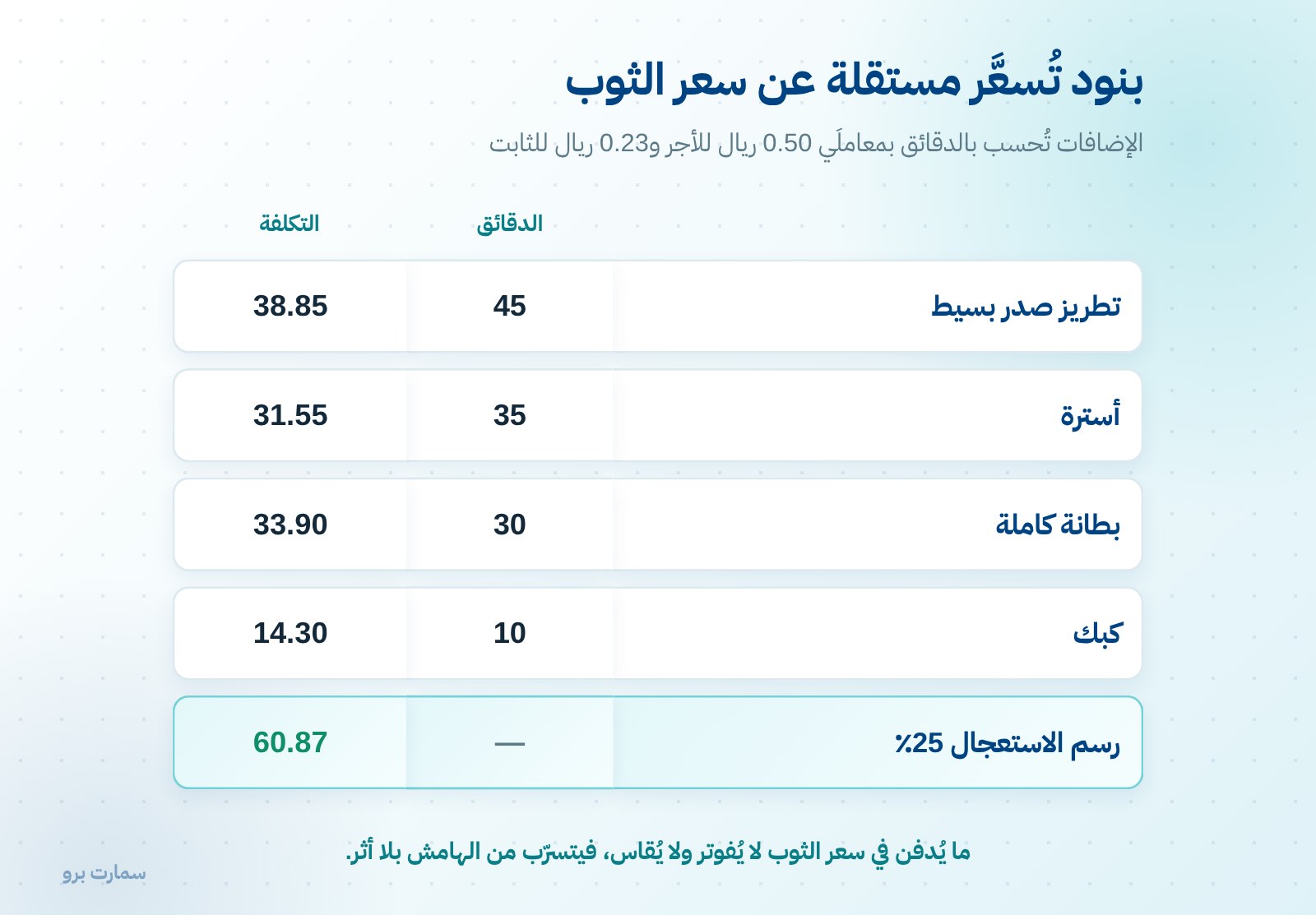
Add-ons are costed by the minute, as in pricing alterations, using two rates: tailor labour at SAR 0.50 per minute, and each minute's share of fixed costs at SAR 0.23.
| Add-on | Minutes | Labour | Fixed | Supplies | Cost |
|---|---|---|---|---|---|
| Simple chest embroidery | 45 | 22.50 | 10.35 | 6.00 | 38.85 |
| Interlining (astara) | 35 | 17.50 | 8.05 | 6.00 | 31.55 |
| Cufflink cuffs | 10 | 5.00 | 2.30 | 7.00 | 14.30 |
| Full lining | 30 | 15.00 | 6.90 | 12.00 | 33.90 |
Each of these has its own listed price, added on top of the garment price rather than hidden inside it. The reason is twofold: the customer who does not ask for embroidery does not pay for it, and the customer who does ask knows the price before the work is done, not after.
Embroidery in particular should be priced by design, not per piece. A simple chest motif and embroidery covering the sleeves and chest are not equal in minutes or in risk. The details are in abaya pricing.
The rush fee belongs in the list
Rush is a separate line, written into the list as a percentage or a fixed amount, not left to staff judgement. Let us assume 25% of the item price before VAT.
The standard thobe is SAR 243.48 before VAT, the rush fee is SAR 60.87, giving SAR 304.35, or SAR 350.00 including VAT.
Writing the percentage into the list achieves three things: the customer knows speed has a known price, the receptionist does not negotiate it, and the shop can decline a rush order when capacity is full instead of accepting it and then running late. How to calculate the fee and when to refuse an order is covered in rush order fees.
What should the written price list contain?
- The item name as the customer says it, not as it appears in your books.
- A short specification for each tier: fabric grade, finishing type, number of fittings.
- Delivery time in working days for each tier, because the date is part of the price.
- The VAT-inclusive price, with an explicit statement that it includes VAT; details in VAT-inclusive pricing.
- Add-ons with their own prices.
- Your customer-fabric policy if you accept it, as in when the customer brings the fabric.
- The list's effective date, which protects open orders from price changes.
When should the price list be reviewed?
Do not review the list every time the price of a metre goes up. Review it on three triggers.
First: every six months. Recalculate the full cost of every item, because rent, salaries and each garment's share of fixed costs all change quietly.
Second: when any input changes by more than a tenth. If tailor pay, fabric price per metre or rent rises by more than 10%, the review does not wait for the scheduled date.
Third: when actual times drift. Each quarter, time five pieces of every item as they are actually made. Times lengthen as tailors change and machines age, while the price stays the same, so the margin erodes without anyone noticing. This is what measuring tailor productivity reveals.
When you update the list, the new prices apply to new orders only. An order taken at the old price is delivered at that price, even if you lose on it, because a reputation for consistency is worth more than the difference on one item.
Why is a written price list stronger than a spoken price?
A spoken price is heard as a personal judgement, so it gets negotiated. A written price is read as company policy, so it is accepted or declined. That psychological difference alone justifies having a list.
Writing it down brings four further management benefits. It standardises prices across staff and branches, so one item no longer has three prices. It shortens order intake, because customers read instead of asking, and the queue moves faster in peak season.
It makes discounts a visible decision: whoever discounts from a written price knows how much and on which item, and that can be measured monthly. And it enables profitability analysis, because you can only calculate tailoring profit margin per item if each item has a fixed, known price.
Finally, the list protects the employee. When a customer questions the price, the employee is not defending a personal call but pointing to a written policy they cannot change, which ends most arguments before they heat up.
Official references
Requirements for tailoring shops, payment methods and the unified code are published by the Ministry of Municipalities and Housing, and rules on showing VAT in prices and invoices are published by the Zakat, Tax and Customs Authority (ZATCA). These are the reference in case of any discrepancy.
Shops that get this right usually manage it inside a single system, such as SmartPro's tailoring shop software, which keeps customer measurement files, stage tracking, fabric inventory and per-cut pricing together.
Key takeaway: Build your tailoring price list on three tiers that each change something measurable, price every add-on separately by the minute, write the rush fee into the list, and review it on fixed triggers rather than gut feel.
Read also
- The true cost of tailoring a thobe
- Pricing alterations in tailoring shops
- Break-even point for a tailoring shop
To see tiered pricing and add-ons running on a live order, start a free trial or book a demo.
Article visuals
Frequently asked questions
How do I build a price list for a tailoring shop?
First calculate the full cost of each item: fabric, waste, sewing labour, trims and the garment's share of fixed costs. Then arrange items into three tiers (standard, premium and rush), list add-ons separately with prices costed by the minute, and write the delivery time and the list's effective date against each item.
Am I legally required to display a price list in my shop?
The current municipal requirements for tailoring shops do not require you to display a price list. What they require is working electronic payment methods that you do not refuse, and the unified code displayed on the shop front. The list is a management tool you choose to standardise prices and reduce haggling, not an obligation you fulfil.
What is the real difference between the standard and premium tiers?
The premium tier changes the fabric grade, the number of sewing minutes and the finishing on the collar and cuffs, and adds a fitting session. It does not change the measurements or the order stages. In the hypothetical example, its cost was SAR 340 against SAR 223.10 for standard, and it supported a 15% margin against 8.4% because its customer is not comparing riyal for riyal.
Should embroidery and interlining be included in the thobe price?
No, they should be priced as separate lines added on top of the thobe price, not buried in it. The customer who does not order them does not pay for them, and the one who does knows the price before the work starts, not after. They are costed by the minute: tailor labour at SAR 0.50 per minute and a fixed-cost share of SAR 0.23 per minute, plus supplies.