
Common Payroll Mistakes: 12 Errors and How to Fix Each One
Payroll mistakes repeat every month and build up quietly. Here are 12 errors with their causes and fixes, from the GOSI contribution base to provisions and reconciliation.
سامي الحيدري
Payroll mistakes are not one-off slips. Most of them repeat every month in exactly the same way, so their effect builds up until it surfaces all at once: a claim for back pay, a Wage Protection violation, or a dispute when an employee's end-of-service benefit is settled.
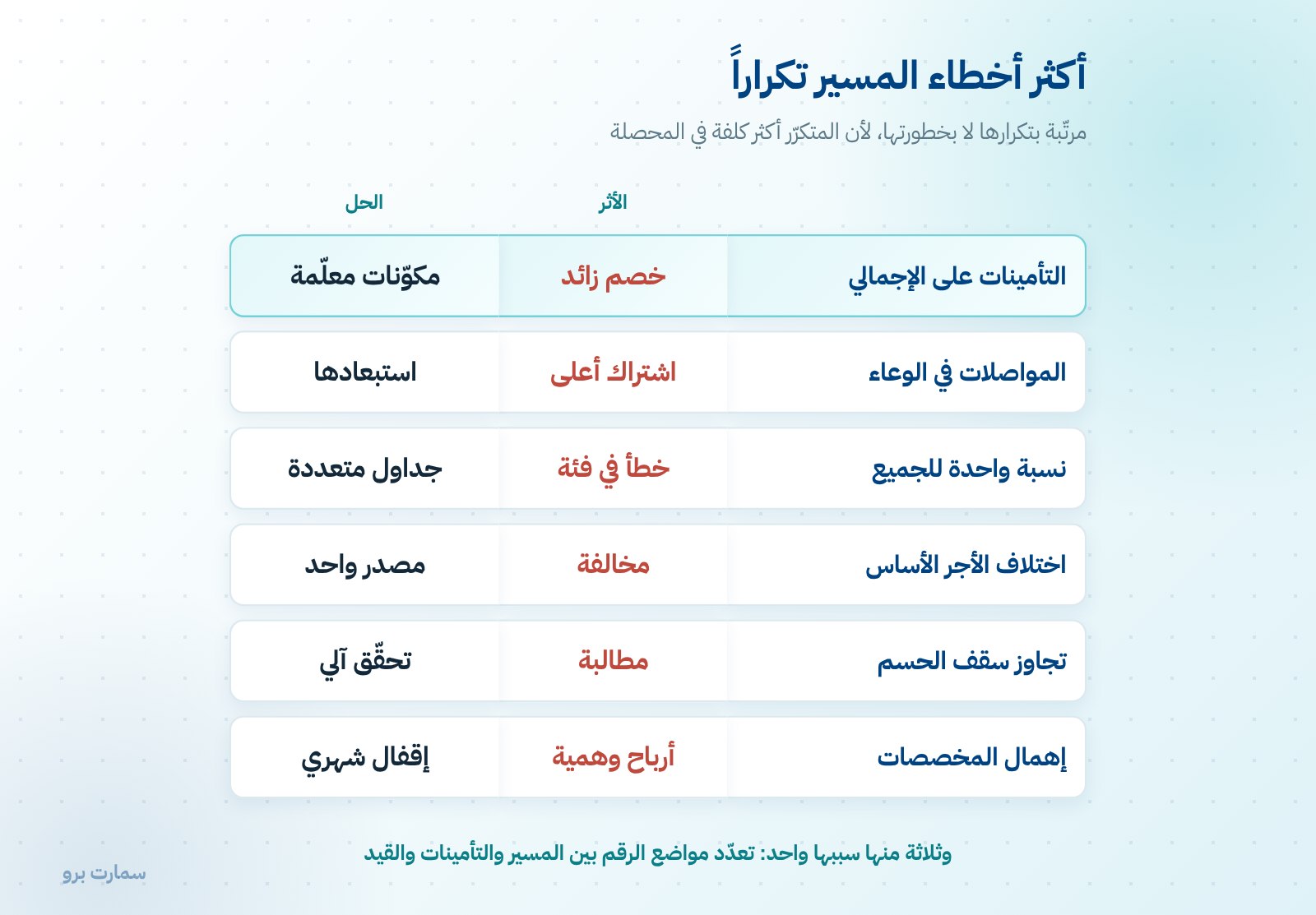
The list below is ordered by how often each mistake happens, not by how serious it is, because the mistake that repeats is the one that costs the most in the end.
Payroll mistakes: the full list
| # | Mistake | Effect |
|---|---|---|
| 1 | Calculating GOSI on gross salary | Over-deduction from the employee |
| 2 | Including transport allowance in the contribution base | Contribution higher than due |
| 3 | One GOSI rate for every employee | An entire category calculated wrongly |
| 4 | Deducting GOSI from non-Saudi employees | A deduction with no legal basis |
| 5 | Basic wage differs from the registered wage | Wage Protection violation |
| 6 | Exceeding the total deduction cap | Violation and employee claim |
| 7 | Recording a salary advance as an expense | One month's cost inflated |
| 8 | Ignoring the end-of-service provision | Phantom profit |
| 9 | Ignoring the leave liability | Hidden liability |
| 10 | Paying overtime straight from the attendance log without approval | An open-ended cost line |
| 11 | Calculating the overtime premium on full wage | Wrong amount |
| 12 | Not reconciling payroll with the books | Differences discovered too late |
Part one: GOSI contribution base mistakes
1 and 2 — The wrong base
GOSI contributions are calculated on the contributory wage, meaning the wage subject to social insurance: basic salary, commissions and sales percentages, and cash housing allowance. Transport allowance is not included, and the upper limit is SAR 45,000.
Calculating on the gross salary deducts more from the employee than they owe, every single month. The fix: flag each pay component in the system as contributory or not, so the base is calculated automatically. See the GOSI contributory wage.
3 and 4 — One rate for everyone
In Saudi Arabia today there are at least three categories: Saudis under the old scheme, Saudis under the new scheme with a higher rate that steps up each year, and non-Saudis, from whom nothing is deducted.
A single rate table in the system produces an error across an entire category. The fix: make nationality and contribution status fields that drive the calculation, not just descriptive fields. See GOSI contribution rates.
Part two: compliance mistakes
5 — A basic wage that doesn't match
This is the most common cause of Wage Protection violations. It happens when a salary is raised internally but not updated with GOSI, or when the definition of "basic" differs between the two systems.
The fix is structural: one source for salary data, with every change passing through a single gateway that updates payroll and GOSI together. See the Wage Protection System.
6 — Exceeding the deduction cap
The overall cap on all deductions is half of the wage due, and within it sit sub-caps: an advance instalment may not exceed one tenth of the wage, and a court-ordered debt may not exceed one quarter.
The cap is usually breached by piling up items that are each correct on their own. The fix: an automatic check that rejects the payroll run when the cap is exceeded and spreads the excess over the following months. See salary deduction limits.
Part three: accounting mistakes
7 — The advance booked as an expense
A salary advance is a receivable from the employee, meaning an amount the employee owes the company, not an expense. Booking it as an expense inflates the cost of the month it was paid and hides it in the months it is repaid.
8 and 9 — Missing provisions
The end-of-service benefit and the leave liability build up every month as the employee works. Ignoring them shows higher profits than reality for years, followed by one huge expense in a single month.
The fix: recalculate both liabilities as part of the monthly close. See the end-of-service provision.
12 — No reconciliation
Four monthly reconciliations catch most errors before they build up:
- Salary expense in the books = total earnings in the payroll run.
- GOSI payable balance = the contribution calculated by GOSI.
- Salaries payable balance = zero after the transfers.
- Employee advances balance = the sum of individual employee statements.
See the payroll journal entry.
Part four: overtime mistakes
10 — Paying from the attendance log
Recorded hours are not approved hours. Paying directly from the fingerprint attendance report turns overtime into an open-ended cost line that grows with no ceiling.
11 — The premium on the full wage
Overtime hourly pay = hourly wage + 50% of the basic wage, not of the full wage. Mixing the two produces a wrong amount for every hour. See overtime calculation.
Why do these particular mistakes keep repeating?
Because three of them share one cause: the same number lives in several places. The salary sits in the payroll, in the GOSI record and in the accounting entry. Three places mean three chances of error, plus a fourth: that one gets updated and the others don't.
The rest are caused by a rule that was never built into the system: the deduction cap, the contribution base and the overtime factor are all fixed rules the system could enforce, but they were left to human review.
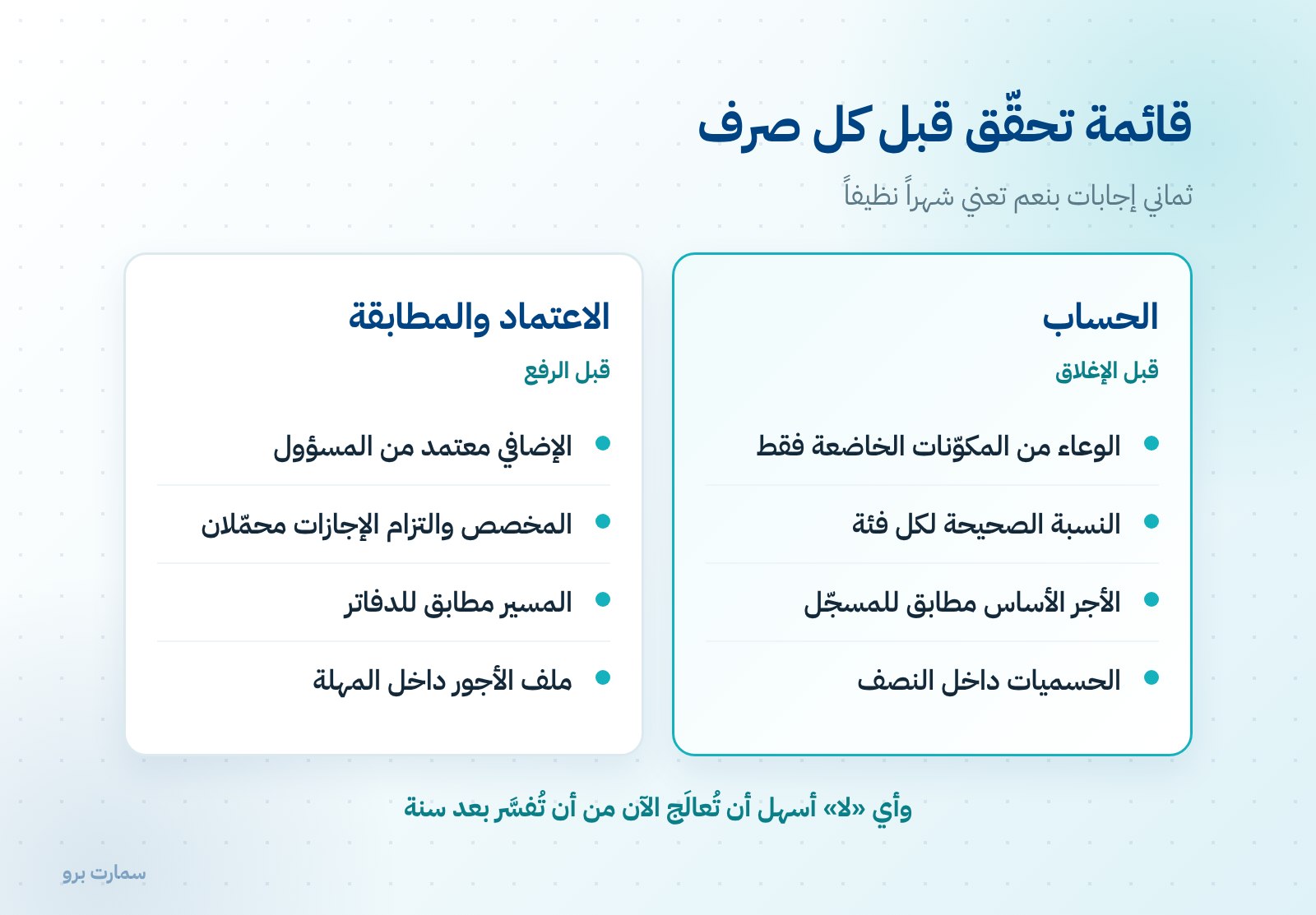
Checklist before every payment
- Is the contribution base calculated from contributory components only?
- Was the correct rate applied to each category?
- Does the basic wage in payroll match the wage registered with GOSI?
- Did total deductions for any employee exceed half the wage?
- Are the overtime hours approved by the responsible manager?
- Were the end-of-service provision and leave liability booked this month?
- Did you reconcile payroll with the books?
- Is the wage file ready to upload within the deadline?
Eight yes answers mean a clean month. Any "no" is easier to fix now than to explain a year from now.
Official references
Contribution rates and contributory wage limits are published by the General Organization for Social Insurance (GOSI), and the rules on wages, deductions and overtime are set out in the Labour Law by the Ministry of Human Resources and Social Development.
Key takeaway: Most payroll mistakes come from the same number living in several places or from fixed rules left to manual review. One salary source, rules enforced by the system and four monthly reconciliations stop them before they build up.
Read also
- Payroll run: how to prepare it step by step
- The Wage Protection System: the file, the deadline and the violations
- The payroll journal entry: how to record payroll in the books
To see how payroll, GOSI and accounting can run from one connected source, explore SmartPro Human Resources or book a demo.
Frequently asked questions
What is the most common payroll mistake?
Calculating GOSI contributions on gross salary instead of the contributory wage. The base includes basic salary, commissions and cash housing allowance but excludes transport allowance, with an upper limit of SAR 45,000. Calculating on gross salary deducts more from the employee than they owe every month.
Why do payroll mistakes repeat every month?
For two reasons. The same number lives in several places (the payroll, the GOSI record and the accounting entry), so one gets updated without the others. And fixed rules such as the deduction cap, the contribution base and the overtime factor are left to human review instead of being enforced by the system.
How can I catch payroll errors before they build up?
Run four monthly reconciliations: salary expense in the books against total payroll earnings, GOSI payable against the calculated contribution, salaries payable, which should be zero after transfers, and the advances balance against individual employee statements. Together they catch most errors early.
Which payroll mistake is the most costly from an accounting point of view?
Ignoring the end-of-service benefit provision and the accrued leave liability. Both build up every month as the employee works, so ignoring them shows higher profits than reality for years. Then a huge expense lands in a single month that has nothing to do with that month's performance.