
Payroll Journal Entry: How to Record Payroll in the Books Correctly
A payroll journal entry is not one entry but three. Here is the full entry with SAR figures, why only the employer's GOSI share is an expense, and how to handle advances and provisions.
سامي الحيدري
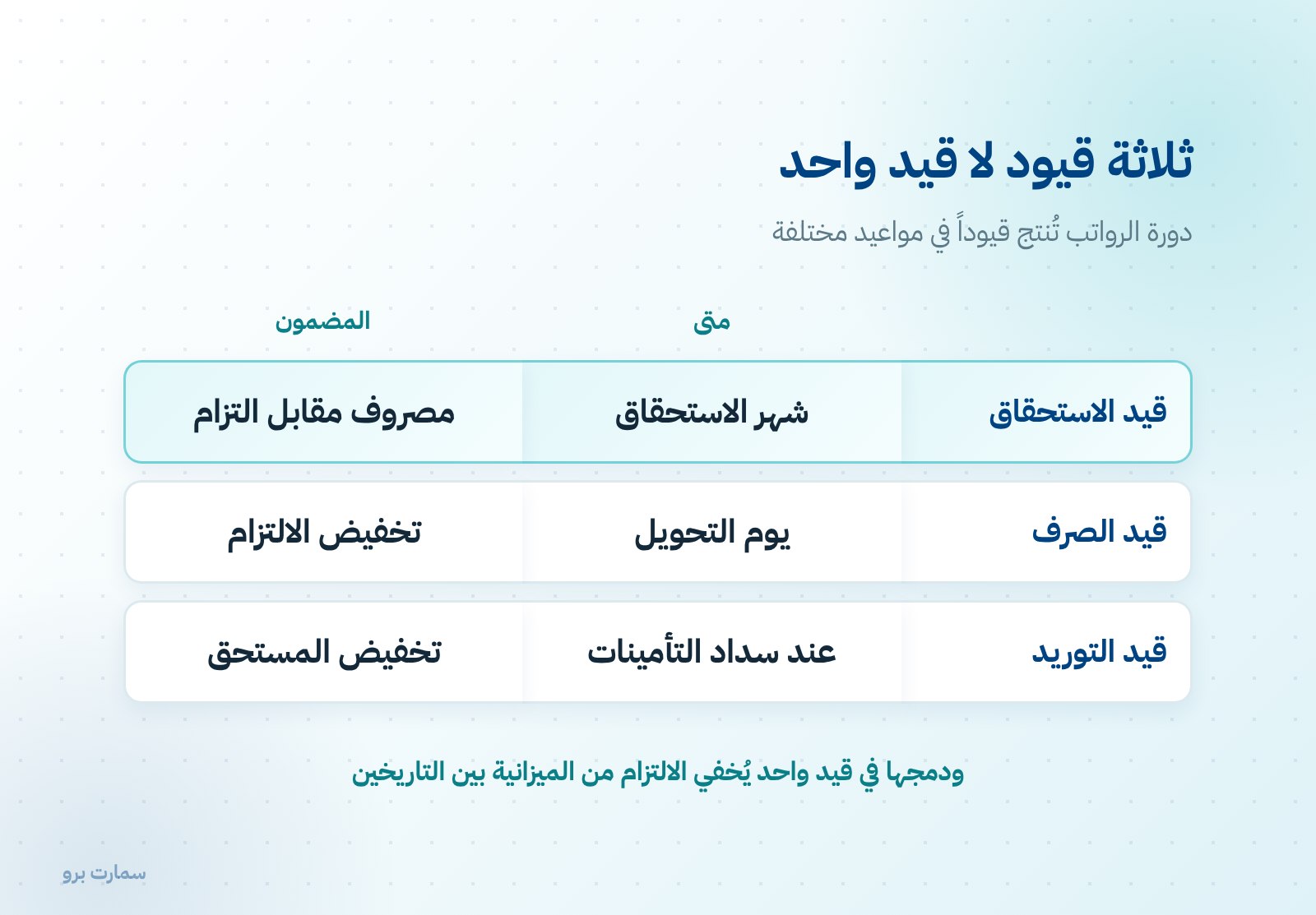
A payroll journal entry is how the payroll run gets into your books. Done correctly, it is three separate entries: an accrual entry in the month the salary is earned, a payment entry when net pay is transferred, and a remittance entry when GOSI contributions are paid. Only the employer's GOSI share is recorded as an expense.
It is also the entry small businesses most often shortcut. Many turn the whole payroll into one line: salaries expense debit, bank credit. That record is incomplete. It hides two liabilities, inflates one figure and hides another.
What lines should a payroll journal entry include?
| Side | Account | What it holds |
|---|---|---|
| Debit | Salaries expense | Employees' total gross pay |
| Debit | GOSI expense | The employer's share only |
| Credit | GOSI payable | Both shares together |
| Credit | Employee advances | Advance instalments recovered |
| Credit | Salaries payable | The net amount to be transferred |
Notice the distinction in the GOSI lines. GOSI is the General Organization for Social Insurance, which collects social insurance contributions from both employer and employee. The employee's share is not an expense for the business, because it is part of the employee's pay, which is already recorded in salaries expense. The employer's share, on the other hand, is an additional cost to the business.
Recording both shares as expense is a common mistake. It overstates payroll cost by the amount of the employee's share.
Entry one: how do you record the payroll accrual?
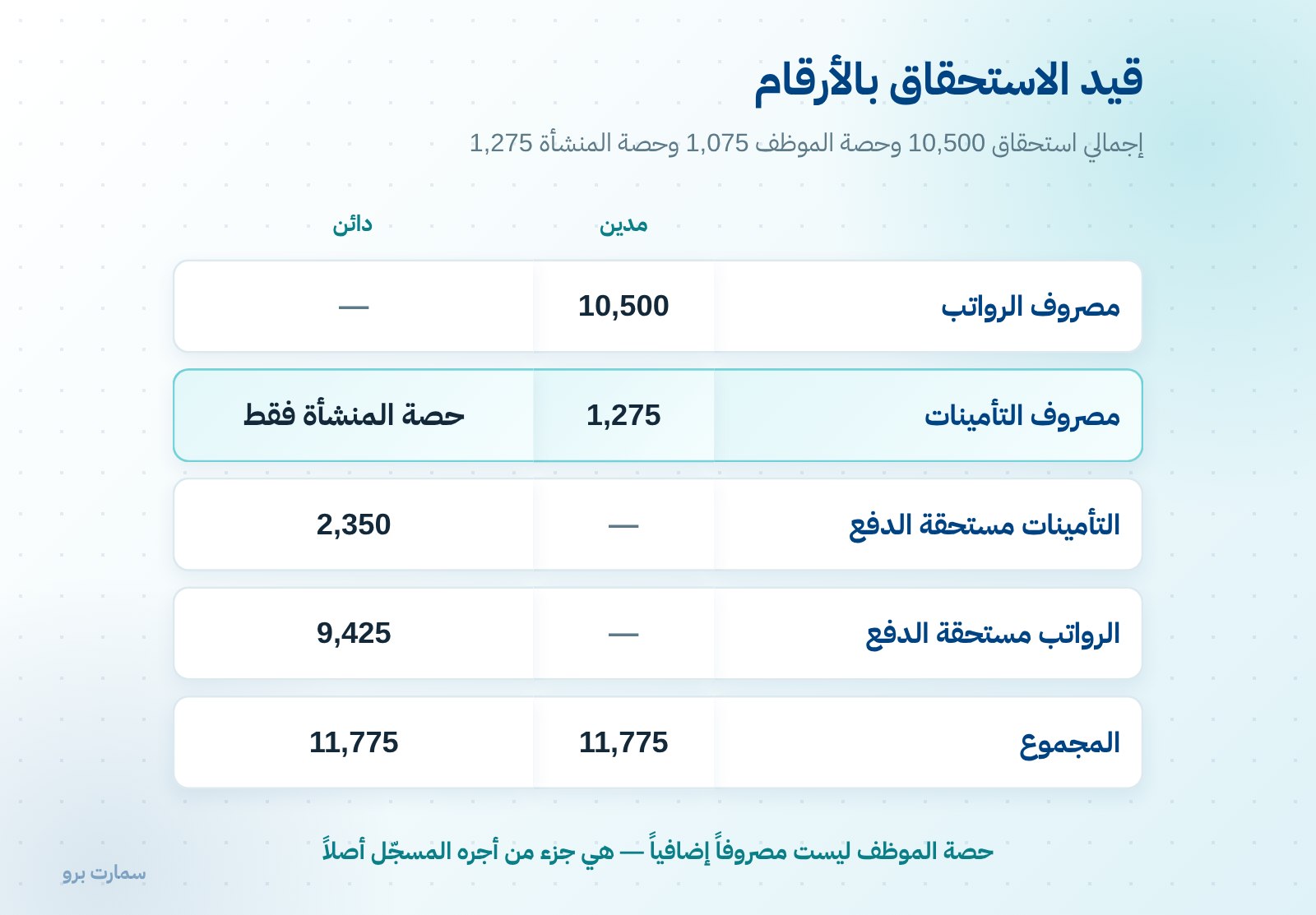
Take an employee with gross pay of SAR 10,500, an employee GOSI share of SAR 1,075 and an employer GOSI share of SAR 1,275:
| Account | Debit | Credit |
|---|---|---|
| Salaries expense | 10,500 | |
| GOSI expense — employer share | 1,275 | |
| GOSI payable | 2,350 | |
| Salaries payable | 9,425 | |
| Total | 11,775 | 11,775 |
This entry is recorded in the month the salary was earned, not the month it is paid. If September's salary is paid in October, the expense belongs to September. This is a direct application of the accrual basis, which records income and expenses when they are earned or incurred rather than when cash moves.
Entry two: how do you record the salary payment?
| Account | Debit | Credit |
|---|---|---|
| Salaries payable | 9,425 | |
| Bank | 9,425 |
Simple, but necessary. Separating the accrual from the payment is what keeps the liability visible on the balance sheet between the two dates.
Entry three: how do you record the GOSI remittance?
| Account | Debit | Credit |
|---|---|---|
| GOSI payable | 2,350 | |
| Bank | 2,350 |
This is recorded on actual payment, which falls within the first fifteen days of the following month.
If payment is late and a fine arises, the fine is a separate expense. It is not added to GOSI expense, because it is not a cost of labour but a cost of delay. Showing it separately makes the cost of the slip visible in your reports.
Are employee advances an expense?
No. An advance is a receivable, an amount the employee owes the business. When the business pays an advance, the entry is:
| Account | Debit | Credit |
|---|---|---|
| Employee advances | Amount | |
| Bank | Amount |
Each monthly deduction then reduces the balance within the payroll entry. Recording the advance as an expense when it is paid inflates one month's cost and hides it in the months that follow. The same logic applies to other salary deductions.
Which provisions does payroll need?
The monthly payroll entry is not complete without charging provisions. A provision is an amount set aside now for an obligation you will pay later.
- End-of-service benefit provision: builds up with every month of service.
- Accrued leave liability: builds up with every month worked.
Both are expenses of the period that benefited from the employee's work, not the period in which the money is eventually paid. These are typically booked as adjusting entries at month end.
Why split payroll by cost centre?
A salaries expense on one line tells you nothing. What helps is allocating it to the cost centres, projects or branches where it arose. A cost centre is a unit of the business whose costs you track separately.
A business that knows its payroll is ten million riyals a year cannot make a decision from that. A business that knows how it splits across production, sales and administration can. That detail starts with the structure of your chart of accounts.
What should you reconcile every month?
- Total salaries expense in the books = total gross pay in the payroll run.
- GOSI payable balance = the monthly contribution calculated by GOSI.
- Salaries payable balance = zero once transfers are made.
- Employee advances balance = the sum of balances on employee statements.
Any difference in one of these four must be explained before closing, not after. See where this fits in the steps of the accounting cycle.
Why does manual entry fail?
Because the same figure is typed three times: in the payroll run, in the GOSI file and in the journal entry. Three places mean three chances of error, plus a fourth: one gets updated and the others don't.
A system that generates the journal entry straight from the payroll run removes those duplicate steps and turns the monthly reconciliation into a check rather than a recalculation. In SmartPro, the Human Resources system handles payroll and is wired into accounting and GOSI-ready.
What are the most common payroll entry mistakes?
- Recording only net pay as salaries expense, so the employee's GOSI share disappears.
- Charging both shares to GOSI expense, so cost is overstated.
- Merging accrual and payment into one entry, so the liability vanishes from the balance sheet.
- Ignoring provisions, so profits look better than they are, followed by a sudden loss.
What about payroll in a foreign currency or across entities?
Two situations break a simple payroll entry. The first is paying part of the workforce in another currency: the expense is recorded at the rate on the accrual date, while the payment settles at the rate on the transfer date, and the gap belongs in a separate exchange difference account rather than inside payroll cost. Burying it in payroll makes every month's labour cost move for a reason that has nothing to do with labour.
The second is a group that runs several commercial registers. Each entity files its own wage protection file and holds its own GOSI registration, so payroll cannot be recorded centrally and allocated afterwards. The entry belongs to the entity that employs the worker, and any recharge between entities is a separate intercompany transaction with its own documentation.
Getting either of these wrong is rarely noticed monthly. It surfaces at the annual close, when labour cost per entity no longer agrees with the wage files filed during the year, and the difference has to be explained line by line.
Where are the official rules?
Contribution rates, payment deadlines and fines are published by the General Organization for Social Insurance. Rules on wages and deductions under the Labor Law are published by the Ministry of Human Resources and Social Development.
Read also
- Journal entries: how to write one step by step
- Double-entry bookkeeping: why your books must balance
- Trial balance: what it reveals and what it hides
Key takeaway: Record payroll as three entries (accrual, payment and GOSI remittance), expense only the employer's GOSI share, and treat advances as receivables and provisions as monthly costs.
To see payroll generate its own journal entries, start a free SmartPro trial.
Frequently asked questions
What is the correct payroll journal entry?
Debit salaries expense with total gross pay and debit GOSI expense with the employer's share only. Credit GOSI payable with both shares, credit employee advances with instalments recovered, and credit salaries payable with net pay. The payment and GOSI remittance are then recorded as separate entries.
Is the employee's GOSI share recorded as an expense?
No. The employee's share is part of their pay and is already included in salaries expense, so recording it again as an expense overstates cost. The additional expense to the business is the employer's share alone, while both shares together appear in the GOSI payable liability.
In which month is the payroll entry recorded?
In the month the salary was earned, not the month it is paid. September's salary paid in October is a September expense. Separating the accrual entry from the payment entry is what shows the liability on the balance sheet between the two dates.
How is an employee advance recorded?
As a receivable, not an expense: debit employee advances and credit bank when it is paid, then reduce the balance with each instalment inside the payroll entry. Recording it as an expense when paid inflates one month's cost and hides it in later months.