
Employee Self-Service: What It Actually Solves and What It Doesn't
Employee self-service removes half of HR's routine questions. What it should include, what doesn't belong in it, and how to roll it out without chaos.
سامي الحيدري
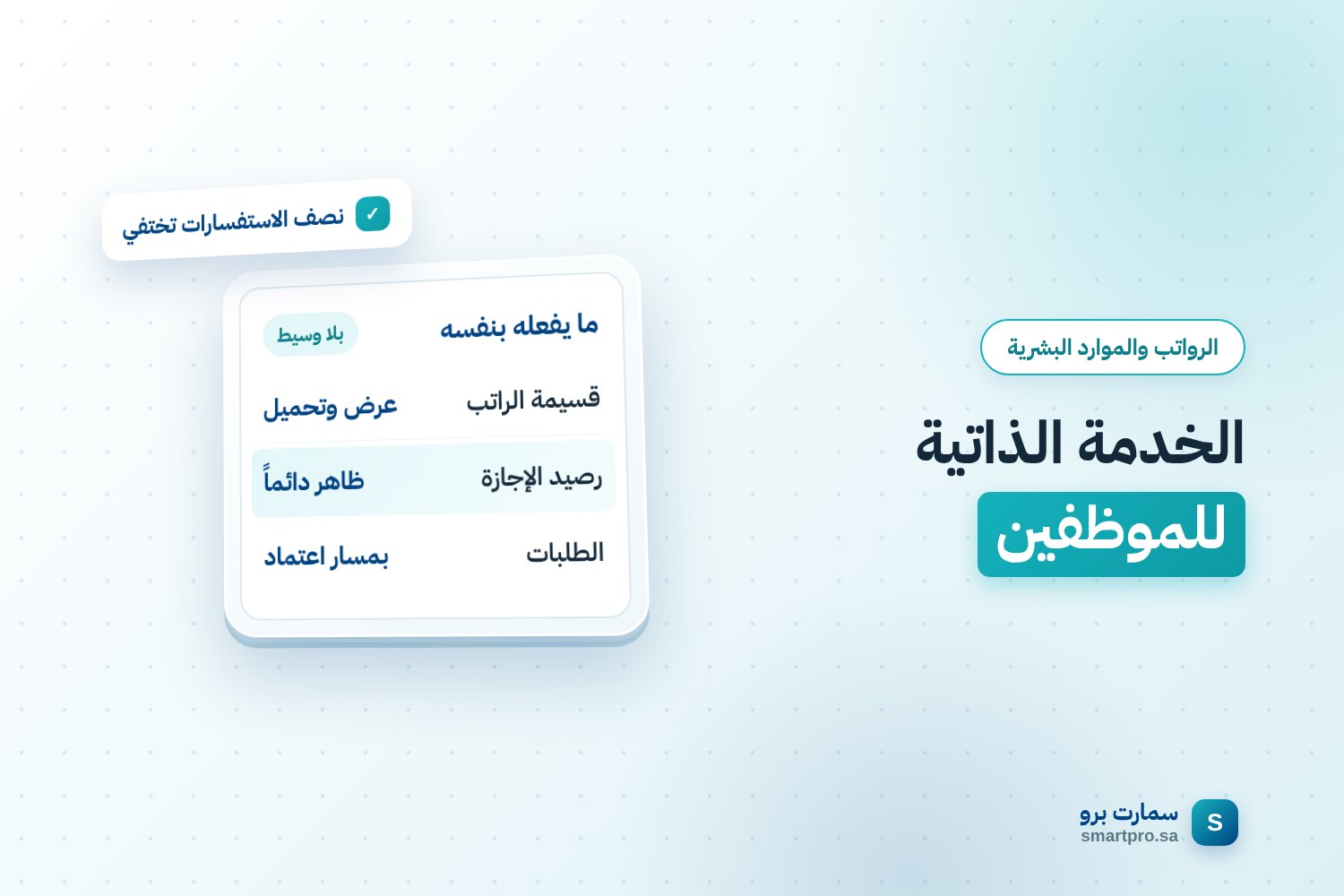
Employee self-service is not a luxury once a business passes twenty employees. It is the difference between an HR team that answers the same questions every month and one that works on what nobody else can do.
The idea is simple: what employees can do for themselves, they do for themselves. Anything that needs a decision or a check goes through the right approval path.
Employee self-service: what does it include?
| Area | What the employee does on their own |
|---|---|
| Pay | View and download the payslip for any month |
| Leave | See the balance, submit a request, track its status |
| Attendance | View the monthly record, request a punch correction |
| Personal data | Update IBAN, address and mobile number |
| Requests | Employment certificate, salary advance request, salary certificate |
| Documents | Copy of the contract, ID, qualifications |
| Calendar | Team leave and official public holidays |
The second row alone removes the single most repeated question of all: "How much leave do I have left?"
What is the real impact? Three gains
First: HR time
Repeat questions about leave balances, payslips and employment certificates eat up hours every week in a mid-sized business. All of them can be removed entirely, not just reduced.
Second: data accuracy
Employees are the most reliable source of their own data. An IBAN updated directly by the employee is more accurate than a message retyped by hand, and less likely to contain the error that bounces a salary transfer.
Third: leave usage
When employees can always see their balance, they use it. That is exactly what reduces the business's accrued leave liability, a real financial obligation that shows up in the books. See annual leave balance.
What doesn't belong in self-service?
Not everything can be delegated:
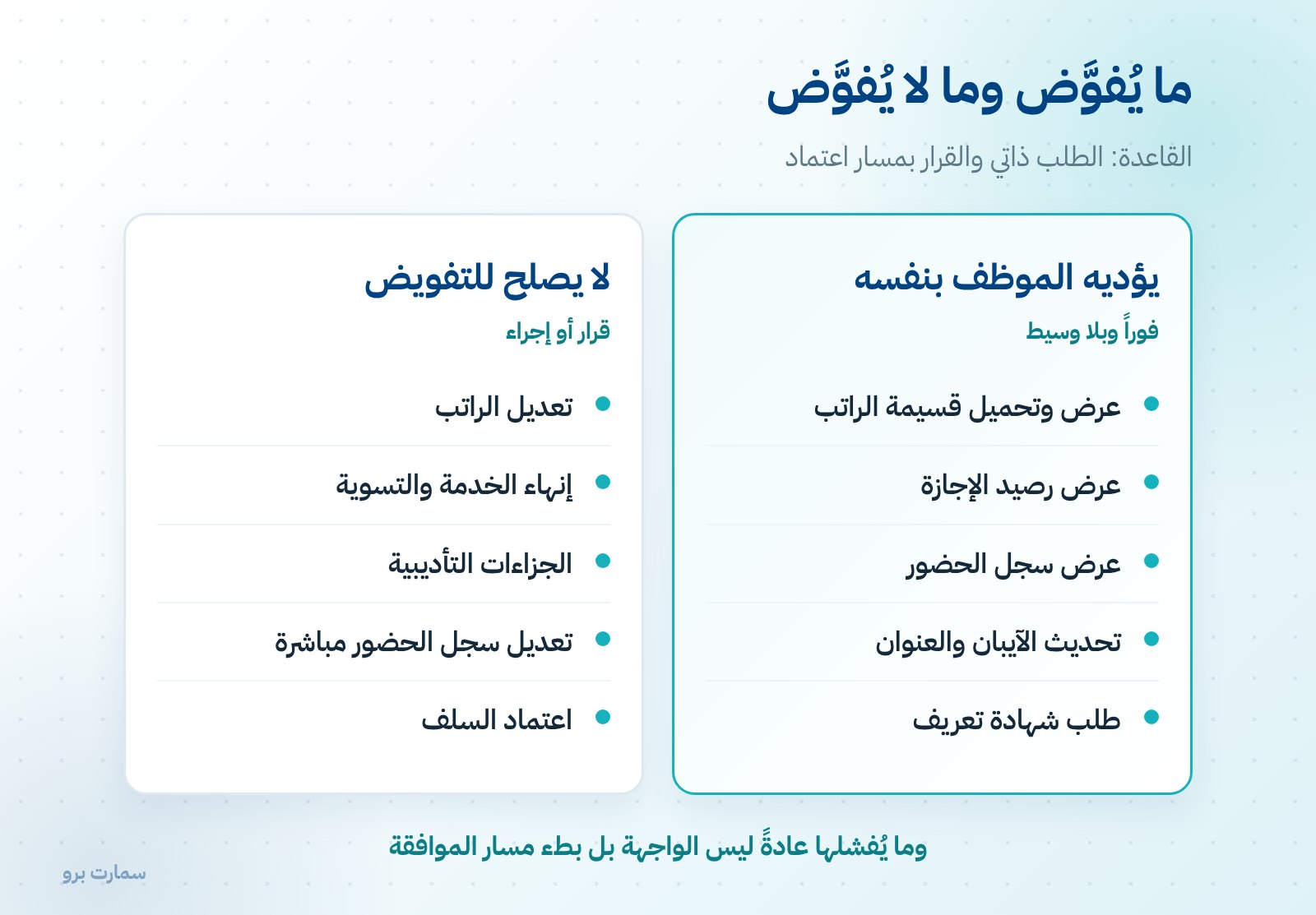
- Salary changes: a management decision that needs specific authority.
- End of service and final settlement: requires review by several parties.
- Disciplinary penalties: a procedure with its own rules and the employee's right to respond.
- Editing the attendance record directly: a correction is requested, not carried out by the employee.
- Approving salary advances: the request is self-service, but the decision follows an approval path.
The rule: the request is self-service, the decision follows a path. What happens instantly is only what cannot be disputed, such as downloading a payslip.
Approvals: where does self-service succeed or fail?
What most often breaks self-service is not the interface but the approval path. A leave request left pending for a week because the manager never opened the system sends the employee back to WhatsApp, and everything returns to how it was.
Getting it right requires:
- An instant alert to the manager when a request arrives.
- A set deadline to respond, with escalation to a more senior manager after it.
- A delegate when the manager is away, defined in advance rather than improvised.
- A complete log of who approved what and when.
How do you roll it out? A three-phase plan
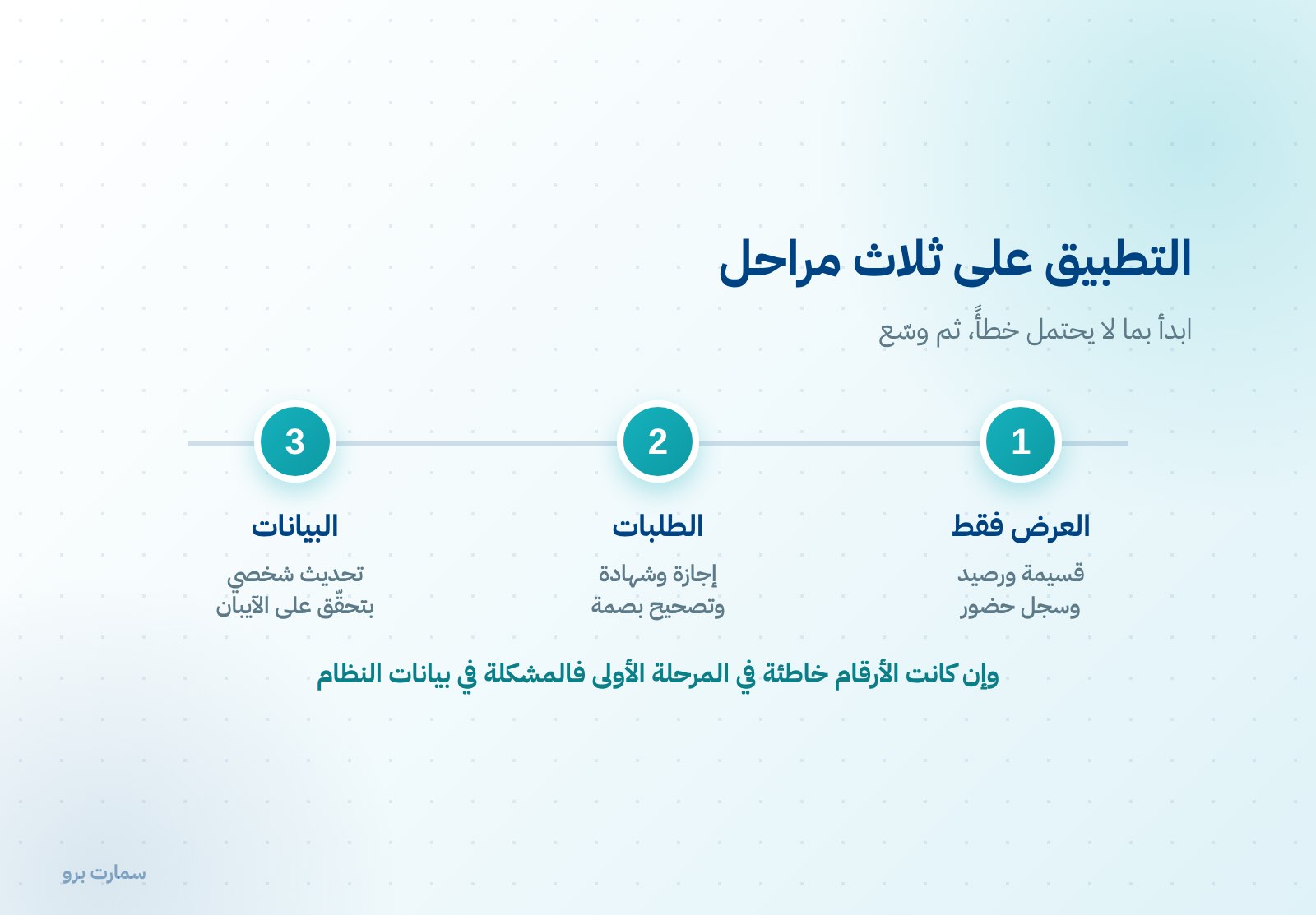
Phase 1: view only
Start with what leaves no room for error: the payslip, the leave balance and the attendance record. No requests and no edits. The goal is to build trust that the numbers shown are correct.
If the numbers are wrong at this stage, the problem lies in the system's data, not in self-service, and it must be fixed before the next phase.
Phase 2: requests
Add leave requests, employment certificates and punch corrections, with clear approval paths that have been tested.
Phase 3: personal data
Open up updates to personal details and documents, with verification on sensitive fields such as the IBAN.
What should a payslip show?
A clear payslip prevents half of the questions before they are asked. At a minimum:
- Itemised earnings: basic salary, housing, transport, overtime, commissions.
- Itemised deductions: GOSI social insurance, advances, penalties, absence.
- Net pay and the account it was transferred to.
- Remaining balance of any salary advance.
A payslip showing only two figures, gross and net, generates a question every time. See running payroll.
How do you handle permissions and privacy?
Payroll data is among the most sensitive information inside a business. Self-service increases the number of access points, so it needs controls:
- Each employee sees only their own data.
- Managers see what they need to make decisions, not everything.
- An access log showing who viewed what.
- Extra verification when an IBAN is changed specifically, as it is the field most targeted by fraud.
That last point is not theoretical: a bank account change requested in what looks like a routine email from a compromised mailbox is a recurring incident. A simple control, confirmation through a second channel, closes that door.
What should you ask before buying?
- Does it really work on mobile, not just as a shrunken web page?
- Does it support Arabic with a right-to-left interface?
- Can approval paths be customised and escalated?
- Does it generate certificates and letters automatically with the company stamp?
- Is it integrated with attendance and payroll in one system?
- Does it keep a trail of every request and approval?
The fifth question is the deciding one. Self-service that is separate from the payroll system moves the problem rather than solving it: the employee requests in one place, and the data is keyed in by hand somewhere else. See choosing an HR system.
Adoption: how do you get employees to use it?
The best system goes unused if employees don't understand why it exists. Three steps lift adoption from day one:
- Announce what goes away: "You won't need to ask about your leave balance anymore" is clearer than "We've launched a new portal."
- Start with the payslip: it is what employees wait for every month, so linking it to the system turns logging in into a habit.
- Phase out the old channel: as long as leave requests are accepted by message, nobody will open the system.
Line managers are the point of success or failure. If they don't approve requests on time, everyone drifts back to informal channels within weeks.
Where is the official reference?
Employees' rights regarding their data, leave and wages are set out in the Labour Law published by the Ministry of Human Resources and Social Development, and social insurance registration details are held by the General Organization for Social Insurance (GOSI).
Key takeaway: Let employees view and request on their own, keep decisions on a clear approval path, and make sure self-service sits in the same system as attendance and payroll.
Read also
- Annual leave balance: carry-over and encashment
- Attendance and linking it to payroll
- Choosing an HR system: what really makes a difference
To see an employee portal connected to payroll and attendance in practice, explore SmartPro Human Resources or start a free trial.
Frequently asked questions
What is employee self-service?
It is an interface where employees handle on their own anything that doesn't need a management decision: viewing their payslip, leave balance and attendance record, submitting leave and employment certificate requests, and updating their personal details. The rule is that the request is self-service while the decision follows an approval path.
What doesn't belong in employee self-service?
Salary changes, end of service and final settlement, disciplinary penalties, approving salary advances and editing the attendance record directly. These are either management decisions requiring specific authority or procedures with their own rules, so employees can request them but the decision goes through an approval path.
Why does employee self-service sometimes fail?
Usually because of the approval path rather than the interface. A request left pending for a week because the manager didn't open the system pushes the employee back to informal channels such as WhatsApp. The fix is an instant alert, a set response deadline with escalation after it, and a delegate defined in advance for when the manager is away.
How does self-service affect the leave liability?
When employees can always see their balance, they use it, which reduces the accrued leave balance the business carries. That balance is a real financial liability that appears in the books and is paid out in cash at the end of service if it remains unused.