
Annual Leave Balance: Entitlement, Carry-Over and Cash Payout
An annual leave balance is a financial liability, not an HR number. This guide covers the entitlement, the carry-over rules, when a cash payout is allowed and when it isn't, and how to record it in the books.
سامي الحيدري
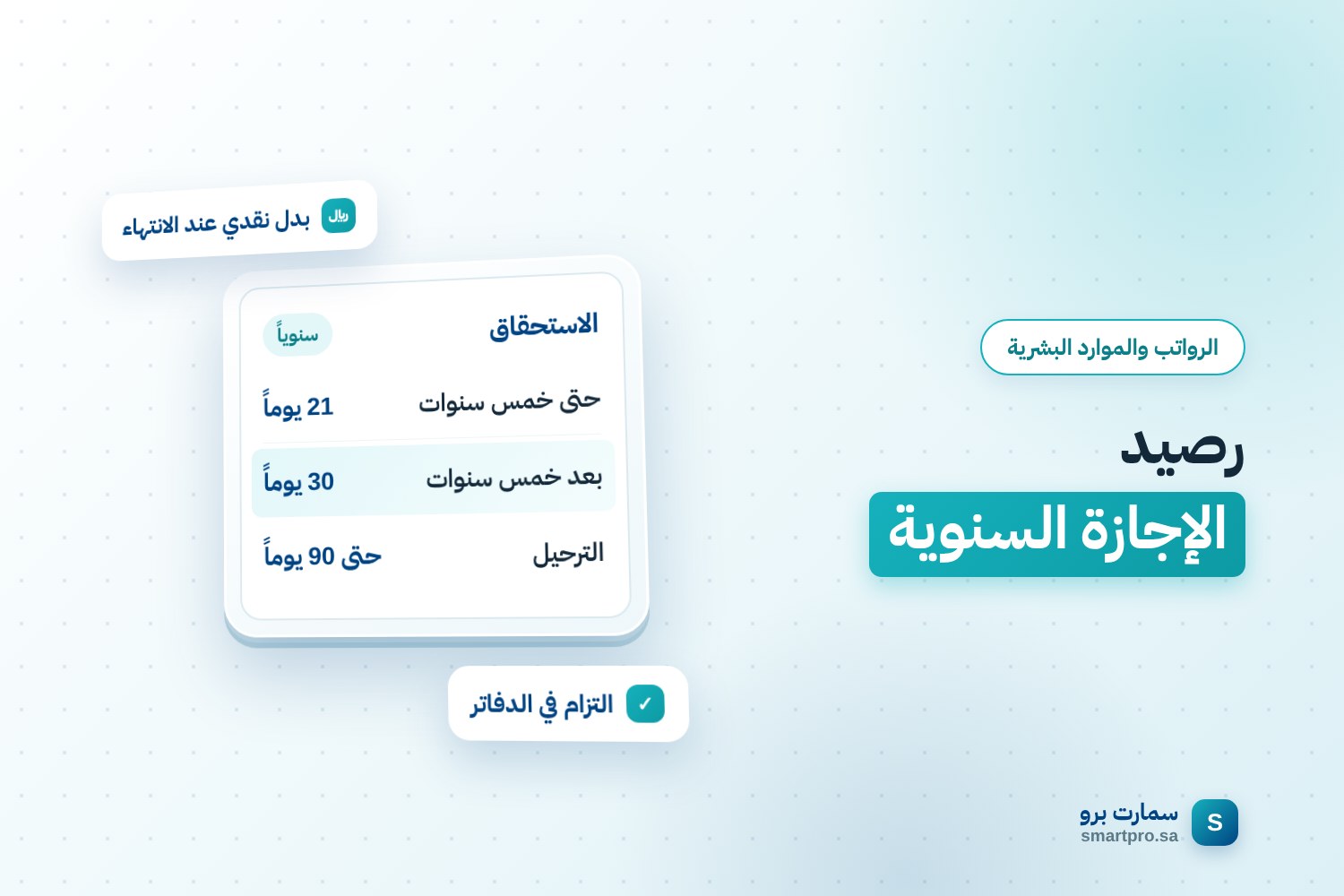
An annual leave balance is not just a number in an employee's file. It is a financial liability for the business, and it grows every month. If you don't measure it, you don't know how much you owe, and the bill arrives with the first wave of resignations.
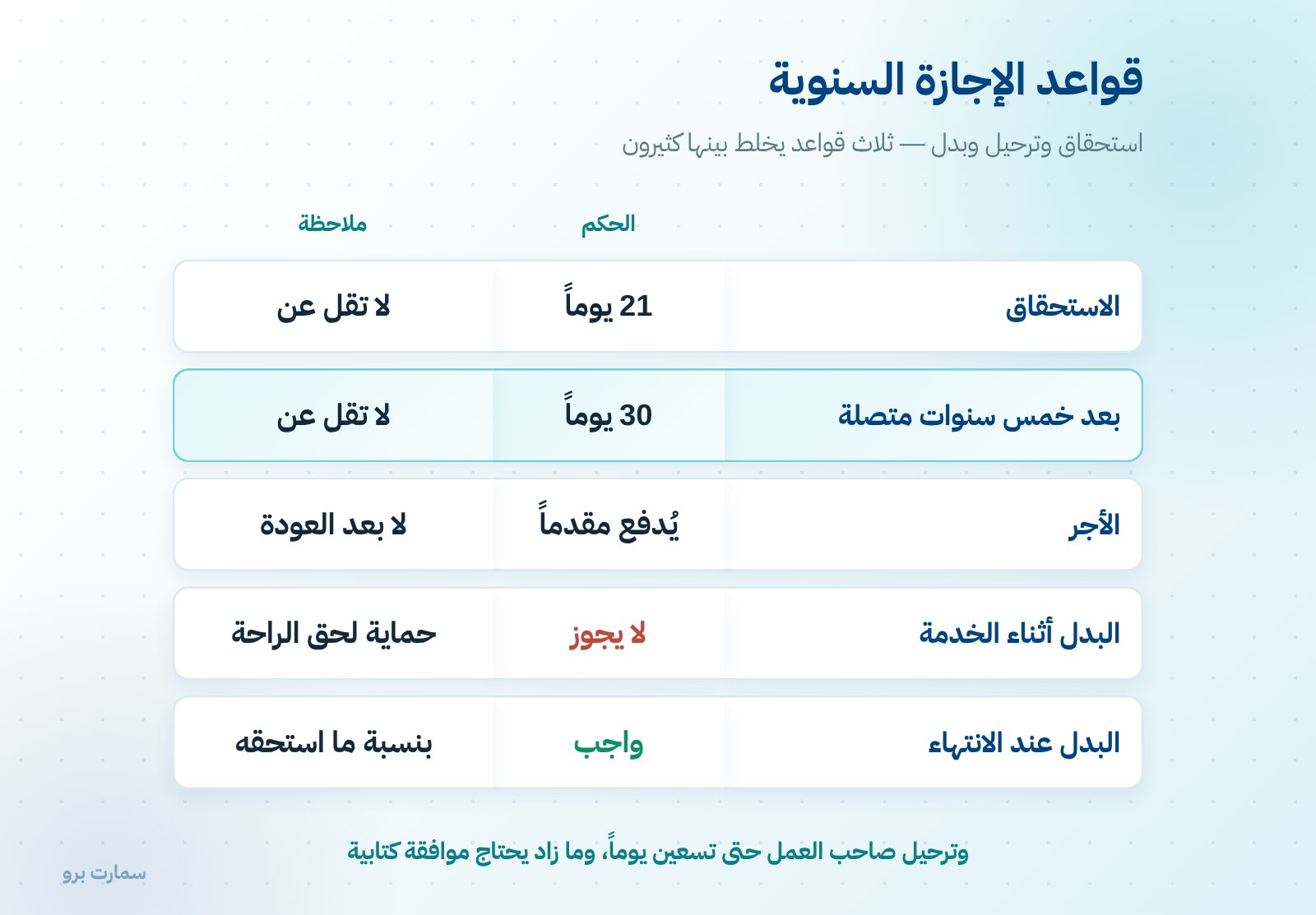
The basic rule: annual leave is no less than 21 days a year. It rises to no less than 30 days after five continuous years with the same employer, and leave pay is paid in advance.
Annual leave balance: the rules in one table
| Item | Rule |
|---|---|
| Basic entitlement | At least 21 days a year |
| After five continuous years | At least 30 days a year |
| Leave pay | Paid in advance |
| Waiving leave or taking cash for it during employment | Not allowed |
| Deferral with the employee's agreement | Allowed to the following year |
| Deferral by the employer for business needs | Up to 90 days after the entitlement year |
| Anything beyond that | Needs written consent, and cannot go past the end of the following year |
| At the end of employment | The remaining balance is paid in cash, pro rata to what was earned |
The apparent contradiction: when is a cash payout allowed?
This is the point that confuses people most. The law says two things that seem to clash:
- During employment: the employee may not give up their leave or take cash instead of it.
- At the end of employment: the employee must be paid in cash for any unused leave balance.
There is no real conflict. The ban during employment protects the right to rest from being bought out, and the obligation at the end makes sure a right that has genuinely built up is not lost.
The practical consequence: a business that pays staff a yearly "leave allowance" so they keep working instead of taking leave is breaking the law, however happy the employee is with the arrangement.
Carry-over limits: 90 days
Deferring leave is not open-ended. The employer may defer it for up to 90 days after the end of the entitlement year for business needs. Anything beyond that requires the employee's written consent, and in no case can it extend past the end of the following year.
This means a balance that has been building for three years is not a compliant position, even if it was the employee who chose not to take leave. The responsibility for scheduling leave sits with the business, not with the employee to ask for it.
Example: calculating the balance when an employee leaves
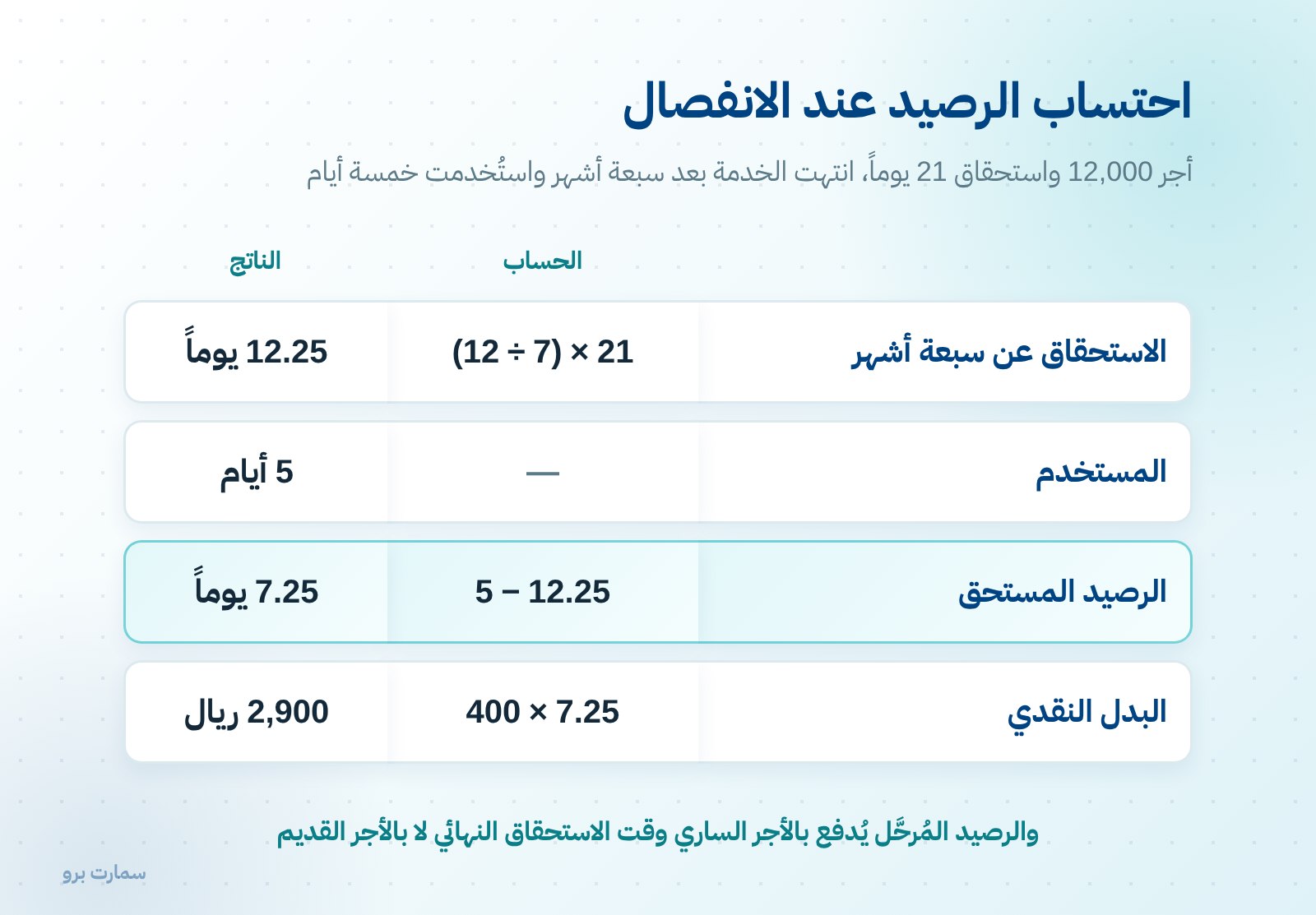
An employee earns SAR 12,000 a month, is entitled to 21 days a year, leaves seven months into the entitlement year, and has used five days:
| Step | Calculation | Result |
|---|---|---|
| Entitlement for seven months | 21 × (7 ÷ 12) | 12.25 days |
| Days used | — | 5 days |
| Balance due | 12.25 − 5 | 7.25 days |
| Daily wage | 12,000 ÷ 30 | SAR 400 |
| Cash payout | 7.25 × 400 | SAR 2,900 |
If the employee has a balance carried over from a previous year, it is added to this figure and paid at the wage in force at the time of final settlement, not at the old wage.
The balance is a liability in your books
This is where the biggest accounting oversight happens. Leave pay is not an expense that appears only when the employee goes on leave. It is a liability that builds every month as the entitlement accrues.
The correct treatment is to book a monthly expense against an accrued leave liability, then reduce that liability when the leave is taken or the cash payout is made.
Without this, the results mislead: months with no leave look profitable, and a month where leave is concentrated looks bad, when in reality the cost was building up the whole time. The same logic applies to the end-of-service provision.
Leave pay: what does it include?
Leave pay is based on the wage as the law defines it, meaning basic pay plus allowances paid on a regular basis, not basic pay alone.
The common mistake is to calculate the cash payout on basic pay only. The result is less than what is owed, and it surfaces as a dispute at settlement. The details are in end-of-service settlement.
Working for another employer during leave
If it is proven that the employee worked for another employer during their leave, the employer may withhold the leave pay or recover what was paid for it.
This rule is often overlooked, even though it matters in sectors where extra seasonal work is common.
How do you manage the balance in practice?
- Show employees their balance in their self-service profile, updated automatically rather than on request from HR.
- Set an annual leave plan approved at the start of the year, not leave by request.
- Trigger an alert when a balance exceeds the permitted carry-over limit.
- Link the balance to finance so the liability appears in the monthly reports.
- Review balances before the year-end close, because they are a material adjustment item.
A system that shows employees their balance directly cuts down on queries and increases the leave people actually take, which is exactly what reduces the accrued liability. See employee self-service.
Other leave types are not deducted from the balance
Sick leave, maternity leave, marriage leave, bereavement leave and paternity leave are all separate entitlements and are not deducted from the annual leave balance.
Deducting them is a recurring mistake in businesses that manage all leave in a single sheet without categories. The details are in sick leave.
The official reference
The rules on annual leave, its length, deferral and cash payout are set out in the Labor Law published by the Ministry of Human Resources and Social Development, which is the reference in any dispute.
Read also
- Sick leave: durations and pay rates
- The end-of-service provision in your books
- End-of-service settlement: what is paid and when
Key takeaway: Treat the annual leave balance as a liability that accrues monthly: schedule leave within the 90-day carry-over limit, never pay cash for leave during employment, and settle the remaining balance in cash at the end of service.
To track leave balances alongside payroll and accounting, start a free trial of SmartPro's Human Resources system.
Frequently asked questions
How much annual leave does the Saudi Labor Law give employees?
Annual leave is no less than 21 days a year, rising to no less than 30 days after five continuous years with the same employer. Leave pay is paid in advance.
Can an employee take cash instead of annual leave?
Not during employment: the employee may not waive their leave or take cash in place of it. At the end of employment, however, they must be paid in cash for their unused balance, pro rata to what they earned. The ban during employment exists to protect the right to rest from being bought out.
How much annual leave can be carried over?
The employer may defer leave for up to 90 days after the end of the entitlement year for business needs. Anything beyond that requires the employee's written consent and cannot extend past the end of the following year, so a balance built up over three years is not a compliant position.
Is sick leave deducted from the annual leave balance?
No. Sick leave, maternity leave, marriage leave, bereavement leave and paternity leave are all separate entitlements that are not deducted from the annual balance. Deducting them is a recurring mistake in businesses that manage all leave in a single sheet without categories.