
End-of-Service Settlement: Every Item and How It Is Calculated
An end-of-service settlement is more than the gratuity. Here are all the amounts owed and deducted, a full worked example in SAR, the statutory payment deadline, and what you are not allowed to deduct.
سامي الحيدري
An end-of-service settlement is not the same as the end-of-service gratuity. The gratuity is one item in it. The settlement is a full statement that brings together what the employee is owed and what they owe, and arrives at a single figure to be paid out or recovered.
Most disputes at separation are not about the gratuity itself. They are about another item that was forgotten or miscalculated: a leave balance, company custody items, or notice-period pay.
What does an end-of-service settlement include?
| Side | Items |
|---|---|
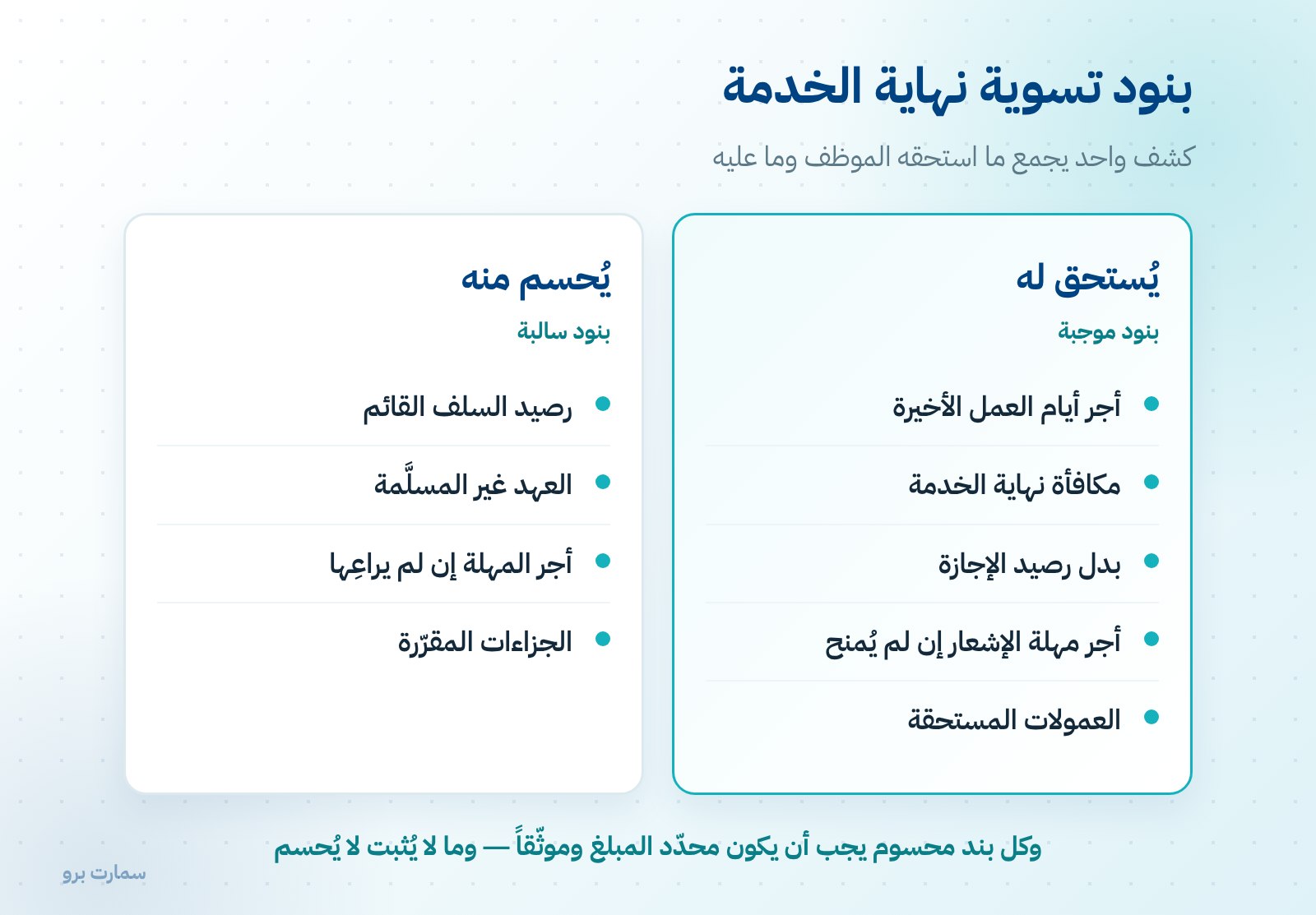
| Owed to the employee | Pay for days worked in the final month · End-of-service gratuity · Payment for the annual leave balance · Notice-period pay if notice was not given · Overtime and commissions due · Return ticket for non-Saudi employees, as per the contract |
| Deducted from the employee | Outstanding salary advances · Value of custody items not returned · Notice-period pay if the employee did not serve notice · Penalties formally imposed · Debts confirmed by a court ruling |
A full worked example
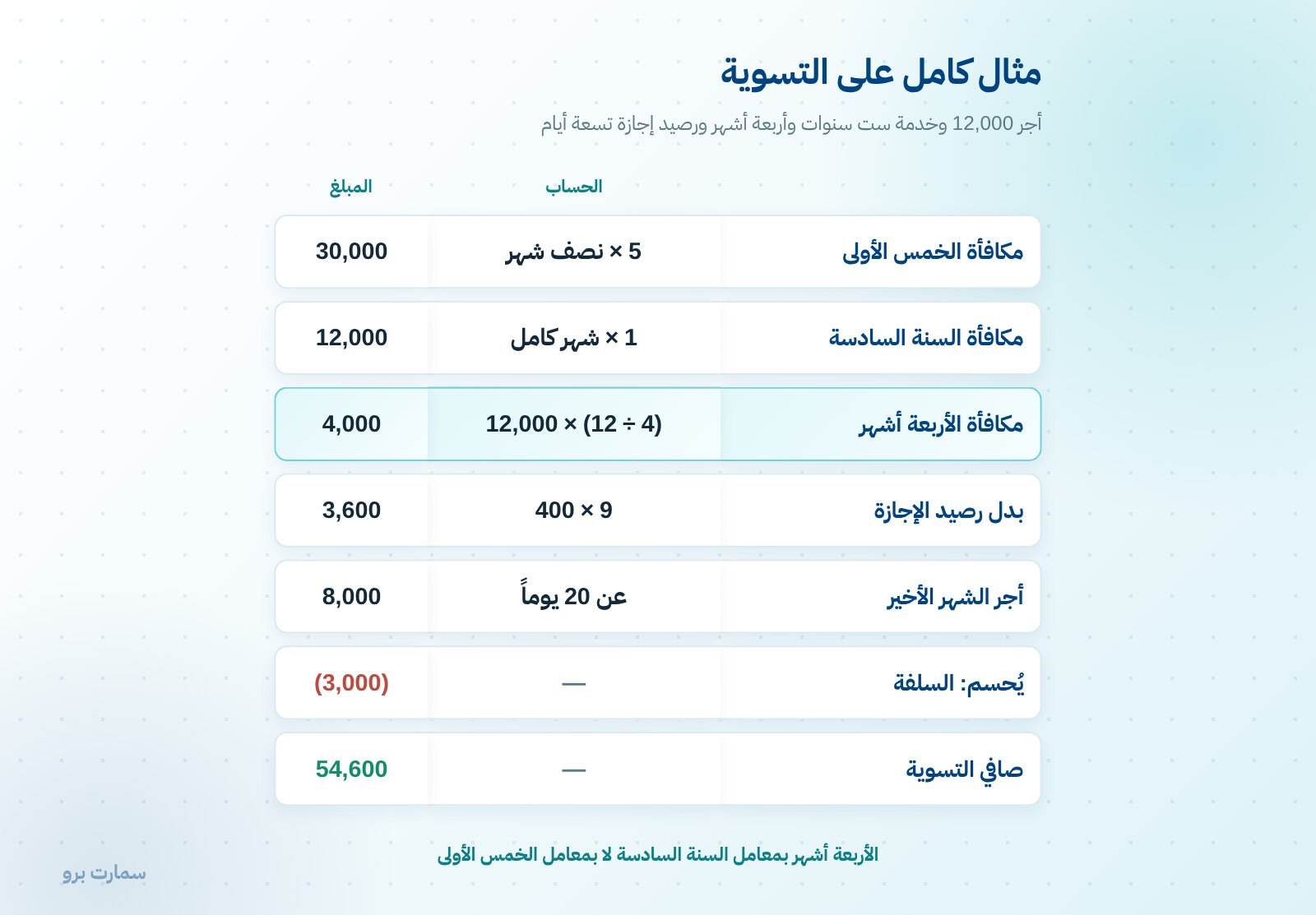
An employee earns SAR 12,000 a month and has served six years and four months. The employer ended the contract with proper statutory notice. The employee has 9 days of leave balance and an outstanding advance of SAR 3,000:
| Item | Calculation | Amount (SAR) |
|---|---|---|
| Gratuity for the first five years | 5 × 0.5 × 12,000 | 30,000 |
| Gratuity for the sixth year | 1 × 1 × 12,000 | 12,000 |
| Gratuity for the four months | (4 ÷ 12) × 12,000 | 4,000 |
| Leave balance payment | 9 × (12,000 ÷ 30) | 3,600 |
| Pay for days worked in the final month | For 20 days | 8,000 |
| Total owed | 57,600 | |
| Deduct: outstanding advance | (3,000) | |
| Net settlement | 54,600 |
Note that the four months were calculated at the sixth-year rate (a full month's pay per year), not the rate for the first five years. This is one of the most common places for errors.
When must the settlement be paid?
- One week from the end of the employment relationship if the employer ended the contract.
- Two weeks if the employee ended it.
In practice, this is a very short window. A business that starts gathering the data the day after the employee leaves is already late before it begins. That is why the gratuity and leave balance should already be calculated in the system before the separation, not after it.
Which items are most often forgotten?
Carried-forward leave balance
This is calculated at the wage in force at the time of final entitlement, not at an older wage. A business that calculates it at the wage of the year the leave was earned pays less than it owes. See annual leave balance.
Commissions earned but not yet paid
A commission on a deal closed before separation but collected after it is a contentious item unless the contract is clear. Clear contract wording settles the question before it arises.
Custody items
Devices, cars, cards and keys. Their value can be deducted if they are not returned, but only if they were documented with a signed acknowledgement of receipt when first handed over. Without that document, a deduction is hard to justify.
Notice-period pay
This appears as a positive item if the employee was not given notice, and as a negative item if the employee did not serve it. The details are in notice period in Saudi Arabia.
What cannot be deducted?
- Estimated amounts not backed by a document or a signed acknowledgement.
- The cost of training the employee received, unless there is an explicit, clear agreement.
- Unproven damages whose value has not been determined through proper legal channels.
The rule: every deducted item must have a specific amount and supporting documentation. Whatever cannot be proven cannot be deducted.
Is clearance a condition for payment?
Clearance is an administrative procedure to confirm that custody items have been returned and system access has been revoked. It is useful, but it must not be used as an excuse to delay payment beyond the statutory deadline.
The right sequence is to start clearance before the last working day, not after it, so the settlement is completed on time.
How is the settlement recorded in the books?
The settlement does not create a new expense equal to its full amount, because most of its items have already been charged in earlier periods:
- The gratuity reduces the end-of-service provision. See end-of-service provision.
- Leave payment reduces the accrued leave liability.
- Pay for days worked is a normal salary expense.
- The outstanding advance reduces the employee receivable.
A business that has built up its provisions regularly sees only the differences in the month of separation. One that has not records the entire amount in a single month. See payroll journal entry.
Checklist before payment
- Was the gratuity calculated with the correct two rates, with partial years prorated?
- Was the resignation percentage applied if the employee ended the contract?
- Is the leave balance calculated at the current wage?
- Is every deducted item supported by a document?
- Has system access been revoked and have custody items been recovered?
- Is the payment date within the statutory deadline?
How should the settlement statement be presented?
The statement handed to the employee should show every item separately, not a single total. The reason is practical: an itemised statement gets reviewed and discussed before signing, while a lump-sum figure gets signed and then disputed later.
At a minimum, it should show: length of service in years, months and days; the wage the calculation is based on; each amount owed with its value; each deduction with its reason and supporting document; and then the net amount.
The statement is signed by both the employee and the business, and kept in the employee's file. This one document heads off most disputes that surface months after separation.
What if the employee disputes an item?
A dispute over one item does not stop payment of the items both sides agree on. The safer course is to pay the undisputed amounts on the statutory date and handle the disputed item separately.
Delaying the entire settlement over one item turns a limited disagreement into a claim for the full entitlement.
Official reference
The entitlements, payment deadlines and permitted deductions are set out in the Labour Law published by the Ministry of Human Resources and Social Development, and matters relating to ending social insurance registration are handled by the General Organization for Social Insurance (GOSI).
Read also
Frequently asked questions
What items does an end-of-service settlement include?
The employee is owed pay for the final days worked, the end-of-service gratuity, payment for the annual leave balance, notice-period pay if notice was not given, commissions due, and a return ticket for non-Saudi employees as per the contract. Outstanding advances, unreturned custody items and formally imposed penalties are deducted.
When must an end-of-service settlement be paid?
Within one week of the end of employment if the employer ended the contract, and within two weeks if the employee ended it. The window is short in practice, so the gratuity and leave balance should already be calculated in the system before the separation, not after it.
Can payment be delayed until clearance is complete?
Clearance is an administrative procedure to confirm custody items have been returned and system access revoked, and it must not be used as an excuse to delay payment beyond the statutory deadline. The right approach is to start clearance before the last working day, not after it.
Which wage is used to calculate the leave balance in the settlement?
The wage in force at the time of final entitlement, not an older wage, even if the balance was carried forward from previous years. Calculating it at the wage of the year the leave was earned produces less than what is owed and tends to come up in disputes.