
Choosing an HR System: The Questions That Actually Make the Difference
Choosing an HR system comes down to a few questions, not a long feature list. Here is what the system must do in Saudi Arabia specifically, and how to test it before you buy.
سامي الحيدري
Choosing an HR system is not settled by comparing feature lists. Every vendor shows dozens of items, and most look the same on paper. The real differences appear in a few questions that never come up in sales presentations.
In Saudi Arabia specifically, a system that does not handle GOSI, the Wage Protection System and the Labour Law correctly creates manual work every month, however good its interface looks.
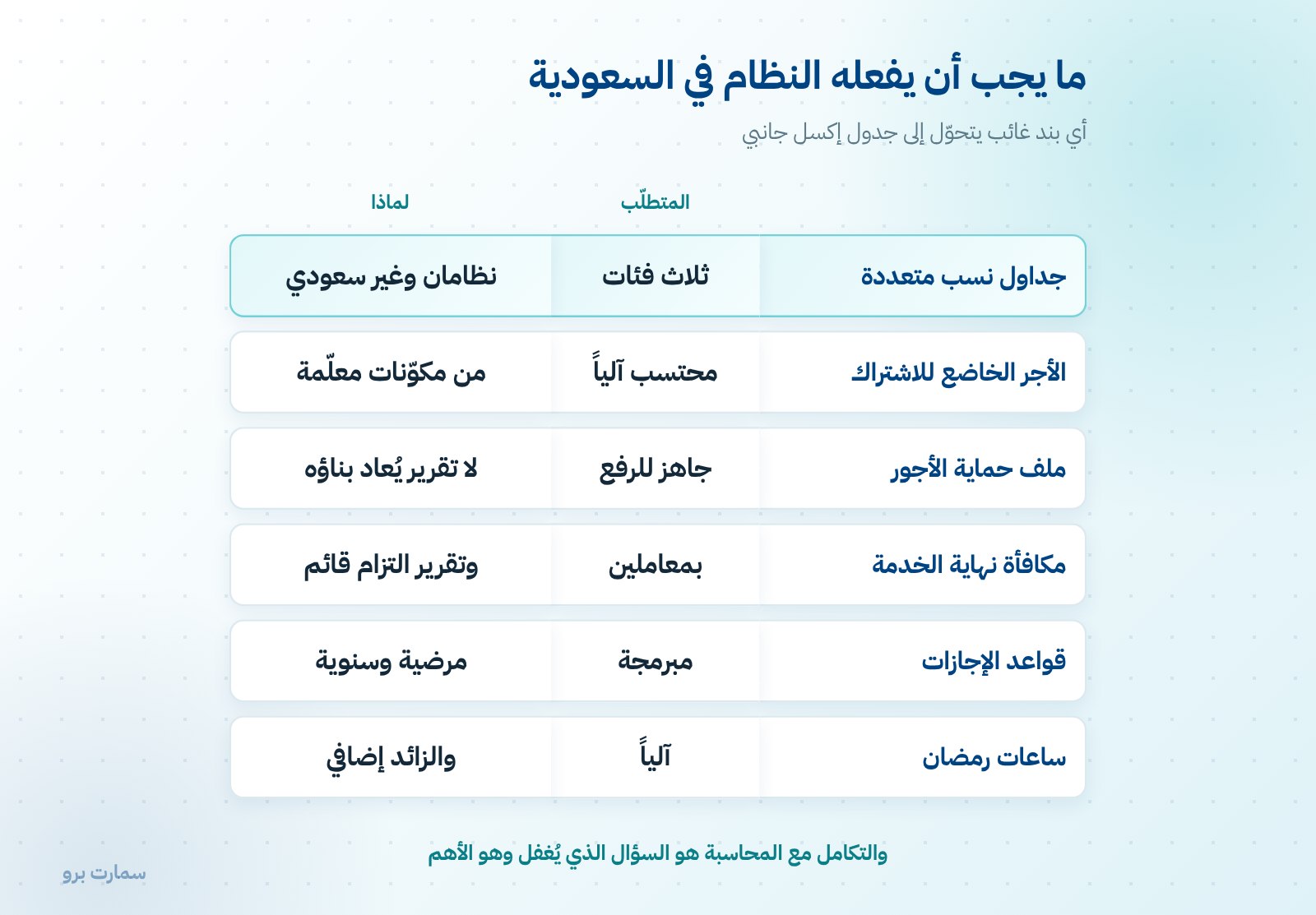
HR system: what it must do in Saudi Arabia
| Requirement | Why it matters |
|---|---|
| More than one GOSI rate table | The old and new schemes run in parallel, and non-Saudis have a third treatment |
| Contributory wage calculation | It is neither the gross salary nor the basic salary alone |
| Wage Protection file generation | In a format that can be uploaded directly through Mudad |
| End-of-service award calculation | With two different factors before and after five years |
| Statutory leave rules | Sick leave in three pay stages, annual leave with limited carry-over |
| Ramadan hours | Six hours for the relevant category of workers, with anything beyond counted as overtime |
| Full Arabic interface | Right-to-left, with both Hijri and Gregorian calendars |
If any of these is missing, it turns into a side spreadsheet in Excel, which is exactly what you came to get rid of.
The six questions that settle the decision
1. Does it calculate GOSI with more than one table?
Ask for a live demonstration: a Saudi employee on the old scheme, another on the new one, and a third who is non-Saudi, all in the same payroll run. A system that allows only one rate is no longer fit for work in Saudi Arabia. See GOSI contribution rates.
2. Does it generate a ready Wage Protection file?
It is not enough that it "exports a report". You need a file in the required format that uploads directly, and the basic wage in it must match what is registered with GOSI. See the Wage Protection System.
3. Does it connect to accounting or stand apart from it?
This is the most important question and the one most often overlooked. An HR system separate from the accounting system means the payroll journal entry is keyed in by hand every month, and provisions are calculated in a side spreadsheet.
An integrated system generates the entry straight from the payroll run, calculates the end-of-service provision and leave liability automatically, and allocates the cost to cost centres. A cost centre is a unit such as a branch, department or project that you track costs against. See the payroll journal entry.
4. Does it calculate the end-of-service award automatically?
Ask for a report showing each employee's outstanding liability as of today. A system that needs a manual calculation for every case will only be used when someone leaves, and that is far too late. See the end-of-service provision.
5. Does it offer real self-service?
On mobile, in Arabic, with approval workflows you can customise. See employee self-service.
6. Does it keep a trail of every change?
Who changed a salary, when, and what the previous value was. This is what protects the business in a dispute and during an audit.
How to test before you buy
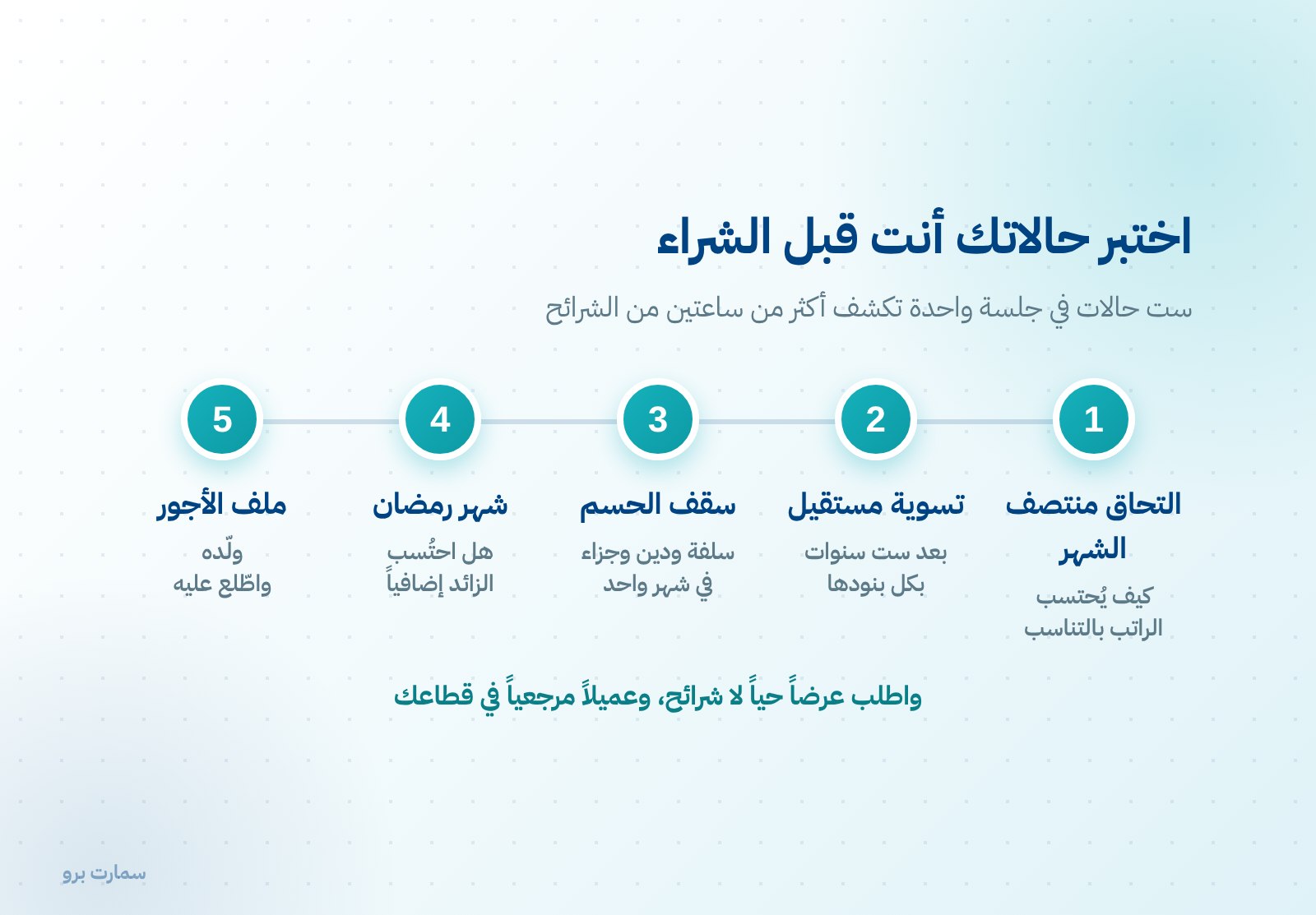
A sales presentation shows what the vendor wants to show. The real test is to ask them to run your own cases:
- An employee who joined mid-month: how is their salary calculated?
- An employee whose service ended by resignation after six years: produce the full settlement.
- An employee with an advance, a court-ordered debt and a penalty in the same month: does the system refuse to exceed the deduction cap?
- The month of Ramadan: were the extra hours calculated as overtime?
- An employee with variable pay from commission: does the contributory wage change accordingly?
- The Wage Protection file: generate it and actually look at it.
Six cases in one session reveal more than two hours of slides.
Contract and support questions
- Total cost: subscription, setup, training, data migration and any extra module. See what ERP costs in Saudi Arabia.
- Cost of each additional user as you grow.
- Service level: response time and permitted downtime, in writing rather than verbally.
- Data ownership: how you extract all of it if you decide to leave, and in what format.
- Regulatory updates: who pays for the change when a rate or rule changes?
The last item matters in practice. The GOSI rate under the new scheme rises every year until it settles, so who updates it in your system?
Do you need a standalone system or a module within an ERP?
The practical rule: if payroll is a large share of your costs and you need to allocate it across projects or branches, integration with accounting matters more than any other feature.
If the business is small and its costs are simple, a standalone system may be enough, provided it exports an importable journal entry and not a report that has to be keyed in again. See accounting software or ERP.
Migration: the step people underestimate
What most often stalls an HR system rollout is not the system but data migration. In established businesses, employee records are scattered across spreadsheets, paper files and the memory of one staff member.
The minimum that must be migrated accurately: each employee's start date (because it is the basis of the end-of-service award), a detailed breakdown of pay components, leave balances, outstanding advance balances and the end-of-service provision balance.
An error in a single start date shows up years later in an end-of-service settlement. That is why migration should be preceded by an audit of the data, not a straight copy of it as it is.
Warning signs
- A vendor that does not show a live system and relies on slides.
- A quotation without a breakdown of setup and migration items.
- An answer of "yes, it supports that" with no practical demonstration.
- No reference customer in your sector or of your size.
- Regulatory updates charged for every time.
The official reference
The regulatory requirements any payroll system must meet are published by the Ministry of Human Resources and Social Development and the General Organization for Social Insurance (GOSI). They are the reference whenever they differ from what a vendor tells you.
Read also
Key takeaway: Judge an HR system on GOSI tables, the Wage Protection file, end-of-service calculation and integration with accounting, and make the vendor run your own cases before you sign.
To run these six cases on your own data, book a demo or start a free trial of SmartPro.
Frequently asked questions
What matters most when choosing an HR system in Saudi Arabia?
Support for more than one GOSI rate table, because the old and new schemes run in parallel. It must also calculate the contributory wage correctly, generate a Wage Protection file ready for upload, calculate the end-of-service award with two factors, and integrate with accounting.
Is a standalone HR system better than an HR module within an ERP?
If payroll is a large share of your costs and you need to allocate it across projects or branches, integration with accounting matters more than any other feature. In small businesses a standalone system may be enough, provided it exports an importable journal entry rather than a report that has to be keyed in again.
How do I test an HR system before buying it?
Ask the vendor to run your own cases rather than presentation slides: an employee who joined mid-month, an end-of-service settlement for someone who resigned after six years, an employee with an advance, a debt and a penalty together, the month of Ramadan, an employee on variable commission, and actually generating the Wage Protection file. Six cases in one session reveal more than hours of slides.
Which clause is most often forgotten in an HR system contract?
Who pays for regulatory updates when a rate or rule changes. The GOSI rate under the new scheme rises every year until it settles, so if every update is charged for, regulatory compliance becomes a recurring, unexpected cost.