
GOSI Contribution Rate in Saudi Arabia: The Old and New Systems
The GOSI contribution rate is no longer a single number. Two systems have run side by side since 2024, with a yearly step-up schedule. Here is how to tell which rate applies to each employee.
سامي الحيدري
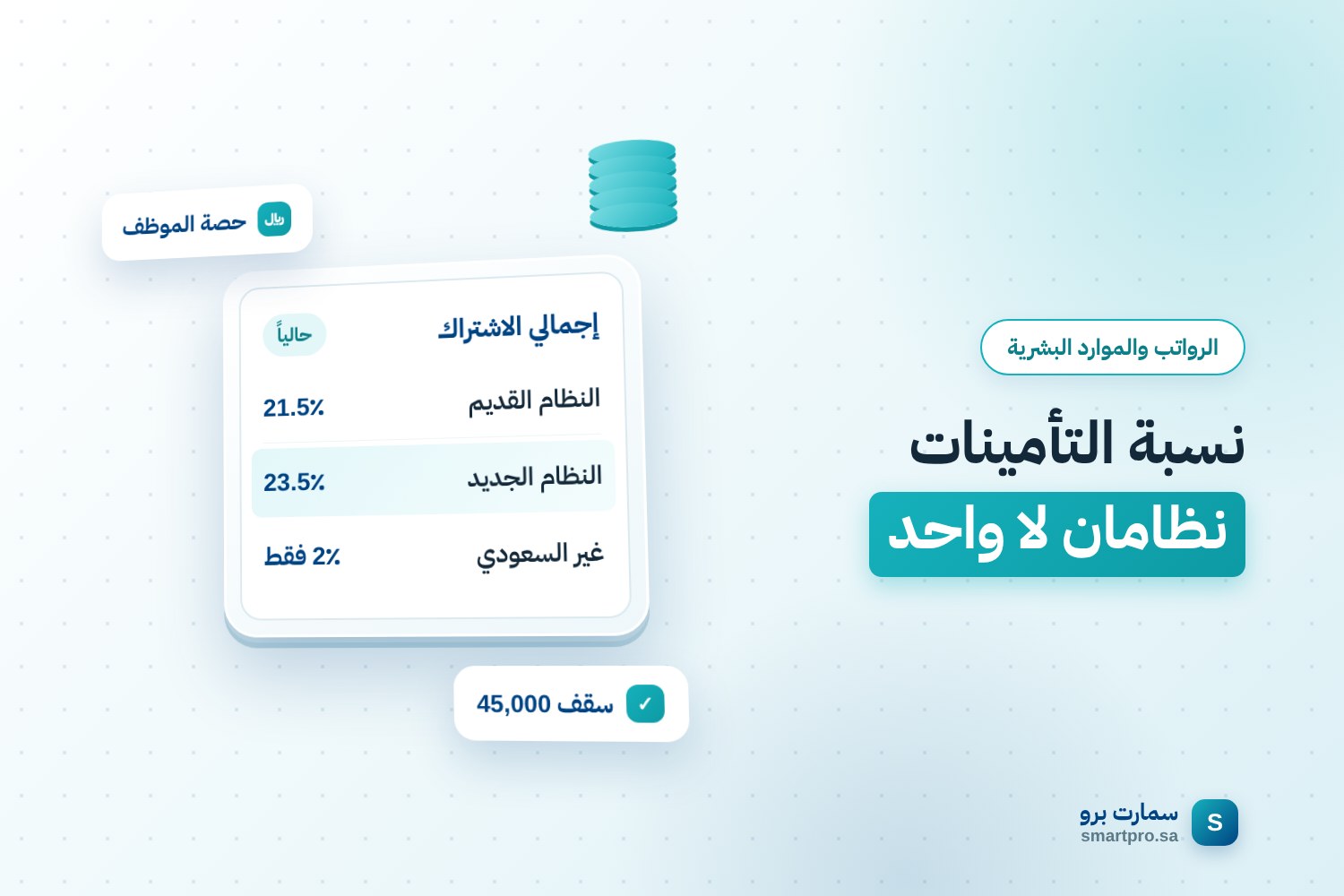
The GOSI contribution rate in Saudi Arabia is no longer a single number. Since the new Social Insurance Law took effect on 3 July 2024, one business can have employees on one rate and others on a higher rate, and both are correct.
Most of what is published online still quotes only 21.5% and 9%, which are the old system's rates. If you rely on them in today's payroll, you under-deduct for part of your workforce, and the gap shows up at the first reconciliation.
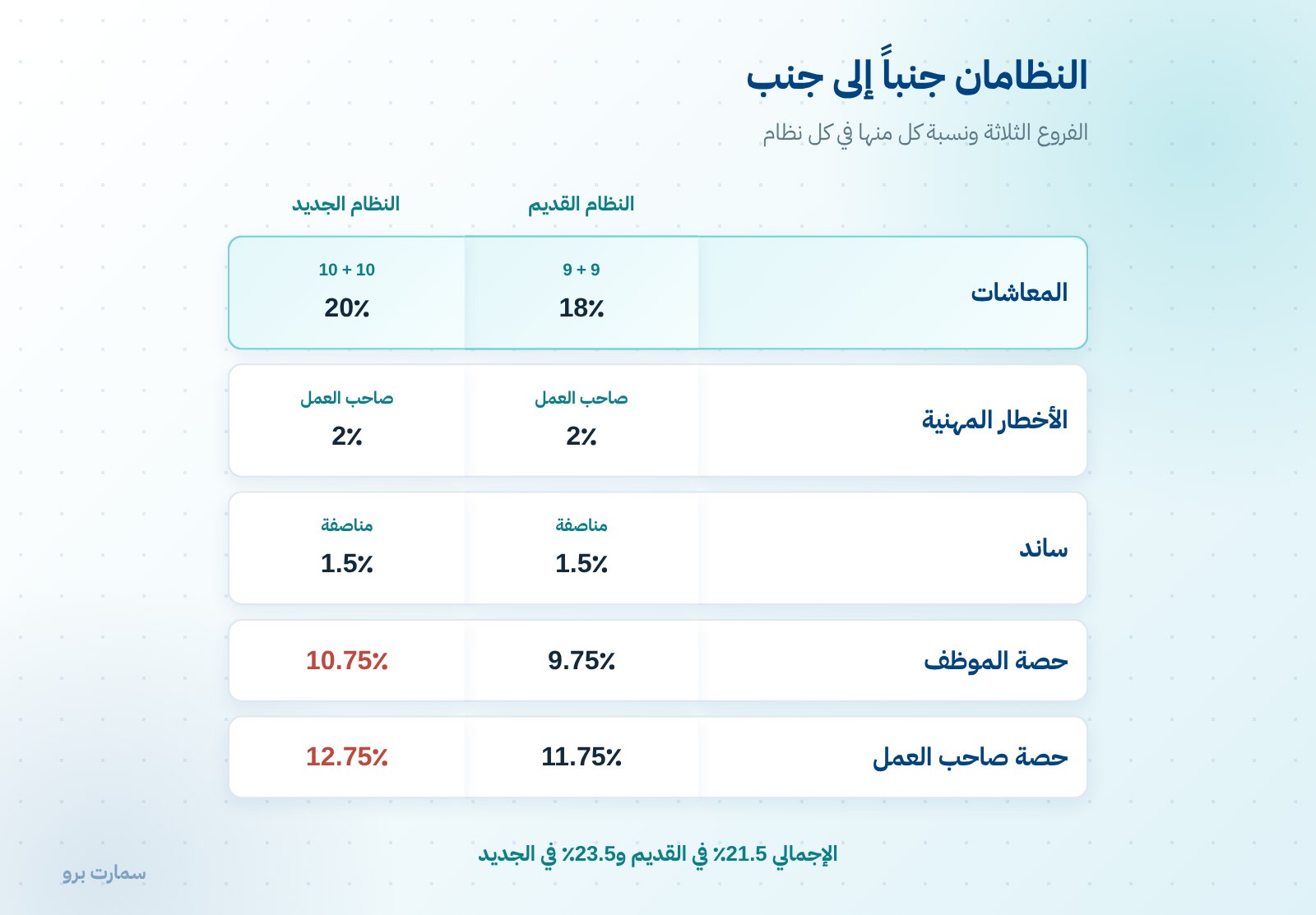
GOSI contribution rate: comparison table
| Branch | Old system | New system (current) |
|---|---|---|
| Pensions (annuities) | 18% (9 + 9) | 20% (10 + 10) |
| Occupational hazards | 2% paid by the employer | 2% paid by the employer |
| Unemployment insurance (SANED) | 1.5% (0.75 + 0.75) | 1.5% (0.75 + 0.75) |
| Total | 21.5% | 23.5% |
| Employee share | 9.75% | 10.75% |
| Employer share | 11.75% | 12.75% |
Who falls under the new system?
This is where most mistakes happen, because the rule is not "anyone who joined after July 2024".
The legal test is whether the employee had previous contribution periods that had not been compensated on the effective date. Anyone with uncompensated earlier periods stayed on the old system. Anyone with no earlier periods, or whose entitlements for those periods had already been paid out, entered the new system.
In practice, an employee who returned to the job market after receiving full entitlements may enter the new system despite years of previous experience. You verify each contributor's status from their GOSI record, not by guessing from the hiring date.
The step-up schedule: from 18% to 22%
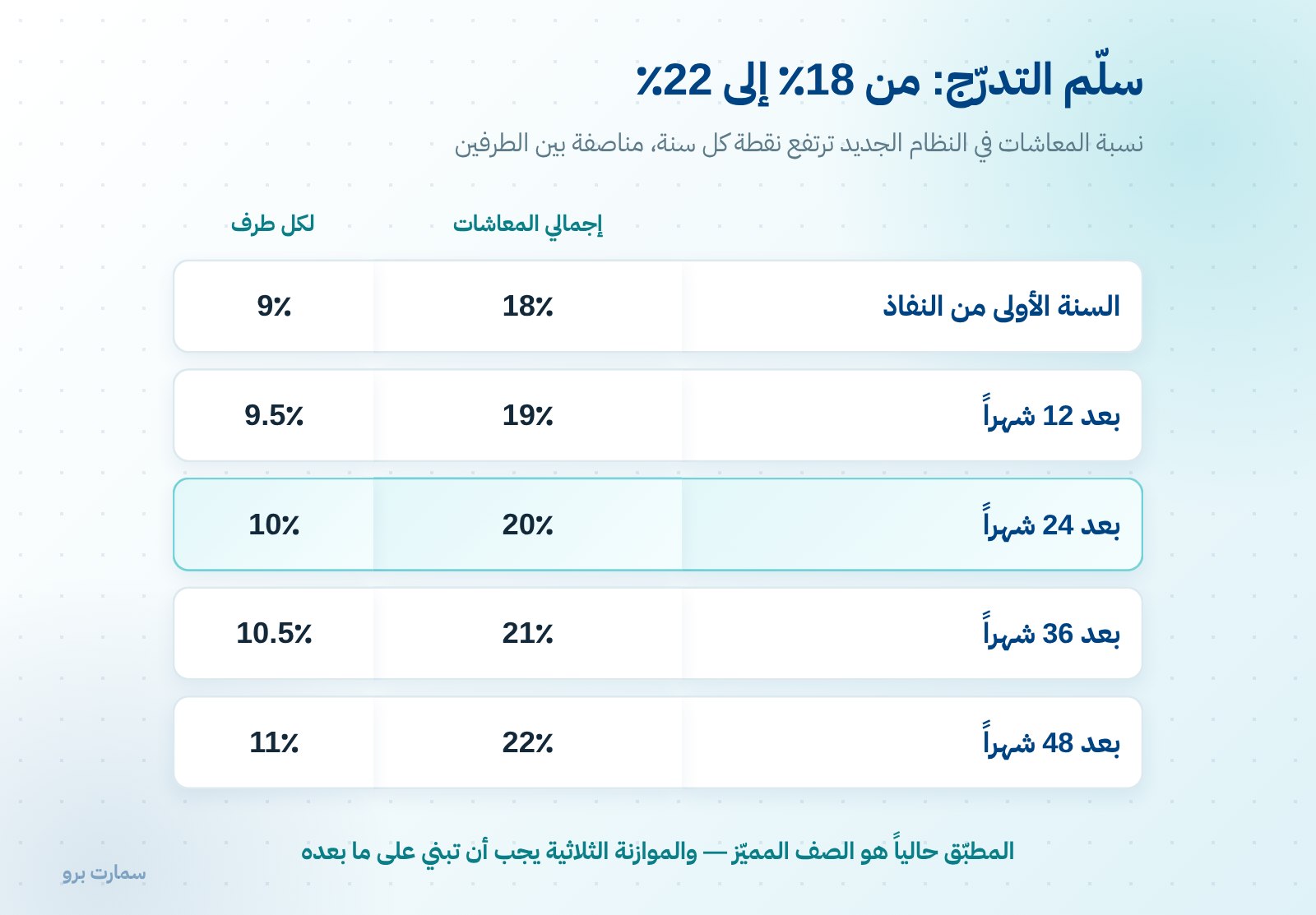
The pension rate under the new system does not jump all at once. It rises by one percentage point a year over four years, split equally between the two parties:
| Period | Total pensions | Employee | Employer |
|---|---|---|---|
| First year after the effective date | 18% | 9% | 9% |
| After 12 months | 19% | 9.5% | 9.5% |
| After 24 months (currently applied) | 20% | 10% | 10% |
| After 36 months | 21% | 10.5% | 10.5% |
| After 48 months | 22% | 11% | 11% |
This means the share of an employee on the new system will rise twice more, and the business's payroll budget rises with it. If you build a three-year budget on today's rate, you understate your real cost.
Occupational hazards: the branch that covers everyone
The 2% occupational hazards contribution is paid by the employer alone; nothing is deducted from the employee. It is the only branch that covers Saudi and non-Saudi employees alike.
This rate can be doubled by decision for a business that refuses to follow occupational health and safety instructions. So it is not a fixed fee but a rate tied to how the business behaves.
SANED: for Saudis only
Unemployment insurance (SANED) is currently applied at 1.5%, split equally, and covers Saudis only. The rate may be adjusted within a defined range, but it always remains split equally.
Unemployment compensation is calculated on the average wage over twenty-four months. It starts at a higher percentage in the first months and then decreases, with a cap on both the amount and the payment period.
Non-Saudi employees: zero deduction
Nothing is deducted from a non-Saudi employee's salary for GOSI. The business pays only the occupational hazards branch at 2% of the contributory wage, borne entirely by the employer.
A common mistake is deducting a percentage from an expatriate's salary in the name of GOSI, which has no legal basis. Details are in GOSI for non-Saudi employees.
What amount is the rate calculated on?
It is not calculated on the gross salary but on the contributory wage: the wage on which GOSI contributions are based, made up of the basic salary plus the cash housing allowance, commissions and sales percentages. The transport allowance is excluded, and the ceiling is SAR 45,000 a month.
So an employee with a gross salary of SAR 12,000 may have a contributory wage of only SAR 10,000. Applying the rate to the wrong figure creates a difference that builds up every month. Details are in the contributory wage.
A worked example: old system vs new
Two Saudi employees, each with a contributory wage of SAR 10,000, one on the old system and one on the new:
| Item | Old | New |
|---|---|---|
| Deducted from the employee | 975 | 1,075 |
| Paid by the business | 1,175 | 1,275 |
| Total remitted | 2,150 | 2,350 |
That is a difference of SAR 200 a month for one employee, or SAR 2,400 a year. In a business with fifty employees on the new system, the difference compared with the old system is roughly SAR 120,000 a year.
Retirement age: what has changed
The statutory pension age under the new system is sixty-five, with a minimum contribution period. Early retirement before that age is allowed under conditions tied to the length of contribution, with a permanent reduction in the pension that grows the earlier you retire.
Existing contributors have a phased age schedule based on their age at the effective date, so nobody moves from one retirement age to another in a single step.
Payment deadline and late penalty
Contributions are paid within the first fifteen days of the following month. Late payment incurs a penalty of 2% of the contribution due for each month of delay or part of a month.
The employer alone is responsible to GOSI for both shares. An employer who did not deduct the employee's share when paying the wage cannot recover it from the employee later, which is reason enough not to postpone fixing your payroll.
How do you check the correct rate for each employee?
- Open your establishment's record with GOSI and review each contributor's status.
- Classify employees as Saudi on the old system, Saudi on the new system, or non-Saudi.
- Link each category to its own rate in your payroll system, not one rate for all employees.
- Review the classification with every new hire, not once a year.
A payroll system that allows only one rate is no longer fit for work in Saudi Arabia today. To see how SmartPro's Human Resources system handles payroll and GOSI, you can review it alongside the rest of your setup.
The official reference
Contribution rates, the conditions for each system and the step-up schedule are published by the General Organization for Social Insurance (GOSI), which is the reference whenever there is a discrepancy. Because the rate changes every year until the schedule is complete, reviewing it before each financial year is a necessary step, not an optional precaution.
Key takeaway: Saudi employees may be on 21.5% (old system) or 23.5% (new system, rising each year), while non-Saudis carry only the employer's 2% occupational hazards contribution. Check each employee's GOSI status and apply the rate to the contributory wage, not the gross salary.
Read also
- The contributory wage: what is included and what is not
- Payroll run: how to prepare it step by step
- The true cost of an employee to your business
To set up payroll with more than one GOSI category, start a free SmartPro trial or book a demo.
Frequently asked questions
What is the GOSI contribution rate in Saudi Arabia?
It depends on which system the contributor falls under. Under the old system the total is 21.5%, split 9.75% for the employee and 11.75% for the employer. Under the new system the total is currently 23.5%, split 10.75% for the employee and 12.75% for the employer, and it rises gradually until it settles.
Who falls under the new GOSI system?
Anyone who had no previous uncompensated contribution periods when the law took effect in July 2024. The test is not the hiring date: someone who received their entitlements for earlier periods and then returned to work enters the new system. You verify this from the contributor's GOSI record.
How much GOSI is deducted from a non-Saudi employee's salary?
Nothing. No GOSI deduction is made from a non-Saudi employee's salary; the business pays only the occupational hazards branch at 2% of the contributory wage, borne entirely by the employer. Deducting a percentage from an expatriate's salary in the name of GOSI has no legal basis.
What amount is the GOSI rate calculated on?
It is calculated on the contributory wage, not the gross salary. This includes the basic salary, cash housing allowance, commissions and sales percentages, but excludes the transport allowance. The ceiling is SAR 45,000 a month.