
The True Cost of an Employee to Your Business: How to Calculate It with Real Numbers
An employee costs your business considerably more than their salary. Here are the items usually overlooked, a full worked calculation in SAR, and how to use the figure in pricing and budgeting.
سامي الحيدري
Employee cost to your business is not the salary on the contract. The figure in the contract is sometimes less than half the story, and the gap between it and the actual cost is what leads businesses to price their services at a loss while believing they are making a profit.
The reason is that the extra items are scattered: some are monthly, some are annual, and some are not paid out until years later.
Employee cost: what are all the items?
| Group | Items |
|---|---|
| Monthly cash | Basic wage, housing allowance, transport allowance, other allowances |
| Variable cash | Overtime, commissions, bonuses |
| Statutory obligations | The employer's GOSI contribution |
| Accrued obligations | End-of-service provision, accrued leave liability |
| Annual costs | Travel ticket, medical insurance, work permit and its renewal for non-Saudis |
| Indirect costs | Training, office space, devices and software, recruitment and replacement |
The fourth and sixth rows are the most often overlooked. The fourth because it is not paid in cash this month, and the sixth because it is not attributed to any one employee.
An end-of-service provision is the amount you set aside each month in your books for the end-of-service award the employee will be owed when they leave.
What does a full calculation look like in numbers?
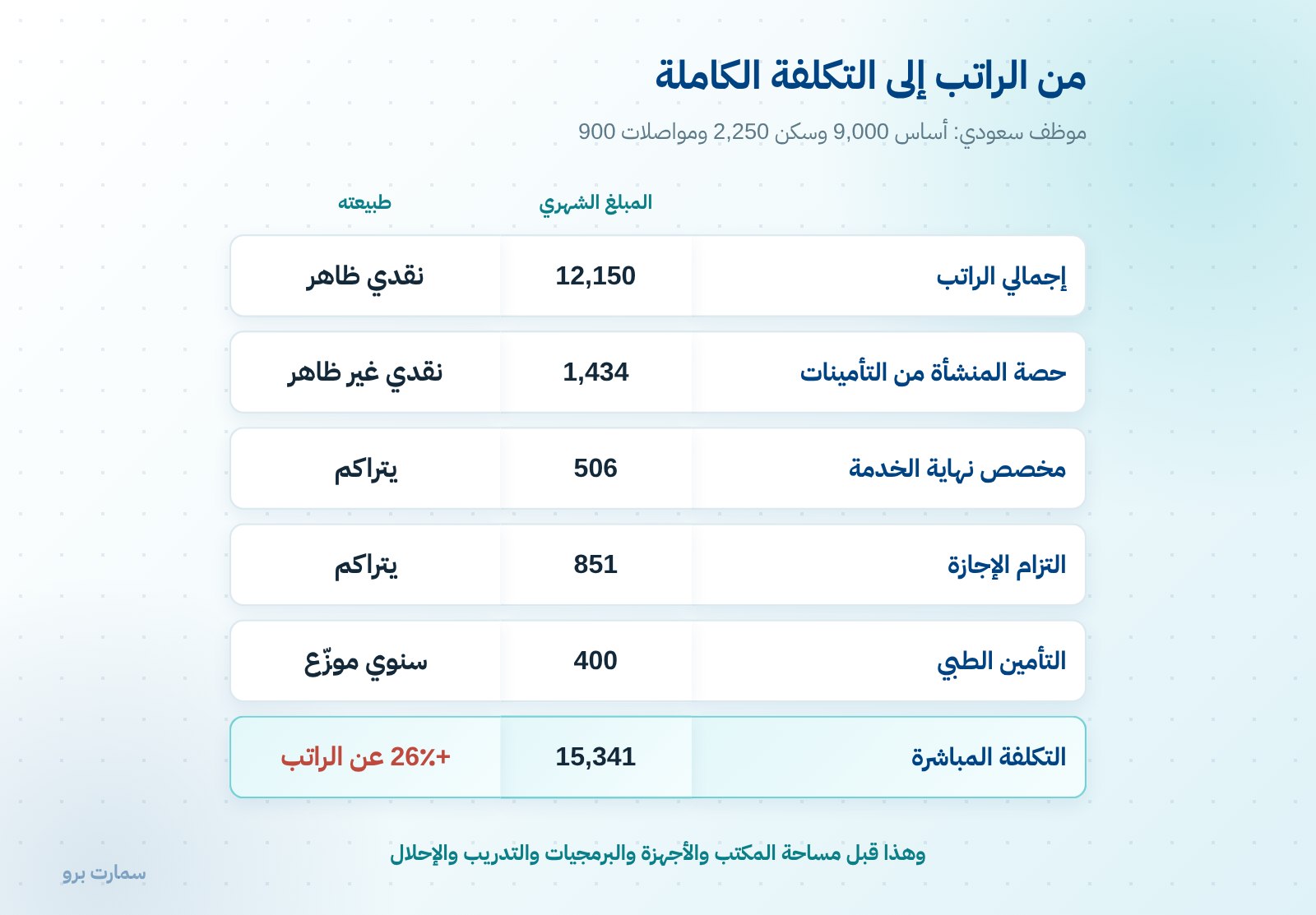
Take a Saudi employee under the new GOSI system, with a basic wage of SAR 9,000, a housing allowance of SAR 2,250 and a transport allowance of SAR 900:
| Item | Monthly amount (SAR) |
|---|---|
| Gross salary | 12,150 |
| Employer's GOSI contribution | 1,434 |
| End-of-service provision (estimated) | 506 |
| Annual leave liability (21 days) | 851 |
| Medical insurance (annual, spread monthly) | 400 |
| Monthly direct cost | 15,341 |
The result: the employee's cost exceeds their stated salary by about 26%, and that is before any indirect cost.
Once you add the employee's share of office space, devices, software and training, the uplift easily passes one third in office-based roles.
Where do these figures come from?
- GOSI contribution: calculated on the contributory wage of SAR 11,250 (the transport allowance is not included), at the employer's rate under the new system. See the GOSI contributory wage.
- End-of-service provision: half a month for each of the first five years, which works out at about 4.17% of the wage each month. After the fifth year the multiplier doubles. See the end-of-service provision.
- Leave liability: 21 days a year, roughly 7% of the annual wage.
Note that the provision doubles after the fifth year. The same employee becomes more expensive to the business in their sixth year without any increase in salary.
How does a Saudi employee differ from a non-Saudi?
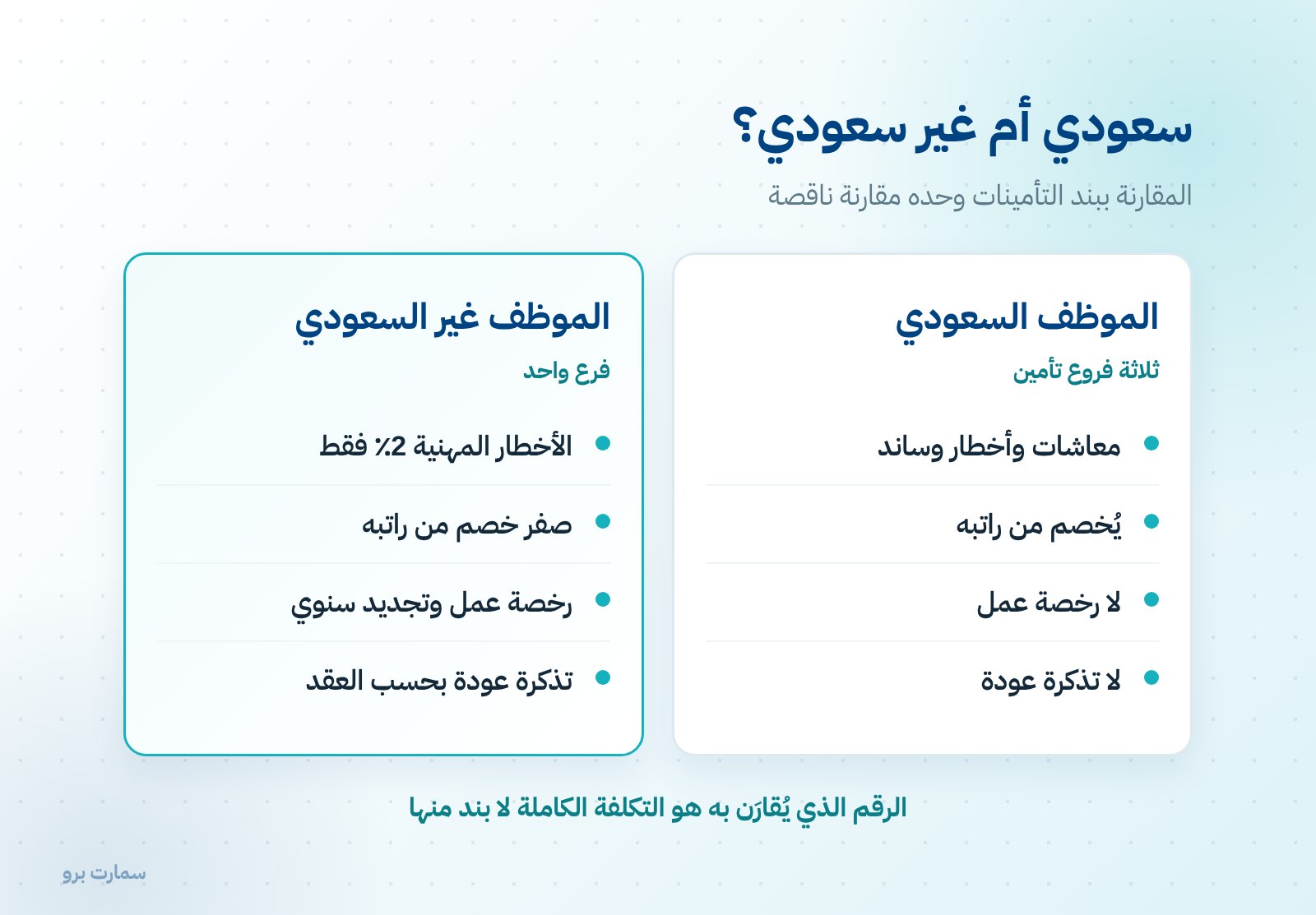
| Item | Saudi | Non-Saudi |
|---|---|---|
| GOSI paid by the employer | Annuities rate + occupational hazards + SANED | Occupational hazards only (2%) |
| Deduction from the employee | Yes | No |
| Work permit and renewal | No | Yes |
| Return ticket | No | Depending on the contract |
So the GOSI obligation is lighter for the business in the case of a non-Saudi, but other items are added. Comparing the two cases on a single item is not valid. Details in GOSI for non-Saudi employees.
Why does this number matter?
In pricing
A service business that prices its hourly rate on salary alone loses money on every hour. The correct price starts from the full cost, plus the hour's share of overheads, then the profit margin.
In budgeting
A payroll budget built on stated salaries falls short of reality by a quarter. Add the gradual increase in the GOSI rate under the new system, and the gap widens year after year. See GOSI contribution rates.
In the hiring decision
The difference between a full-time employee and an independent contractor is not the difference in pay, but full cost against fees. Many decisions are made on the wrong comparison.
In the retention decision
The cost of replacing an employee, from advertising and screening to interviews and the new hire's period of lower productivity, often exceeds several months of their salary. A business that calculates it looks at a pay-rise request differently.
How do you calculate it for each cost centre?
A cost centre is a unit in your books, such as a department, branch or project, to which you assign costs so you can measure its results separately.
- Define the cost centre for each employee in their file: department, branch or project.
- Load every cost item onto the centre, not the salary alone.
- Allocate indirect costs using a fixed, documented rule.
- Produce the full-cost report monthly alongside your other reports.
This way you know the real profitability of each project and each branch, not an estimate. See the chart of accounts guide and the payroll journal entry.
How do you estimate the indirect items?
Indirect costs are not attributed to a specific employee, but they arise because of them. The simplest way to estimate them is to divide the annual total by the number of employees:
- Workspace: rent, utilities and maintenance divided by the number of seats.
- Devices and software: the cost of the device spread over its useful life, plus software subscriptions per user.
- Recruitment and replacement: the cost of advertising, screening, interviews and the initial training period, spread over the average length of an employee's stay.
- Training and development: the annual budget divided by the number of people who benefit.
A rough estimate is better than ignoring the item. A business that knows one employee's seat costs it SAR 1,000 a month makes different decisions from one that does not.
Is there a quick rule for estimating it?
For a quick estimate in office-based roles in Saudi Arabia: multiply the gross salary by 1.25 to 1.35 to reach the approximate direct cost, before indirect costs.
The ratio varies with nationality, length of service and allowance structure, so the rule is for quick estimates, not the final budget.
If you run payroll in SmartPro's Human Resources system, it is wired into accounting, so salary and related costs can be tracked by cost centre in Finance & Accounting.
Official references
GOSI contribution rates and the contributory wage limits are published by the General Organization for Social Insurance, and the rules on the end-of-service award and leave under the Labour Law are available from the Ministry of Human Resources and Social Development.
Read also
- The end-of-service provision in your books
- GOSI contribution rates: the old and new systems
- Payroll run: how to prepare it step by step
Key takeaway: An employee's direct cost typically runs about 25% to 35% above gross salary in Saudi office roles, and more once indirect costs are added. Price, budget and hire on the full cost, not the contract salary.
To see how payroll and cost centres connect in practice, start a free SmartPro trial.
Frequently asked questions
How do I calculate an employee's true cost?
Start with the gross salary, then add the employer's GOSI contribution, the monthly end-of-service provision and the annual leave liability. Add annual costs spread monthly, such as medical insurance, the travel ticket and the work permit. Finally, add the employee's share of indirect costs.
How much more than their salary does an employee cost?
In office-based roles in Saudi Arabia, the direct cost is roughly a quarter to a third above salary, and higher once indirect costs are included. For a quick estimate, multiply the gross salary by 1.25 to 1.35, bearing in mind that the ratio varies with nationality, length of service and allowance structure.
Why does an employee become more expensive after five years?
Because the end-of-service award multiplier doubles after the fifth year: half a month for each of the first five years, and a full month for each year after that. The monthly provision therefore rises without any increase in salary.
Is a non-Saudi employee cheaper?
On GOSI, yes, because the employer pays only the occupational hazards branch and nothing is deducted from the employee's salary. However, other items are added, such as the work permit and its renewal and a return ticket depending on the contract, so comparing on a single item is not valid.