
Payroll Sheet: How to Prepare It Step by Step Without Errors
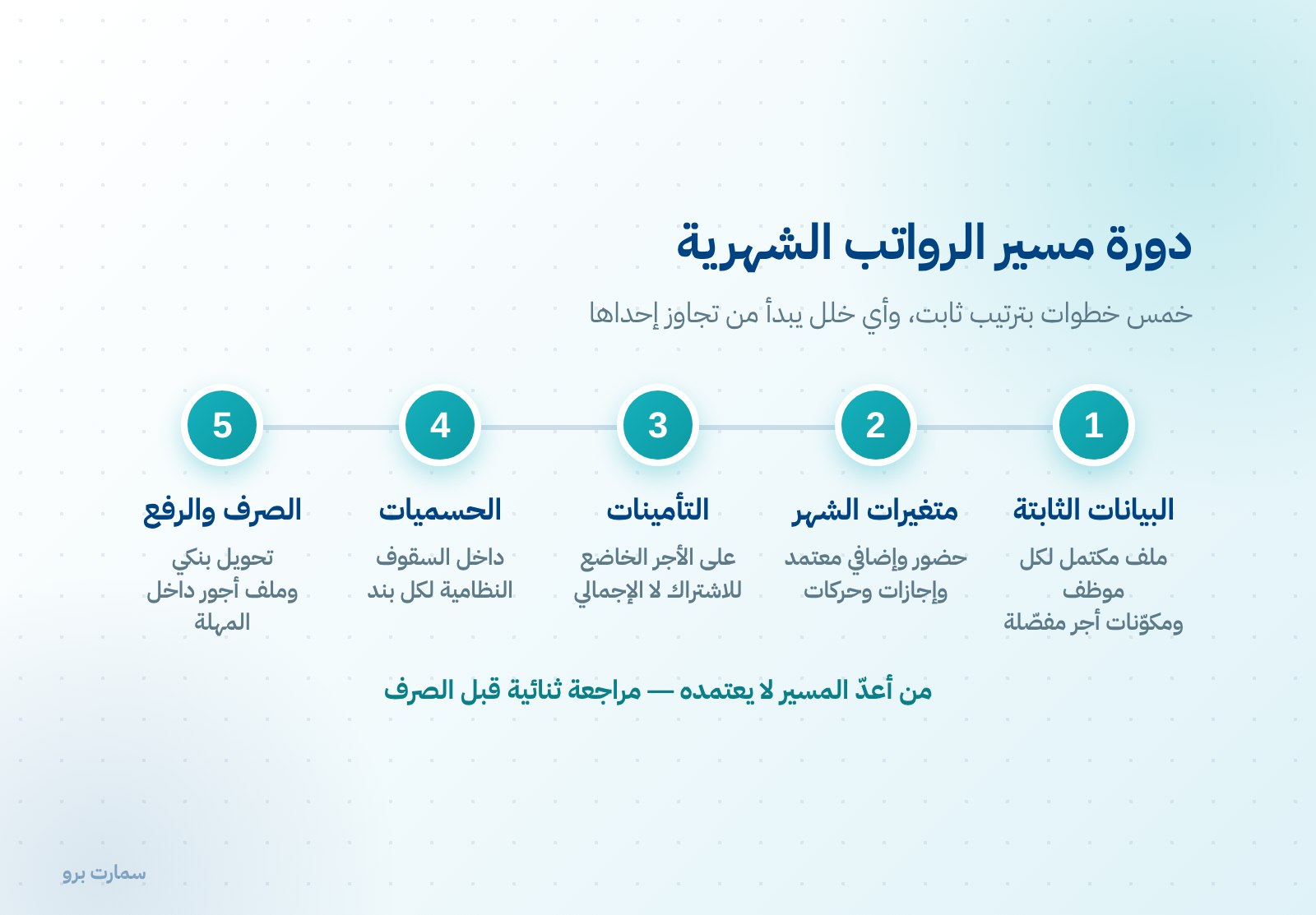
A payroll sheet serves four parties, each reading a different number. Here are the five steps to prepare it, a complete worked example in SAR, and the most common error that stops your Wage Protection file.
سامي الحيدري
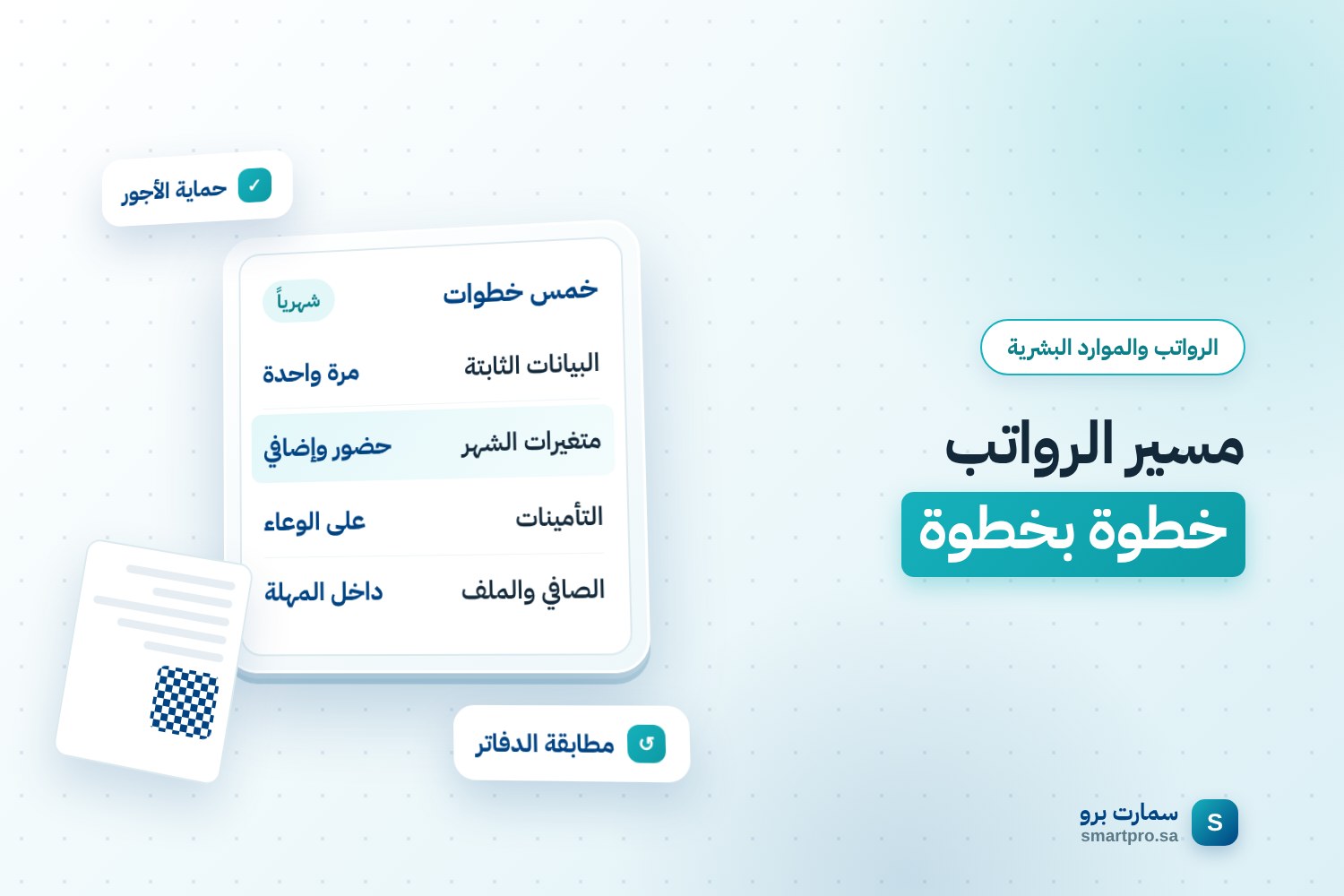
A payroll sheet is the monthly statement that sets out what each employee is entitled to, what is deducted, and what actually reaches their bank account. It is one document, but it serves four parties at once: the employee, the bank, GOSI (the General Organization for Social Insurance), and the Ministry of Human Resources through the Wage Protection file.
This is exactly where most businesses run into trouble: these parties do not read the same number. The bank wants the net pay, GOSI wants the contributory wage, and Wage Protection matches the two. If the payroll sheet is built with a single figure per employee, the gap shows up at the first reconciliation.
What does a payroll sheet actually consist of?
| Section | Items |
|---|---|
| Earnings | Basic salary, housing allowance, transport allowance, other allowances, overtime, commissions |
| Deductions | Employee's GOSI share, advance instalments, penalties, unpaid absence, court-ordered debts |
| Derived figures | Gross earnings, contributory wage, net pay |
| Cost to the business | Net pay + employer's GOSI share + end-of-service provision |
Note the last row: the employee's cost to the business is not usually a figure on the payroll sheet, yet it is the number the owner cares about. The full breakdown is in the true cost of an employee.
Step 1: Lock down the fixed data
Before any monthly calculation, every employee needs a complete file: name as shown on the national ID or iqama, ID number, nationality, start date, IBAN, and salary components itemised rather than lumped together.
The word "itemised" is the heart of the matter. A salary recorded as one figure turns GOSI, end-of-service benefit and overtime calculations into guesswork. Separating basic pay from allowances is not cosmetic tidiness; it is a condition for three different calculations to be correct.
Step 2: Collect the monthly variables
- Attendance and absence: unpaid absence days, and lateness if it is counted.
- Overtime: hours approved by the direct manager, not just hours recorded.
- Leave: sick leave at its applicable pay rates, and unpaid leave.
- Movements: new joiners or end of service during the month, calculated pro rata by days.
- Deductions: advance instalments and penalties.
Changes should close on a fixed date each month. A payroll sheet without a cut-off date stays open until the moment of payment, and that is the root of most errors.
Step 3: How do you calculate GOSI contributions?
GOSI is not calculated on gross salary but on the contributory wage, which is the basic salary plus the cash housing allowance, commissions and sales percentages. The transport allowance is not included, and the contributory wage is capped at SAR 45,000 a month.
The rate depends on which system the contributor falls under, because the new social insurance law in force since July 2024 raises the pension rate gradually. Full details are in GOSI contribution rates and the GOSI contributory wage.
Nothing at all is deducted from a non-Saudi employee; only the occupational hazards branch applies to them, and it is paid by the employer alone.
Step 4: How much can you deduct from salary?
Salary deductions are not open-ended. The Labor Law sets explicit caps:
- An instalment on an advance from the employer: no more than one tenth of the wage.
- A court-ordered debt: no more than one quarter of the wage per month.
- Damage to tools caused by the worker's fault: no more than five days' wages per month.
- The overall cap for all deductions combined: half of the wage due.
Any deduction outside the cases set out in the law requires the employee's written consent. Details are in salary deduction limits.
Step 5: Net pay and uploading the file
Once earnings and deductions are calculated, net pay is produced, transferred through an approved bank, and the wage file is uploaded through the Mudad platform. The Wage Protection System (WPS), the ministry's mechanism for verifying that salaries are paid as registered, matches the file automatically against GOSI data, so any difference in basic salary between the payroll sheet and the GOSI record is logged as a violation.
A complete worked example
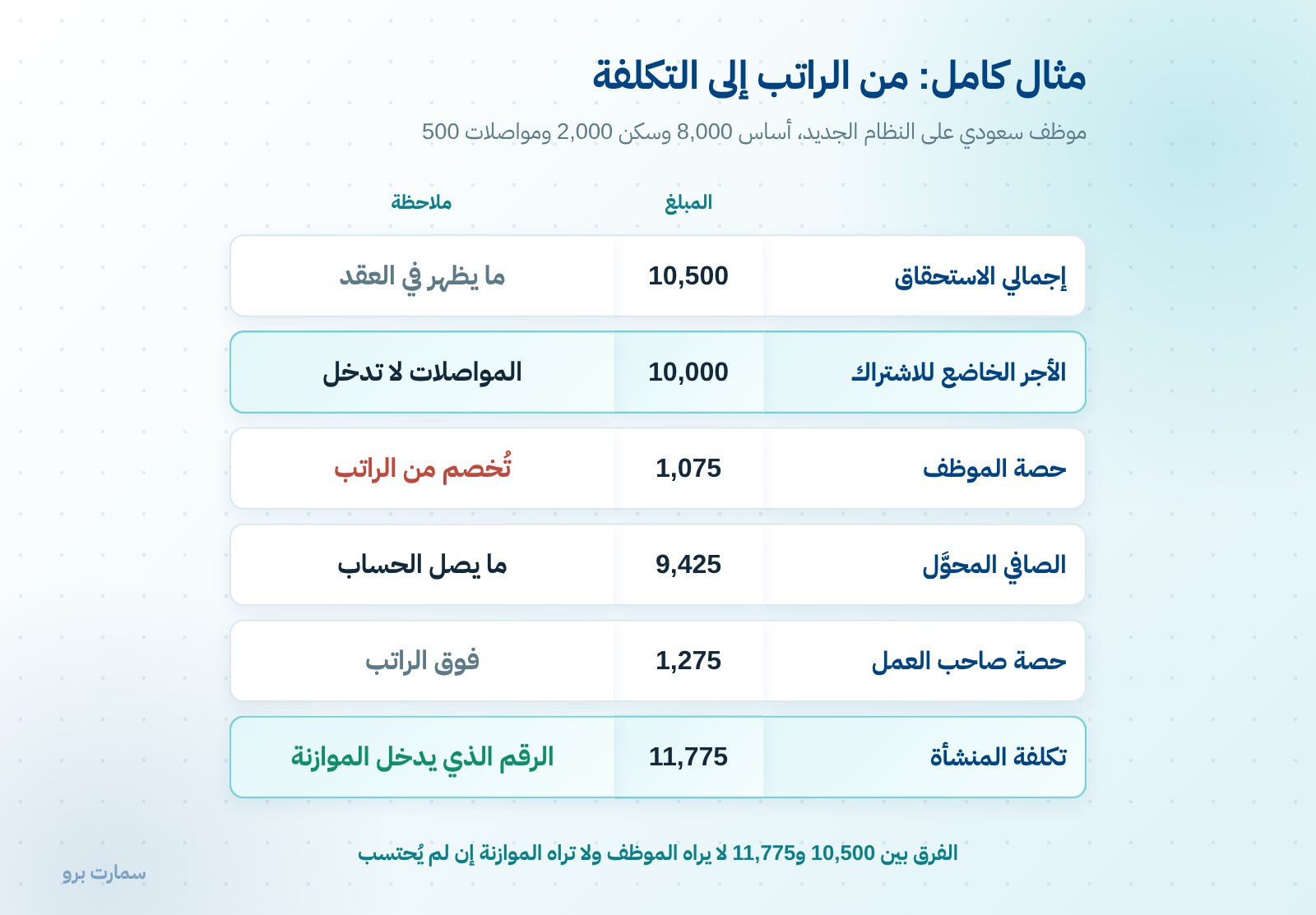
A Saudi employee under the new system, with a basic salary of SAR 8,000, a housing allowance of SAR 2,000 and a transport allowance of SAR 500:
| Item | Amount (SAR) |
|---|---|
| Gross earnings | 10,500 |
| Contributory wage | 10,000 (transport excluded) |
| Employee's GOSI share | 1,075 |
| Net pay transferred | 9,425 |
| Employer's share | 1,275 |
| Cash cost to the business | 11,775 |
The difference between SAR 10,500 and SAR 11,775 is what the business actually pays and the employee never sees. That is the figure that belongs in the budget, not the advertised salary.
What is the most common error that stops the Wage Protection file?
A mismatch in basic salary between the payroll sheet and what is registered with GOSI. It happens when an employee's salary is raised in the internal system and nobody updates GOSI, or when the gross wage is recorded in one place and the basic in another.
The consequence is not a minor remark: the compliance rate drops, violations pile up, ministry services are suspended after two months of delay, and after three months the employee can be transferred to another business without the employer's consent.
What does a sound monthly payroll cycle look like?
- One week before cut-off: direct managers approve overtime hours and leave.
- Cut-off day: freeze the variables and calculate the payroll sheet.
- One day after cut-off: two-person review; whoever prepared the payroll sheet does not approve it.
- Payment day: bank transfer and wage file upload.
- During the following week: reconcile the payroll sheet with the payroll entry in the books, as explained in the payroll journal entry.
When is Excel no longer enough?
A payroll sheet for ten employees can run in a spreadsheet without trouble. But three signs tell you it is time to move to a system:
- Repeated entry: the same salary is typed into the payroll sheet, into GOSI and into the accounting entry.
- Pro-rata errors: an employee joins mid-month or leaves, the calculation is done by hand, and it goes wrong.
- No audit trail: you cannot tell who changed a figure or when.
An accounting system that links the payroll sheet directly to journal entries removes the double-entry step entirely. In SmartPro, the Human Resources system covers employee files, attendance and payroll, and is wired into Finance & Accounting.
Where do you check when sources disagree?
Contribution rates and contributory wage rules are published by the General Organization for Social Insurance, and the Labor Law provisions on wages and deductions by the Ministry of Human Resources and Social Development. These are the reference whenever they differ from what a system or an adviser says.
Read also
- GOSI contribution rates: the old and new systems
- The payroll journal entry: how to record payroll in the books
- Common payroll sheet mistakes
Key takeaway: A correct payroll sheet keeps basic salary, allowances and the GOSI contributory wage separate, and matches the basic salary on record with GOSI, otherwise the Wage Protection file flags a violation.
To see payroll linked to your accounts, start a free trial or book a demo with SmartPro.
Frequently asked questions
What is a payroll sheet?
It is a monthly statement that sets out each employee's earnings, deductions and net pay. It serves four parties with different figures: the employee sees the net pay, the bank transfers it, GOSI calculates contributions on the contributory wage, and Wage Protection matches the payroll sheet against GOSI data.
How do I calculate GOSI on the payroll sheet?
GOSI is calculated on the contributory wage, not on gross salary. The contributory wage is the basic salary plus the cash housing allowance, commissions and sales percentages; the transport allowance is excluded, and the cap is SAR 45,000 a month. The rate depends on whether the contributor falls under the old or the new system.
What is the most common error that causes a Wage Protection violation?
A mismatch in basic salary between the payroll sheet and what is registered with GOSI. It usually happens when a salary is raised internally without updating GOSI. The result is a lower compliance rate, followed by suspension of ministry services after two months of delay.
How much can be deducted from an employee's salary?
The overall cap for all deductions combined is half of the wage due. Within that, there are sub-limits: an advance instalment cannot exceed one tenth of the wage, a court-ordered debt cannot exceed one quarter, and damage to tools cannot exceed five days' wages per month. Any deduction outside the cases set out in the law requires the employee's written consent.