
Salary Deductions in Saudi Arabia: Legal Caps and What Needs Employee Consent
Salary deductions are limited by explicit caps for each item and an overall ceiling that cannot be exceeded. Here is the full table, a worked example in SAR, and what requires the employee's written consent.
سامي الحيدري
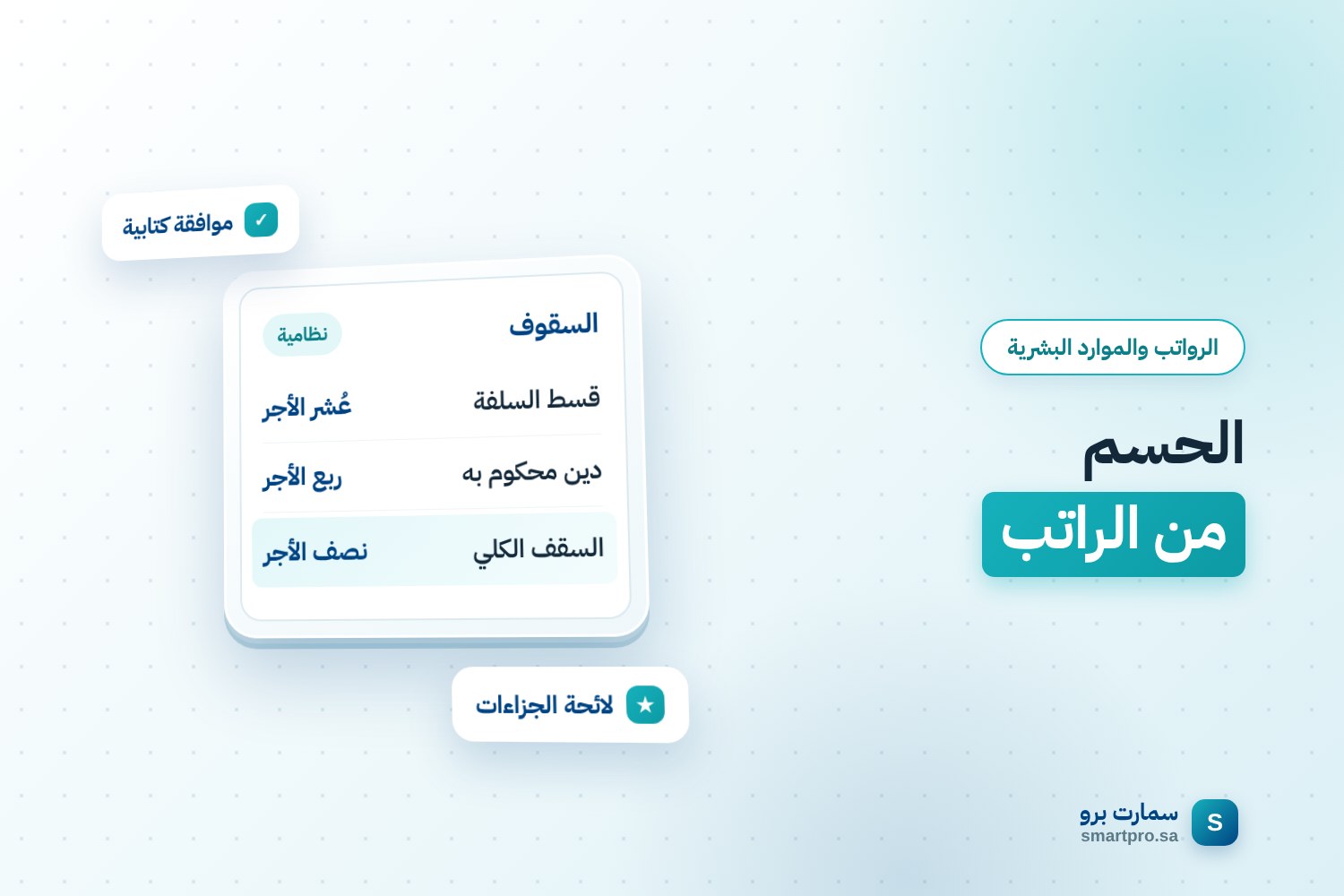
Salary deductions in Saudi Arabia are not an open management decision. The Labour Law limits what may be deducted, sets a cap for each item, and then places on top of them an overall ceiling of half the wage due that cannot be exceeded, however many reasons there are. Anything outside those cases needs the employee's written consent.
Most violations in this area do not come from bad intent. They come from items that are each correct on their own, which together end up exceeding the permitted limit.
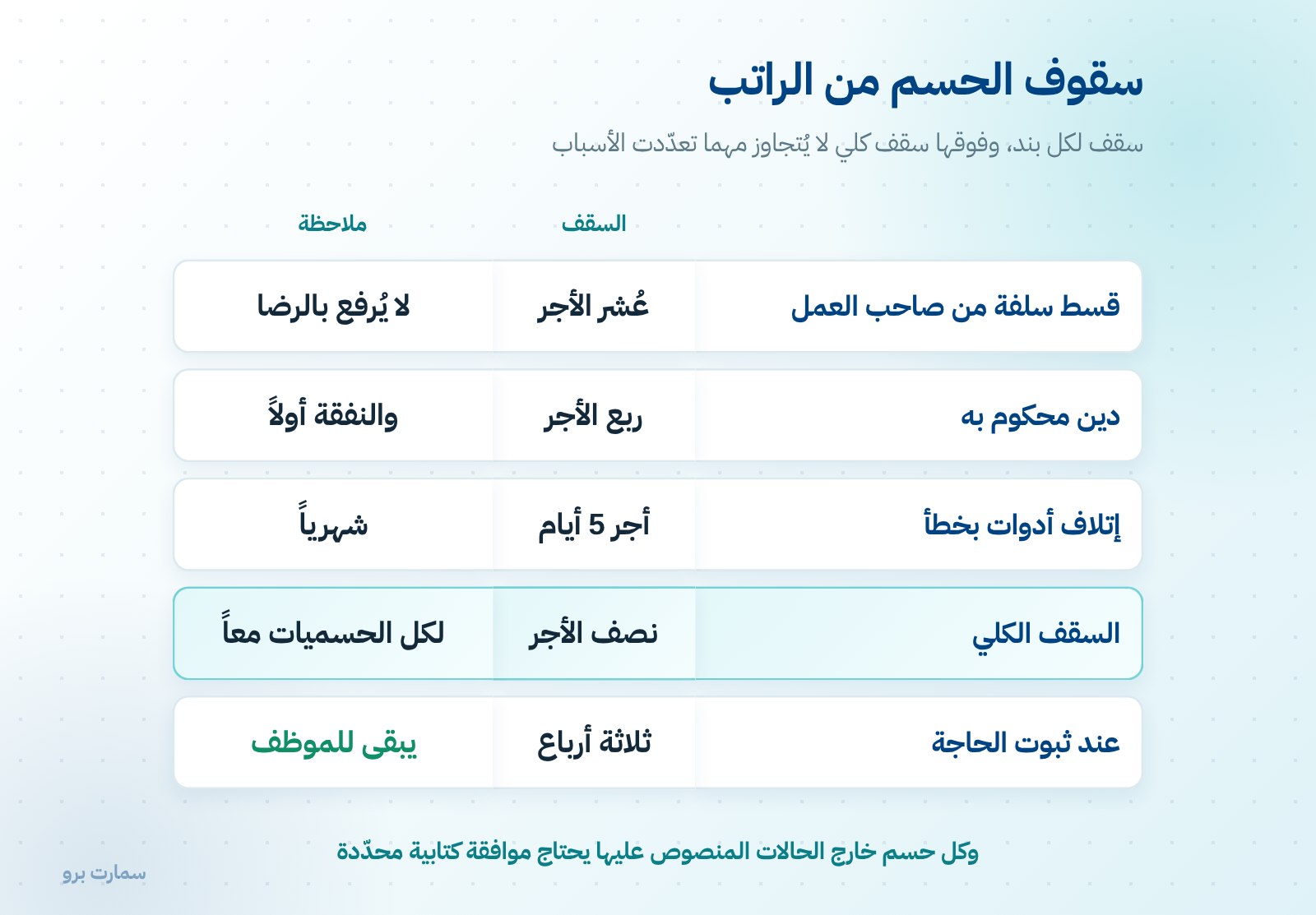
Salary deductions: what are the caps?
| Item | Cap |
|---|---|
| Instalment on an advance or loan from the employer | No more than one tenth of the wage |
| Court-ordered debt | No more than one quarter of the wage per month, with alimony (nafaqa) paid first |
| Damage to tools or products through the employee's fault | No more than five days' wages per month |
| Social insurance contributions and other legally required deductions | At the prescribed rates |
| Savings fund contributions and loans | According to the fund's rules |
| Instalments on an employer housing scheme | As agreed |
| Disciplinary penalties and fines | According to the disciplinary regulations |
| Overall cap for all of the above combined | Half of the wage due |
Where the employee's need is established, they must keep three quarters of the wage, and the overall cap can only be exceeded with permission from the labour court.
How does the overall cap work in practice?
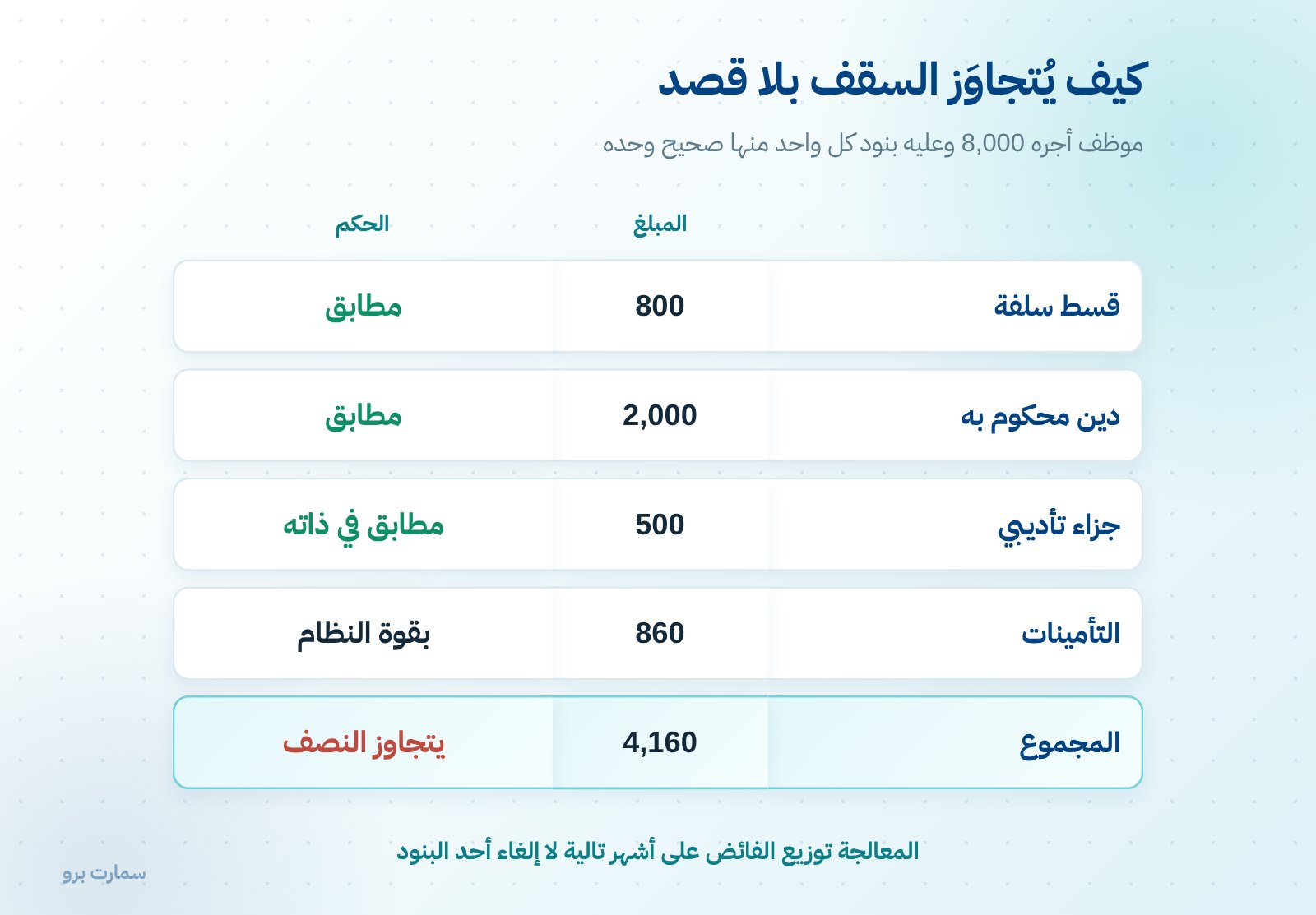
An employee earns SAR 8,000 and has several deductions in the same month:
| Item | Amount (SAR) | Assessment |
|---|---|---|
| Advance instalment | 800 | Compliant (one tenth of the wage) |
| Court-ordered debt | 2,000 | Compliant (one quarter of the wage) |
| Disciplinary penalty | 500 | Compliant on its own |
| Social insurance | 860 | Required by law |
| Total | 4,160 | Exceeds half the wage |
Each item is correct on its own, but the total has gone above SAR 4,000, which is half the wage. The fix is not to cancel one of the items but to spread it over the following months so the monthly deduction stays within the cap.
This is exactly what gets recorded as a violation in the Wage Protection System when the file is submitted with an excess deduction. See the Wage Protection System.
Which deductions need written consent?
Any deduction outside the cases set out in the law. Deducting the cost of a uniform, an additional medical insurance subscription, a contribution to an activity, or a charge for a service all require the employee's written consent.
Verbal agreement or implied acceptance is not enough if there is a dispute. The safest form is consent that specifies the amount, the period and the reason, not a general open-ended authorisation.
Are disciplinary penalties ordinary deductions?
No. A financial penalty requires approved internal work regulations that define the violation and its penalty in advance. A penalty cannot be invented when the incident happens.
The employee also has the right to give their side before the penalty is imposed. This step is often skipped, and that alone invalidates the penalty even when the violation is proven.
Is unpaid absence a deduction?
This is an important distinction. Withholding pay for days of unexcused absence is not a deduction in the legal sense; the wage was simply never earned, because pay is in return for work.
That is why it does not count towards the overall cap. It must still be kept separate from financial penalties and shown as two different lines in the payroll so the treatment does not get mixed up. See running payroll.
How do you manage salary advances without a violation?
An advance from the employer is a common item, and its instalment cannot exceed one tenth of the wage. A recurring mistake is agreeing with the employee on faster repayment "because they asked for it".
Consent does not lift the cap here, because the rule exists to protect the wage, not as a right the employee can waive. The correct approach is to extend the repayment period, not to raise the instalment.
In the books, an advance is a receivable from the employee, not an expense. It is debited when paid out, and its balance falls with each instalment. Recording it as an expense inflates payroll cost in the month it is paid and hides it later. See the payroll journal entry.
How are court-ordered debts prioritised?
When a court order to deduct is received, the deduction is limited to one quarter of the wage per month unless the ruling states otherwise. If there are several debts, alimony is paid first, followed by debts for food, clothing and housing before any others.
The business is not a party to the dispute, but it is responsible for carrying out the deduction in the correct order and within the correct limit.
What can never be deducted?
- Pay for the weekly rest day in exchange for working it; rest cannot be bought out in the first place.
- Annual leave pay in exchange for the employee staying at work.
- Unspecified amounts worded open-endedly, such as "whatever the employee may owe".
Each of these appears in written contracts, and being in the contract does not make it enforceable.
Five steps to keep deductions under control
- Set up deductions as defined items in your system, each with its cap built in.
- Turn on an automatic check that rejects the payroll if total deductions exceed half the wage.
- Separate absence from penalties in both presentation and treatment.
- Keep written consents linked to the employee's file, not in separate folders.
- Review deductions before submitting the wage file, not after a violation arrives.
A payroll system such as SmartPro Human Resources, which links employee files, attendance and payroll to accounting, helps keep these items defined and visible in one place.
What can be deducted at end of service?
When the employment ends, the employer may deduct work-related debts from the employee's entitlements: the outstanding advance balance, the value of custody items not returned, and pay in lieu of the notice period if the employee did not observe it.
The monthly half-wage cap does not apply in the same way here, because the final settlement is not a monthly wage. But the deducted items must be documented and of a specific amount, not estimated. Any item not backed by a document or an acknowledgement is hard to defend if challenged. Details are in the end-of-service final settlement.
Where is the official reference?
The permitted deductions, their caps and the overall ceiling are set out in the Labour Law published by the Ministry of Human Resources and Social Development, and social insurance contribution rates are published by the General Organization for Social Insurance (GOSI).
Read also
- Running payroll: how to prepare it step by step
- The Wage Protection System: the file, the deadline and the violations
- The payroll journal entry: how to record payroll in the books
Key takeaway: Each deduction has its own cap, but all of them together must never exceed half the wage due; anything outside the listed cases needs specific written consent from the employee.
To see how deductions, advances and payroll fit together in practice, start a free SmartPro trial or book a demo.
Frequently asked questions
How much can be deducted from an employee's salary in Saudi Arabia?
The overall cap for all deductions combined is half of the wage due, and where the employee's need is established they must keep three quarters of the wage. Within that there are item caps: an advance instalment cannot exceed one tenth of the wage, a court-ordered debt cannot exceed one quarter, and damage to tools cannot exceed five days' wages per month.
Can an advance instalment be increased if the employee agrees?
No. Consent does not lift the cap, because the rule exists to protect the wage rather than being a right the employee can waive. The correct approach is to extend the repayment period, not to raise the instalment above one tenth of the wage.
Does withholding pay for absence count as a salary deduction?
No. Withholding pay for days of unexcused absence is not a deduction in the legal sense but wages that were never earned, since pay is in return for work, so it does not count towards the overall cap. It should still be shown in the payroll as a separate line from any financial penalty.
Which deductions need the employee's written consent?
Any deduction outside the cases set out in the law, such as the cost of a uniform, an additional insurance subscription or a contribution to an activity. Verbal consent is not enough in a dispute, and the safest form specifies the amount, period and reason rather than giving a general open-ended authorisation.