
The GOSI Contributory Wage: What Counts Toward Social Insurance and What Doesn't
The GOSI contributory wage is neither the gross salary nor the basic wage alone. Here are the components that count and those that don't, the monthly cap, and a common mistake with the transport allowance.
سامي الحيدري
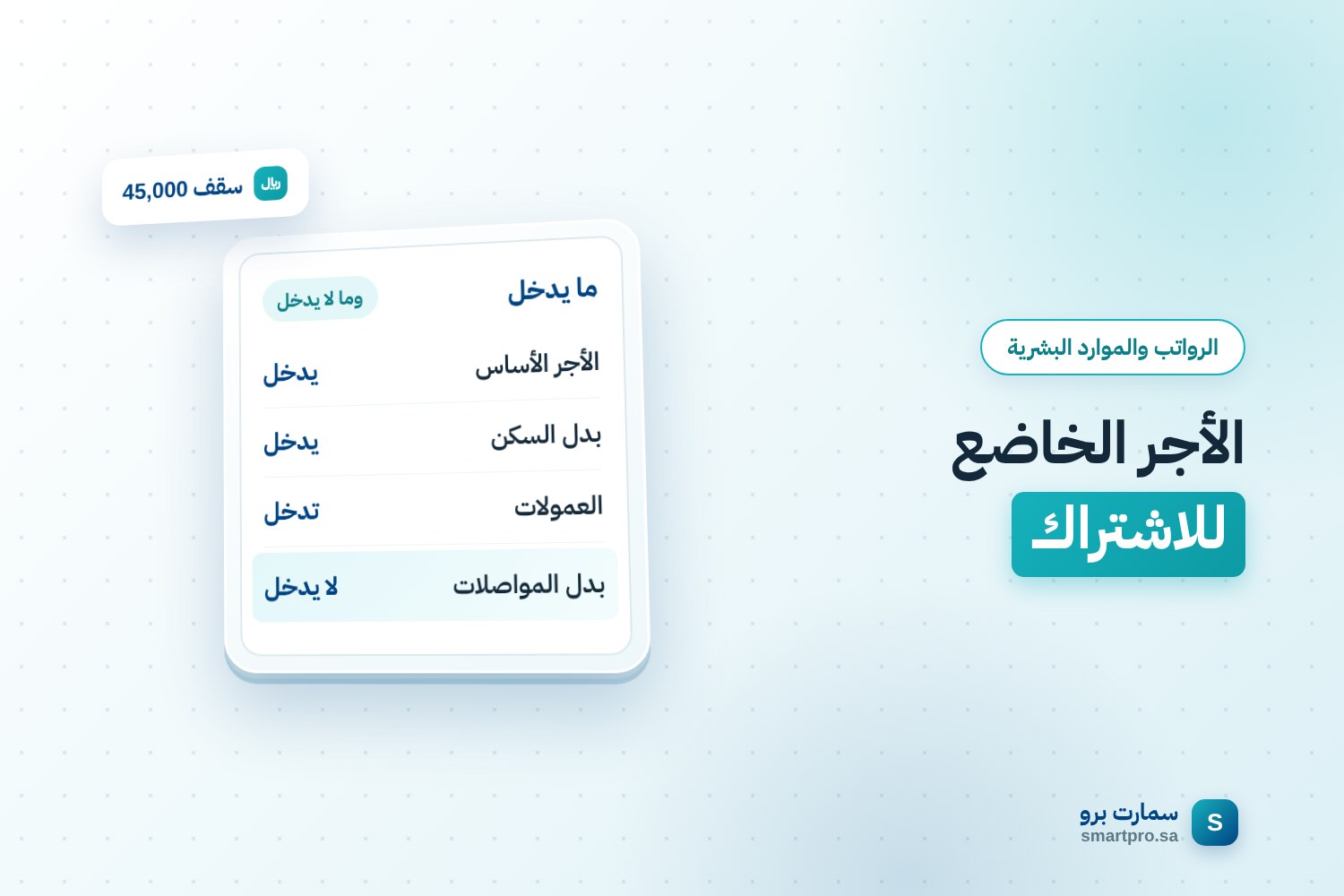
The GOSI contributory wage is the amount on which social insurance contributions are calculated. It is neither the gross salary nor the basic wage alone. That distinction causes some of the costliest payroll mistakes, because the difference repeats every month for every employee.
The mistake can go either way. Calculating on the gross salary means paying more than you owe. Calculating on the basic wage alone means paying less, which creates a shortfall you will be asked to settle and a recorded violation under the Wage Protection System.
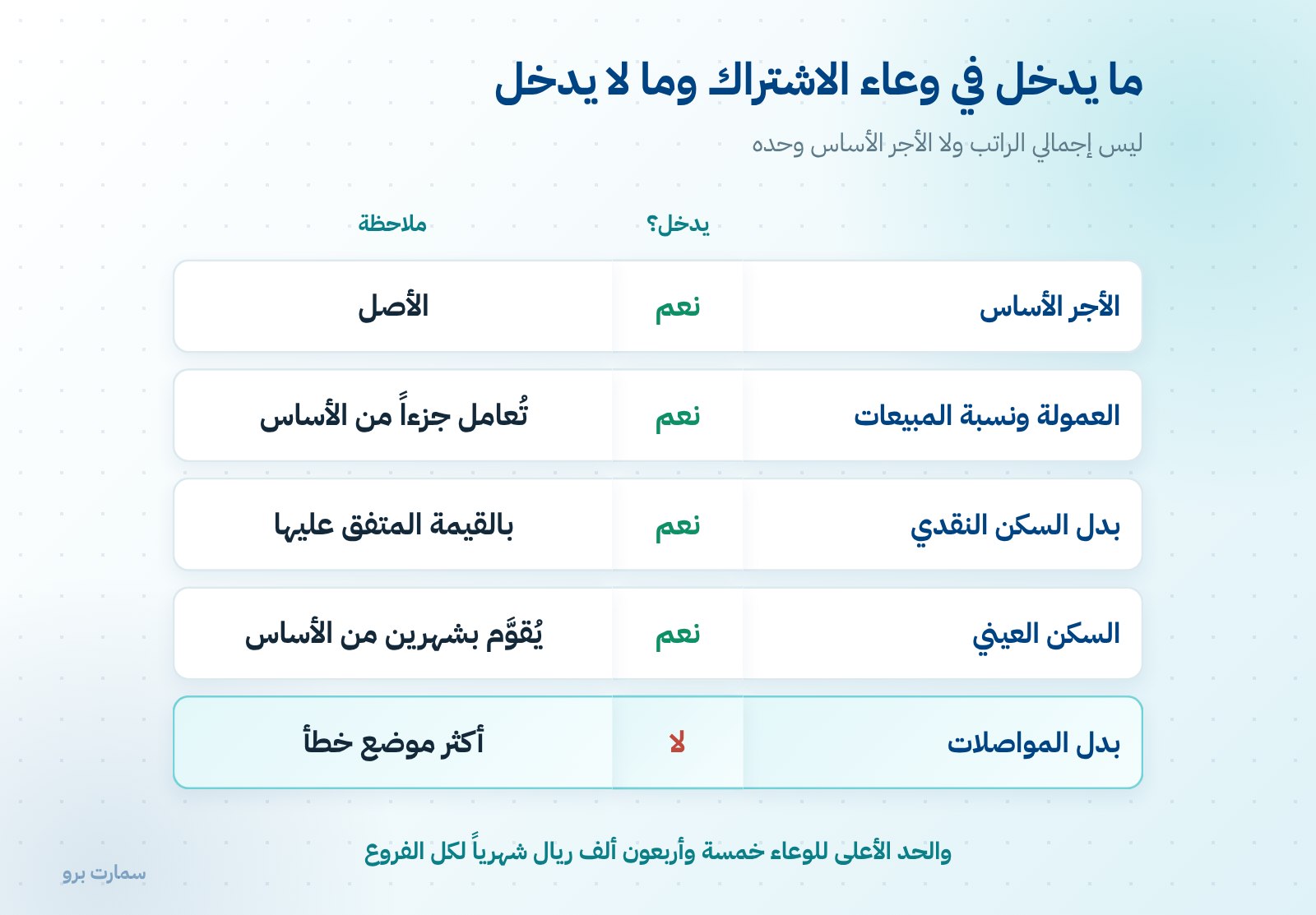
What counts in the GOSI contributory wage and what doesn't?
| Component | Included? |
|---|---|
| Basic wage | ✅ Yes |
| Commission and sales percentage | ✅ Yes, treated as part of the basic wage |
| Profit share | ✅ Yes |
| Cash housing allowance | ✅ Yes, at the agreed amount |
| In-kind housing | ✅ Valued at two months of basic wage |
| Transport allowance | ❌ No |
| Other allowances not specified | ❌ No |
The sixth row is where most people go wrong. The transport allowance is not part of the contributory wage, and including it raises the contribution for no reason.
What is the maximum contributory wage?
The cap on the contributory wage is SAR 45,000 per month. It is a single ceiling for all insurance branches: annuities (pensions), occupational hazards and unemployment insurance.
So an employee whose contributory wage is SAR 60,000 has contributions calculated on SAR 45,000 only. A payroll system that does not apply the cap automatically will overcharge contributions on higher salaries.
Is there a minimum contributory wage?
The law does not set a riyal figure as the minimum contributory wage. The text refers to the minimum wage set by the competent authority and does not state an amount.
This corrects a widespread misconception. The figure many articles quote as the "minimum contributory wage" is actually a minimum related to the pension under the social insurance law, not to the contribution base. Likewise, the threshold for counting a Saudi employee in Nitaqat (the Saudisation classification programme) is a separate figure that has nothing to do with the contribution base.
Presenting either figure as a minimum for contributions leads businesses into wrong calculations.
How big is the difference in practice?
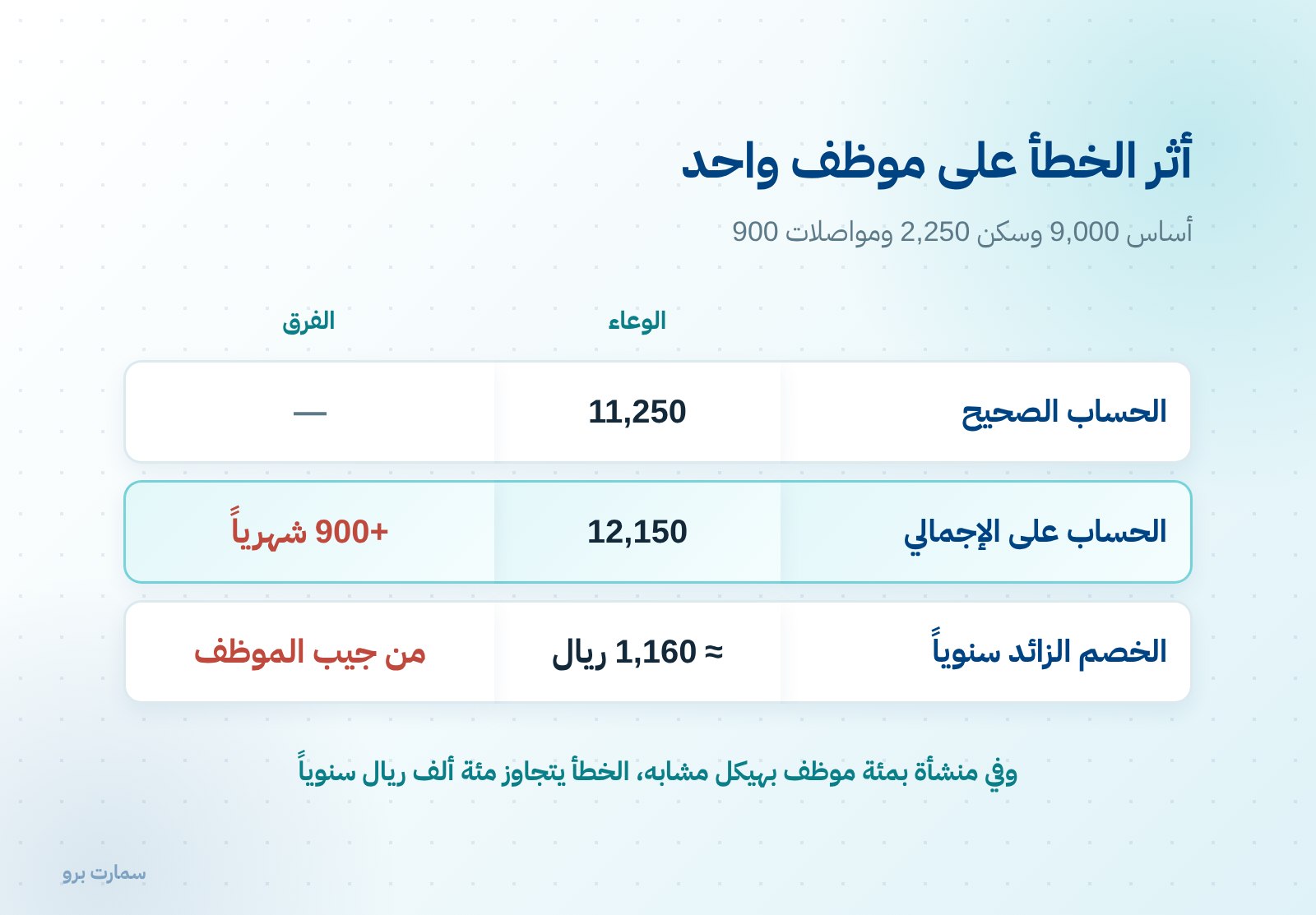
Take a Saudi employee under the new system with this pay structure:
| Item | Amount (SAR) |
|---|---|
| Basic wage | 9,000 |
| Housing allowance | 2,250 |
| Transport allowance | 900 |
| Gross salary | 12,150 |
| Contributory wage | 11,250 |
The contribution base differs by SAR 900 a month. At the current employee rate under the new system, calculating on the gross salary instead of the correct base increases the deduction by about SAR 97 a month, or roughly SAR 1,160 a year for a single employee, deducted from the employee without justification.
In a business with 100 employees on a similar structure, the error exceeds SAR 100,000 a year.
How is in-kind housing treated?
If the business provides housing in kind instead of a cash allowance, it is valued for contribution purposes at the equivalent of two months of basic wage per year.
This is common in contracting, manufacturing and hospitality, and overlooking it means a contribution base lower than it should be and a potential violation. Housing provided by the employer is not outside the calculation just because it is not paid in cash.
How are commissions treated?
Commissions, sales percentages and profit shares are treated as part of the basic wage, whether the pay consists of them alone or they are added to a fixed salary.
The practical effect is that a sales representative's contribution base changes every month. Registering a fixed wage with GOSI while paying commissions outside it creates a permanent gap between what is paid and what is registered, and that is exactly the gap the Wage Protection System picks up.
One distinction matters here. Commission is included in the contribution base by law, but the parties may agree in writing to exclude it from the end-of-service benefit base. These are two separate items with two separate rules, and mixing them up leads to a mistake in one of them.
Why does this matter for wage protection?
Because the Wage Protection System matches the basic wage registered with GOSI against the amount in the payroll file. If the basic wage is defined differently in the two systems, a recurring monthly violation arises that has nothing to do with late payment.
The details are in our guide to the Wage Protection System.
How do you set this up in your system?
- Split the pay components in the employee file: basic, housing, transport and other allowances. Do not record a single figure.
- Flag each component as subject to contribution or not, so the base is calculated automatically.
- Apply the SAR 45,000 cap in the calculation itself, not through manual review.
- Link commissions to the contribution base every month, and do not leave them unregistered.
- Review the valuation whenever in-kind housing is provided.
A payroll system that calculates the base from pre-flagged components closes this gap for good, unlike a spreadsheet recalculated by hand every month. See our payroll run guide, and the SmartPro Human Resources system for employee files, payroll and GOSI integration connected to accounting.
How does the mistake affect the employee?
The contribution base is not only about contributions. The retirement pension is calculated on the average contributory wage, and so is unemployment compensation.
An employee registered below their real wage for many years discovers the difference in their pension, not their salary, and by then it is hard to correct. That makes getting the base right a responsibility toward the employee before it is an obligation toward the authority.
Where is the official reference?
The components of the contributory wage, its cap and the rules for valuing in-kind housing are published by the General Organization for Social Insurance (GOSI), which is the reference in any disagreement with what a system or adviser tells you.
Read also
- GOSI contribution rates: the old and new systems
- The Wage Protection System: the file, the deadline and the violations
- GOSI for non-Saudi employees
Key takeaway: The contributory wage includes basic wage, commissions, profit share and housing (cash or in kind), excludes the transport allowance, and is capped at SAR 45,000 a month. Split and flag pay components in your payroll system so the base is calculated correctly every month.
To see how pay components and the contribution base are handled in practice, start a free trial or book a demo.
Frequently asked questions
What is the GOSI contributory wage?
It is the amount on which social insurance contributions are calculated. It includes the basic wage, commissions, sales percentages, profit share and the cash housing allowance, while in-kind housing is valued at two months of basic wage. It does not include the transport allowance, and its cap is SAR 45,000 per month.
Is the transport allowance included in GOSI contributions?
No. The transport allowance is not part of the contributory wage, and including it in the base raises the contribution unnecessarily and deducts more from the employee than they owe. This is one of the most frequent payroll mistakes.
Is there a minimum contributory wage?
The law sets no riyal figure; the text refers to the minimum wage set by the competent authority. The figures circulating in blogs relate to a minimum pension or to the threshold for counting a Saudi employee in Nitaqat, not to the contribution base.
How are commissions treated in the contribution base?
Commissions are treated as part of the basic wage, whether the pay consists of them alone or they are added to a fixed salary, so the base changes from month to month. Registering a fixed wage with GOSI while paying commissions outside it creates a gap that the Wage Protection System picks up.