
GOSI for Non-Saudi Employees: What to Deduct and What Not to Deduct
GOSI for non-Saudi employees covers one branch only, paid by the employer, with zero deducted from salary. What to register, what not to, and how it affects cost and reconciliation.
سامي الحيدري
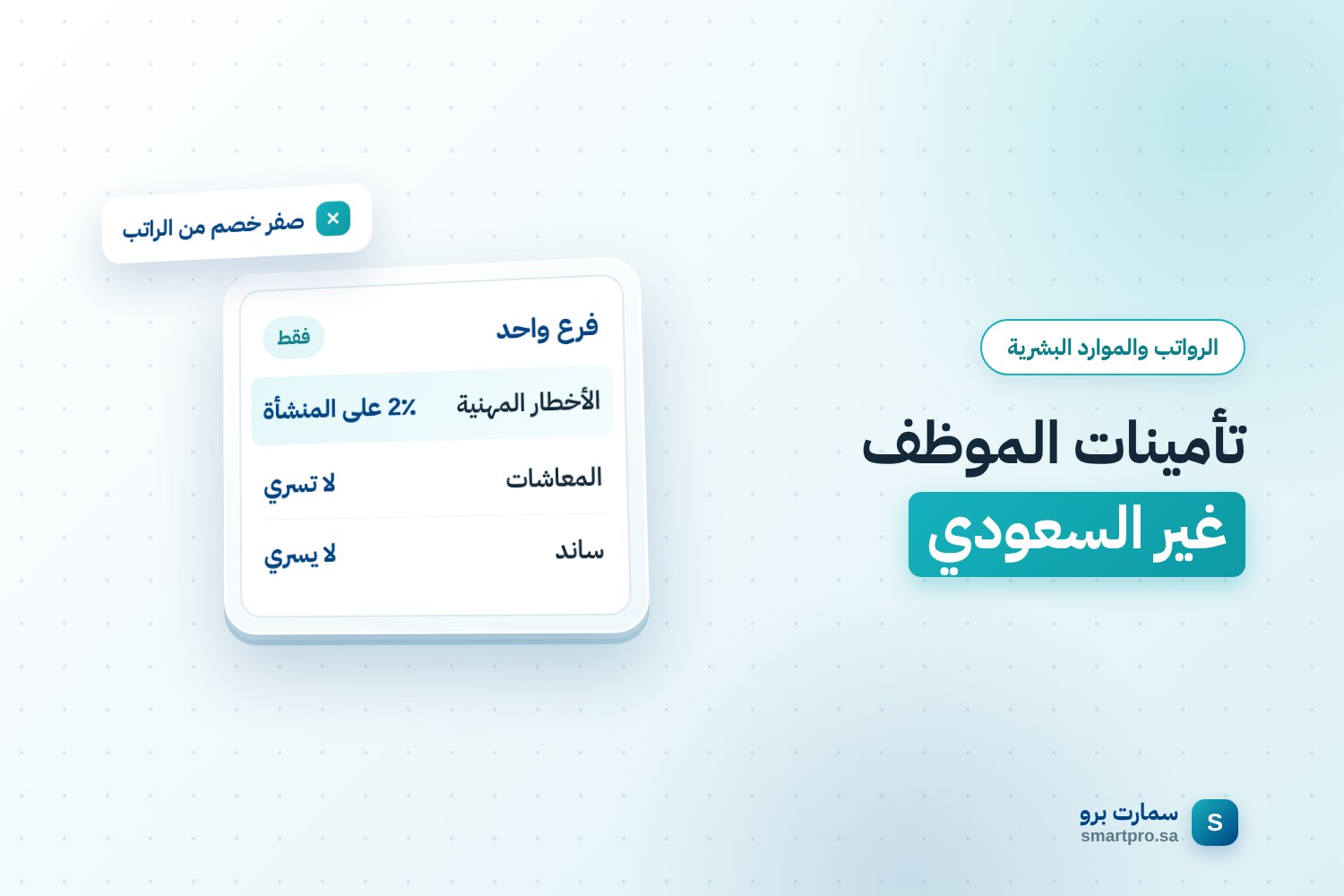
GOSI for non-Saudi employees is simpler than many people think, but that simplicity is exactly where the mistakes come from. The rule fits in one sentence: the occupational hazards branch only, at 2% paid by the employer, and zero deducted from the employee's salary.
Any deduction labelled "social insurance" on an expatriate's payslip has no legal basis, and the employee can claim it back.
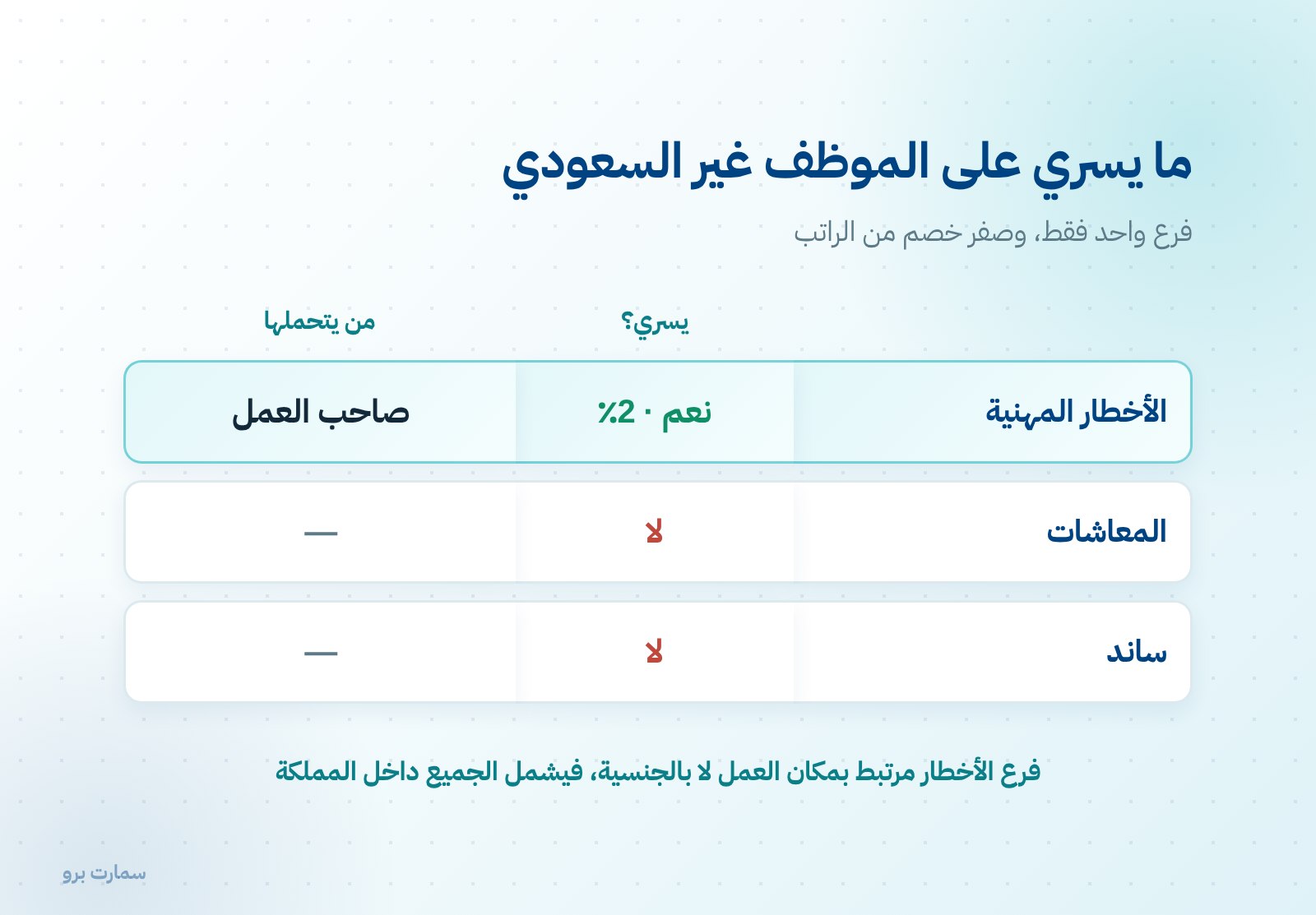
GOSI for non-Saudi employees: the table
GOSI (the General Organization for Social Insurance) is the Saudi body that collects social insurance contributions. Here is how its branches apply to a non-Saudi employee:
| Branch | Applies? | Rate | Who pays |
|---|---|---|---|
| Occupational hazards | ✅ Yes | 2% | Employer only |
| Pensions (annuities) | ❌ No | — | — |
| Unemployment insurance (SANED) | ❌ No | — | — |
| Total | 2% | Employer |
The contrast with Saudi employees is clear: a Saudi employee is covered by two additional branches and has a share deducted from salary; a non-Saudi employee does not.
Why only the occupational hazards branch?
Because the occupational hazards branch covers everyone working inside the Kingdom, regardless of nationality. It is tied to the place of work, not to citizenship. The pensions and unemployment branches are limited to Saudis.
This explains something important: occupational hazards coverage is not optional and does not depend on the type of work. An office employee and an expatriate on a construction site are both covered.
What amount is the 2% calculated on?
On the contributory wage, not on total salary. The contributory wage is the part of pay GOSI counts: basic salary, cash housing allowance, and commissions and sales percentages. Transport allowance is excluded, and the ceiling is SAR 45,000 a month.
So an expatriate with a total salary of SAR 14,000, made up of SAR 10,000 basic, SAR 3,000 housing and SAR 1,000 transport, has a contributory wage of SAR 13,000 and a contribution of SAR 260 a month, paid by the business. Details are in the contributory wage.
A special case: injury, disability and death
The occupational hazards branch covers work injuries and what follows from them. The difference in treatment is that a non-Saudi who qualifies for a monthly pension because of disability or death resulting from work receives a lump sum instead of a monthly pension, calculated as a multiple that varies by the type of entitlement.
This means the business's obligation in an injury case is not smaller, just different in form. Additional insurance cover that some businesses buy does not replace the statutory contribution.
What must be registered?
- Register the employee with GOSI as soon as they start work, not after the probation period ends.
- Register the correct contributory wage, not the basic salary alone and not the total.
- Update the wage whenever it changes, because matching against the Wage Protection file is done on the basic salary.
- End the registration when employment ends, since leaving it open creates contributions due.
A newly arrived expatriate is exempt from Wage Protection violations during the first 90 days after entering the Kingdom. This exemption is often overlooked, and violations get counted for no reason. See the Wage Protection System.
How does it affect the cost of an employee?
Many businesses assume an expatriate is "cheaper" because the GOSI obligation is lower. The full calculation shows the difference is not that clear-cut:
| Item | Saudi | Non-Saudi |
|---|---|---|
| GOSI paid by the business | Much higher rate | 2% only |
| Deduction from the employee | Yes | No |
| Work permit and renewal | No | Yes, annually |
| Return ticket | No | Depending on the contract |
| Housing or housing allowance | Depending on the contract | Often part of the package |
Comparing on the GOSI line alone is an incomplete comparison. The figure to compare is the total cost, not one item of it. See the true cost of an employee.
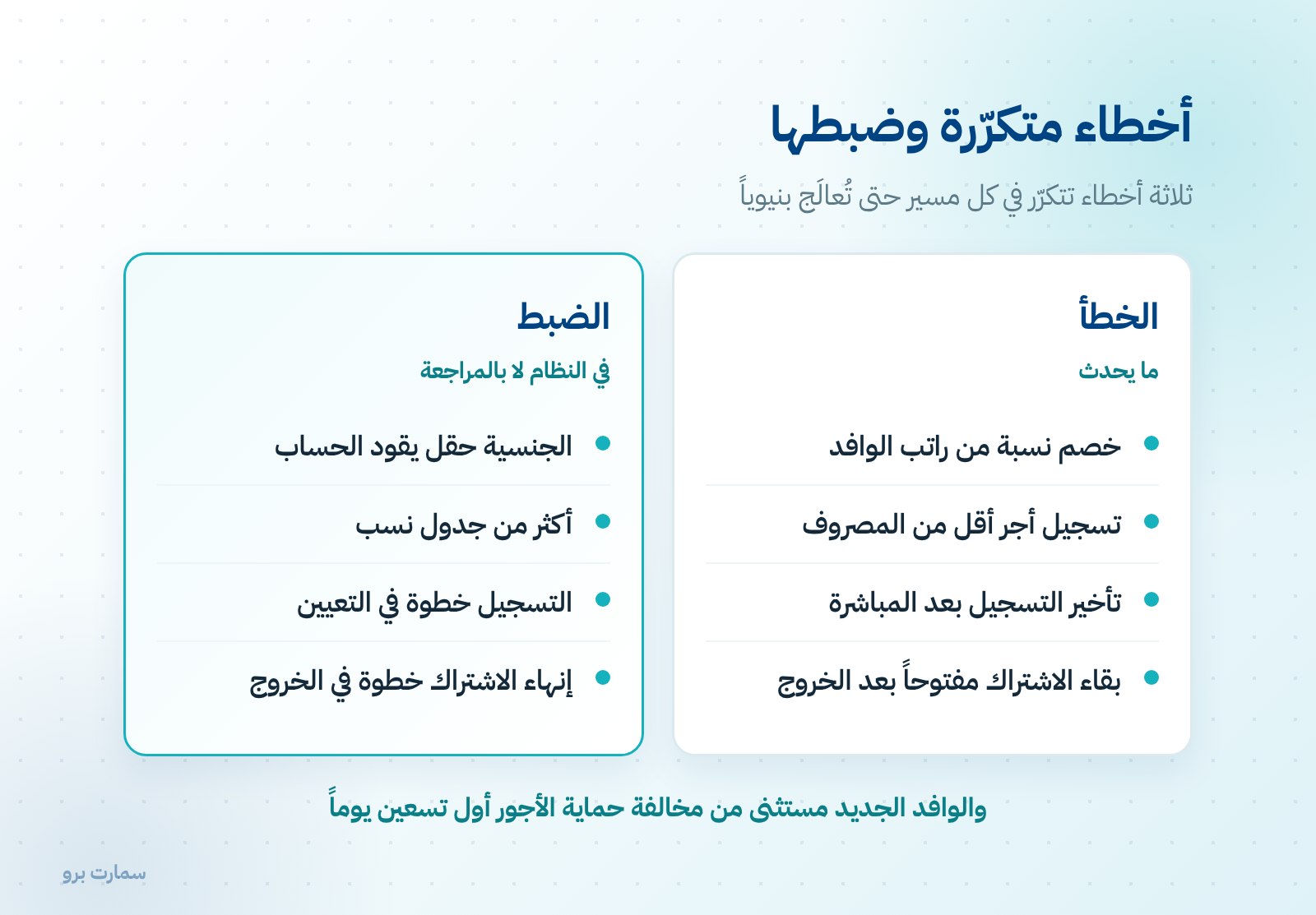
What are the three most common mistakes?
First: deducting a percentage from the expatriate's salary
This happens when a single rate table is applied to every employee in the system. The result is an unjustified deduction from every expatriate, every month.
Second: registering a wage different from the one paid
A lower basic salary is registered with GOSI to reduce the contribution, while a higher wage is actually paid. Automated matching picks up the difference straight away.
Third: registering late
Registering an employee months after they started creates retroactive contributions due and a late-payment fine, plus a Wage Protection violation.
What about medical insurance?
Medical insurance is completely separate from social insurance. It falls under a different regulator and covers the employee and their dependants according to the applicable rules.
Mixing the two up is common, in conversation and in the books. The safer approach is to keep them as two separate accounts in the chart of accounts, because their nature and their authority are different.
How do you set it up in your system?
- Make nationality a field that drives the calculation, not a descriptive field.
- Define more than one rate table: Saudi on the old system, Saudi on the new system, and non-Saudi.
- Block deductions from non-Saudi employees at system level, not through manual review.
- Link end of service to ending the GOSI registration in a single step.
See GOSI contribution rates for the rates for each category. An HR system wired into payroll and accounting, such as SmartPro Human Resources, lets you build these rules in once rather than checking them every month.
What happens on transfer of sponsorship or a change of employer?
When a non-Saudi employee's services are transferred from one business to another, their registration ends at the first business and starts at the second. The releasing business ends the registration on time, and the receiving business registers the employee as soon as they start.
Neglect here is common: the registration stays open at the first business, so contributions pile up for an employee who no longer works there, and a Wage Protection violation appears because the employee is registered with GOSI but missing from its wage file.
The sound control is to make ending the registration a mandatory step in the end-of-service procedure, not a separate task someone has to remember later.
Where is the official reference?
The scope of each insurance branch, the set rates and the treatment of entitlements for non-Saudis are published by the General Organization for Social Insurance, and the rules on contracts and entitlements by the Ministry of Human Resources and Social Development.
Read also
- GOSI contribution rates: the old and new systems
- The contributory wage: what is included and what is not
- The true cost of an employee to the business
Key takeaway: A non-Saudi employee costs the business 2% of the contributory wage for occupational hazards, and nothing is deducted from their salary. Register on day one, record the right wage and close the registration when service ends.
To see how payroll and GOSI rules work in practice, start a free trial or book a demo with our team.
Frequently asked questions
How much GOSI is deducted from a non-Saudi employee's salary?
Nothing. A non-Saudi employee has no social insurance deduction from their salary. The business pays only the occupational hazards branch at 2% of the contributory wage, borne entirely by the employer. Any deduction labelled social insurance on an expatriate's salary has no legal basis.
Why does the occupational hazards branch apply to non-Saudi employees?
Because this branch covers everyone working inside the Kingdom regardless of nationality; it is tied to the place of work, not to citizenship. The pensions and unemployment branches are limited to Saudis. Coverage is not optional and does not depend on the type of work.
What amount is the 2% GOSI contribution calculated on?
It is calculated on the contributory wage: basic salary, cash housing allowance, and commissions and sales percentages. Transport allowance is excluded, and the ceiling is SAR 45,000 a month. So an expatriate with a contributory wage of SAR 13,000 has a contribution of SAR 260 a month.
Is an expatriate employee really cheaper to employ?
On the GOSI line, yes, but comparing on one item is incomplete. There are costs that do not apply to a Saudi employee, such as the work permit and its annual renewal, a return ticket depending on the contract, and housing or a housing allowance. The figure to compare is the total cost of employment.