
Time and Attendance and Payroll: From Fingerprint to Payroll Run
Time and attendance does not turn into salary on its own. Learn the difference between recorded and approved hours, why a written policy comes before any device, and the integration mistakes to avoid.
سامي الحيدري
Time and attendance is the data source that payroll relies on for half its calculations: absence, lateness, overtime and leave. Yet many businesses treat it as a standalone fingerprint device and then copy numbers by hand into a separate spreadsheet.
The result is familiar: overtime paid that nobody requested, deductions that employees dispute, and two hours of HR time lost every month to manual reconciliation.
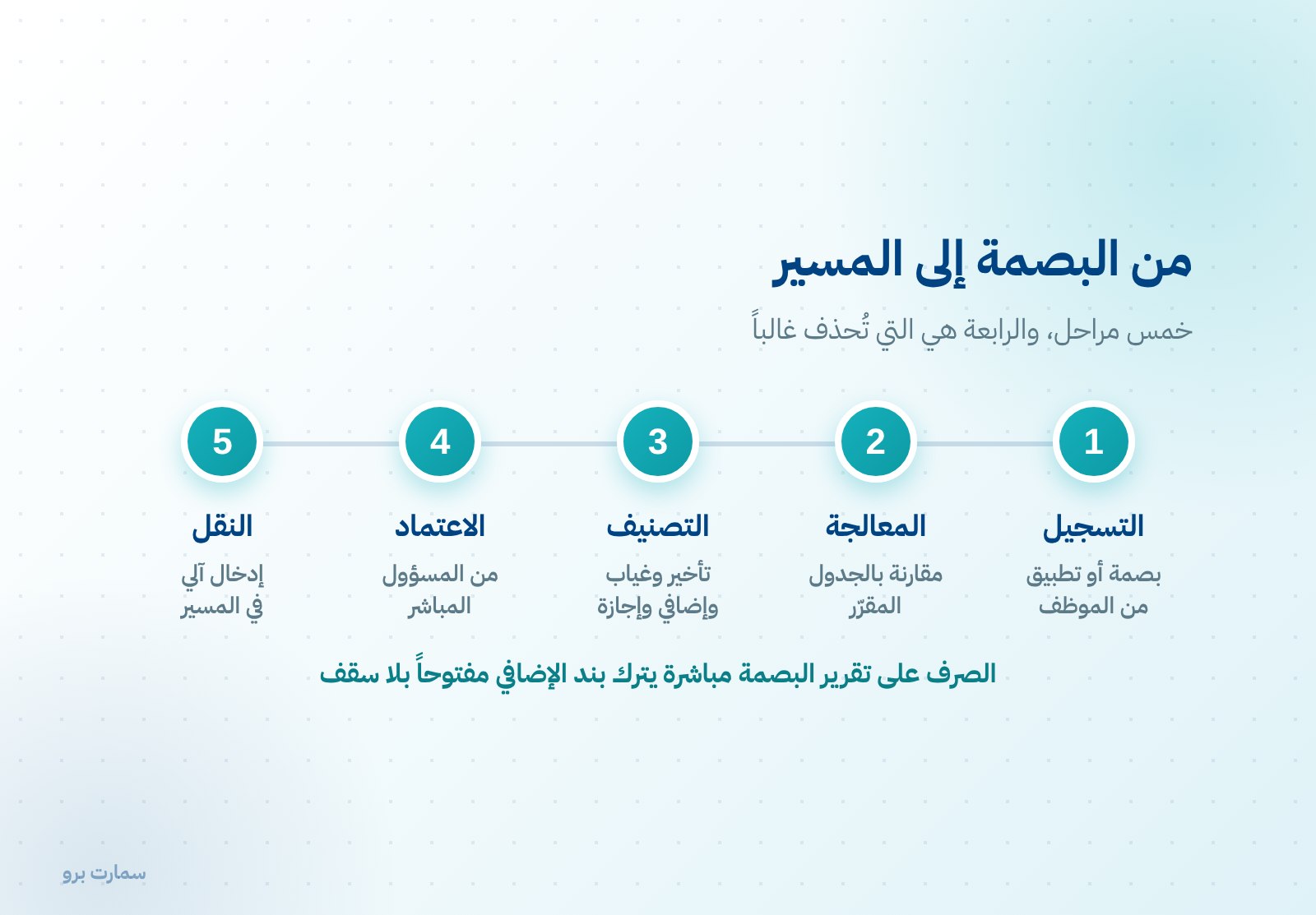
Time and attendance: from recording to salary
| Stage | What happens | Who is responsible |
|---|---|---|
| Recording | Fingerprint, app or location check-in | Employee |
| Processing | Comparison with the planned schedule | System |
| Classification | Lateness, absence, overtime, leave | System |
| Approval | Confirming what actually counts | Direct manager |
| Transfer | Entry into the payroll run | System |
The fourth stage is the one most often skipped, and it is the most important.
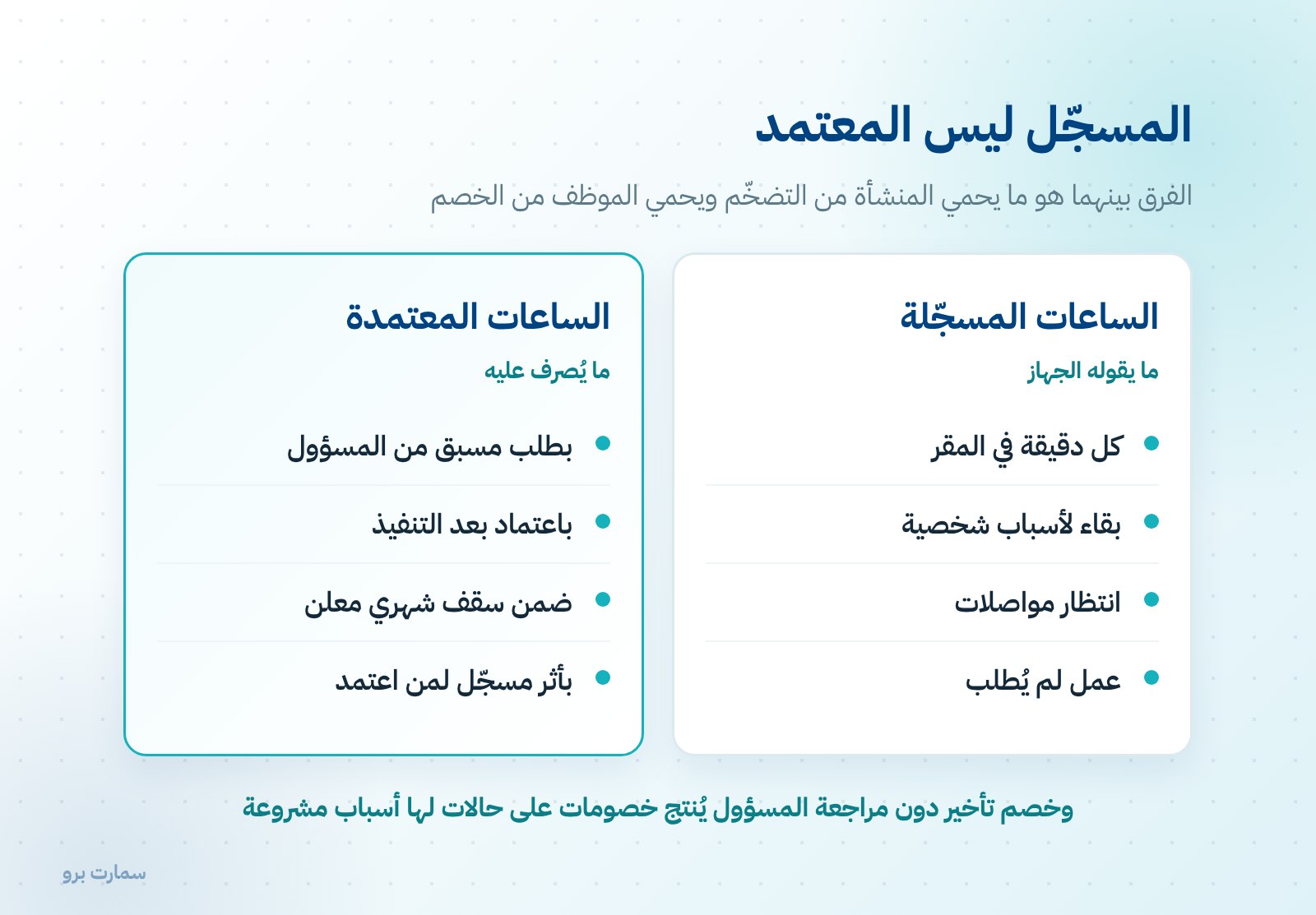
Recorded is not the same as approved
An employee staying two hours after the shift is not necessarily overtime. It may be making up for arriving late, waiting for transport, or work nobody asked them to do.
The sound sequence is: advance request from the direct manager, then approval after the work is done, then entry into the payroll run. A business that pays straight from the fingerprint log leaves its overtime line open with no ceiling.
The reverse is also true: deducting for lateness without a manager's review produces deductions in cases that have legitimate reasons, such as an external assignment, a device fault, or prior permission that was never recorded.
A written policy before any device
Before choosing any technology, these questions should be answered in writing:
- What is the grace period? Five minutes? Ten? And who does it apply to?
- How is lateness handled? A graduated warning or a deduction? Under what rule?
- When is absence unpaid? And when is it a violation that calls for disciplinary action?
- Who approves overtime? And with what monthly cap?
- How are external assignments recorded? And who signs them off?
- What happens when someone forgets to clock in? How many times a month is allowed?
A financial penalty for lateness in particular requires approved internal work regulations that define the violation and its penalty in advance. A penalty cannot be invented after the incident. See salary deductions.
What is the difference between a deduction and a penalty?
This distinction changes the whole treatment:
- Withholding pay for days of unexcused absence is not a deduction in the legal sense but non-entitlement, because wages are paid in return for work.
- A financial penalty for lateness is a disciplinary deduction subject to the work regulations and to deduction caps.
Showing both as a single line in the payroll run mixes two different treatments and weakens the business's position if an employee objects. See the payroll run.
Which statutory hours must the system know?
Any attendance system should have the following rules built in, not calculated by hand:
- Eight actual working hours a day, or forty-eight a week.
- Six hours a day during Ramadan for Muslim workers.
- Overtime hourly pay = the hourly wage + fifty percent of the basic wage.
- A weekly rest day of no less than twenty-four consecutive hours.
- An absolute ceiling that must not be exceeded: ten hours a day or sixty a week.
The details are in calculating overtime.
How do shifts and multiple locations complicate things?
Businesses that run shifts or have branches far apart face extra complexity:
- Different schedules for each team, and swaps between them.
- Check-ins from multiple locations, which requires location detection or a designated network.
- Night shifts that run past midnight into another day.
- Linking the cost to the branch or project where the employee actually worked.
That last point is an accounting one: the hours of an employee who worked on two projects must be split between them, otherwise both show misleading profitability. See the payroll journal entry.
Four integration mistakes
- Manual transfer from the device report to the payroll sheet, a step that produces an error every cycle.
- Paying overtime without approval, so it becomes an open line that grows month after month.
- Mixing leave with absence, so entitled days get deducted or unearned leave gets counted.
- Not linking leave to the balance, so an employee takes leave with no balance and it is only discovered at settlement.
What does automatic integration solve?
When attendance, leave and payroll sit in one system:
- The employee requests leave from their self-service profile, and it is deducted from their balance as soon as it is approved.
- The manager approves overtime from a single screen.
- The payroll run is calculated directly from approved data, with no transfer.
- The balance is always visible to the employee, so there are fewer queries. See employee self-service.
What should you ask before buying?
- Does it support more than one work schedule and shift?
- Does it calculate Ramadan hours automatically for the relevant group?
- Does it separate recorded hours from approved hours?
- Does it link hours to cost centres?
- Does the output move to the payroll run without manual intervention?
- Does it keep a trail of every change and who made it?
The sixth question is the one that protects the business in a dispute. An audit trail showing who changed which number and when is the difference between a documented defence and a verbal account.
The official reference
Working hours, overtime rules and disciplinary penalties are set out in the Labour Law published by the Ministry of Human Resources and Social Development, which is the reference when drafting internal work regulations.
Read also
- Calculating overtime: the formula and special cases
- Salary deductions: the statutory caps
- Employee self-service
Key takeaway: Recorded hours become salary only after a manager approves them under a written policy, and the transfer to payroll should happen inside one system with a full audit trail.
To see attendance, leave and payroll working together, start a free trial of SmartPro.
Frequently asked questions
How is time and attendance linked to payroll?
Through five stages: the employee records attendance, the system processes and classifies it into lateness, absence, overtime and leave, the direct manager approves it, and the system transfers it automatically to the payroll run. The approval stage is the one most often skipped, and it is the most important.
Does every hour after the shift count as overtime?
No. Staying after the shift is not necessarily overtime; it may be making up for lateness, waiting, or work that was never requested. The sound sequence is an advance request from the manager, approval after the work is done, then entry into the payroll run.
What is the difference between an absence deduction and a financial penalty?
Withholding pay for days of unexcused absence is not a deduction in the legal sense but non-entitlement, because wages are paid in return for work. A financial penalty for lateness is a disciplinary deduction subject to approved internal work regulations and deduction caps, and the two should appear as separate lines in payroll.
What matters most when choosing an attendance system?
Support for shifts and multiple work schedules, automatic calculation of Ramadan hours, separation of recorded and approved hours, and linking hours to cost centres. It should also transfer results to the payroll run automatically and keep an audit trail showing who changed which number and when.