
End of Service Benefit Calculation in Saudi Arabia: The Formula and Worked Examples
End of service benefit calculation in Saudi Arabia uses two formulas, not one. This guide explains the formula with SAR examples, which wage it is based on, when the benefit is forfeited and when it must be paid.
سامي الحيدري
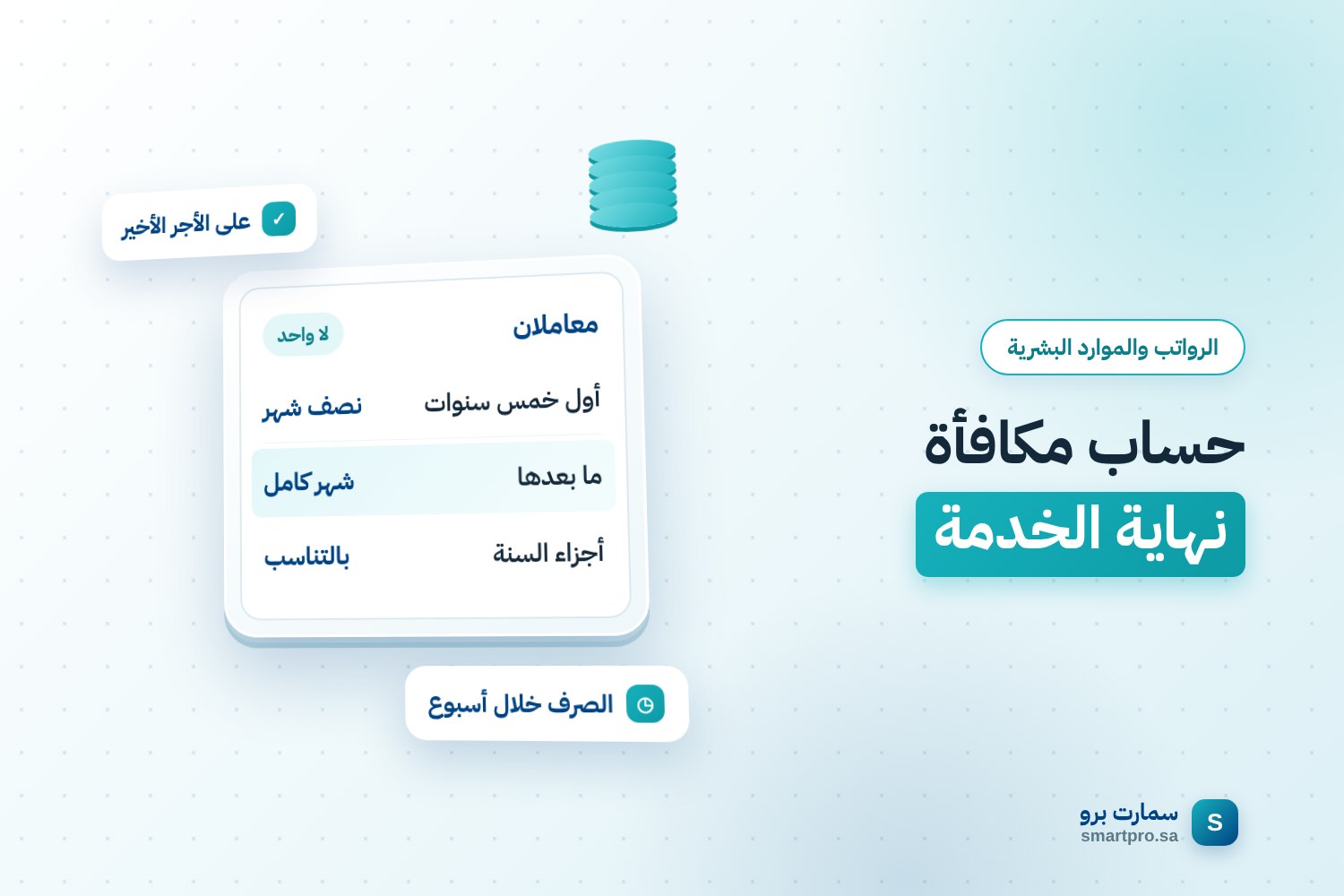
End of service benefit calculation in Saudi Arabia rests on two rates, not one: half a month's wage for each of the first five years, and a full month's wage for each year after that. It is calculated on the last wage, and part-years are paid in proportion to the time actually served.
Applying a single rate to the whole period is the root of most disputes between a business and an employee when they part ways. The Labor Law separates the first five years from the years that follow, and gives each period its own rate.
End of service benefit calculation: the two rates
| Length of service | Rate | Result |
|---|---|---|
| First five years | Half a month per year | Up to 2.5 months |
| After five years | A full month per year | One month per year |
| Part of a year | Pro rata | In proportion to the days served |
The common mistake is applying one rate to all years of service. An employee with eight years of service is not entitled to four months (eight × half) or to eight months (eight × one), but to five and a half months.
What does the calculation look like with real numbers?
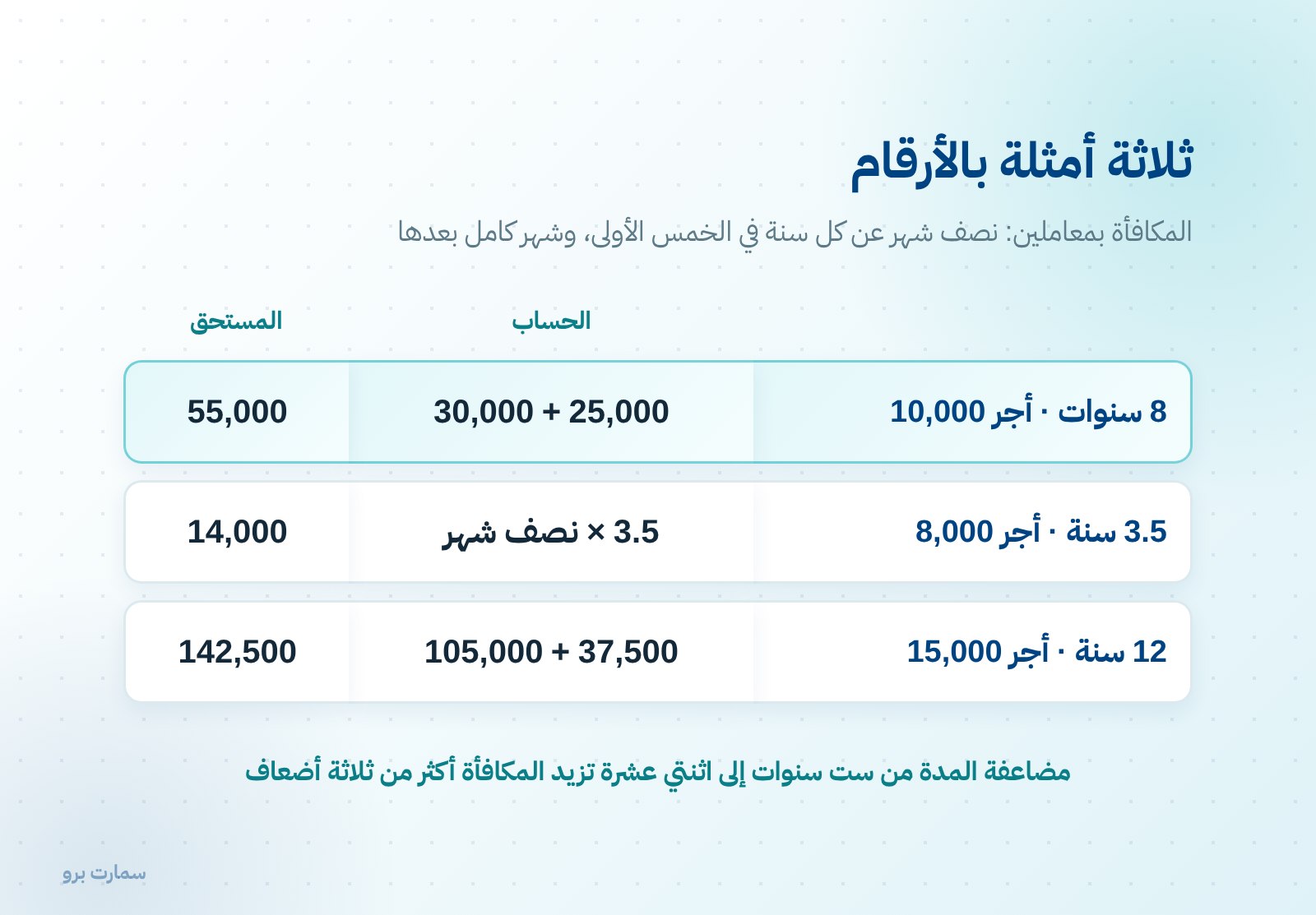
Example 1: eight years, last wage SAR 10,000
- First five years: 5 × 0.5 × 10,000 = 25,000
- Next three years: 3 × 1 × 10,000 = 30,000
- Total: SAR 55,000
Example 2: three years and six months, last wage SAR 8,000
- 3.5 × 0.5 × 8,000 = SAR 14,000
The whole period falls within the first five years, and the half year is calculated pro rata. It is neither ignored nor rounded up to a full year.
Example 3: twelve years, last wage SAR 15,000
- First five years: 5 × 0.5 × 15,000 = 37,500
- Next seven years: 7 × 1 × 15,000 = 105,000
- Total: SAR 142,500
Notice how the benefit accelerates after year five. Doubling service from six years to twelve does not double the benefit; it almost triples it, from 3.5 months' wages to 9.5 months' wages.
Which wage is the benefit based on?
The benefit is calculated on the last wage in its legal sense: the basic wage plus allowances and increments paid on a regular basis, not the basic wage alone.
There is an important exception many businesses overlook: the parties may agree in writing to exclude commissions, sales percentages and similar payments from the benefit base. Without a written agreement, they are included in the calculation.
The impact is large in sales-driven businesses. Take a sales representative with a fixed wage of SAR 6,000 and monthly commissions of around SAR 9,000: the difference in the benefit base with and without that agreement can be several times the fixed salary. This clause belongs in the contract at signing, not in a negotiation at exit.
When is the end of service benefit not payable?
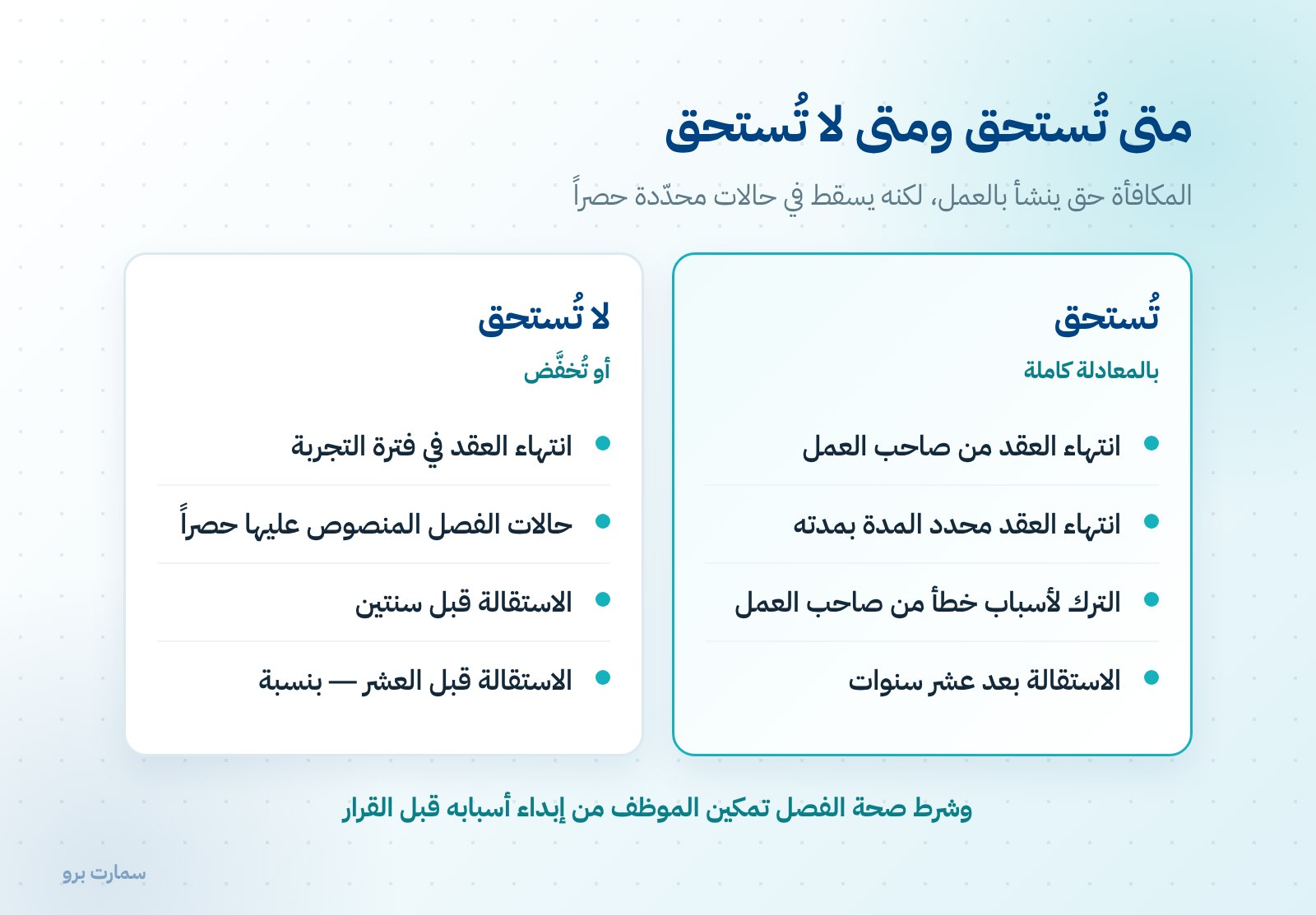
- During the probation period: a contract that ends during probation does not create a benefit.
- In the dismissal cases set out in the law: the law allows the contract to be terminated without a benefit or notice in specific, exhaustively listed cases, including assault, forgery to obtain the job, absence beyond the permitted limits after a written warning, and disclosure of confidential information.
- Resignation before two years: no benefit. After that, the employee is entitled to a graduated percentage; see the end of service benefit on resignation for details.
For a dismissal in these cases to be valid, the employee must be given the chance to state their reasons before the decision. Skipping this step weakens the business's position, however clear the violation.
When must the benefit be paid?
The employer must pay wages and all entitlements within one week of the end of the relationship if the employer ended the contract, and within two weeks if the employee ended it. The employer may deduct work-related debts the employee owes.
In practice, that window is short. A business that only calculates the benefit after service ends has a single week to gather the data, review it and pay. That is why the figure should already be in the books before the event, not after it.
Why shouldn't the benefit be a surprise expense?
The costliest accounting mistake is treating the benefit as an expense that appears in the month the employee leaves. The entitlement builds up over the years of service, and the correct treatment is a provision: an amount set aside and charged monthly to the results of the period that benefited from the employee's work.
Without the provision, profits look inflated for years, followed by a sudden loss in a single month. The details are in the end of service provision.
What else is paid at the end of service?
The benefit is only one item in the final settlement. Alongside it:
- Unused annual leave balance, paid in cash in proportion to what the employee has earned.
- Wages for the notice period if notice was not observed.
- Wages for days worked in the final month.
- Return ticket for non-Saudi employees, according to the contract.
Outstanding advances and unreturned company custody items are deducted. The full breakdown is in the final settlement.
What are the most common calculation mistakes?
- Rounding the length of service up or down to a full year, when the law requires a pro rata calculation.
- Calculating on the basic wage only when there are regular allowances that form part of the legal wage.
- Applying a single rate to all years instead of separating the first five years from the rest.
- Forgetting the written agreement to exclude commissions, then being surprised by the size of the base at exit.
How do you keep the figure ready at all times?
Calculate each employee's accrued benefit monthly, not at exit, and show it in a single report reviewed at month-end close. A system that calculates the accrual automatically from the joining date and current wage turns this from a project into a figure that appears alongside your other reports.
The benefit is not only accounting. Knowing the existing liability before any restructuring or downsizing decision sometimes changes the decision itself. SmartPro's Human Resources system keeps employee files and payroll connected to finance and accounting, so wage data and the books stay in one place.
Where is the official reference?
The rules on the end of service benefit, the cases in which it is forfeited and the payment deadlines are set out in the Labor Law published by the Ministry of Human Resources and Social Development, which is the reference in any dispute over interpretation.
Read also
- The end of service benefit on resignation
- The end of service provision in your books
- Final settlement: what is paid and when
Key takeaway: Half a month per year for the first five years, a full month per year after that, on the last wage including regular allowances, with part-years pro rata. Accrue it monthly so the figure is ready within the one- or two-week payment window.
To see how SmartPro connects HR, payroll and accounting for your business, start a free trial or book a demo.
Frequently asked questions
How do I calculate the end of service benefit in Saudi Arabia?
Pay half a month's wage for each of the first five years and a full month's wage for each year after that, based on the last wage, with part-years calculated pro rata. An employee with eight years of service and a last wage of SAR 10,000 is entitled to SAR 25,000 for the first five years and SAR 30,000 for the next three, a total of SAR 55,000.
Is the end of service benefit calculated on the basic salary or the total salary?
It is calculated on the last wage in its legal sense, meaning the basic wage plus allowances paid on a regular basis, not the basic wage alone. The employer and employee may agree in writing to exclude commissions and sales percentages from the benefit base. Without a written agreement, those payments are included in the calculation.
When is the end of service benefit forfeited?
It is not payable if the contract ends during the probation period. It is also forfeited in the dismissal cases exhaustively listed in the Labor Law, such as assault, forgery and absence beyond the permitted limits after a warning, provided the employee was given the chance to state their reasons. An employee who resigns before completing two years receives no benefit.
When must the end of service benefit be paid?
It must be paid within one week of the end of the relationship if the employer ended the contract, and within two weeks if the employee ended it. The employer may deduct work-related debts the employee owes. Because the deadline is short, the figure should already be calculated in the books before the employee leaves.