
End-of-Service Benefit on Resignation: Rates and Exceptions
The end-of-service benefit on resignation is reduced according to length of service, but there are four cases where it is paid in full. Here are the rates, worked examples and the new resignation procedures.
سامي الحيدري
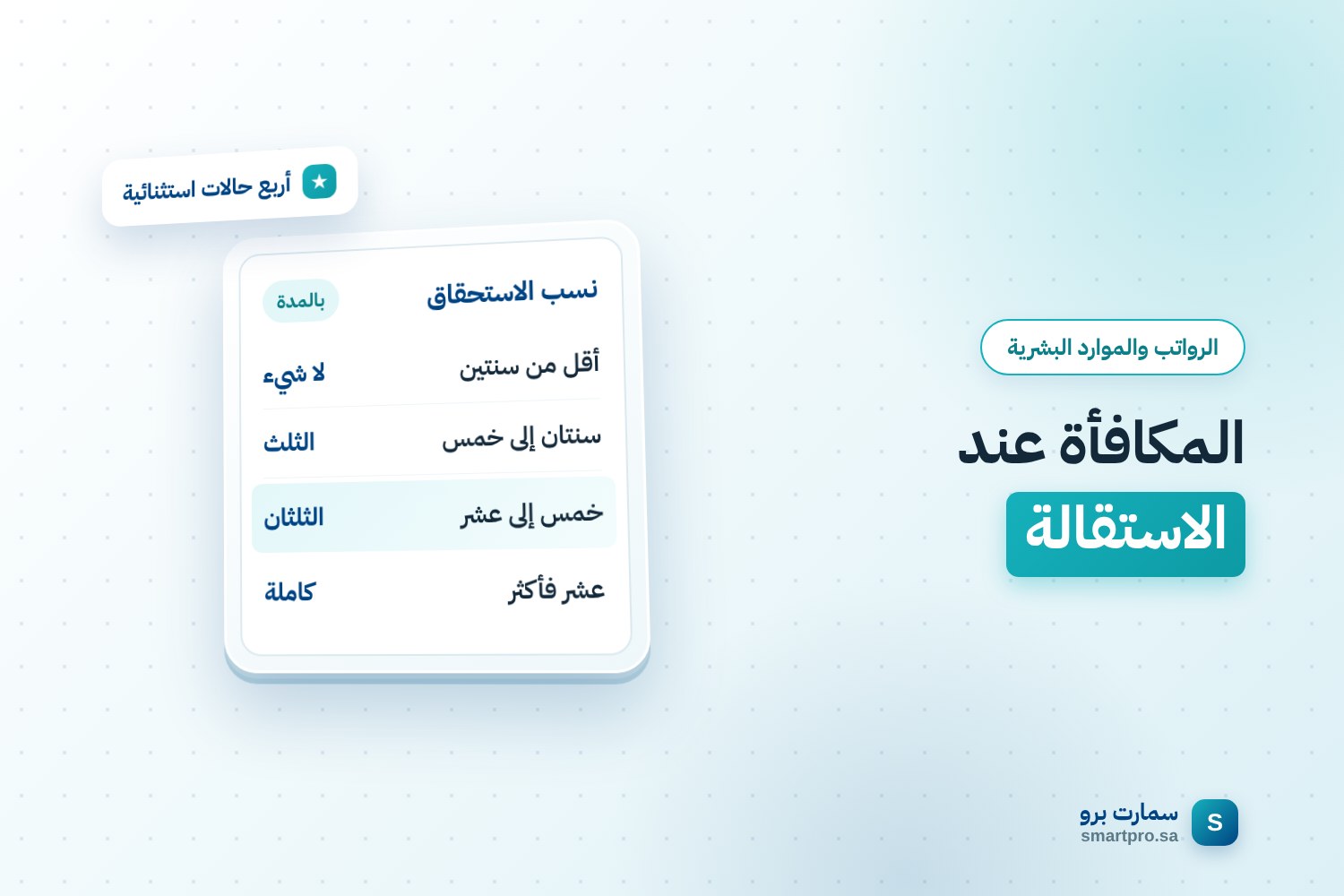
The end-of-service benefit on resignation is not cancelled, but in most cases it is not paid in full. The Saudi Labor Law links the amount to continuous service and sets four clear bands. It then carves out cases where the benefit is paid in full, even though the employee ended the contract.
Most disputes come from two opposite assumptions: that resignation wipes out the benefit, or that it makes no difference at all. The truth sits between them.
End-of-service benefit on resignation: the rates table
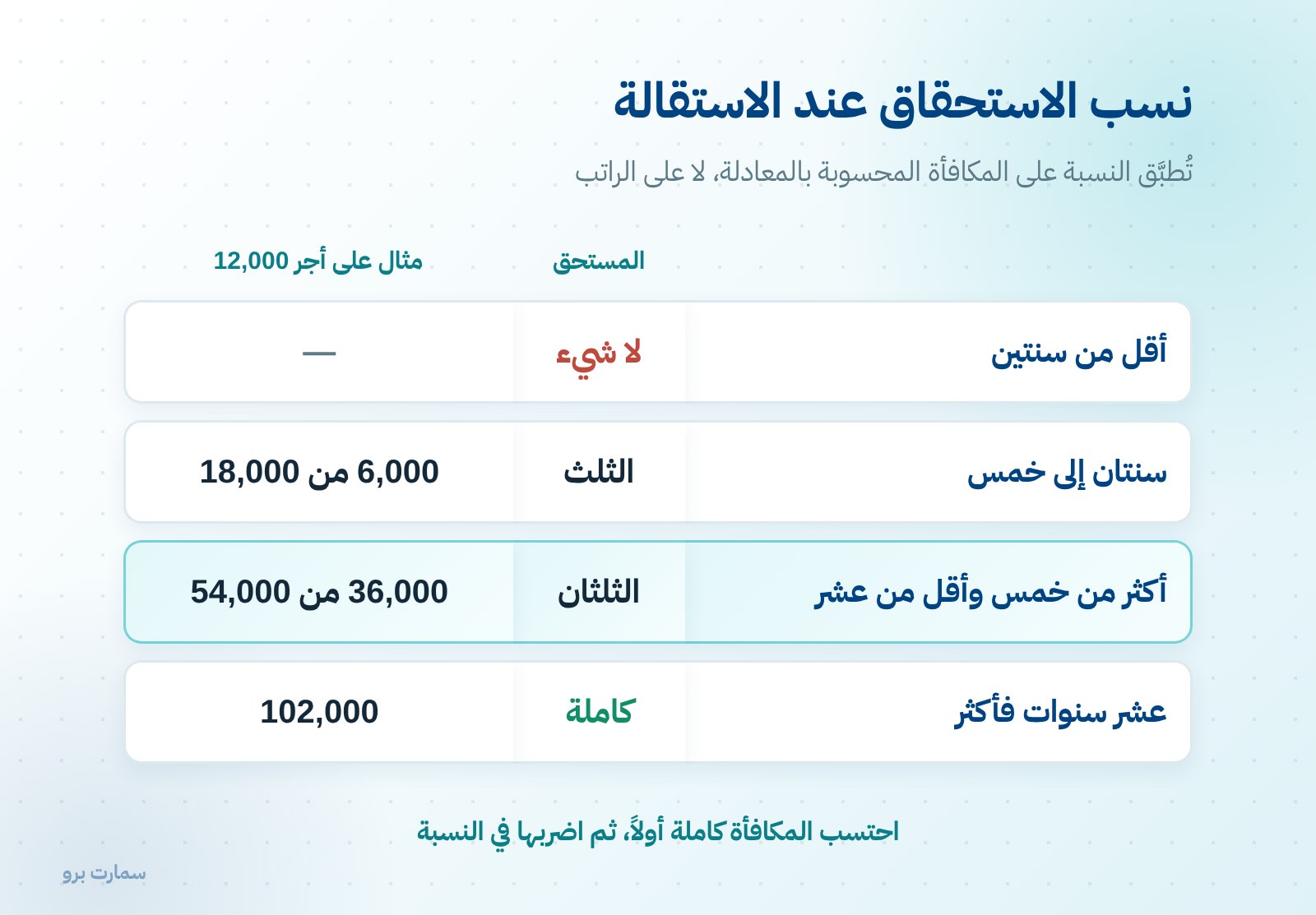
| Continuous service | Benefit payable |
|---|---|
| Less than two years | Nothing |
| Two to five years | One third |
| More than five and less than ten years | Two thirds |
| Ten years or more | Full benefit |
Note that the rate applies to the benefit calculated with the normal formula, not to the salary. So the first step is always to calculate the full benefit, then multiply it by the rate.
Three worked examples
Example 1: resignation after four years, last wage SAR 9,000
- Full benefit: 4 × 0.5 × 9,000 = 18,000
- Payable: one third = SAR 6,000
Example 2: resignation after seven years, last wage SAR 12,000
- First five years: 5 × 0.5 × 12,000 = 30,000
- Following two years: 2 × 1 × 12,000 = 24,000
- Full benefit: 54,000
- Payable: two thirds = SAR 36,000
Example 3: resignation after eleven years, last wage SAR 12,000
- First five years: 30,000
- Following six years: 72,000
- Full benefit: 102,000
- Payable: SAR 102,000, in full
The gap between the second and third examples is striking. Four extra years of service raised the amount payable from SAR 36,000 to SAR 102,000, close to three times as much. This comes from two effects combined: the higher multiplier after year five, and the rate rising to the full benefit after year ten.
When is the benefit paid in full?
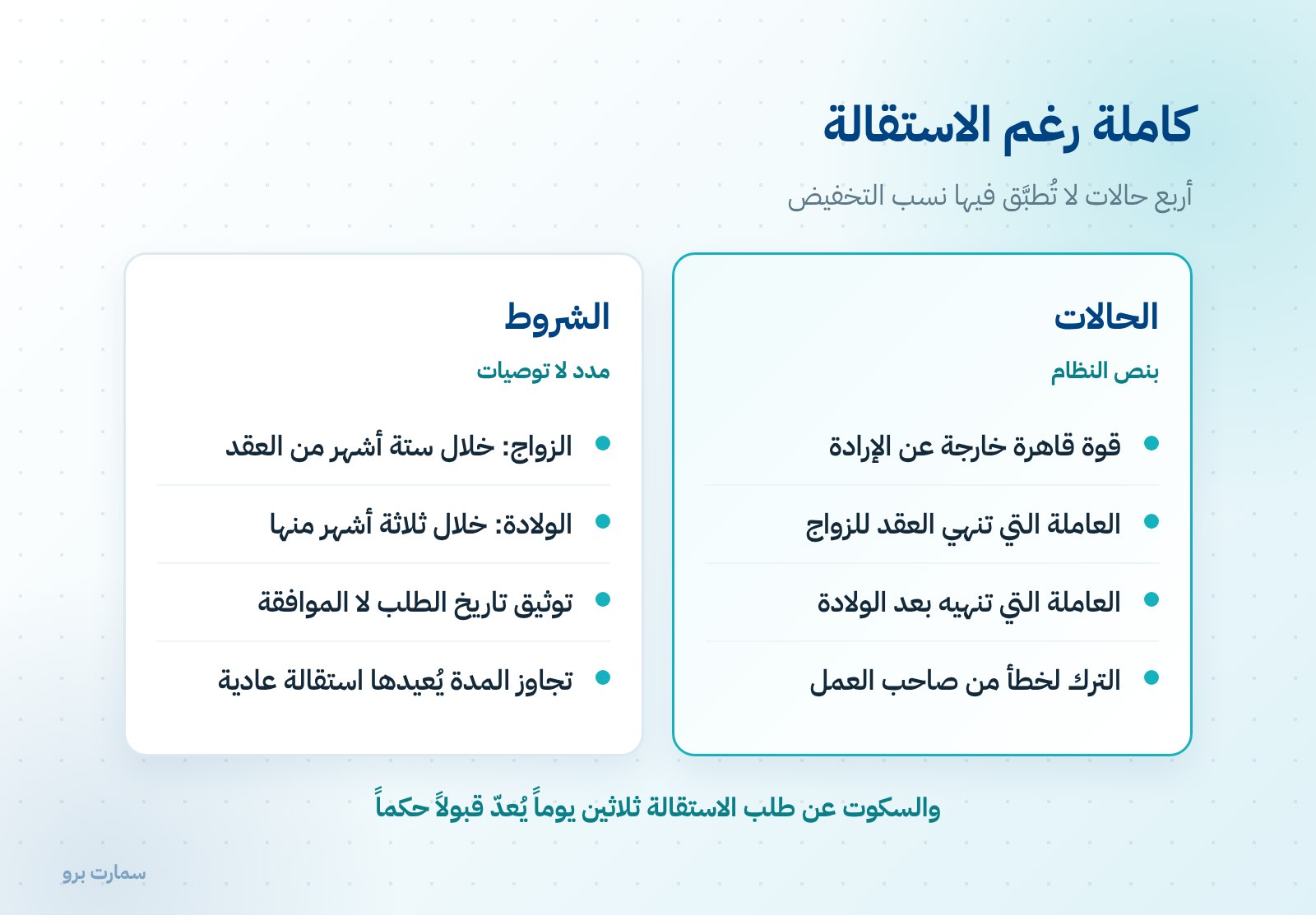
1. Force majeure
If the employee leaves because of force majeure beyond their control, they are entitled to the full benefit, whatever their length of service.
2. A female employee who marries
A female employee who ends her contract because of marriage is entitled to the full benefit, provided the contract is ended within six months of the date of the marriage contract.
3. A female employee after childbirth
The same applies to a female employee who ends her contract because she has given birth, provided she does so within three months of the date of delivery.
Both time limits are conditions, not recommendations. Missing them turns the case into an ordinary resignation with its graduated rates. That is why the business must record the date the request was submitted, not only the date it was approved.
4. Leaving for reasons caused by the employer
An employee who leaves without notice in situations where the employer is at fault keeps all their statutory rights in full. Examples include the employer breaching a fundamental obligation, misleading the employee when the contract was signed, assigning work that is fundamentally different from what was agreed, assaulting the employee, or failing to address a serious hazard it knew about.
Under the law this is not a resignation but a termination caused by the other party. For that reason the reduction rates do not apply.
Resignation procedures: what is new?
Provisions have been added to the Labor Law that govern the resignation process itself. The most important are:
- A resignation is deemed accepted if thirty days pass without a response from the employer.
- Acceptance may be postponed for up to sixty days for work-related reasons, provided the employee is notified in writing before the thirty days run out.
- The employee may withdraw the resignation within seven days, unless it has already been accepted.
- A resignation cannot be submitted with a future date.
In practice, silence is no longer an option. A business that does not respond to a resignation will find the contract ended by force of law after thirty days, with all the entitlements and payment deadlines that follow.
Is the end of a fixed-term contract a resignation?
A fixed-term contract ends when its term expires, and this is not a resignation. The reduction rates do not apply, and the employee is entitled to the full benefit under the normal formula.
A common mistake is treating non-renewal as a resignation and deducting two thirds. It is a costly error because it repeats with every employee whose contract is not renewed.
What about the notice period?
Resigning does not exempt the employee from the notice period in open-ended contracts. Whoever fails to observe it must pay the other party the wage for the notice period. Details are in notice period and contract termination.
This amount is usually deducted from the final settlement, so it appears on the settlement statement as a negative line next to the benefit.
Practical steps for the business
- Record the date the resignation was submitted in writing, because every time limit starts from it.
- Respond within thirty days, either accepting or postponing with reasons. Silence counts as acceptance.
- Calculate the full benefit first, then apply the rate based on length of service.
- Check the exceptional cases before applying any reduction.
- Pay within two weeks of the end of the employment relationship, which is the deadline when the employee is the one who ended the contract.
An overlooked point: continuous service
The rates are based on continuous service. An employee who resigns and is rehired after a break starts their service period again, unless the break was only nominal.
This needs attention in businesses that move staff between related entities. A transfer between two different commercial registrations may be read legally as termination and rehiring, which breaks the service period and makes the benefit for the earlier period payable immediately.
The official reference
The resignation rates, the exceptional cases and the resignation procedures are set out in the Labor Law published by the Ministry of Human Resources and Social Development, which is the reference in case of any discrepancy.
Read also
Frequently asked questions
How much end-of-service benefit is paid on resignation in Saudi Arabia?
It depends on continuous service: nothing before two years, one third from two to five years, two thirds for more than five and less than ten years, and the full benefit for ten years or more. The rate applies to the benefit calculated with the normal formula, not to the salary.
When is the benefit paid in full despite resignation?
In four cases: force majeure beyond the employee's control; a female employee who ends her contract because of marriage within six months of the marriage contract; a female employee who ends it because of childbirth within three months of delivery; and an employee who leaves for reasons where the employer is at fault.
Is the end of a fixed-term contract considered a resignation?
No. A fixed-term contract ends when its term expires, and the resignation reduction rates do not apply, so the employee is entitled to the full benefit under the normal formula. Treating non-renewal as a resignation and deducting part of the benefit is a common and costly mistake.
What happens if the employer does not respond to a resignation?
It is deemed accepted once thirty days have passed. Acceptance may be postponed for up to sixty days for work-related reasons, notified in writing before the thirty days end. The employee may withdraw within seven days unless it has been accepted, and a resignation cannot be submitted with a future date.