
Customer Complaints in Tailoring Shops: When to Redo and When to Explain
Customer complaints come down to one question: does the garment contradict what was written down, or what the customer imagined? A four-point redo policy, plus the cost of a redo weighed against the cost of a lost customer.
Author:سامي الحيدري

Customer complaints in a tailoring shop are settled by one question: does the garment contradict what was written at intake, or only what the customer imagined? If it breaks the written measurements or specification, the shop redoes it free. If it matches the paperwork, the change is explained calmly and priced as an alteration.
In practice, most complaints are decided in two minutes at the front counter. Staff either say "this is the measurement you gave us" or "leave it with us, we'll redo it." The decision changes with whoever is standing at the counter, and with how loud the customer is, not with the nature of the fault.
The result is that the shop loses twice. It redoes garments it was never obliged to redo, and it loses customers who only needed someone to listen.
Customer complaints: a real defect or a changed expectation?
A real defect can be measured with a tape and a ruler: a measurement that differs from the sheet, an open seam, one sleeve shorter than the other, or a fabric other than the one the customer chose. These are not up for debate, because the reference is written down.
A changed expectation is something else. The customer wanted the thobe "a bit looser" although it matches the recorded measurement, or their weight changed between fitting and delivery, or they saw a cut on someone else and now want it.
| Complaint situation | Reference | Who bears it |
|---|---|---|
| Measurement differs from the written sheet | Tailor's worksheet | The shop |
| Work differs from a written specification | Order form | The shop |
| Visible workmanship defect after delivery | Quality check | The shop |
| Specification never written down | No reference | The shop, and the lesson is its own |
| Customer's measurements changed after fitting | Measurement record | The customer, at alteration price |
| Customer changed their mind about the cut | No reference | The customer, at alteration price |
Note the fourth row: a specification that was never written down counts against the shop, not the customer. Whoever holds the worksheet holds the responsibility for filling it in completely.
What to give the customer immediately, without debate
Before deciding who is responsible, there are three things you give in the first minute, and they cost nothing:
- Listen fully, without interrupting or justifying, until the customer has finished describing what they see.
- Acknowledge what is visible: if the seam is open, it is open. Never say "that's normal."
- Give a specific time for your reply, not "we'll check and get back to you." A day and an hour.
The most common mistake is a staff member defending the shop before understanding the complaint. That turns a fault that could be fixed in twenty minutes into a personal dispute that no repair will fix.
A written four-point redo policy
A written policy is not protection against the customer; it protects staff from improvising. Four points are enough:
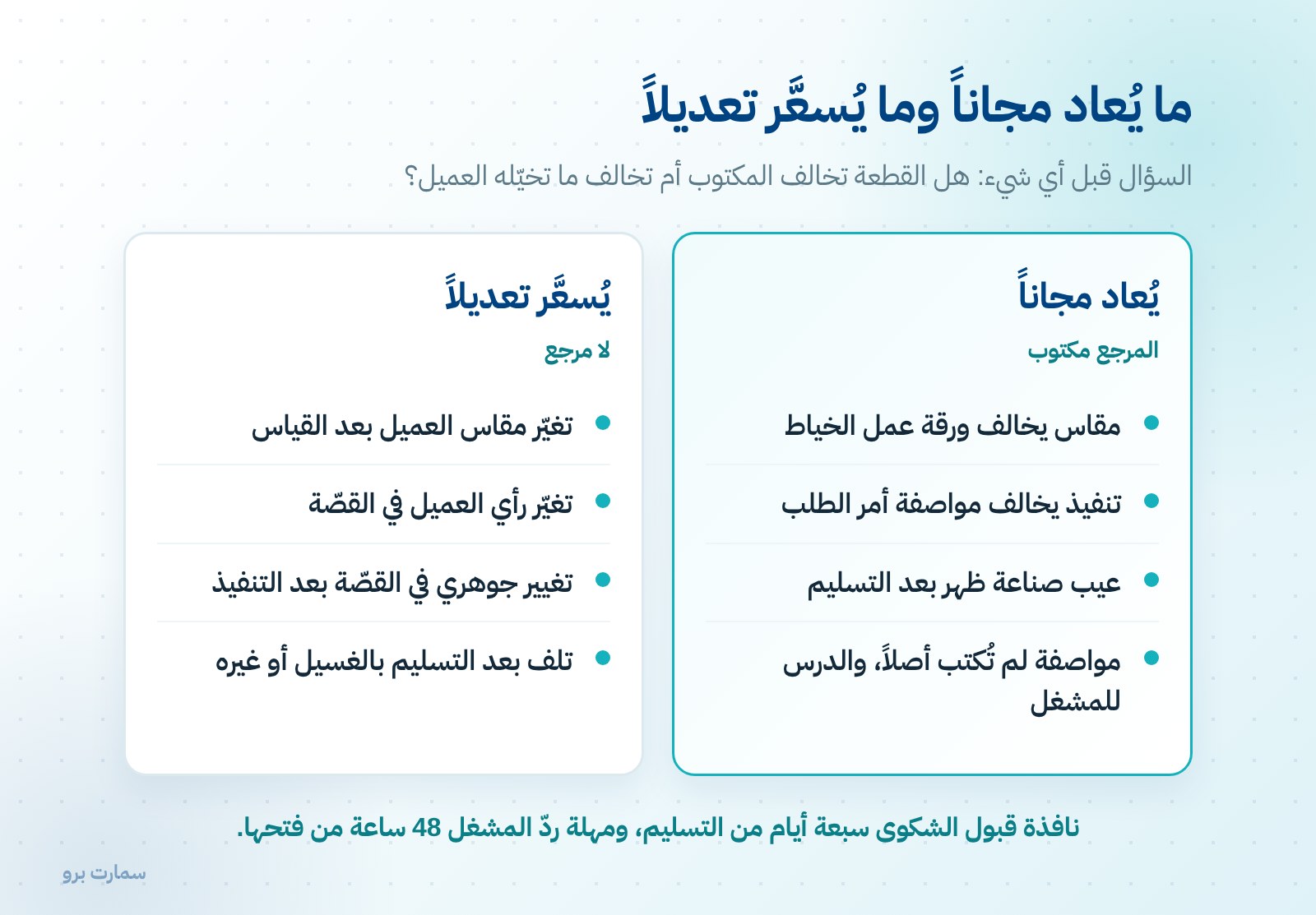
- What is redone free: anything that contradicts the order form or the measurement sheet, and any workmanship defect, with no limit on the number of times.
- What is priced as an alteration: any change to measurements or cut after the customer has signed the sheet, at the published alterations price list.
- Time limits: complaints about visible defects are accepted within seven days of delivery, and the shop replies within 48 hours of the complaint being opened.
- Who decides: staff decide the clear-cut cases and escalate unclear ones to the shop owner the same day, not the next.
The third point protects both sides. A window that never closes turns every washing mark into a complaint, while a one-day window makes the policy meaningless. If you have not yet published alteration prices, see how to structure them in building a tailoring price list in tiers and add-ons.
Worked example: the cost of a redo vs the cost of a lost customer
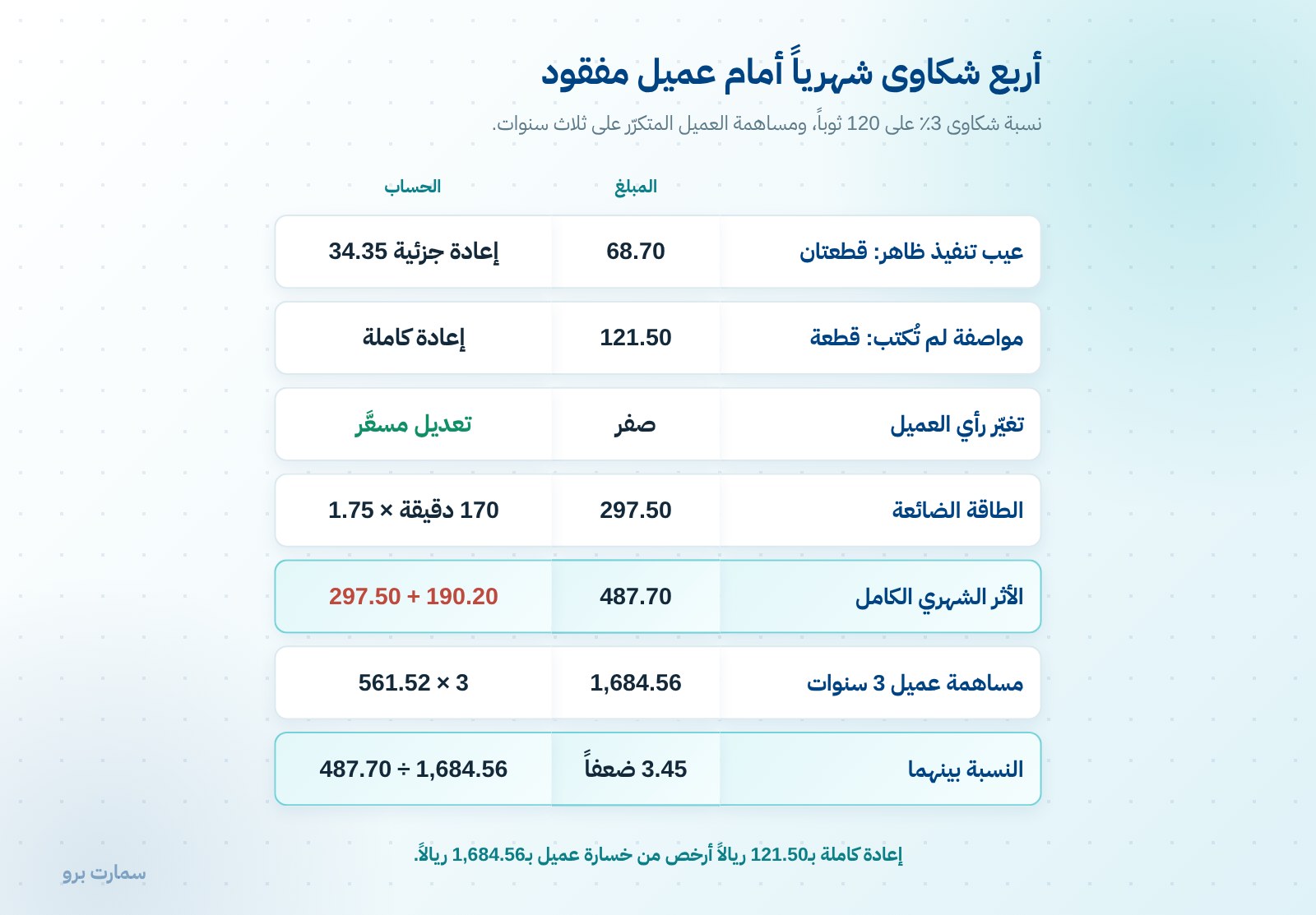
The figures below are hypothetical, used to illustrate the method; they do not represent typical market prices. Using the parameters from this series, a partial redo taking 45 minutes costs SAR 34.35, and a full remake taking 80 minutes costs SAR 121.50. The contribution per thobe minute is SAR 1.75.
Assume a shop that delivers 120 thobes a month with a complaint rate of 3%, which is about four complaints a month, broken down like this:
| Complaint type | Count | Treatment | Direct cost (SAR) |
|---|---|---|---|
| Visible workmanship defect | 2 | Partial redo | 68.70 |
| Specification not written down | 1 | Full remake | 121.50 |
| Customer changed their mind | 1 | Priced alteration | Zero |
| Total | 4 | 190.20 |
The minutes spent on redos could have produced new garments: 2 × 45 + 80 = 170 minutes. At a contribution of SAR 1.75 per minute, that is SAR 297.50 of lost capacity.
- Full monthly impact: 190.20 + 297.50 = SAR 487.70
Now the other side of the scale. Assume a repeat customer orders four thobes a year and the average relationship lasts three years. The contribution per thobe is SAR 140.38, as worked out in tailoring profit margin per item:
- Annual contribution: 4 × 140.38 = SAR 561.52
- Contribution over three years: 3 × 561.52 = SAR 1,684.56
So losing one customer costs more than three times the cost of handling all four complaints for a full month: 1,684.56 ÷ 487.70 = 3.45.
Put more plainly: a full remake at SAR 121.50 is cheaper than losing a customer worth SAR 1,684.56, at a ratio of about one to fourteen. That alone is enough to settle most disputed cases in the customer's favour, without any abstract talk about "customer satisfaction."
When should you not redo the garment?
The calculation above does not mean always redoing. In three cases a free redo is refused and the reason is explained calmly:
- A fundamental change to the cut after the work is done, because that is a new order, not a repair.
- Damage after delivery from wear, washing or another tailor.
- Repeated changes without reason from the same customer on the same garment after two free alterations; the third is charged.
A written refusal backed by a signed sheet is usually accepted. A verbal refusal backed by a staff member's memory never is.
Why record every complaint, and what fields do you need?
A complaint that is fixed but not recorded comes back. Six fields are enough: order number, complaint date, the description in the customer's own words, the likely cause, the responsible stage in the flow Received → Cutting → Sewing → Ironing → Ready → Delivered, and the treatment with its cost.
The fourth field, the likely cause, is what turns a complaint log from a book of apologies into a diagnostic tool. Four complaints a month are not four cases of bad luck:
| Likely cause | Complaints | Fix |
|---|---|---|
| Work done on an old measurement version | 2 | Check the version number in the measurement record |
| Term the tailor understood differently from the front desk | 1 | A shared glossary of thobe terms |
| Expectation not discussed at intake | 1 | A written description the customer reads and signs |
There is no line here saying "difficult customer." Every cause can be fixed once, and its complaints disappear.
How do complaints relate to quality checks?
A complaint is a defect that slipped past the quality check. If complaints are rising while the workshop's rejection rate at inspection is low, the problem is in the inspection, not the sewing.
Always read the two indicators together: a high rejection rate with few complaints is a sign of health, and the reverse is a sign that the inspection is only for show.
Three mistakes in handling complaints
First: negotiating by volume. Whoever raises their voice gets a free redo, and whoever stays quiet is charged. The policy becomes a reward for the loudest.
Second: redoing without recording the cause. The complaint is satisfied but its cause remains, and it returns a month later with another customer's face.
Third: promising a date you cannot keep. A rushed redo produces a second defect, and a second complaint on the same garment is the most expensive thing a shop can face.
The official reference
Rules on invoices, and on any adjustment or credit note (a document that reduces the value of an issued invoice) arising from a redo or a refund, are published by the Zakat, Tax and Customs Authority (ZATCA), which is the reference in case of any difference. Tailoring shops usually issue simplified tax invoices, so any refund should be recorded against the original invoice rather than handled off the books.
Applying all this on the ground is easier when orders, fabrics and invoices sit in one system, such as SmartPro's tailoring shop management system, where measurements, order stages and Fatoora-compatible invoices are connected.
Read also
- Tailoring profit margin per item: costing by the minute
- Tailoring price list: how to build it in tiers and add-ons
- Tailoring shop management system
Key takeaway: Judge every complaint against the written order and measurement sheet, not against how loud it is. When the case is unclear, remember that a full remake costs about one-fourteenth of a lost repeat customer.
If you want to see measurements, order stages and complaints tracked in one place, start a free trial or book a demo with our team.
Article visuals
Frequently asked questions
How do I tell a real defect from a change in the customer's expectations?
Use the written reference, not the intensity of the complaint. Anything that contradicts the measurement sheet or a written specification is a defect the shop bears without debate, while a garment that matches the paperwork but not what the customer imagined is a service priced as an alteration. A specification that was never written down counts against the shop, not the customer.
What should I give a customer immediately when they complain?
Three things that cost nothing: full listening without interrupting or justifying, an honest acknowledgement of anything visibly wrong without calling it normal, and a specific day and hour for your reply instead of "we'll check and get back to you." Defending the shop before understanding the complaint turns a small fault into a personal dispute.
Is redoing a garment cheaper than losing the customer?
In the hypothetical example, yes, by a wide margin. A full remake costs SAR 121.50, while a repeat customer who orders four thobes a year over three years contributes SAR 1,684.56. That makes the redo worth roughly one-fourteenth of the value of the lost customer.
Why record complaints if I fix them immediately?
Because a complaint that is fixed but not recorded comes back with another customer. The key field is the likely cause, which turns the log from a book of apologies into a diagnostic tool. In the example, two complaints came from working on an old measurement version and one from a term that was not agreed between the front desk and the tailor.