
Tailoring Workshop Reports: Six Reports, Each with Its Own Cycle
A tailoring workshop runs on six reports, and three of them lose their value if read monthly. Order stages and delays, fabric, contribution, productivity, deposits and cash, with worked examples.
Author:سامي الحيدري
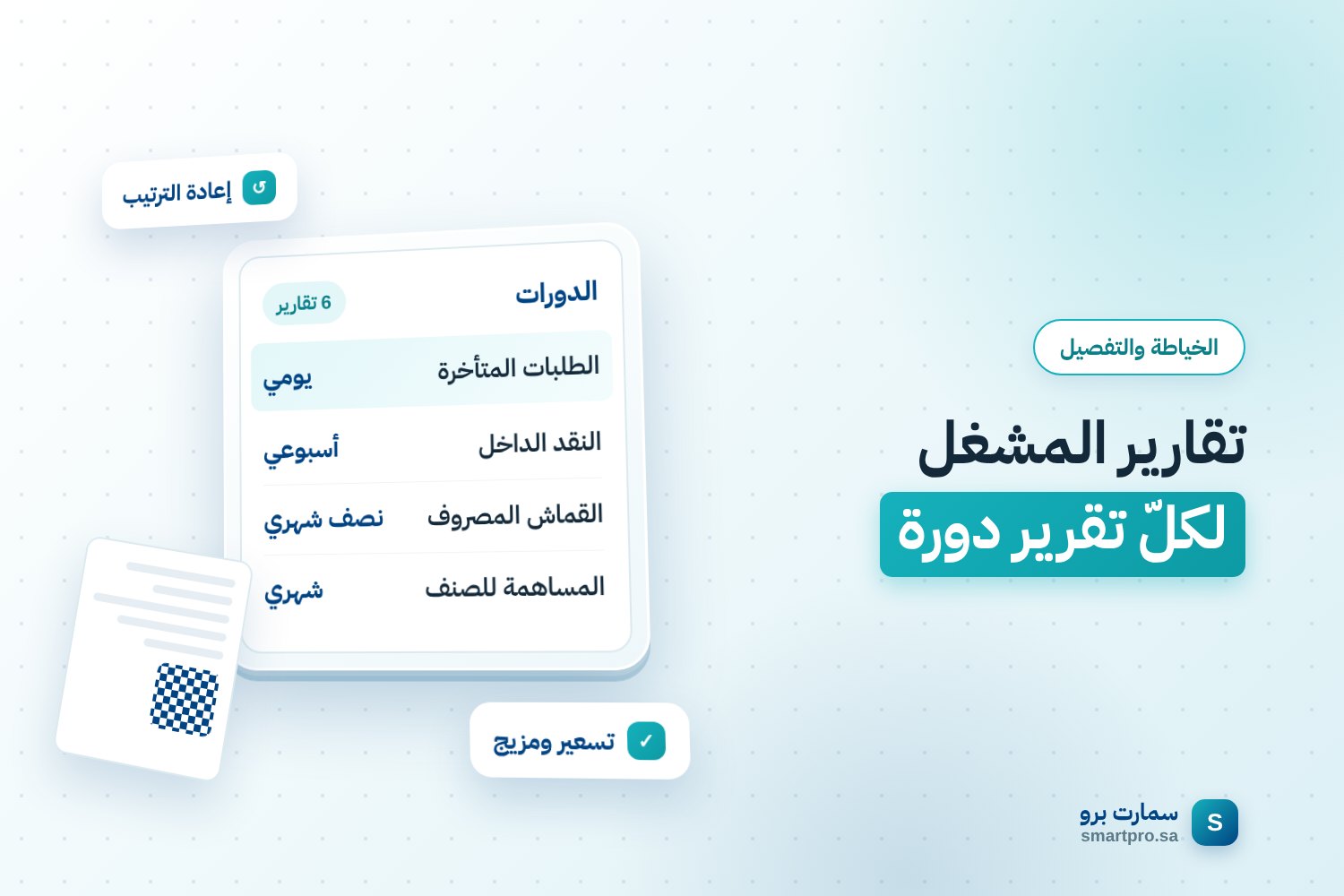
In most tailoring workshops, "reports" means one report that arrives late: the monthly statement the accountant presents halfway through the following month. So on 20 November the owner learns that October was weak.
The information is accurate and worthless. What is past is past, and the window to fix anything has already closed.
The problem is not the report but its cycle. Six reports run a tailoring workshop, and three of them lose all their value if read only once a month.
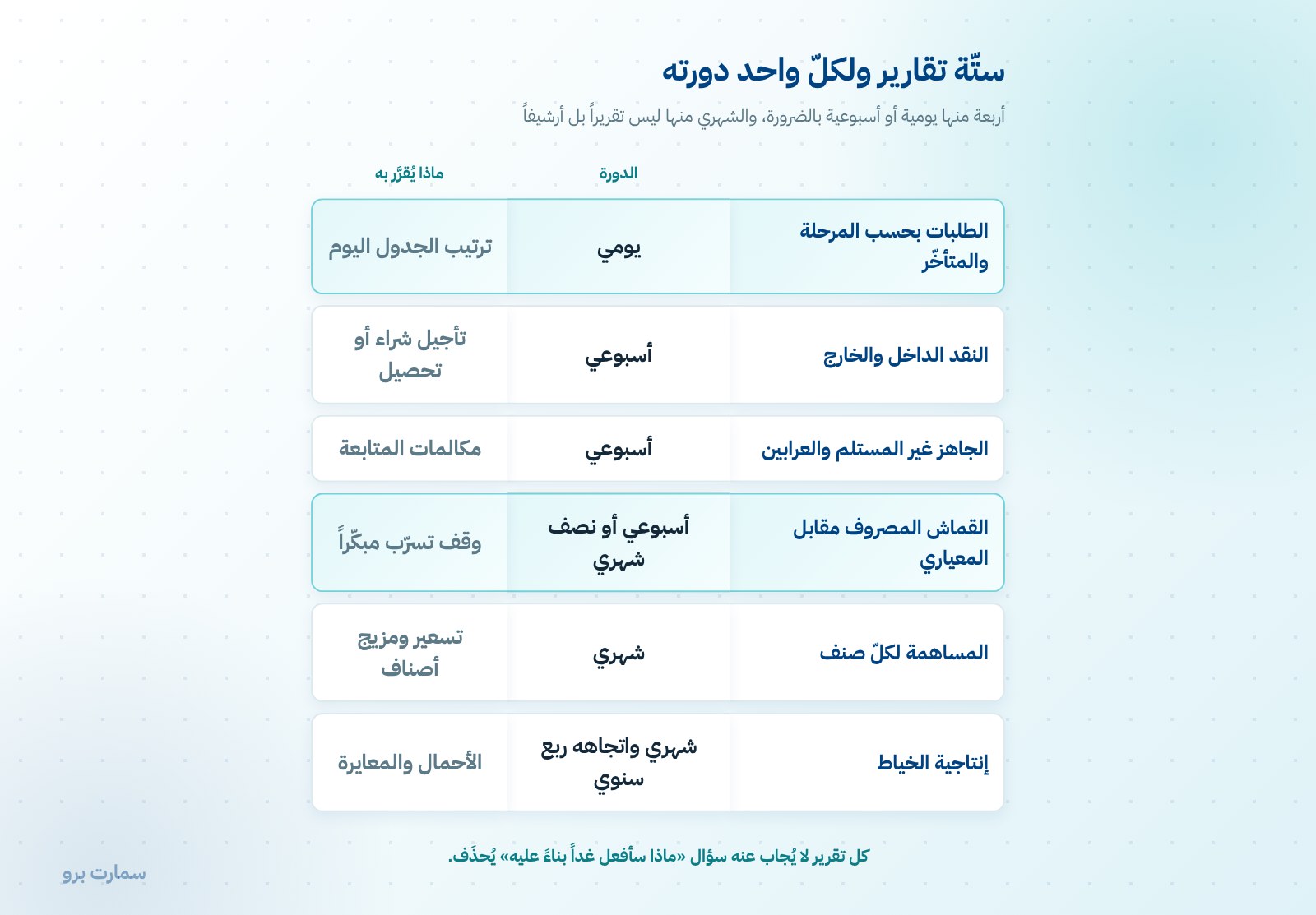
Tailoring workshop reports: six reports, each with its own cycle
| Report | Cycle | What it decides |
|---|---|---|
| Orders by stage and overdue | Daily | Reordering today's schedule |
| Cash in and out | Weekly | Delaying a purchase or chasing a collection |
| Ready but uncollected, and deposits | Weekly | Follow-up calls this week |
| Fabric issued vs standard | Weekly or fortnightly | Stopping a leak before the month is used up |
| Contribution per item | Monthly | Pricing and product mix |
| Tailor productivity | Monthly, with a quarterly trend | Workload allocation and calibration |
The first four rows must be daily or weekly. Each one drives a decision today, and a monthly version of them is not a report but an archive.
Report 1: Order stages and overdue orders, daily without exception
The report could not be simpler: the number of orders at each stage of the route intake → cutting → sewing → pressing → ready → delivered, and how many have passed their due date.
The figures below are hypothetical, used only to illustrate the method, and do not represent typical market prices. Assume this snapshot at the end of a working day:
| Stage | Orders | Overdue |
|---|---|---|
| Intake | 28 | 0 |
| Cutting | 41 | 2 |
| Sewing | 74 | 6 |
| Pressing | 19 | 3 |
| Ready | 34 | — |
| Total in progress | 196 | 11 |
- Overdue rate: 11 ÷ 196 = 5.6%
The insight is not in the total but in where the delays sit. Six of the eleven overdue orders are stuck in sewing and three in pressing, a short stage where nothing should be late. A pile-up in pressing signals a bottleneck at one stage, not a general lack of capacity. Reading stages in detail is covered in order stages.
If this report were read monthly, the workshop would learn about a delay twenty days after the customer did. That is what "monthly is far too late" means.
Report 2: Fabric issued vs standard
Using the same mix: 120 thobes at 3.5 metres, 30 abayas at 3 metres, and 200 uniform pieces at 2.2 metres.
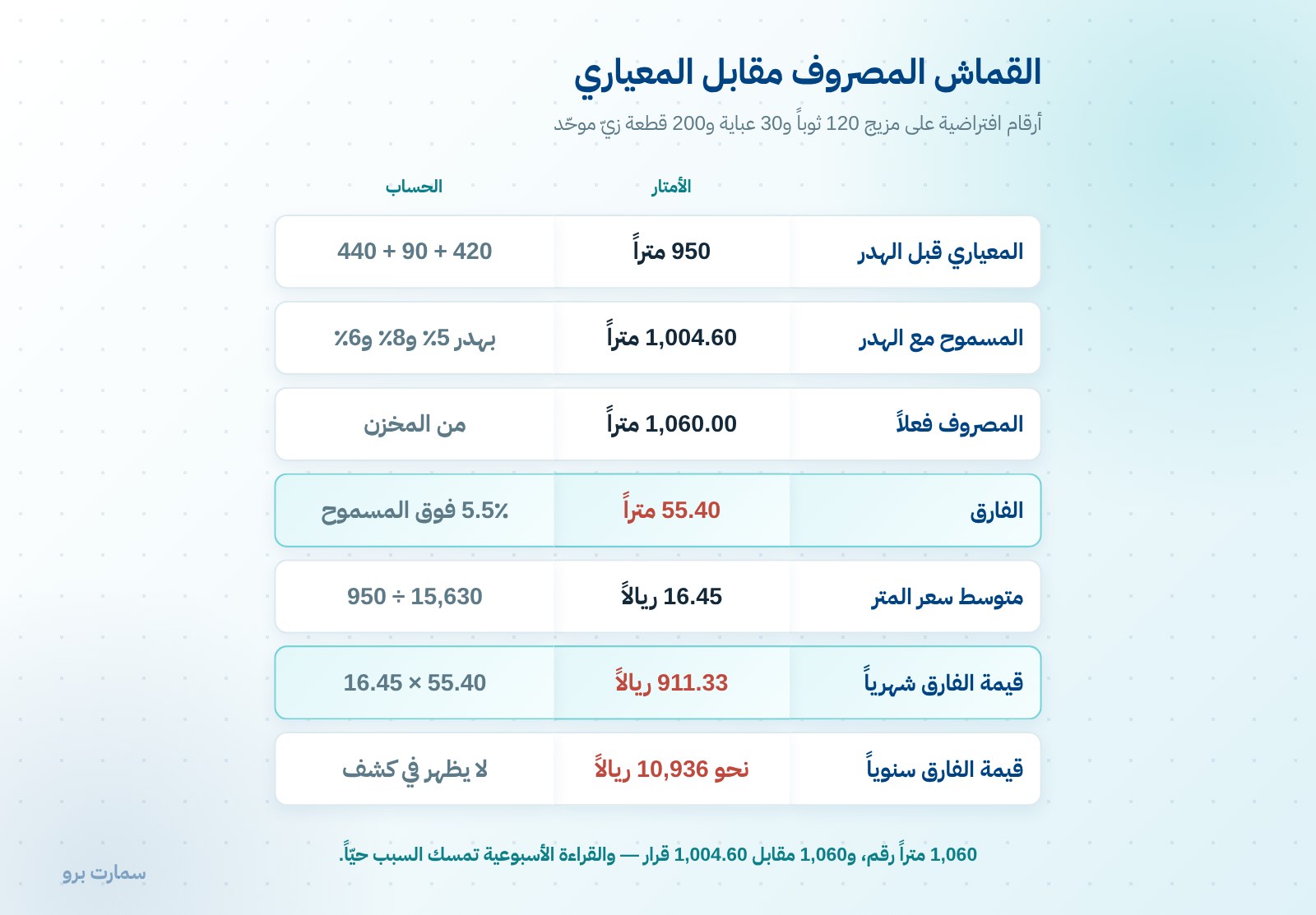
- Standard before waste: 420 + 90 + 440 = 950 metres
- Allowed with waste of 5%, 8% and 6%: 441 + 97.20 + 466.40 = 1,004.60 metres
- Assume the fabric actually issued from the store was 1,060 metres
| Item | Metres |
|---|---|
| Allowed with waste | 1,004.60 |
| Actually issued | 1,060.00 |
| Variance | 55.40 |
- Overrun: 1,060 ÷ 1,004.60 = 5.5% above the allowance
- Average price per metre across the mix: 15,630 ÷ 950 = SAR 16.45
- Value of the variance: 55.40 × 16.45 = SAR 911.33 a month
That is roughly SAR 10,936 a year from a line that appears on no statement. Reading it weekly catches the cause while it is still live: a damaged pattern, cutting pieces one at a time instead of in batches, or fabric issued without being recorded. Reading it monthly gives you a number but not a reason. More detail is in fabric cutting waste and fabric stocktake.
Report 3: Contribution per item, monthly is enough
This report genuinely belongs on a monthly cycle, because the decisions it drives are slow: pricing, changing the mix, or dropping an item. None of these is made within a week.
Contribution is what each item leaves after its direct costs (fabric, trims and labour), available to cover overheads and profit.
| Item | Quantity | Contribution per piece (SAR) | Total (SAR) |
|---|---|---|---|
| Thobe | 120 | 140.38 | 16,845.60 |
| Abaya | 30 | 130.20 | 3,906.00 |
| Uniform | 200 | 25.52 | 5,104.00 |
| Thobe shortening | 150 | 15.24 | 2,286.00 |
| Total | 500 | 28,141.60 |
The useful reading is not ranking by contribution per piece but by contribution per minute when capacity is full. The thobe earns SAR 1.75 a minute and the abaya SAR 0.59. This tension is explained in tailoring profit margin per item.
Report 4: Tailor productivity, two numbers, not one
This report is not read as a piece count. It is read in three columns: standard minutes for the mix actually produced, minutes actually logged, and the ratio between them.
A fourth column belongs with them: the rework rate. A fast tailor with a lot of rework costs more than a slower, precise one. The calculation is detailed in tailor productivity.
Its cycle is monthly, with a quarterly trend. The absolute figure is affected by the mix; the trend does not lie.
Report 5: Deposits and ready but uncollected orders
Two reports in one table, and both are about cash:
| Item | Count | Amount (SAR) |
|---|---|---|
| Deposits on orders in progress | 85 orders | 9,520.00 |
| Balance due on ready, uncollected pieces | 34 pieces | 5,712.00 |
The first row is a liability: money in the till against work not yet done. Where it sits in the books is covered in the workshop chart of accounts.
The second row is earned but uncollected revenue: pieces finished and paid for in materials and labour but not yet picked up. Following them up is covered in uncollected orders.
Reading the second row weekly is the difference between four follow-up calls and thirty-four.
Report 6: Cash, weekly, not monthly
Profit is not cash. The workshop in this example has an operating profit of SAR 15,241.60, yet SAR 9,520 in its till is not its own, and SAR 5,712 has not come in yet.
Three numbers are enough each week: cash in, cash out, and what is owed to suppliers over the next two weeks. That is what stops you buying a roll of fabric in the worst possible week.
Why does a report fail even when it is accurate?
- It arrives late for the decision it is meant to serve.
- It is compiled by hand, so it takes longer than it is worth and is the first thing dropped in peak season.
- No one is responsible for reading it at a set time, so it gets printed and never opened.
- It carries no comparison: a number with no previous month and no standard cannot drive a decision.
- Its source is not unified, so the workshop sheet says one number and the ledger says another. Moving away from the paper ledger is covered in from ledger to software.
The last point is the deepest cause. A daily report cannot be built by hand; anyone who wants one needs a single data source, and that is a core criterion when choosing a tailoring workshop system.
Three mistakes in tailoring workshop reports
First: one cycle for every report. The daily report becomes monthly, or the monthly one becomes a weekly burden.
Second: a report with no matching decision. Any report that cannot answer "what will I do tomorrow because of this?" should be dropped.
Third: numbers with no standard. 1,060 metres is a number; 1,060 against 1,004.60 is a decision.
The official reference
Rules on invoices, returns and the documents you must keep are published by the Zakat, Tax and Customs Authority (ZATCA), which is the reference in case of any difference. What to hand the customer is covered in the simplified invoice for tailors.
Workshops that get this right usually do it inside one system, such as SmartPro's tailoring workshop software.
Read also
Key takeaway: Six reports run a tailoring workshop, and the cycle matters as much as the numbers: stages daily, cash, deposits and fabric weekly, contribution and productivity monthly. A report without a standard or a decision attached is just an archive.
To see these reports built from one data source, start a free trial or book a demo.
Article visuals
Frequently asked questions
Which reports does a tailoring workshop owner need?
Six reports: orders by stage and overdue, cash in and out, ready but uncollected orders with deposits held, fabric issued against standard, contribution per item, and tailor productivity. The first four are daily or weekly, and the last two are monthly, with a quarterly trend reading for productivity.
Why is a monthly report far too late?
Because some decisions are daily. The stages and overdue report is used to reorder today's schedule, and if it were read monthly the workshop would learn about a delay twenty days after the customer did. Fabric is similar: a weekly reading catches the cause while it is live, while a monthly one gives a number without a reason.
How do I read the fabric issued report?
Compare it with the standard rather than reading it on its own. In the hypothetical example, the allowance including waste was 1,004.60 metres and 1,060 metres were issued, a 5.5% overrun worth SAR 911.33 a month at an average of SAR 16.45 per metre. A figure without a standard cannot drive any decision.
Why do reports get printed but never read?
There are five common reasons: the report arrives after the decision it serves, it is compiled by hand and dropped first in peak season, no one is responsible for reading it at a set time, it carries no comparison with a previous month or standard, and its source is not unified, so the workshop sheet and the ledger show different numbers.