
The Six Order Stages: An Owner, an Entry Condition and an Exit Condition
A tailoring order moves through six stages: Received → Cutting → Sewing → Pressing → Ready → Delivered. What each stage means, who owns it, and where the delay really sits, in numbers.
Author:سامي الحيدري
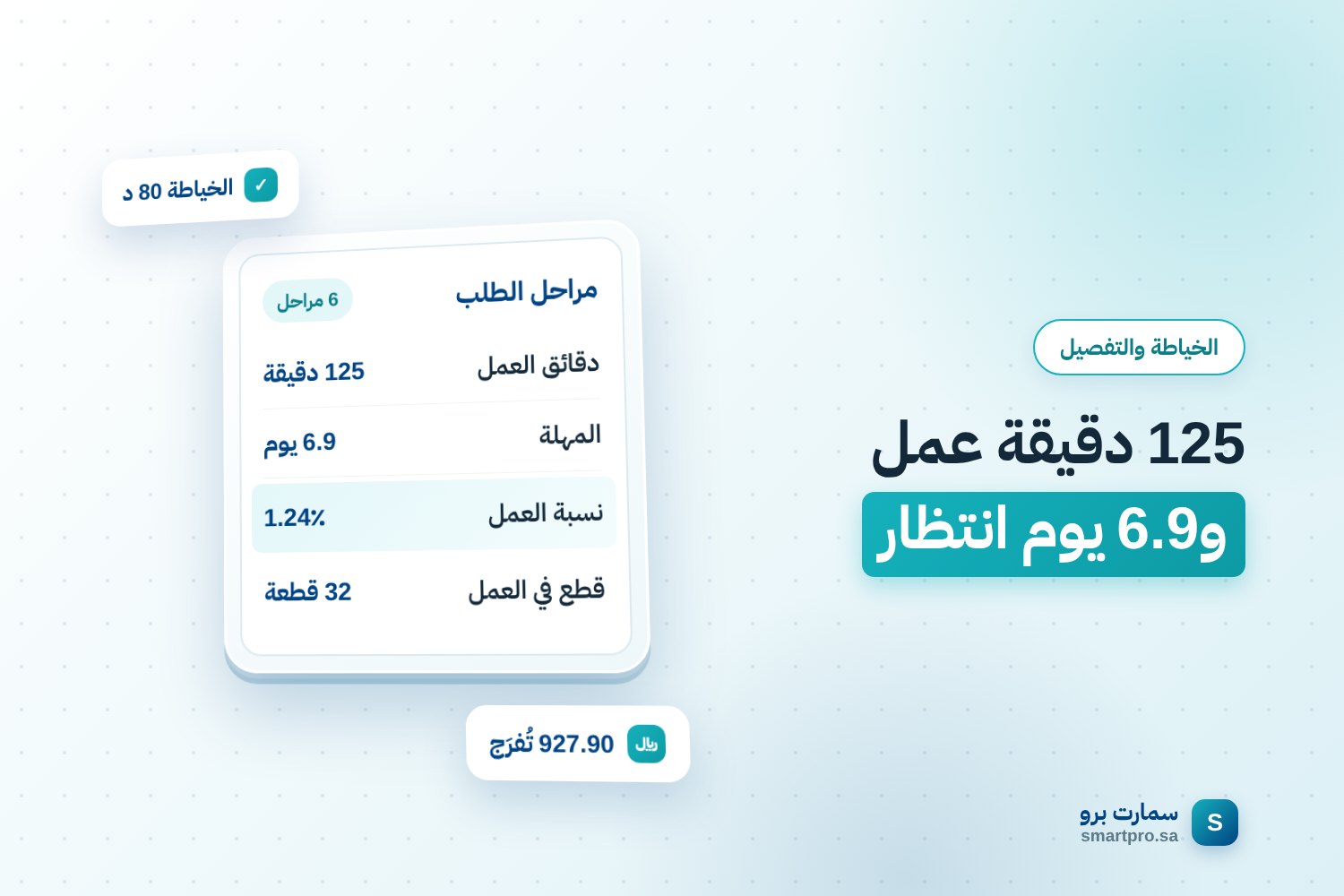
A tailoring workshop's order moves through six stages: Received → Cutting → Sewing → Pressing → Ready → Delivered. Most workshops know these names and write them on a board. Then they get nothing out of them.
The reason is that a stage is not a name on a board. It is three things together: one owner responsible for it, an entry condition that must be met before the piece is accepted, and an exit condition that must be met before the piece moves on. A stage missing any one of the three is not a stage. It is a label.
Ask in a workshop that is running late, "Where is the order?", and the answer is "With the tailor." That is not a location. It is an assumption, because nobody recorded when the piece arrived or who took it.
What do the six order stages actually mean?
| Stage | Owner | Entry condition | Exit condition | Work minutes |
|---|---|---|---|---|
| Received | Front desk | A customer and a defined order | Measurements recorded, date set, deposit taken, trims reserved | 12 |
| Cutting | Cutter | Fabric available and an approved pattern | Pieces cut and tagged with the order number | 18 |
| Sewing | Tailor | All pieces complete, with their trims | A sewn garment with nothing missing | 80 |
| Pressing | Presser | A complete sewn garment | Garment pressed, hung and bagged | 10 |
| Ready | Rack supervisor | Quality check passed | Customer notified that the order is ready | — |
| Delivered | Front desk | Customer present and payment complete | Invoice issued and receipt signed | 5 |
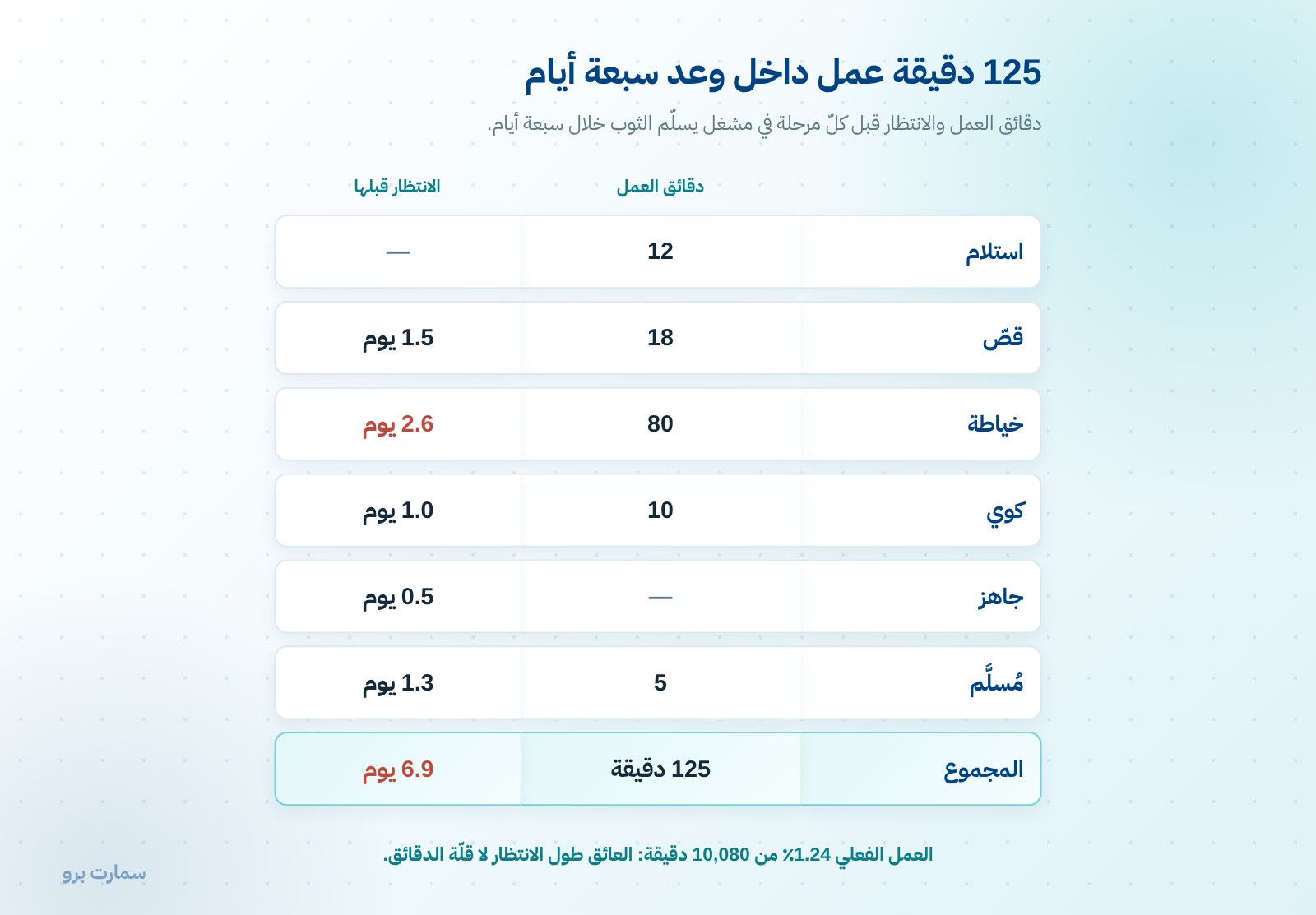
The minutes in the last column are for a standard thobe, using the rates adopted throughout this series, and they add up to 125 minutes. That number is the key to everything that follows.
Waiting, not working: a worked example
The figures below are hypothetical, to illustrate the method, and do not represent prevailing market prices. Assume a workshop that promises customers delivery in seven days:
| Stage | Work minutes | Wait before it |
|---|---|---|
| Received | 12 | — |
| Cutting | 18 | 1.5 days |
| Sewing | 80 | 2.6 days |
| Pressing | 10 | 1.0 day |
| Ready | — | 0.5 days |
| Delivered | 5 | 1.3 days |
| Total | 125 minutes | 6.9 days |
Seven days = 7 × 24 × 60 = 10,080 minutes. The share of actual work in that time is 125 ÷ 10,080 = 1.24%.
In other words, someone works on the thobe for less than 130 minutes, and it waits for close to 9,900 minutes. Every workshop that complains about not having enough time is really suffering from long waits, not a shortage of minutes.
This is the first truth of stage management: shortening your delivery date does not need a faster tailor. It needs a shorter queue. How to build the date itself is covered in setting the delivery date.
How much capital is tied up in the stages?
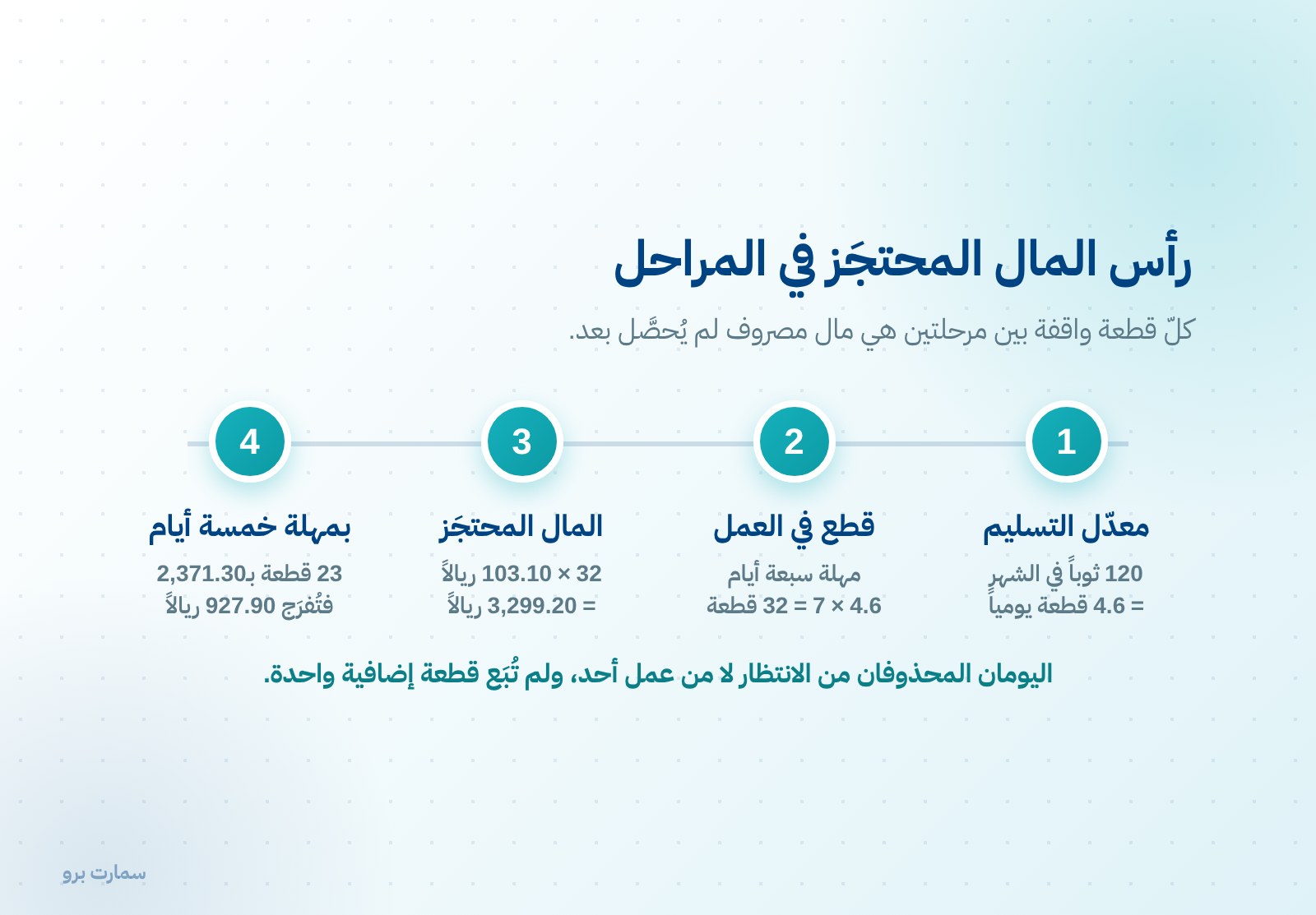
The figures below are hypothetical, to illustrate the method, and do not represent prevailing market prices. Every piece sitting between two stages is money already spent and not yet collected. At 120 thobes delivered over 26 working days, that is 4.6 pieces a day:
- With a seven-day lead time: 4.6 × 7 = 32 pieces in progress at any moment
- Their direct cost: 32 × 103.10 = SAR 3,299.20 tied up
- Cut the lead time to five days: 4.6 × 5 = 23 pieces
- That is 23 × 103.10 = SAR 2,371.30, so SAR 927.90 is released without selling a single extra piece
The two days removed were not taken from anyone's work. They came out of waiting. The direct cost rates come from the true cost of tailoring a thobe.
What must be true before a piece moves to the next stage?
The exit condition is the most important column in the first table, because it prevents one specific problem: a piece that moves on incomplete.
A piece that leaves cutting without an order number on it becomes anonymous on the rack. A piece that enters sewing without its buttons reserved stops halfway through the stage; the cost of that is set out in tailoring trims inventory. A piece that reaches "Ready" without a check comes back from the customer.
Every return to an earlier stage costs more than waiting in it, because the earlier stage has to be set up again from scratch. Hence the rule: a stage does not accept incomplete work, and whoever accepts incomplete work owns the problem.
Where do orders actually get stuck?
The waiting in the table is not spread evenly, and the three worst bottlenecks are well known:
- Before sewing (2.6 days). The longest queue, because cutting is faster than sewing, so work piles up in front of it. This is normal on any line; the fix is to order the queue by due date, not by arrival.
- Before pressing (1.0 day). Pressing is usually a single station, so every garment type piles up on it at once.
- After Ready (1.3 days). This wait is not on your side but the customer's, and it stretches a long way if they are not told. How to deal with it is covered in uncollected orders.
The irony is that sewing, at 80 of the 125 work minutes or 64%, is not the biggest source of delay. The biggest source is the time when nobody is working on the piece at all.
Why is the stage without an owner where the delay sits?
Look at the "Ready" stage in the first table: its work minutes are zero, yet it has an owner. That is deliberate.
A stage with no work in it is exactly the stage that easily ends up with no owner, because nobody feels they have a job to do there. So the piece sits on the rack, pressed and bagged, nobody calls the customer, and delivery slips after all the work is finished.
This is the worst kind of delay: the cost has been paid in full, the value has not been collected, and the customer is angry about something that took not a single minute of work.
The general rule: delay lives in the stage that has no owner. If you want to know where your time disappears, look for the stage where everyone answers, "It's not with me."
How do you measure the stages with just two numbers?
You do not need a complicated report. It is enough to record the time each piece enters each stage, then pull two numbers for every stage:
- The average time spent in it over the week, compared with the target time in the table.
- The age of the oldest piece sitting in it right now. This number matters more than the average, because a healthy average can hide a piece that has been stuck for nine days.
The second number is what stops delays before they happen; handling the ones that have already happened is covered in late order handling. Linking each piece to its number on the rack is a precondition for all of this, explained in garment tagging.
Is capacity usually the constraint?
Before you hire another tailor, do the maths. 120 thobes × 80 minutes = 9,600 minutes a month, out of 62,400 minutes available from five tailors. The rest goes on abayas and alterations, but in most workshops the gap remains wide.
That means an extra tailor does not solve the waiting problem, because the piece is not waiting for a busy tailor. It is waiting for a decision: who takes it, at what priority, and whether its pieces are complete. Calculating capacity in detail is covered in workshop capacity.
The exception is peak season, when the constraint becomes genuine capacity rather than organisation, as discussed in tailoring workshops in Ramadan.
What are the three common mistakes in managing stages?
First: stages with no exit condition. Pieces move on incomplete, and every gap sends them back to an earlier stage at the cost of a full re-setup.
Second: shared ownership. A stage owned by two people is owned by nobody, and when you ask, the answer is always "I thought he took it."
Third: measuring output without measuring waiting. The number of pieces delivered each month is useful, but it says nothing about where the time is lost. The two numbers in the previous section do.
The official reference
Requirements for tailoring shop space and storage areas are published by the Ministry of Municipalities and Housing, which is the reference in case of any difference; details are in tailoring shop requirements.
Everything described here is run in practice in SmartPro's tailoring system: orders, measurements, fabrics and invoicing in one place.
Read also
Article visuals
Frequently asked questions
What are the order stages in a tailoring workshop?
There are six stages, in order: Received → Cutting → Sewing → Pressing → Ready → Delivered. Each stage has one owner, an entry condition that must be met before the piece is accepted, and an exit condition that must be met before it moves on. A stage missing any of these three is not a stage but just a name on a board.
Why are orders late when so little work goes into them?
Because the time goes on waiting, not working. In the hypothetical example, a thobe takes 125 minutes of work across the six stages, within a seven-day lead time of 10,080 minutes. That means actual work is only 1.24% of the time, and the rest is queues.
How can I tell where orders are getting stuck?
Record the time each piece enters each stage, then pull two numbers for every stage: the average time spent in it this week, and the age of the oldest piece sitting in it right now. The second number matters more, because a healthy average can hide a single piece that has been stuck for nine days.
How does shortening the delivery lead time affect working capital?
It releases money that is tied up. In the hypothetical example, delivering 4.6 pieces a day with a seven-day lead time means 32 pieces are always in progress, at a direct cost of SAR 3,299.20. With a five-day lead time that drops to 23 pieces, releasing SAR 927.90 without any extra sales.