
Delivery Date: How to Set One That Holds Up in Peak Season
A delivery date should be calculated from the queue and capacity, not from habit. The formula in minutes, how big the buffer should be, stage checkpoints, and measuring promised against actual.
Author:سامي الحيدري

In most tailoring workshops, the delivery date is an inherited number, not a calculated one: "a week for a thobe, ten days for an abaya." The same line goes to the first customer of the season and the hundredth, as if the queue between them had not changed.
Then delivery slips, so you apologise. Then the tailor is rushed, so pieces come back from quality control, so other orders slip. One wrong date ends up creating a whole chain of delays.
A delivery date that holds is built from two numbers: the order's position in the queue, and the workshop's effective capacity. This article covers how to calculate it, how big the buffer should be, how to tell the customer, and how to follow it up afterwards.
Delivery date: a formula instead of a habit
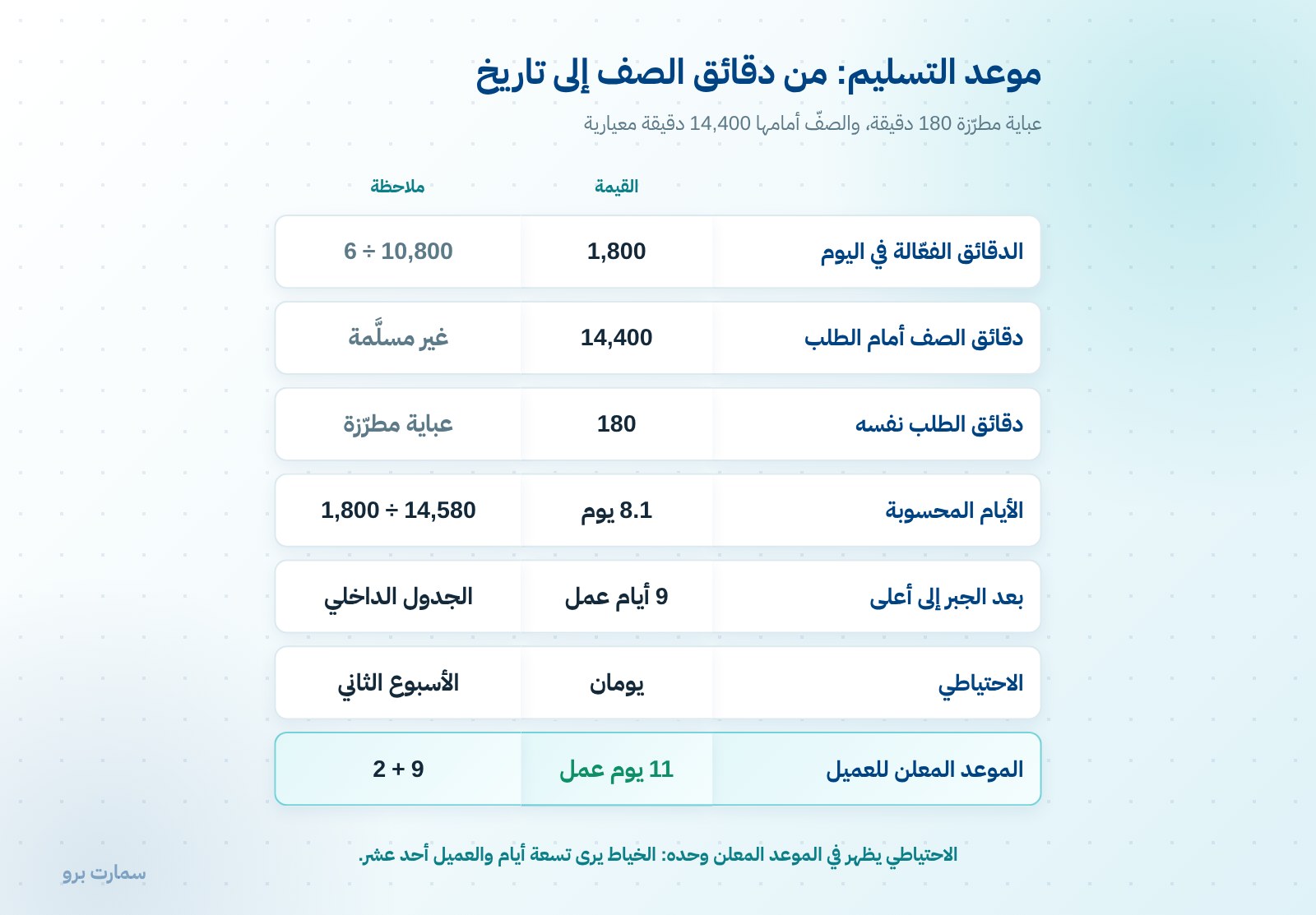
The figures below are hypothetical, used only to illustrate the method; they do not represent typical market rates. Using this series' parameters: five tailors × eight hours × six days = 14,400 available minutes a week. At a realistic 75% utilisation, that becomes 10,800 effective minutes, or 10,800 ÷ 6 = 1,800 effective minutes per working day.
The formula in one line:
Delivery date = today + (minutes already booked ahead of the order + the order's own minutes) ÷ 1,800 + buffer
Suppose an order for an embroidered abaya that takes 180 minutes, with 14,400 standard minutes of undelivered work queued ahead of it. Standard minutes are the expected time a trained tailor needs to complete one item.
- (14,400 + 180) ÷ 1,800 = 14,580 ÷ 1,800 = 8.1 working days
- Rounded up: 9 working days before the buffer
How to work out the standard minutes for each item and the minutes booked in the queue is explained in calculating workshop capacity.
How big should the buffer be?
The buffer is not a favour to the tailor; it is the price of uncertainty: absences, a broken machine, rework, and rush orders pushed ahead in the queue.
| Order's position in the queue | Buffer |
|---|---|
| Within the first week | One working day |
| One to two weeks | Two days |
| Two to four weeks | Three days |
| Peak season | 20% of the calculated days, minimum three days |
In our example the order sits in the second week, so the buffer is two days: 9 + 2 = 11 working days, which is the date announced to the customer.
The rule most people get wrong: the buffer appears in the date announced to the customer, not in the internal schedule. The tailor sees nine days; the customer sees eleven. Give the tailor the announced date and the buffer is used up before it is needed, leaving the date unprotected.
Stage checkpoints
A delivery date is not monitored on its last day but stage by stage: received → cut → sewn → pressed → ready → delivered. Each stage has its share of the minutes and a date it must be finished by.
For a plain thobe taking eighty minutes, with an announced date of eleven working days:
| Stage | Minutes | Share | Finish by |
|---|---|---|---|
| Cutting | 15 | 19% | Day 3 |
| Sewing | 55 | 69% | Day 8 |
| Pressing | 10 | 12% | Day 10 |
| Ready | — | — | Day 10 |
| Delivered | — | — | Day 11 |
The value of these checkpoints is that they turn a delay from a surprise on day eleven into a signal on day three. An order not cut by day three will not be delivered on day eleven, and knowing that early allows a cheap fix instead of an expensive apology.
How to record stages is covered in order stages, and linking each stage to the order and garment number in garment tagging.
How should the date be given at reception?
- A date, not a duration. "Thursday the 12th," not "in a week," because the customer counts the duration from the day you spoke and you count it from the day work starts.
- One date, not a range. The customer hears "between Sunday and Wednesday" as "Sunday," and you are held to "Wednesday."
- Written on the receipt, not spoken, together with the order number, the time it was received and the name of the person who received it.
- With the fitting condition, if there is one. A fitting the customer is late for delays delivery, and this is said at reception, not after the delay.
- No verbal promise faster than the written one. Most workshop delays come from a receptionist who wanted to please the customer by taking three days off.
- With a specific time if delivery falls on a busy day: "after Asr" prevents a queue at the door in the morning.
If a deposit is taken at reception, it needs its own invoice; details are in the deposit and VAT and the simplified invoice for tailors.
Tracking promised against actual
One number is measured monthly: on-time delivery rate = orders delivered on or before their date ÷ total orders delivered.
Suppose a month in which 320 orders were delivered, 41 of them late:
- On time: 320 − 41 = 279 orders
- On-time rate: 279 ÷ 320 = 87.2%
The practical target is 95% or above. In this workshop each percentage point equals about three orders a month, so the gap between 87.2% and 95% is 25 orders that need not have been late.
Measuring the rate alone is not enough. For every late order, record three things: the stage where it stalled, the reason, and the number of days late. That turns the indicator into a to-do list. Classifying the causes and dealing with them is covered in handling late orders.
Compare promised with promised, too
There is a second, less common but more useful measure: the gap between the calculated date and the announced date.
If the formula gives eleven days and staff announce eight, the problem is not in the workshop but at reception, and speeding up the tailors will not fix it. Measuring it is simple: store the calculated date with every order, then read the average gap each month.
If it is the other way round — the formula gives nine and staff announce fifteen — you are losing orders you would never have been late on, because the customer goes to whoever offers a sooner date that you could have met.
Three mistakes that break delivery dates
First: a date from memory, not from the queue. A thobe that needs eighty minutes might be delivered in three days if the queue is empty, and in three weeks if it is full. The minutes did not change; the position did.
Second: ignoring the intake ceiling. A precisely calculated date breaks if you take on orders beyond capacity afterwards, because the queue the calculation was built on has grown. The link between the two is explained in when to stop taking orders.
Third: free rushing. Every order moved up the queue without a fee delays other orders that were promised their dates, so free rushing becomes a tax paid by your reliable customers. Pricing it is covered in rush order fees.
Checklist before you state any date
- Did you take the standard minutes for this item from the table, not from memory?
- Did you read the minutes booked in the queue this morning?
- Did you add the buffer according to the order's position?
- Is the date a single date written on the receipt?
- Was the calculated date recorded next to the announced one for later comparison?
Five questions that take less than a minute at reception and save a week of apologies in the middle of the season.
The official reference
Rules on issuing invoices when payments are received and showing VAT are published by the Zakat, Tax and Customs Authority (ZATCA), which is the reference in case of any discrepancy.
Putting this into practice is easier when orders, fabrics and invoices live in one system — tailoring workshop management system.
Read also
Article visuals

Frequently asked questions
How do I calculate an order's delivery date?
Add the minutes booked ahead of the order to the order's own minutes, divide the total by the effective minutes in a working day, then add the buffer. In the hypothetical example, effective daily minutes came to 1,800, giving a date of nine working days before the buffer.
How big should the delivery date buffer be?
It depends on the order's position in the queue: one working day within the first week, two days up to two weeks, three days up to four weeks, and in peak season 20% of the calculated days with a minimum of three days. The buffer appears only in the date announced to the customer, not in the internal schedule.
How can I tell an order will be late before its due date?
Use stage checkpoints. A thobe with an eleven-day date must be cut before day three, sewn before day eight and pressed before day ten. An order not cut by day three will not be delivered on day eleven, so the warning shows up early.
What on-time delivery rate should I aim for?
95% or above. It is calculated by dividing orders delivered on or before their date by total orders delivered. In the hypothetical example, 320 orders were delivered and 41 were late, giving 87.2%, so the gap to the target is 25 orders that need not have been late.