
Workshop Capacity: Calculate It Before You Promise a Customer a Date
Tailoring workshop capacity is calculated in minutes, not by feel. Start with available minutes and a realistic utilisation rate. Add the average minutes per item to get a safe weekly intake number, then see what promising beyond it really costs.
Author:سامي الحيدري
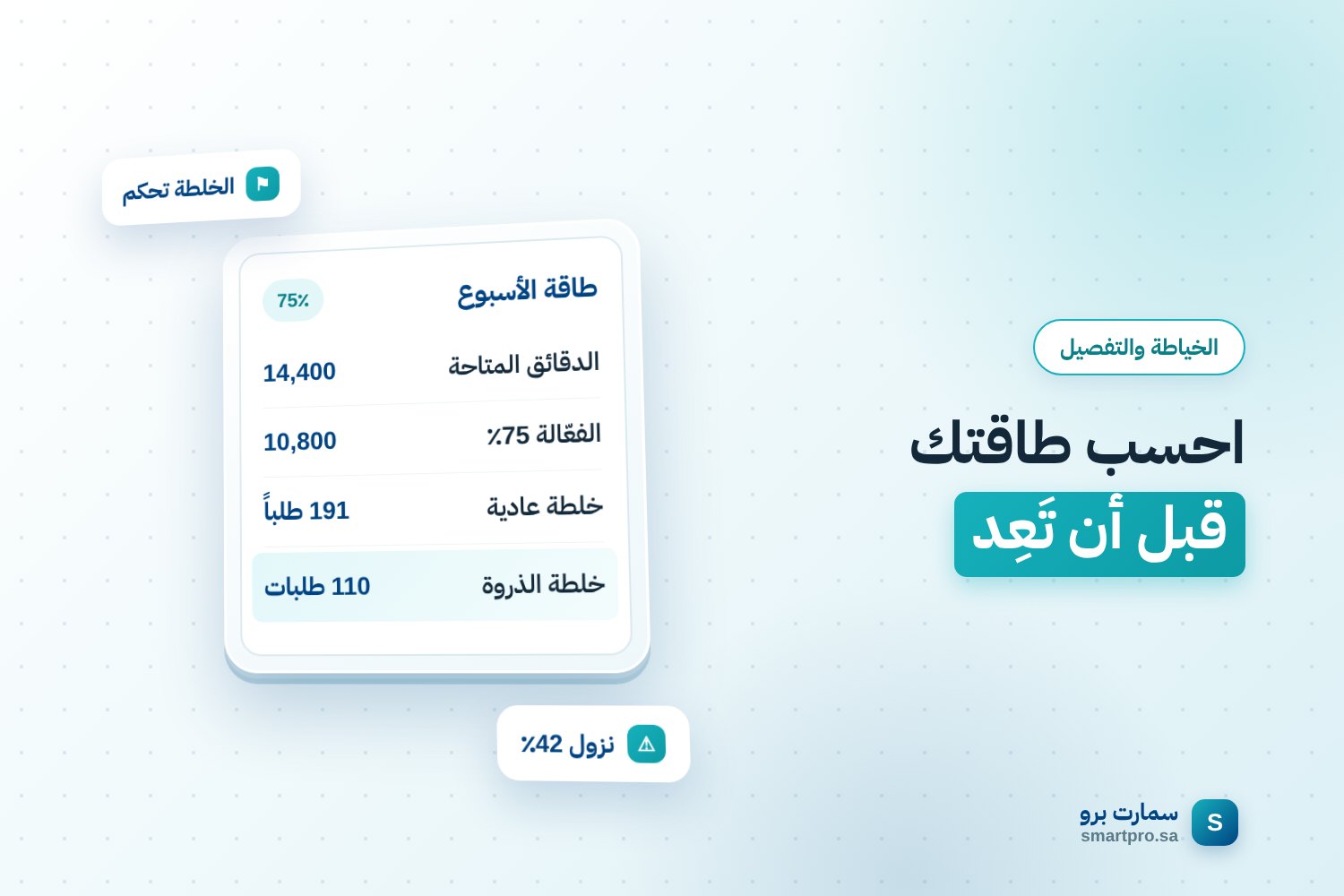
Tailoring workshop capacity is the number you should calculate before any delivery date is spoken. In most tailoring workshops the date is promised first, and the schedule then tries to catch up with it. It never does.
The result is familiar. The queue keeps growing, every day turns into a rush, and delays pile up. Discounts and compensation then eat the margin on orders that were profitable when you accepted them.
Calculating capacity does not need a complex system or a long spreadsheet. It needs three numbers: available minutes, average minutes per item, and a realistic utilisation rate.
Workshop capacity: start with available minutes
The figures below are hypothetical and only illustrate the method. They do not represent typical market rates. The reference workshop in this series has five tailors working eight hours a day, six days a week.
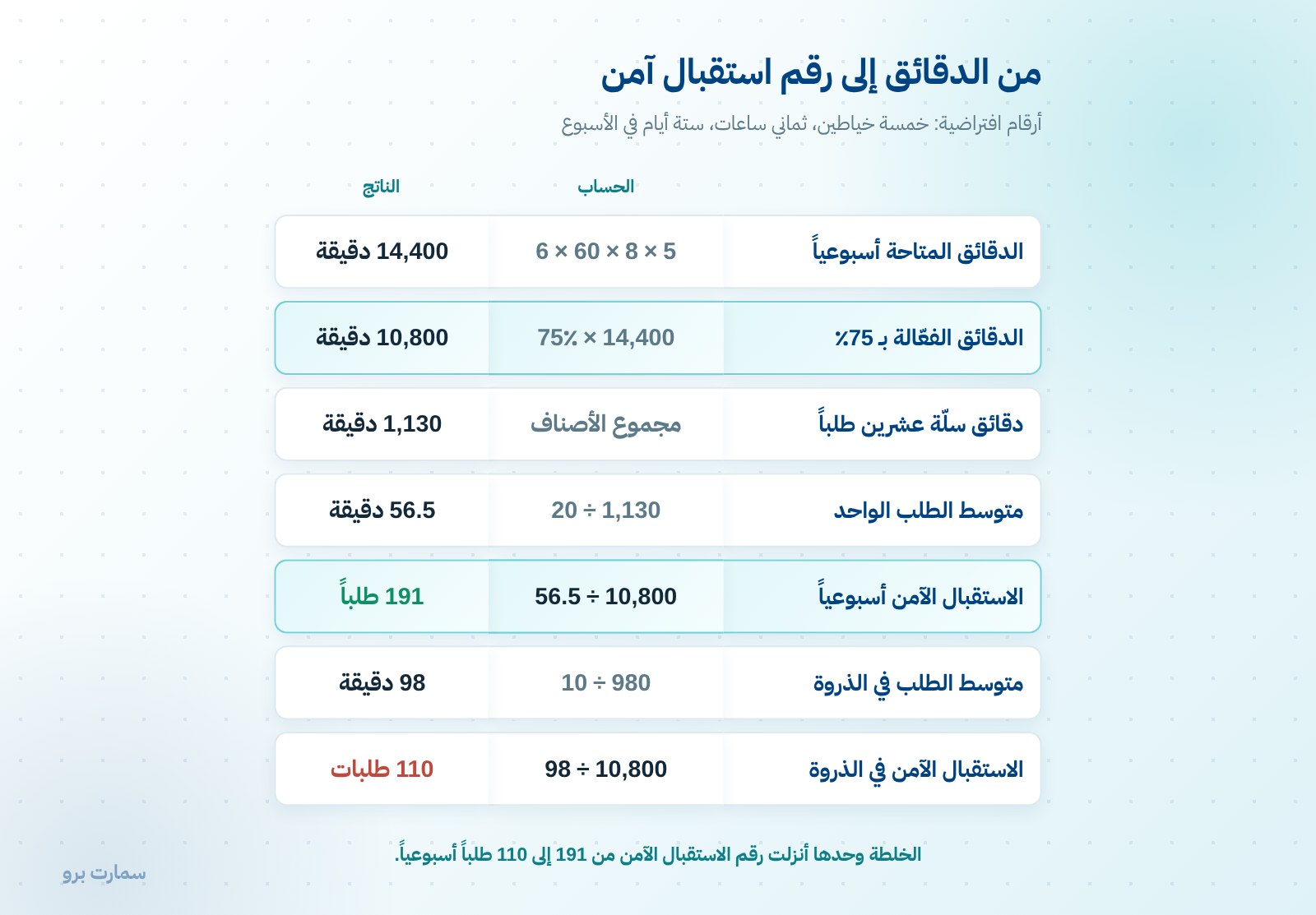
- Available minutes per week: 5 × 8 × 60 × 6 = 14,400 minutes
- Over 26 working days a month: 5 × 8 × 60 × 26 = 62,400 minutes
This is a gross figure, and it is no basis for any promise. It assumes every minute of a tailor's shift is a sewing minute. That never happens in any workshop, and it isn't meant to.
Realistic utilisation: where does a quarter of the minutes go?
Utilisation means the share of paid working time that actually goes into producing garments.
| What uses up the minutes | Estimate |
|---|---|
| Receiving, measuring and fittings | 7% |
| Waiting between stages | 6% |
| Rework and repairs | 5% |
| Machine setup and maintenance | 4% |
| Interruptions and partial absence | 3% |
| Total | 25% |
So effective minutes per week are 14,400 × 75% = 10,800 minutes, and per month 62,400 × 75% = 46,800 minutes. This is the number your promises should rest on, not the gross figure.
The 75% is not a rule. It is a starting estimate that you replace with your own measurement. Add up the standard minutes for the pieces actually delivered in a month, then divide by the available minutes in that month: the result is your real utilisation. How to measure it for each tailor is covered in tailor productivity.
Average minutes per item
Minutes are measured only on the stages that consume a tailor's time. The usual order stages run: received → cutting → sewing → ironing → ready → delivered. The "ready" and "delivered" stages use no sewing minutes, so they are left out of this calculation.
| Item | Cutting | Sewing | Ironing | Total |
|---|---|---|---|---|
| Plain thobe | 15 | 55 | 10 | 80 |
| Thobe with custom details | 20 | 78 | 12 | 110 |
| Plain abaya | 12 | 48 | 10 | 70 |
| Embroidered abaya | 20 | 140 | 20 | 180 |
| Medium alteration | 3 | 15 | 2 | 20 |
Measure these times on five real pieces of each item, using the average rather than the fastest, and review them every quarter. Never borrow them from another workshop. They change with your equipment, your tailors' skill, your cutting method and even the fabric you mostly work with.
From capacity to a safe intake number
You don't take in "orders"; you take in minutes. Turning capacity into a number of orders requires knowing your mix, meaning the share of each item in what actually comes through your door.
Suppose every 20 orders in a normal week look like this:
| Item | Count | Minutes each | Minutes |
|---|---|---|---|
| Plain thobe | 4 | 80 | 320 |
| Thobe with custom details | 2 | 110 | 220 |
| Plain abaya | 3 | 70 | 210 |
| Embroidered abaya | 1 | 180 | 180 |
| Medium alteration | 10 | 20 | 200 |
| Total | 20 | 1,130 |
The average per order is 1,130 ÷ 20 = 56.5 minutes. The safe weekly intake is therefore 10,800 ÷ 56.5 = 191 orders.
That number is a ceiling, not a target. Anything above it doesn't become work; it becomes a delay scheduled in advance.
The same number flips when the mix changes
In peak season the mix changes. Alterations almost disappear and made-to-measure work takes a bigger share. Assume a peak mix of 10 orders:
| Item | Count | Minutes each | Minutes |
|---|---|---|---|
| Plain thobe | 5 | 80 | 400 |
| Thobe with custom details | 3 | 110 | 330 |
| Plain abaya | 1 | 70 | 70 |
| Embroidered abaya | 1 | 180 | 180 |
| Total | 10 | 980 |
The average per order is 980 ÷ 10 = 98 minutes. The safe intake drops to 10,800 ÷ 98 = 110 orders.
Same workshop, same tailors, same hours, yet the safe intake fell from 191 to 110, about 42%, purely because the mix changed. A workshop that takes orders in peak season using the number it learned in normal months starts the season late from its first week. The full seasonal plan is in tailoring workshops in Ramadan.
The cost of promising beyond capacity
Suppose that in a peak week you accept 140 orders instead of 110, which is 30 orders over capacity. They need 30 × 98 = 2,940 minutes that have no place in that week.
Those minutes don't vanish; they get pushed into the following week. The delay from one week is 2,940 ÷ 10,800 = 0.27 weeks, or about 1.6 working days.
The real problem is accumulation, not the single week. If it happens four weeks in a row: 2,940 × 4 = 11,760 minutes, and 11,760 ÷ 10,800 = 1.09 weeks, or about six and a half working days of delay. That delay lands on every order in the queue, not just the last thirty.
This is where the true cost shows up: rushing and overtime, rework from finishing under pressure, late-delivery compensation, and customers who don't come back. Handling it after it happens is covered in late orders, and preventing it in stopping order intake.
How do you use the number every week?
- Update your booked minutes every morning: the total standard minutes of all orders not yet delivered.
- Divide them by 10,800 to see how many weeks of work are in the queue. This is the only number to look at before making any promise.
- Subtract booked minutes from capacity to see the minutes left this week, and use them to set the date for each new order, as explained in setting delivery dates.
- Review your mix monthly, because any change in it changes your safe intake number even if nothing else changes.
- Re-measure your times every quarter, and after any change in equipment or tailors.
Linking these steps to recorded order stages is what makes them workable every day, instead of an exercise done once a year and then forgotten. The details are in order stages.
Capacity isn't only minutes
A single cutting table limits how many pieces can be cut in a day. The fitting room limits how many fittings you can do. Storage space limits how many finished pieces you can hold before their owners collect them.
So a workshop that tries to raise capacity by hiring more tailors alone may hit the space limit before the minutes limit, and end up paying wages for people with no table to work at. Requirements for shop space, the sewing area and storage are published by the Ministry of Municipalities and Housing, and summarised in tailoring shop requirements.
There is a third constraint the calculation tends to miss: minutes are not interchangeable between tailors. Ten free minutes with a tailor who can't cut do not replace ten minutes needed by the cutter. That is why the constraint is calculated at the narrowest stage, not on the total, and in most workshops the narrowest stage is cutting.
Three mistakes in calculating capacity
- Calculating on gross minutes without a utilisation rate, which produces a ceiling a third higher than reality.
- Using one average for all items, so an alteration and an embroidered abaya are both counted at twenty minutes in the same figure.
- Ignoring the mix, so the normal-month intake number is used in peak season. As shown above, that overshoots the correct number by about 81 orders a week.
If you want to do all of this without scattered spreadsheets, that is what the tailoring and made-to-measure system is for.
Read also
Article visuals

Frequently asked questions
How do I calculate my tailoring workshop's capacity?
Start with available minutes: number of tailors × hours × 60 × working days. In the hypothetical example, five tailors working eight hours over six days give 14,400 minutes a week. Multiply that by a realistic utilisation rate of about 75% and you get 10,800 effective minutes.
Why shouldn't every minute of the shift be counted?
Because roughly a quarter of the time goes to receiving, measuring and fittings, waiting between stages, rework, machine setup and maintenance, and interruptions. Calculating on gross minutes gives a ceiling a third higher than reality, so the first date built on it breaks. The right rate is measured from your own records, not borrowed.
How many orders should I accept per week?
Divide your effective minutes by the average minutes per order in your mix. In the hypothetical normal mix the average was 56.5 minutes, giving a ceiling of 191 orders. In the peak mix it was 98 minutes, so the ceiling fell to 110 orders, about 42% lower. Review your mix monthly, because a change in it alone changes the ceiling.
What does accepting orders beyond capacity cost?
The delay accumulates rather than disappearing. Thirty orders over capacity mean 2,940 minutes pushed into the next week, about 1.6 working days. Repeating that for four weeks creates a delay of about six and a half working days on every order in the queue.