
Tailoring Shop Requirements in Saudi Arabia: The Complete Guide in Numbers
The approved tailoring shop requirements in numbers: areas, required zones, the fitting room, women's shops, and five widely shared claims that turn out to be wrong.
Author:سامي الحيدري
Tailoring shop requirements in Saudi Arabia are published and set out in specific numbers, yet most of what shop owners pass around comes from old guides or personal interpretation. The result: a shop gets fitted out for a requirement that no longer applies, or misses out on a layout that was allowed all along.
This article sets out the approved requirements issued by ministerial decision of the Ministry of Municipalities and Housing, then corrects five widely shared but wrong claims.
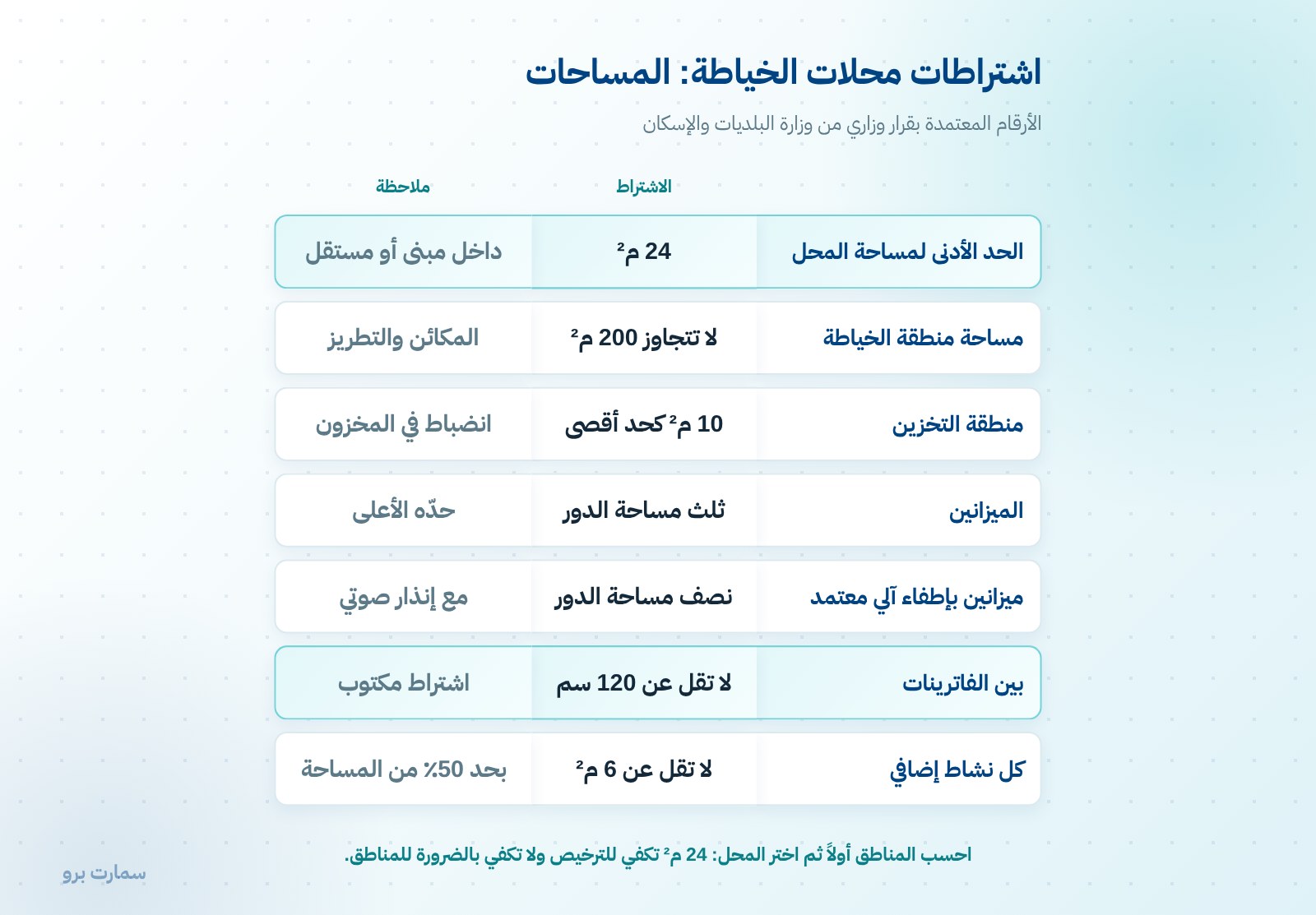
Tailoring shop requirements: floor areas
| Item | Requirement |
|---|---|
| Minimum shop area | 24 m² |
| Tailoring zone area | No more than 200 m² |
| Storage zone | 10 m² maximum |
| Mezzanine | No more than one third of the floor area |
| Mezzanine with approved automatic fire suppression and audible alarm | Up to half of the floor area |
The 24 m² minimum is the same whether the shop is inside an existing building or on a standalone site.
Which internal zones are required?
The shop is not one open space; it is made up of defined zones:
- Reception and cashier zone.
- Storage zone, capped at 10 square metres.
- Tailoring zone, where the sewing machines and embroidery equipment sit.
- Display zone, laid out so customers can move around, with at least 120 cm between showcases or central display units.
- Toilets, washbasins and a prayer area where needed.
- Fitting room, which has its own separate, detailed requirements.
The 120 cm spacing is not a design recommendation; it is a written requirement. It is also the first thing inspectors notice on a site visit, because it is easy to measure.
What extra rules apply to women's shops?
Outlets staffed by women have additional provisions within the same requirements: only women may work there, men may not enter during working hours, the design must prevent the interior from being seen from outside, and internal surveillance cameras are prohibited, allowed only in a separated reception area. These provisions are published within the requirements approved by the ministry.
The unified QR code and electronic payment
- The unified electronic code (QR) is placed on the shop front or at a visible point such as the customer service counter, and must be accessible outside working hours too. It removes the need to print and hang documents.
- Electronic payment methods must be available and working, and refusing to accept them is not allowed. A sticker must show which methods are accepted.
Refusing electronic payment because of a fault or the card fees is a clear violation, not a matter of interpretation.
What must be in place before licensing?
- Compliance with the Municipal Licensing Law and its implementing regulations.
- Civil Defense approval before the licence is issued.
- A valid commercial registration that covers the activity being licensed.
- Approval from the authority supervising the activity, if there is one.
Applications are submitted through the Balady platform.
Can you run additional activities in the same shop?
Additional approved activities may be carried out inside the shop, subject to three limits:
- Their combined area must not exceed 50% of the total area stated on the licence.
- The minimum area for the main activity must remain intact.
- Each additional activity must be at least 6 m².
Carrying out an activity that is not recorded on the licence is prohibited, even if it complements tailoring.
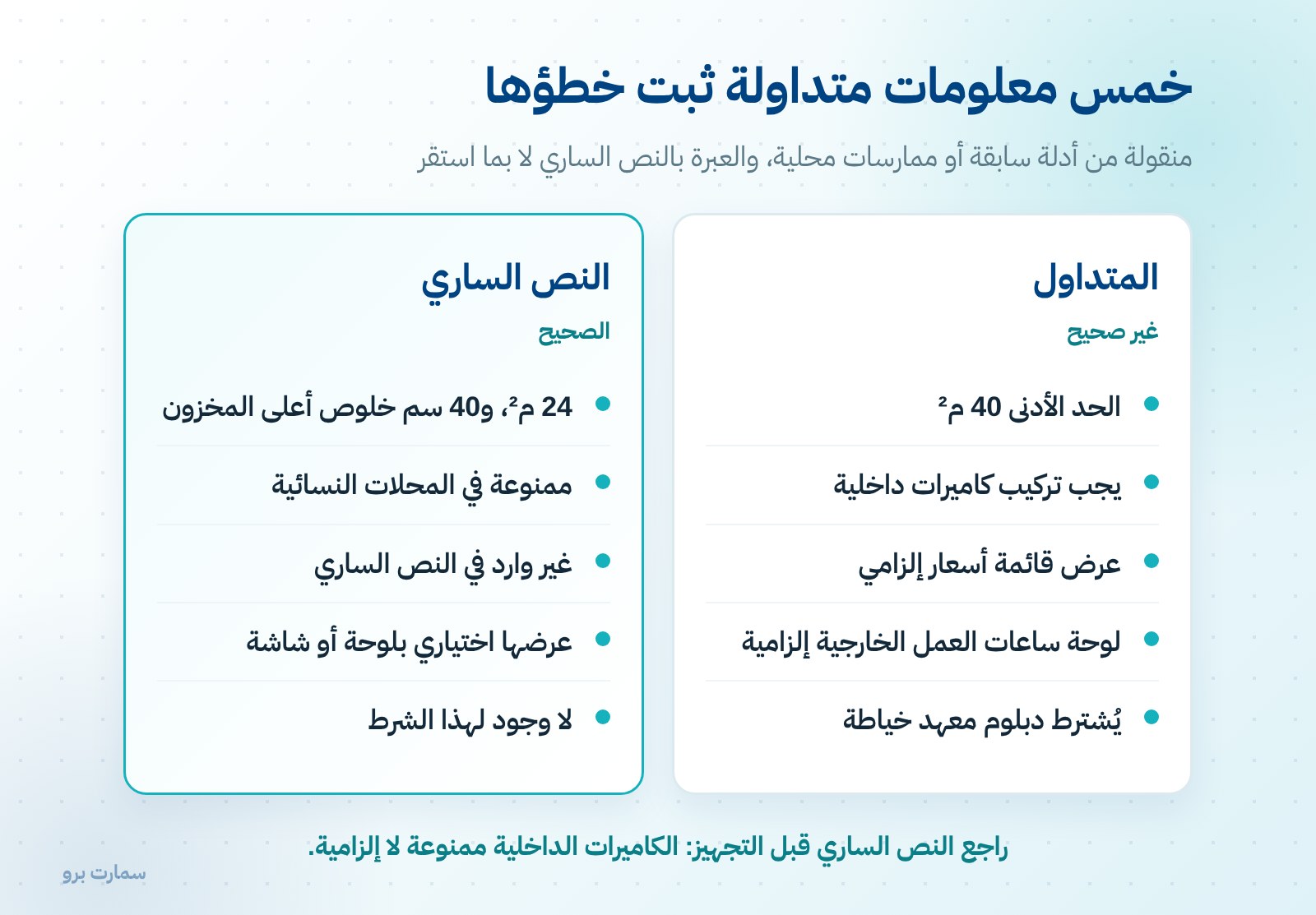
Five widely shared claims that are wrong
| What people say | What is correct |
|---|---|
| The minimum is 40 m² | 24 m². The 40 in the text is 40 centimetres of clearance above stored goods |
| Internal cameras must be installed | Prohibited in women's shops |
| Displaying a price list is mandatory | Not in the current text; prices are required on the products the shop sells |
| An external working-hours sign is mandatory | Displaying it is optional; if shown, it can be a sign or a screen |
| A tailoring institute diploma is required | No such condition exists in the current text |
These five come from earlier guides or local practice, and some of them really did apply years ago. What counts is the current text, not what has settled in people's minds.
Three practical points before you fit out
First: the minimum area is not a target. 24 square metres is enough for a licence, but not necessarily enough for a tailoring zone, a display zone, a fitting room and a store with 120 cm between showcases. Work out your zones first, then choose the shop.
Second: the store is only 10 square metres. That forces strict discipline on fabric stock, with no room for excess, and turns managing metres and offcuts into a question of space, not just accounting. Pricing your work carefully helps here too; see how to build a tailoring price list in tiers and add-ons and costing tailoring margin per item by the minute.
Third: Civil Defense comes before, not after. Its approval is a condition for issuing the licence, so safety fit-out comes before the application, not after it.
What if the shop opened before the requirements?
The requirements were issued by a ministerial decision with a specific number and date, and some municipalities announce correction periods for existing businesses. The reliable source for what applies to your shop is the municipality (Amanah or Baladiyah) your shop falls under and the Balady platform, not what circulates among shop owners.
The safest approach is to measure your shop against the table above yourself before someone else comes to measure it: the areas, the spacing between showcases, the fitting room, the unified QR code and the payment methods.
The official reference
The approved tailoring shop requirements are published by the Ministry of Municipalities and Housing, and they are the only reference in case of any discrepancy. This article summarises them and does not replace them; check the published text before any fit-out or alteration decision.
Putting all this into practice is easier when orders, fabrics and invoices sit in one system: SmartPro's tailoring shop management system.
Read also
- Tailoring price list: how to build it in tiers and add-ons
- Tailoring profit margin per item: costing by the minute
Key takeaway: Plan your shop around the published numbers (24 m² minimum, 10 m² storage, 120 cm between showcases) and get Civil Defense approval before applying; when in doubt, the ministry's published text and your municipality decide.
To see how measurements, fabric stock and invoices work together in one place, start a free SmartPro trial.
Article visuals
Frequently asked questions
What is the minimum area for a tailoring shop in Saudi Arabia?
The minimum is 24 square metres, whether the shop is inside an existing building or on a standalone site. The widely quoted figure of 40 square metres does not appear in the approved requirements; the number 40 in the text refers to 40 centimetres of clearance between the top of stored goods and the ceiling.
Do women's tailoring shops have to install surveillance cameras inside?
No, the opposite is true: the requirements prohibit internal surveillance cameras in women's shops and allow them only in a reception area separated from the work area. This is one of the rules most often understood the wrong way round during fit-out.
Which zones must a tailoring shop contain?
A tailoring shop needs a reception and cashier zone, a storage zone of no more than 10 square metres, a tailoring zone, a display zone with at least 120 centimetres between showcases, and a fitting room. Toilets, a prayer area and a mezzanine within its permitted limits may also be added.
Do I need a qualification or diploma to open a tailoring shop?
No such condition appears in the current requirements. What is required is compliance with the Municipal Licensing Law, Civil Defense approval before the licence is issued, a valid commercial registration covering the activity, and approval from the supervising authority if there is one.