
From Notebook to System: Moving a Tailoring Workshop in Four Weeks
Moving from notebook to system starts with the present, not the past. What to digitise first, how to move measurements without copying errors, and how long to run both in parallel before you stop.
Author:سامي الحيدري
Moving a tailoring workshop from notebook to system works when you digitise only what you will use tomorrow: active customers, their current measurements, every order in progress, the price list and opening fabric balances. Archive the old notebooks as scanned reference, run notebook and system in parallel for a fixed four weeks, and close the notebook against measurable exit criteria.
In practice, the switch usually starts with the worst possible step. The owner and the front-desk employee sit down to enter three years of old orders. They keep at it for two weeks, then stop. The notebook stays the reference, and the system becomes an open screen nobody looks at.
The problem is not the system or the staff. The problem is that the switch started from the past instead of the present.
The past is not digitised; it is preserved. The old notebook is scanned and archived, and it stays a reference to read, not a source to enter. What goes into the system is only what will be used tomorrow.
From notebook to system: what to digitise first and what to leave
| Data | Digitise now? | Why |
|---|---|---|
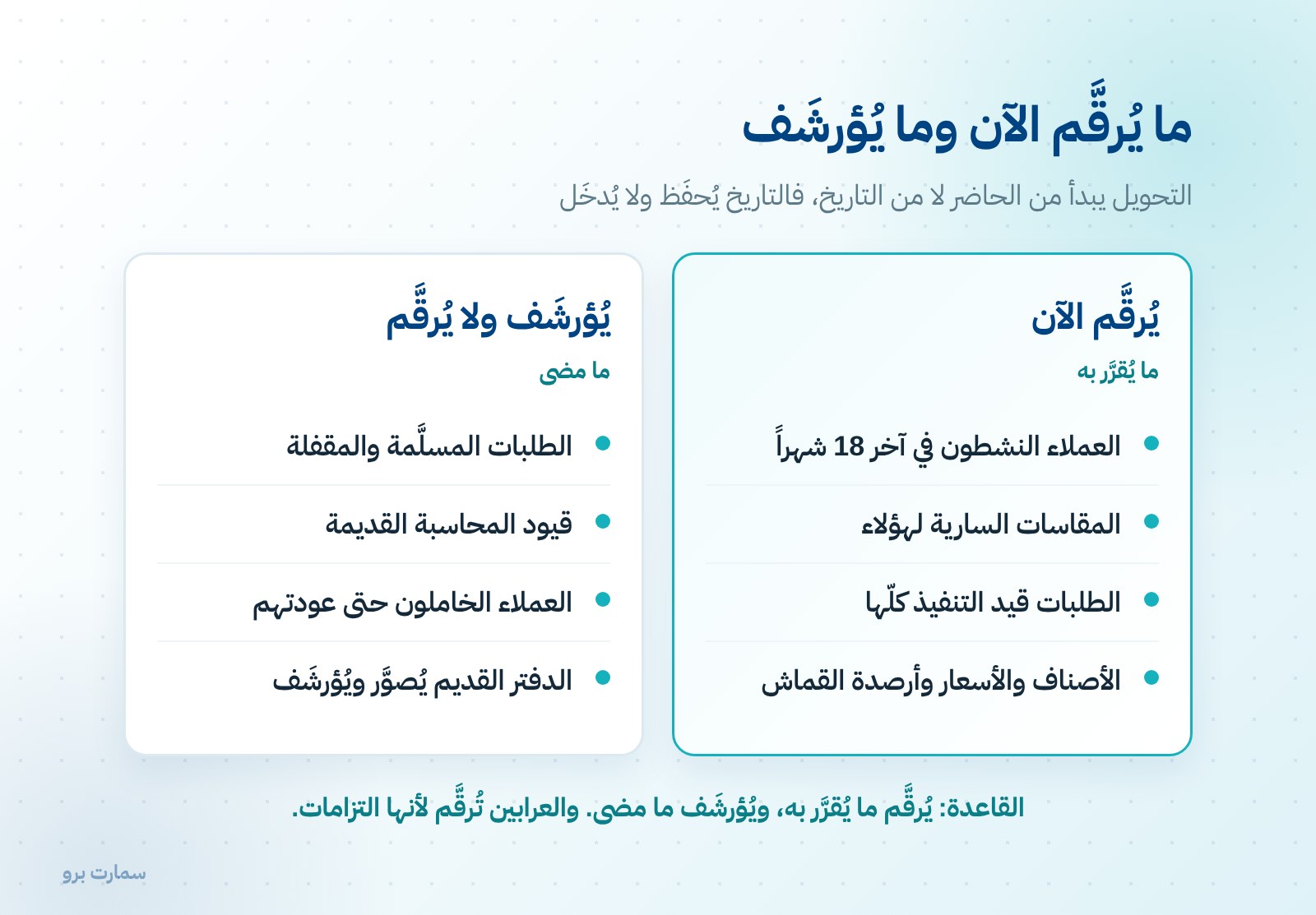
| Customers active in the last 18 months | Yes, first | They are the ones coming back this month |
| Current measurements for those customers | Yes, first | Without measurements the system cannot work at all |
| All orders in progress | Yes, without exception | Any order left out gets lost between the two records |
| Items and price list | Yes | Required before any new order can be entered |
| Fabric and trimmings balances | Yes, as an opening balance from a physical count | The notebook balance is usually wrong |
| Deposits and finished orders not yet collected | Yes | Open financial obligations on the workshop |
| Delivered and closed orders | No | They are finished, and no decision depends on them |
| Old accounting entries | No | They stay in their own books; the system opens with a balance |
| Inactive customers | No | They are entered the moment they return, not before |
The rule behind the whole table: digitise what you make decisions with, archive what is over. A customer who has not visited in two years costs you nothing while outside the system, and costs you two weeks of data entry once inside it.
There is one exception from the past, and it is a single field: a reference order number for every repeat customer who was fully satisfied with it. That number turns "same as the last thobe" into something the workshop can actually make, and it alone deserves to be carried over from the notebook.
How do you move measurements without copying the errors?
This is the most dangerous step of the whole switch, because a mistake here becomes fixed. A handwritten number in a notebook is read as an estimate; the same number on a clean screen is read as fact. Copying word for word gives the notebook's errors the look of precision.
Six steps prevent this:
- Write the measurement standard before you copy a single figure. Define where each field is measured from and to, and whether it is taken on the body or on the garment, as set out in thobe measurements. Copying without a standard is copying numbers without meaning.
- Copy the number as it is, and do not correct it by guesswork. A doubtful number is flagged, not changed, because correcting from memory adds a second error on top of the first.
- Add two fields to every transferred record: the source of the number (notebook) and the date it was measured. If the date is unknown, write "unknown" and do not invent one.
- Every transferred record goes in as version one with the status "unconfirmed". Confirmation happens on the next order with a short re-measure, which opens a second, "confirmed" version, as described in measurement records.
- Check the ranges before entry. Any number outside a reasonable range is flagged and not entered, because most of these are handwriting misreads, not measuring errors.
- Enter ten percent twice. Two people enter them independently and the results are compared. The rate of mismatch between them is your first real measure of how reliable your old notebook is.
Check ranges you can adopt for a men's thobe:
| Field | Accepted range without a flag |
|---|---|
| Total length | 130 – 160 cm |
| Chest circumference | 84 – 140 cm |
| Waist circumference | 70 – 140 cm |
| Sleeve length | 54 – 68 cm |
| Neck circumference | 36 – 50 cm |
Step six is the one most often dropped because it looks like a luxury. It is not. If mismatches show up in ten percent of the records, your notebook carries an error in every tenth record, and double entry should cover everyone, not just a tenth.
Why do staff resist, and what should you do?
Resistance is not stubbornness. Four real reasons sit behind it, and each needs a different answer:
- Fear of being measured. The system records who completed each stage and when, which the notebook never did. Performance that was hidden becomes visible.
- Fear for their pay. The tailor assumes the system is a prelude to changing how he is paid, and that the minutes will be used against him.
- The digital and language barrier. A screen in written Arabic for a tailor who cannot read it is a real barrier, not bad faith.
- Loss of standing. Whoever kept a hundred customers' measurements in his head was indispensable; the system makes that knowledge available to everyone.
Five actions bring resistance down to a minimum:
- Do not introduce the system and change the pay method in the same month. This is the most important line in this article. Mixing the two changes gives staff a legitimate reason to resist and links the system in their minds to a pay cut. Review the pay method three months after the system has settled; the details are in piece-rate wages for tailors.
- Show the gain, not the duty. The tailor gets a complete work sheet instead of a scrap of paper, fewer interruptions, and pay calculated in front of him without argument.
- One screen per role. The cutter needs only two screens: what is waiting to be cut, and recording the metres used. The full system is for management, not the workshop floor.
- Whoever enters the data owns the field. The person who takes the measurement records it, and the person who completes a stage updates it. Entry on others' behalf by the front desk is what produces data nobody trusts.
- Pick your first adopter from the workshop. One tailor respected by his colleagues is trained first and becomes their go-to person. Learning from a colleague is accepted; learning from management is resisted.
How long should notebook and system run in parallel?
Parallel running means operating the notebook and the system side by side during the switch. It is necessary, but open-ended parallel running is a disaster. A workshop running both with no closing date does not have a system; it has two notebooks and double the work.
Three rules keep it under control:
- A declared, written duration: four weeks is enough for a mid-sized workshop. Write the closing date on the notebook's cover on day one.
- One source of truth from day one: the system is the source, and the notebook is a backup that is written, not read. If they differ, the system is right and the notebook is corrected to match it, not the other way round.
- A measurable exit criterion, not a feeling of comfort.
Three conditions for leaving parallel running:
- One hundred percent of new orders entered the system on the day they were received, not the next day.
- Fabric stock variance below 2% between the system balance and the physical count, as explained in fabric stocktake.
- Zero orders in the system with a stage not updated for 48 hours, because a stale stage is a sign updates are happening in the notebook, not the system.
The stages themselves keep the names the workshop already uses: received → cutting → sewing → ironing → ready → delivered. The details are in order stages.
Worked example: what does the switch cost?
The figures below are hypothetical to illustrate the method and do not represent prevailing market prices. Using this series' parameters: a front-desk minute costs SAR 0.36, and a tailor's loaded minute costs SAR 0.73. Assume a workshop with 420 active customers, 196 orders in progress, five tailors and two front-desk staff.
| Item | Calculation | Amount (SAR) |
|---|---|---|
| Entering customers and measurements | 420 × 4 minutes × 0.36 | 604.80 |
| Entering orders in progress | 196 × 2 minutes × 0.36 | 141.12 |
| Items, prices and fabric balances | 600 minutes × 0.36 | 216.00 |
| Workshop training | 5 × 90 minutes × 0.73 | 328.50 |
| Front-desk training | 2 × 120 minutes × 0.36 | 86.40 |
| Four weeks of parallel running | 20 minutes × 24 days × 0.36 | 172.80 |
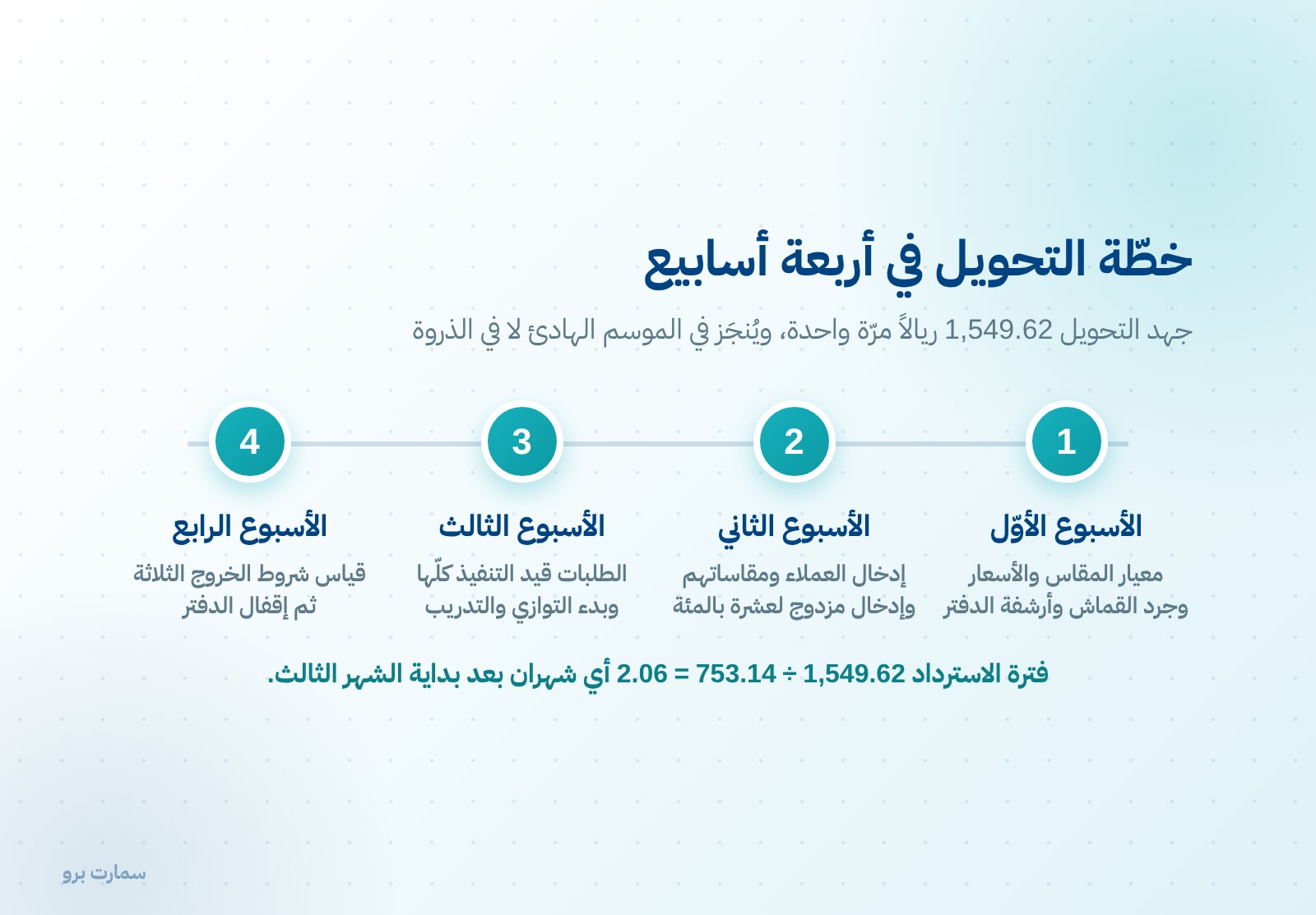
| Total switch effort | 1,549.62 |
This figure is internal effort, not cash out the door, and it should be done in the quiet season, not at peak. Note that the largest item is entering customers and measurements, the very item that would have tripled had the past been entered too.
What do you gain in month one, and what in month three?
The figures below are hypothetical to illustrate the method and do not represent prevailing market prices.
| Month one | Month three | |
|---|---|---|
| What you get | Visibility | Numbers |
| Stages | You know how many orders are at each stage today | You know where the bottleneck keeps recurring |
| Late orders | They show on a screen instead of in a customer's phone call | You know the cause and the stage |
| Ready but not collected | A list you can call | A written policy applied with dates |
| Fabric | Opening balance only | Usage against standard with a measured variance |
| Productivity | Nothing to compare yet | Averages per tailor and per item |
| Speed | Slower than the notebook | Clearly faster |
The last line must be said plainly before you start: month one is slower than the notebook, because staff are learning, entering and checking at the same time. That is normal and not a sign of failure. Anyone not told this in advance concludes in week two that the system has failed and goes back to the notebook.
In month three the numbers begin. Using this series' parameters: the variance between fabric used and standard is SAR 911.33 a month in workshop reports, and the cost of measurement errors is SAR 892.40 a month in measurement records:
- Half the fabric variance is caught by the weekly review: 911.33 × 50% = SAR 455.67
- A third of measurement errors are prevented by versioning: 892.40 ÷ 3 = SAR 297.47
- Value captured per month: SAR 753.14
Payback period for the switch effort: 1,549.62 ÷ 753.14 = 2.06, roughly two months after the start of month three. This is a conservative estimate, because it does not count the orders that are no longer late or the complaints that never happen.
What does the four-week plan look like?
- Week one: write the measurement standard, items and prices; count fabric for an opening balance; scan and archive the notebook.
- Week two: enter active customers and their measurements as unconfirmed version one, and double-enter ten percent.
- Week three: enter every order in progress, start parallel running, and train each role on its own screen.
- Week four: measure the three exit conditions, fix what falls short, then close the notebook on its written date.
One month after closing is dedicated to a single task: confirming transferred measurements order by order, so that no "unconfirmed" record remains in the system after six months.
Three mistakes to avoid in the switch
First: starting with the past. Two weeks of entering data that no decision depends on, and the enthusiasm runs out before you reach the present.
Second: changing the system and the pay method together. Resistance moves from learning to salary, and that is a battle you cannot win.
Third: parallel running with no closing date. The workshop settles into two notebooks, and the system becomes an extra burden rather than a replacement.
Where is the official reference?
Rules on the invoices handed to customers, and the invoice data your system must hold, are published by the Zakat, Tax and Customs Authority (ZATCA), which is the reference in case of any difference; the details are in the simplified invoice for tailors. Requirements for the shop itself are covered in tailoring shop requirements.
Everything described here is handled in practice in SmartPro's tailoring system: orders, measurements, fabrics and invoicing in one place.
Read also
- Tailoring workshop management system: how to choose one
- The six workshop reports and the cycle for each
- Measurement records and measurement versions
Key takeaway: Digitise the present, archive the past, and close parallel running on a written date once three measurable conditions are met. Never change the pay method in the same month you introduce the system.
To see this workflow on your own data, start a free trial or book a demo tailored to tailoring workshops.
Article visuals
Frequently asked questions
What should I digitise first when moving my tailoring workshop to a system?
Start with customers active in the last 18 months and their measurements, then every order in progress, then items, prices and fabric balances as an opening balance from a physical count. Closed orders, old accounting entries and inactive customers are not digitised, because no decision depends on them.
How do I move measurements without copying the notebook's errors?
Write the measurement standard before transferring anything, copy each number as it is without correcting it by guesswork, and record its source and date. Enter it as an unconfirmed first version that is confirmed with a re-measure on the next order. Check values against reasonable ranges, and have two people enter ten percent of records independently and compare the results.
How do I handle tailors' resistance to the new system?
The most important rule is not to introduce the system and change the pay method in the same month, because mixing them links the system to a pay cut. Show staff what they gain rather than what they must do, give each role a single screen, and train a tailor respected by colleagues to be their go-to person. Make the person who takes a measurement record it personally, not have someone enter it on their behalf.
How long should the notebook and the system run side by side?
Four weeks is enough for a mid-sized workshop, with a closing date written on the notebook's cover from day one. You exit on three measured conditions: every new order entered the system on its day, fabric stock variance below 2%, and zero orders with a stage not updated for 48 hours.