
Piece Rates for Tailors: Build Them by Calculation, Not Habit
Piece rates for tailors come from a division, not a guess. How to work out the rate per minute and per piece, and what Saudi Labour Law says about pay timing and deduction limits.
Author:سامي الحيدري

Piece rates for tailors are the most common pay model in tailoring workshops, and the least disciplined in the books. The rate is agreed verbally, tallied in a notebook and paid whenever cash is available. Months later a dispute surfaces, and there is nothing to refer back to.
The problem is not the model itself. Piece-rate pay is legitimate and suits the nature of the work. The problem is that it is run on habit instead of being built on a calculation and a record. This article is about building it: where the rate comes from, what it should cover, and what Saudi labour rules say about paying it and deducting from it.
Piece rates for tailors: where does the rate come from?
A piece rate is not a number borrowed from the workshop next door, because your costs and capacity are not theirs. It is the result of a division, not an estimate.
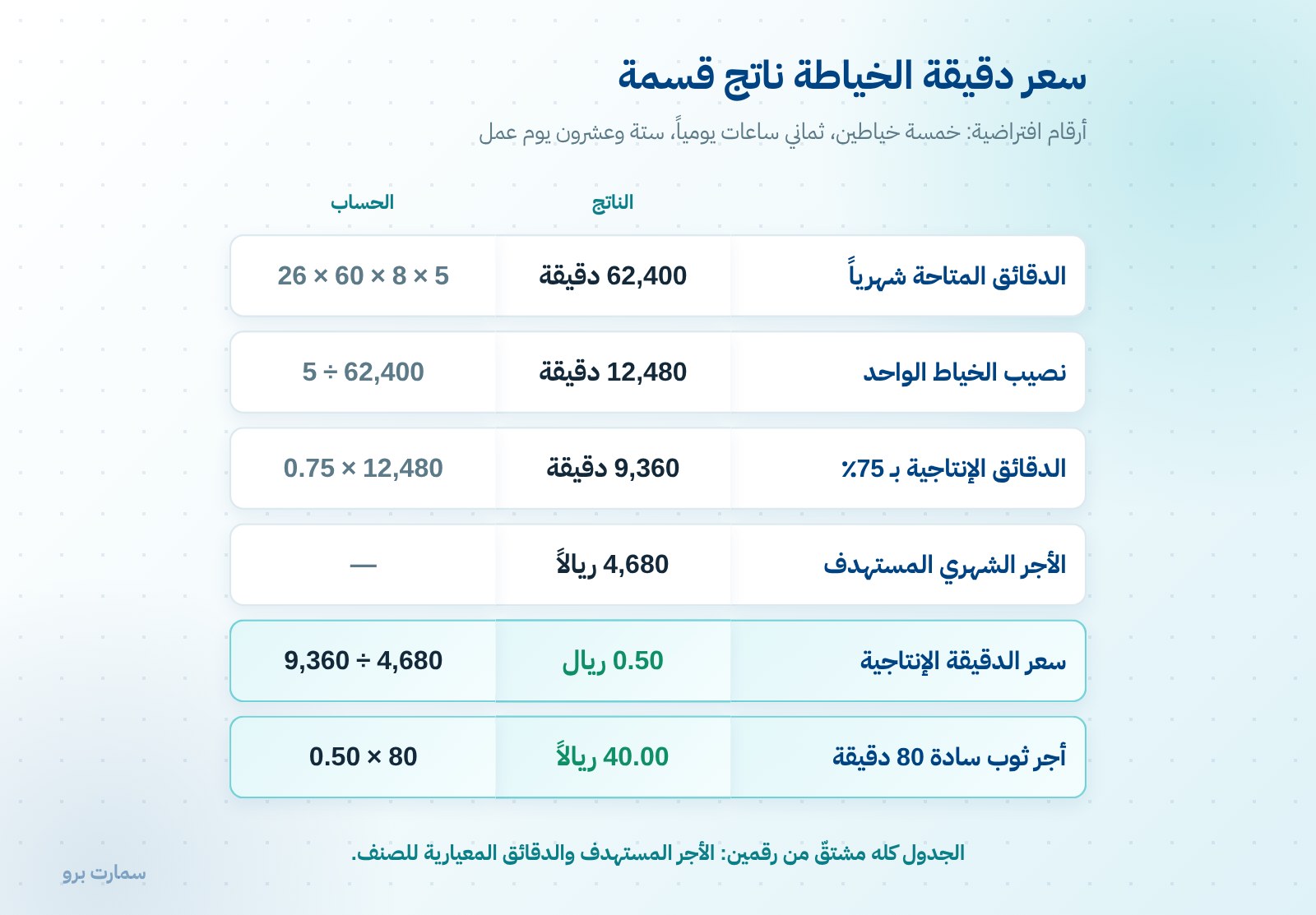
The figures below are hypothetical, used to illustrate the method; they do not represent prevailing market rates. We use the parameters of this series: five tailors, eight hours a day, 26 working days a month.
| Step | Calculation | Result |
|---|---|---|
| Available minutes per month | 5 × 8 × 60 × 26 | 62,400 minutes |
| Share per tailor | 62,400 ÷ 5 | 12,480 minutes |
| Productive minutes at a realistic 75% | 12,480 × 0.75 | 9,360 minutes |
| Target monthly pay per tailor | — | SAR 4,680 |
| Rate per productive minute | 4,680 ÷ 9,360 | SAR 0.50 |
The rate per minute is then multiplied by each item's standard minutes. Standard minutes are the time a trained tailor normally needs to complete an item at a steady pace.
| Item | Standard minutes | Piece rate (SAR) |
|---|---|---|
| Plain thobe | 80 | 40.00 |
| Detailed thobe | 110 | 55.00 |
| Plain abaya | 70 | 35.00 |
| Embroidered abaya | 180 | 90.00 |
| Medium alteration | 20 | 10.00 |
| Thobe shortening | 12 | 6.00 |
The whole table is derived from just two numbers: target pay and standard minutes. Change either one and the entire table is recalculated in one go, not haggled over item by item.
How to work out standard minutes is covered in tailor productivity, and pricing by difficulty in difficulty-based piece rates.
Why is the 75% utilisation rate the critical number?
The most common mistake that ruins a piece-rate table is building it on 100% capacity. A tailor does not sew 12,480 minutes a month. Between pieces there is machine setup, waiting for fabric, receiving customers, checking measurements and dead time in quiet months.
If you base the rate per minute on 12,480 minutes, it drops to SAR 0.375 and a thobe drops to SAR 30. The result is that a tailor can only reach reasonable pay at a capacity nobody achieves, so they leave for someone who calculates realistically.
The opposite is also a mistake. Building on 50% pushes a thobe to SAR 60, so you pay for capacity you never use. See workshop capacity.
What should a piece rate cover, and what should it not?
This is the root of most disputes. A piece rate buys output, and a workshop involves plenty of work that is not output:
| Task | Covered by the piece rate? |
|---|---|
| Cutting, sewing and pressing the piece | ✅ Yes |
| Machine setup and thread changes | Within standard minutes |
| Tidying the store and moving fabric | ❌ No |
| Training a new tailor | ❌ No |
| Quality-checking other tailors' pieces | ❌ No |
| Waiting because fabric is late | ❌ No |
| Rework caused by the workshop's own error | ❌ No |
Every "No" row is a minute the tailor works unpaid if their pay is pure piece rate. That is why well-run workshops split pay: a fixed monthly base that buys this work, and a piece rate that buys output.
Using the ratios in this series: 40% as base (SAR 0.20 per minute, SAR 1,872 a month) and 60% as piece rate (SAR 0.30 per minute). The detail is in workshop payroll.
Which labour law rules apply to piece-rate pay?
Three rules are often overlooked in this pay model specifically.
First: when to pay. A worker on monthly pay is paid once a month. A worker whose pay is not monthly, including piece-rate pay, must be paid at least once a week. Holding piece-rate earnings until the end of the month, without an agreement on a fixed monthly wage, does not comply with this rule.
Second: deduction limits. Where a worker damages tools or materials through their own fault, no more than five days' wages per month may be deducted, and the overall cap on all deductions is half of the wage due. Recovering the full value of spoiled fabric from a single week's pay breaches both limits.
Third: notice period. A worker on non-monthly pay has a notice period of 30 days from either party, unlike a monthly-paid worker, whose notice can reach 60 days when the employer is the one terminating.
The rules on deductions and entitlements are covered in more detail in end-of-service entitlements and the payroll run guide.
Do working-hour limits still apply on piece rates?
The pay model does not cancel working-hour rules. The limit is eight actual hours a day or 48 a week, and in Ramadan six hours a day for Muslim workers, with an absolute ceiling of ten hours a day or 60 a week that must not be exceeded.
This means the Eid peak cannot be handled by stretching the day without limit just because pay is per piece. It is handled within the legal ceiling, with overtime paid at the hourly wage plus 50% of the basic wage. See tailoring workshops in Ramadan.
A piece-rate tailor who works overtime is entitled to this premium on the basis of their wage. It is not enough that the extra pieces themselves are paid.
How should rework be handled?
A reworked piece consumes minutes twice. Paying the piece rate twice puts the full cost of the error on the workshop; never paying it puts the full cost on the tailor, even when they did not cause the error.
The fix is to classify the reason for rework before deciding: tailor error, a wrong measurement taken, a customer change, or a fabric defect. Each reason has its own treatment, and a customer change is invoiced to the customer, not deducted from anyone.
The full detail is in rework policy and quality checks.
What should be recorded for every piece?
A piece rate without a record is a dispute postponed. The minimum written for every piece is four fields: order number, item and standard minutes, tailor, and completion date.
From these four fields you get the pay sheet, a productivity report per tailor, the cost of each order and the rework rate. A workshop that records them on the worksheet itself does not need a second notebook. See the tailor worksheet and order tagging.
What are the six most common mistakes?
- A rate borrowed from another workshop with different costs and capacity.
- Building on 100% capacity, making reasonable pay unreachable.
- Pure piece-rate pay with no base to buy non-productive work.
- One rate per item regardless of embroidery and detail, so the hard jobs pile up at the end.
- Holding pay until month end without an agreement on a fixed monthly wage.
- Deducting the full value of damage from a single period's pay, beyond the legal limit.
How do you build your table in one sitting?
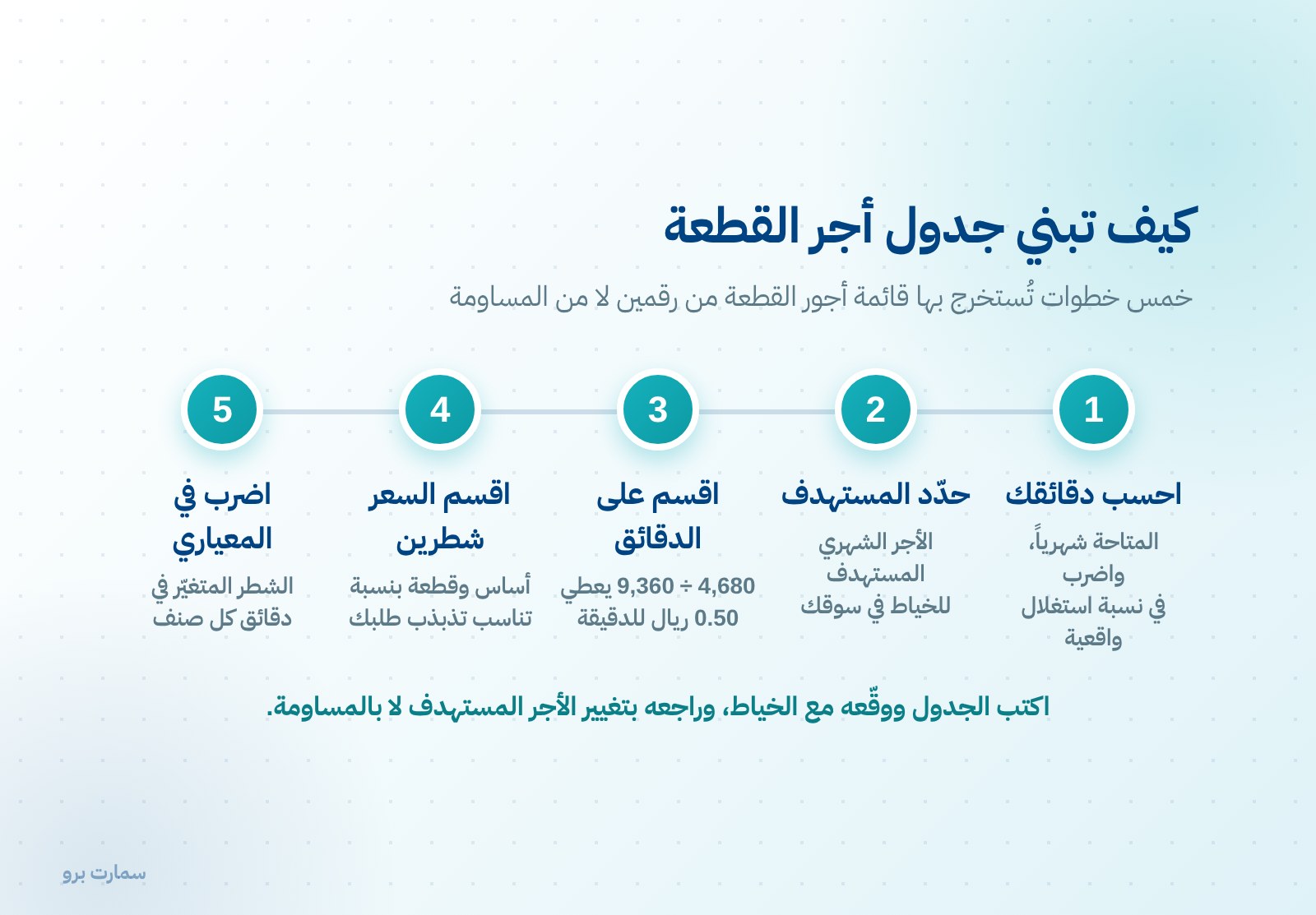
- Calculate your available minutes per month, then multiply by a realistic utilisation rate.
- Set the target monthly pay for a tailor in your market.
- Divide the pay by the productive minutes to get the rate per minute.
- Split the rate per minute into base and piece portions, in a ratio that suits how much your demand fluctuates.
- Multiply the variable portion by each item's standard minutes.
- Write the table down and sign it with the tailor, and revise it by changing the target pay, not by haggling.
Where is the official reference?
The rules on wage payment timing, deduction limits, working hours, overtime and notice periods are published in the Labour Law and its Implementing Regulations by the Ministry of Human Resources and Social Development, which is the reference in any disagreement. What is set out here summarises those rules and does not replace them.
If you want to run all of this without scattered spreadsheets, that is what the tailoring management system does.
Key takeaway: Build piece rates by dividing target pay by realistic productive minutes, pair them with a fixed base for non-productive work, and stay within the Labour Law rules on weekly payment, deduction caps and working hours.
Read also
- Piece rate or salary: the full calculation
- Difficulty-based piece rates
- Tailor productivity and how to measure it
To see how SmartPro records each piece and tailor for your workshop, start a free trial.
Article visuals
Frequently asked questions
How is a tailor's piece rate calculated?
Divide the target monthly pay by the actual productive minutes, not by full capacity, to get the rate per minute, then multiply it by the item's standard minutes. A tailor with 9,360 productive minutes a month and target pay of SAR 4,680 has a rate of SAR 0.50 per minute, so a thobe that takes 80 minutes pays SAR 40.
How often must piece-rate pay be paid in Saudi Arabia?
A worker whose pay is not monthly, including piece-rate pay, must be paid at least once a week, unlike a monthly-paid worker who is paid once a month. Holding piece-rate earnings until the end of the month without an agreement on a fixed monthly wage does not comply with this rule.
Can the value of damaged fabric be deducted from a tailor's pay?
Only within limits. Where a worker damages tools or materials through their own fault, no more than five days' wages per month may be deducted, and the overall cap on all deductions is half of the wage due. Recovering the full value of spoiled fabric from a single period's pay exceeds both limits.
Does piece-rate pay cancel overtime?
No. The pay model does not cancel working-hour rules: eight hours a day or 48 a week, six hours a day in Ramadan for Muslim workers, and a ceiling of ten hours a day. Each overtime hour is paid at the hourly wage plus 50% of the basic wage.
What work does a piece rate not cover?
Tidying the store and moving fabric, training a new tailor, quality-checking other tailors' pieces, waiting because fabric is late, and rework caused by the workshop's own error. Under pure piece-rate pay these are all unpaid minutes, which is why a fixed monthly base is set aside to cover them.