
Tailoring Workshops in Ramadan: The Season Plan in Numbers
Tailoring workshops in Ramadan run on six working hours instead of eight, so capacity drops 25% right at peak demand. Here is the full calculation, the order cap and the season calendar.
Author:سامي الحيدري
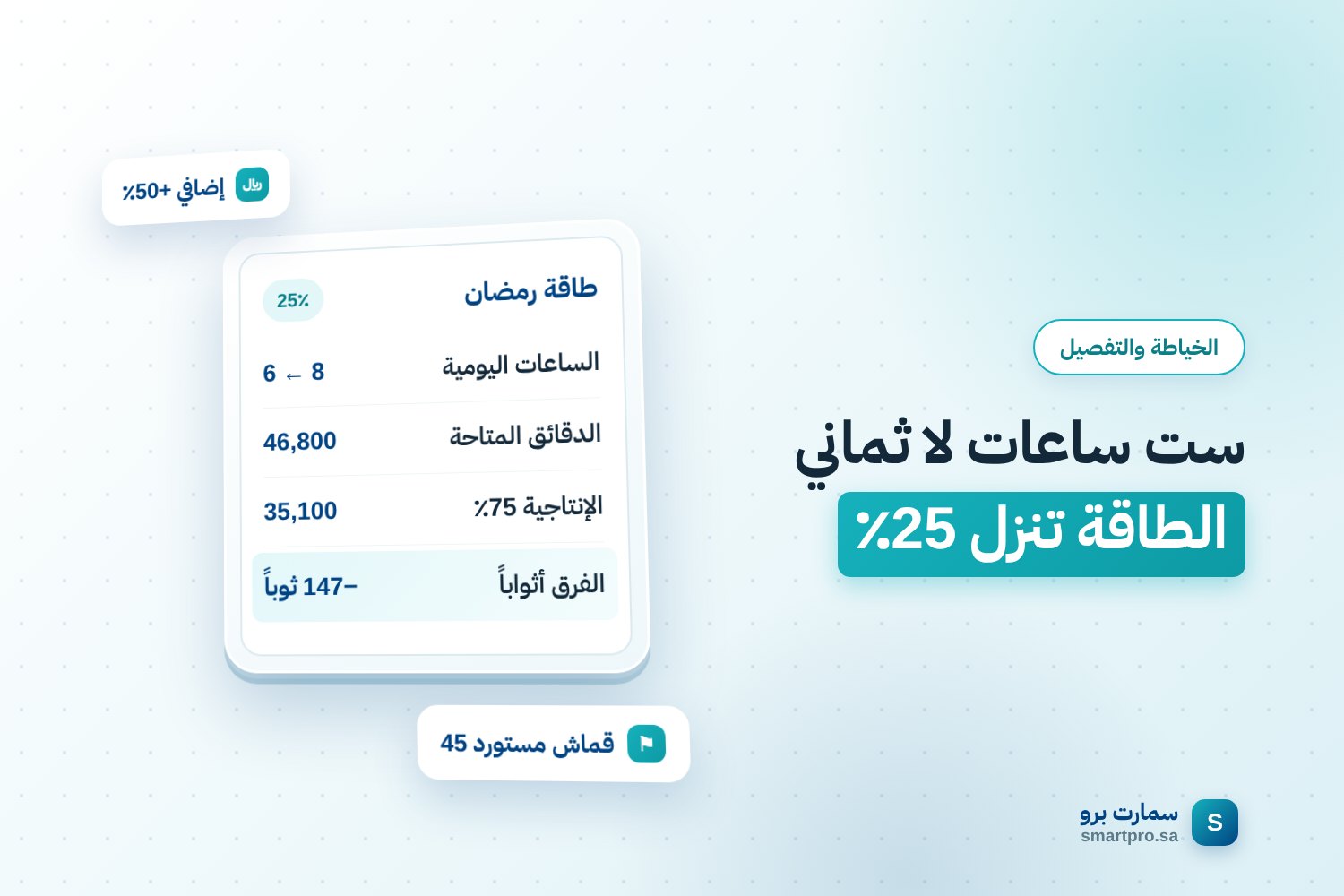
Tailoring workshops in Ramadan face a paradox few businesses of the same size do: demand doubles in the very month when working hours are cut by law. A plan that only adds more orders for the peak runs into less capacity, not more.
Saudi press coverage records, every year, workshops that stop taking orders halfway through Ramadan. That is not always poor management. It is the arithmetic result for anyone who did not do the numbers before the season started.
Tailoring workshops in Ramadan: capacity drops 25%
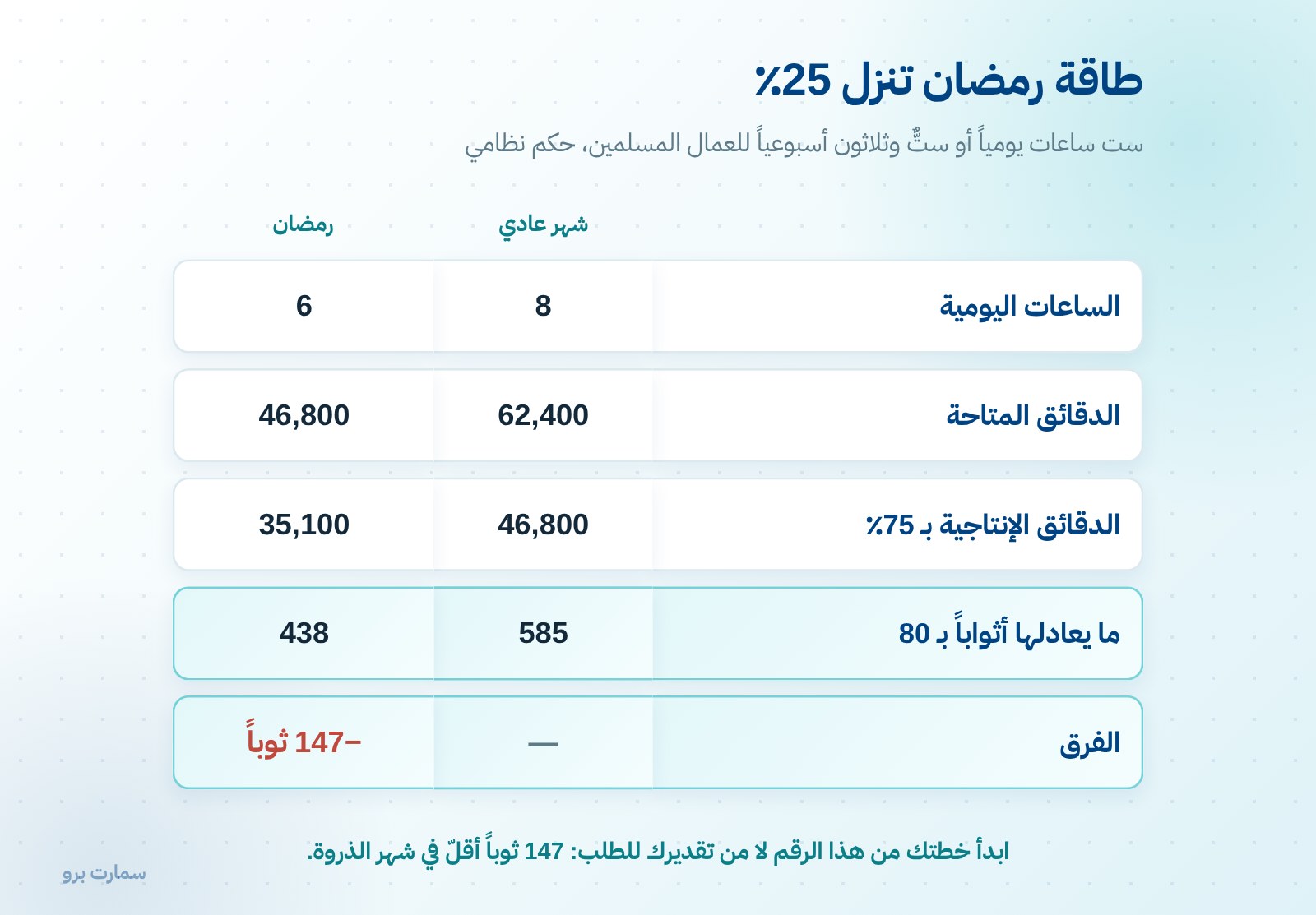
Working hours in Ramadan are six hours a day or thirty-six a week for Muslim workers, instead of eight hours or forty-eight. This is not an organisational choice; it is a legal requirement.
The figures below are hypothetical, to illustrate the method, and do not represent market prices. Using this series' parameters — five tailors, 26 working days and 75% utilisation:
| Item | Normal month | Ramadan |
|---|---|---|
| Daily hours | 8 | 6 |
| Available minutes | 62,400 | 46,800 |
| Productive minutes at 75% | 46,800 | 35,100 |
| Equivalent in thobes (80 minutes) | 585 | 438 |
| Difference | — | −147 thobes |
Your capacity falls by 147 thobes in the month when the market asks for the most. That is the number your plan should start from, not your demand estimate.
The detailed capacity method is in workshop capacity.
Overtime: how much can you recover, and at what cost?
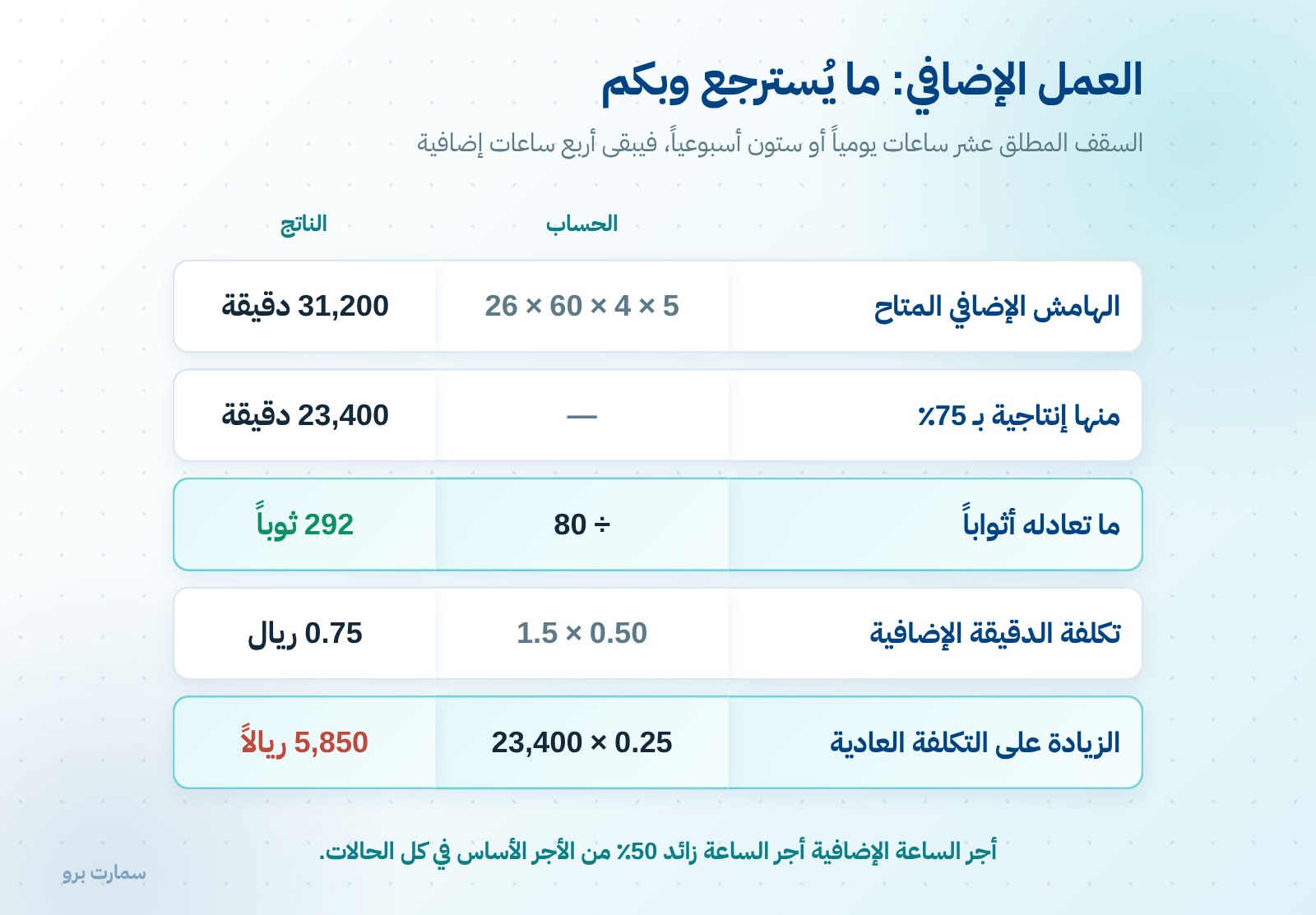
The absolute cap of ten hours a day or sixty a week cannot be exceeded. On a base of six regular hours in Ramadan, that leaves room for up to four overtime hours a day within the cap.
Overtime pay is the hourly wage plus 50% of the basic wage. There is no "double pay" for Fridays or Eid: the rate is fifty percent in every case, noting that all hours worked on Eid holidays and public holidays count as overtime.
| Item | Calculation | Result |
|---|---|---|
| Available overtime margin | 5 × 4 × 60 × 26 | 31,200 minutes |
| Productive share at 75% | — | 23,400 minutes |
| Equivalent in thobes | ÷ 80 | 292 thobes |
| Cost per overtime minute | 0.50 × 1.5 | SAR 0.75 |
| Increase over normal cost | 0.25 × 23,400 | SAR 5,850 |
So the lost capacity can be recovered and even exceeded, but at a cost fifty percent higher on the wage portion. If you price Ramadan orders at your usual rate, you pay for that increase out of your margin. See rush order fees.
Why isn't working on Friday the answer?
The weekly rest day is fully paid, at least 24 consecutive hours, and cannot be replaced with cash. You cannot buy out the rest day, and you cannot bank rest days until after Eid.
That narrows your expansion options to three: overtime within the cap, temporary extra staff, or setting an order cap and stopping intake when you reach it. The third is what disciplined workshops do, and it is the subject of when to stop taking orders.
When should Ramadan planning start?
The biggest mistake is starting your Ramadan plan in Ramadan. Lead time for local fabric is twelve working days and for imported fabric forty-five days, with a 25% safety stock.
| Timing | What must be done |
|---|---|
| Two months before Ramadan | Order imported fabrics |
| One month before Ramadan | Set the order cap and the cut-off date |
| One month before Ramadan | Raise the deposit percentage and announce the policy |
| Two weeks before Ramadan | Receive local fabric and sewing supplies |
| First week of Ramadan | Take orders at full capacity and spread delivery dates |
| Mid-Ramadan | Stop intake once the cap is reached |
| Ten days before Eid | Deliver, press and finish; no new orders |
The third row is what protects your cash: seasonal orders consume fabric and wages weeks before delivery. See deposits in tailoring and fabric stock levels.
How do you calculate the order cap precisely?
The cap is not an estimate. It is available minutes minus booked minutes:
- Start from Ramadan productive minutes: 35,100.
- Add the overtime you actually intend to use, not the whole margin.
- Subtract the minutes of existing orders due for delivery during Ramadan.
- Subtract a rework reserve — ten percent is a reasonable buffer.
- Divide the remainder by the average minutes of your orders, not by the minutes of a plain thobe.
Step five is where most people go wrong: if you set your cap based on plain thobes and then take embroidered abayas at 180 minutes each, you use up your cap at less than half the count.
How should delivery dates be set in Ramadan?
A delivery date in Ramadan is not a negotiable promise, because the date of Eid is fixed and cannot be moved. Promise delivery on day 28 and miss it by a single day, and you have failed completely, not partially.
That is why deliveries are scheduled spread across the weeks of Ramadan rather than bunched at the end, and the last week's capacity is reserved for pressing, delivery and urgent alterations, not for sewing. See setting delivery dates and handling late orders.
What happens after Eid?
What Ramadan planning tends to overlook is the month that follows. Demand drops sharply after Eid while your fixed costs stay the same — SAR 14,400 in this series' example — so the share each piece carries rises steeply.
Three decisions are made before Eid, not after: do not expand with permanent staff for a temporary peak, keep deposits on undelivered orders under a clear policy for uncollected orders, and schedule non-productive work — stocktaking, maintenance and training — in the quiet month, when its opportunity cost is zero.
See uncollected orders and fabric stocktaking.
Pre-Ramadan checklist
- Have you calculated capacity on six hours, not eight?
- Have you set the order cap in minutes, not in number of pieces?
- Have you announced the intake cut-off date before it arrives?
- Have you raised the deposit percentage to cover direct costs?
- Was imported fabric ordered two months ahead?
- Have you priced rush orders to cover the fifty percent increase?
- Is the last week's capacity reserved for delivery, not sewing?
- Is non-productive work scheduled for after Eid?
Official reference
The rules on Ramadan working hours, the absolute cap on hours, overtime pay and the weekly rest day are set out in the Labour Law published by the Ministry of Human Resources and Social Development, which is the reference in case of any discrepancy.
Workshops that keep this under control usually do it inside one system, such as SmartPro's tailoring workshop software.
Key takeaway: Plan Ramadan from your reduced six-hour capacity, set an order cap in minutes, and order fabric two months ahead, because demand peaks exactly when legal working hours fall.
Read also
- Stopping order intake: when and how
- Workshop capacity: calculating in minutes
- Rush order fees and how to price them
To see how measurements, orders and delivery dates run in one place before your next season, start a free trial of SmartPro.
Article visuals
Frequently asked questions
How many working hours apply in a tailoring workshop during Ramadan?
Six hours a day or thirty-six a week for Muslim workers, instead of eight hours or forty-eight. This is a legal requirement, not an organisational choice. Its effect is that production capacity drops by about twenty-five percent in the month when demand peaks.
Can the shortfall be made up with overtime?
Yes, within the absolute cap of ten hours a day or sixty a week, which leaves room for up to four overtime hours a day. Overtime pay is the hourly wage plus fifty percent of the basic wage. So capacity is recovered at a higher cost, not the same cost.
Can staff work on Friday during the peak in exchange for cash?
The weekly rest day is fully paid, lasts at least 24 consecutive hours and cannot be replaced with cash. You cannot buy it out or bank rest days until after Eid. The options remain three: overtime within the cap, temporary staff, or an order cap.
When should a workshop stop taking orders in Ramadan?
When it reaches a cap calculated in minutes, not in number of pieces: productive minutes plus the overtime you will actually use, minus the minutes of existing orders and a rework reserve. The cut-off date should be announced before it arrives, not after the schedule is already overloaded.
When should fabric be ordered for the Ramadan season?
Imported fabric two months ahead, because its lead time is about forty-five days, and local fabric two weeks ahead, because its lead time is twelve working days, with a twenty-five percent safety stock. Fabric ordered during Ramadan itself arrives after the need has passed.