
Fabric Inventory: How Many Metres to Keep, and in Which Colours
Fabric inventory comes down to three numbers: daily usage, supplier lead time and turnover. Set a reorder point for each item, then weigh the cost of dead colours against the price of running out.
Author:سامي الحيدري
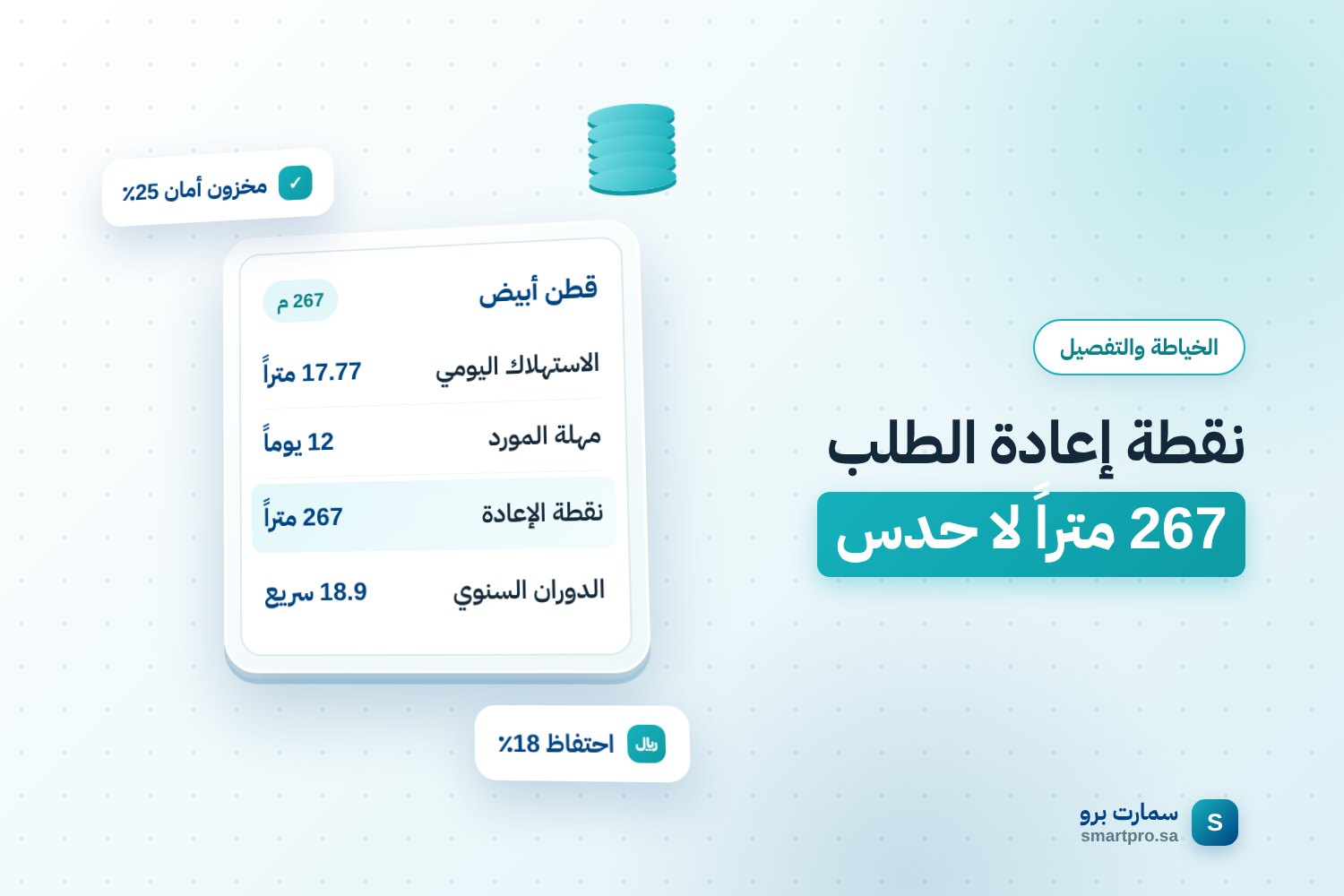
Fabric inventory is the biggest item tying up a tailoring workshop's cash, and the one least often calculated with any method. Decisions are usually made by feel: “white cotton never runs out” or “this colour is nice, let's take a roll.”
The result shows up at both ends at once. Rolls that have not been opened in a year fill the storeroom, while a core fabric runs out mid-season and promised orders slip.
The irony is that one fix solves both problems: three numbers measured from your own records (daily usage, supplier lead time and the turnover of each fabric), used to set a reorder point for every item separately.
Fabric inventory: which three numbers drive the decision?
| Number | Where it comes from | What it determines |
|---|---|---|
| Daily usage | Metres issued ÷ working days | Order size and reorder point |
| Supplier lead time | From order to actual receipt | When to reorder |
| Annual turnover | Metres issued ÷ average stock | Whether to stock this fabric at all |
None of these can be borrowed from another workshop, because all three change with your product mix, your suppliers and your season.
How do you set a reorder point from usage, not instinct?
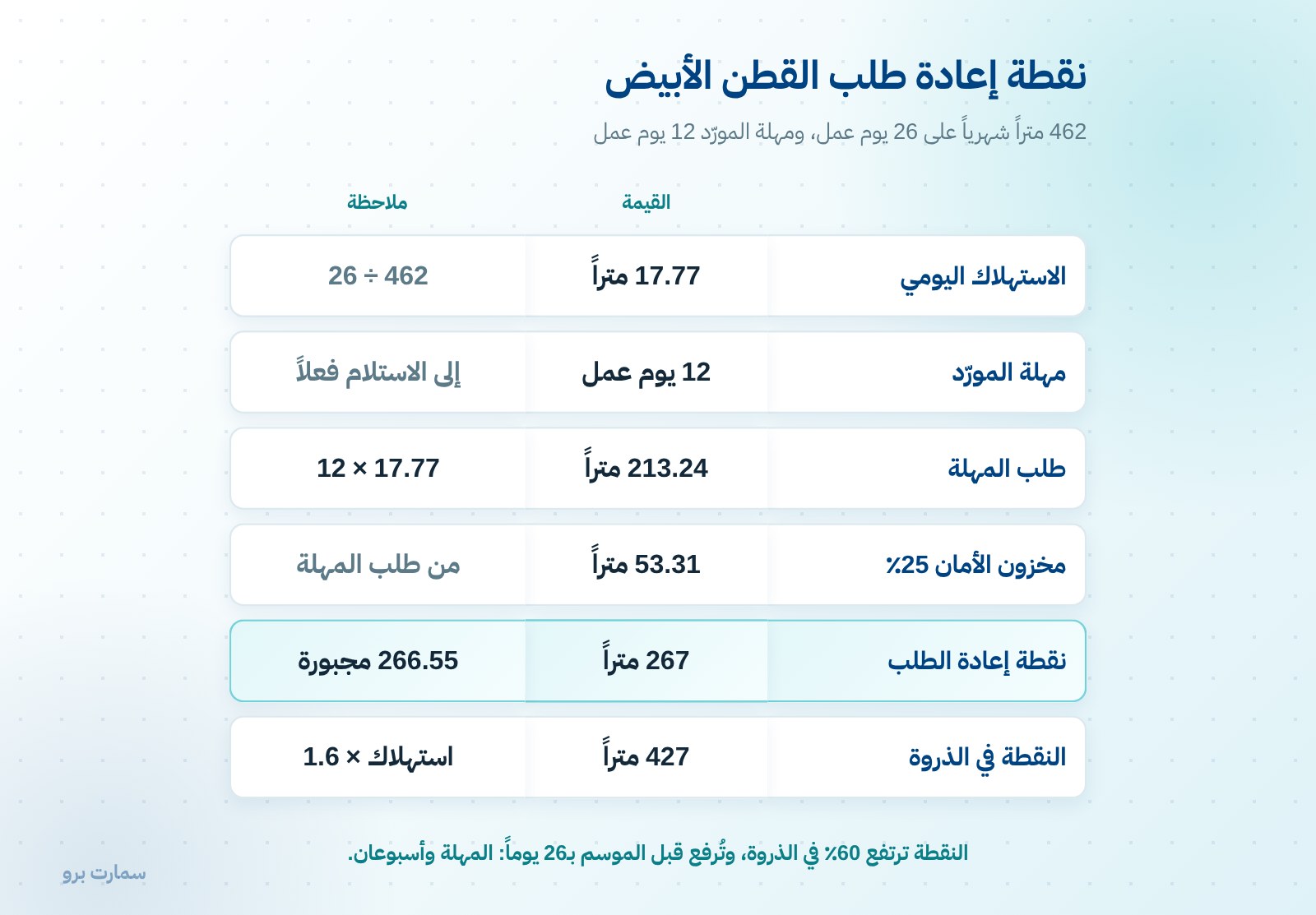
The figures below are hypothetical, used only to illustrate the method; they do not represent current market prices. In this series' example, the workshop uses 462 metres of white cotton a month over 26 working days, at SAR 15 per metre.
- Daily usage: 462 ÷ 26 = 17.77 metres
- Local supplier lead time: 12 working days
- Lead-time demand: 17.77 × 12 = 213.24 metres
- Safety stock at 25% of lead-time demand: 53.31 metres
- Reorder point: 266.55, i.e. 267 metres
A reorder point is the stock level at which a new order must be placed so it arrives before the shelf runs empty. So when the white cotton balance drops to 267 metres, the order goes out: not when the last roll is finished, and not when the cutter asks. The number is written on the item card, not kept in someone's memory.
Supplier lead time is measured from the order date to the actual receipt date, not to the promised date. The gap between the two is what eats into safety stock; how to document it is covered in Fabric suppliers.
How much should you order each time?
The reorder point answers “when”, not “how much”. The quantity is set by the usage of a chosen period, then rounded up to whole rolls.
Assume a roll holds 60 metres and the chosen period is one month:
- Monthly usage: 462 metres
- 462 ÷ 60 = 7.7 rolls, rounded up to 8 rolls = 480 metres
- Maximum balance: 267 + 480 = 747 metres
- Average balance: 53 + (480 ÷ 2) = 293 metres, or SAR 4,395
A longer period means fewer orders but more cash tied up; a shorter one does the opposite. The choice between them depends on the supplier's quantity pricing and your storage space, not on a general rule.
How do you tell fast-moving fabric from slow with your own numbers?
Annual turnover = metres issued in the year ÷ average stock in metres. Here is a hypothetical six-month reading:
| Fabric | 6-month usage | Average stock | Annual turnover | Category |
|---|---|---|---|---|
| White cotton | 2,772 | 293 | 18.9 | Fast |
| Black crepe | 648 | 110 | 11.8 | Fast |
| Ivory cotton | 540 | 120 | 9.0 | Medium |
| Winter wool | 210 | 95 | 4.4 | Slow |
| Coloured crepe | 96 | 140 | 1.4 | Slow |
| Classic stripe | 42 | 130 | 0.6 | Dead |
The reading reveals what instinct misses. Coloured crepe and classic stripe occupy 270 metres of storage, close to the 293-metre average allocated to white cotton alone. White cotton turns 18.9 times a year; the two together do not reach twice.
| Annual turnover | Category | Decision |
|---|---|---|
| 12 or more | Fast | Calculated reorder point and safety stock |
| 6 to under 12 | Medium | Reorder in smaller quantities over shorter periods |
| 2 to under 6 | Slow | No safety stock; buy to order |
| Under 2 | Dead | Clear out and stop buying |
What do dead colours really cost?
Holding cost is not zero even when the fabric is already paid for. Assume it is 18% a year of stock value: twelve points for tied-up capital, four for space, and two for damage, fading and dye changes.
| Fabric | Metres | Price per metre (SAR) | Value (SAR) | Months to clear | Annual holding cost (SAR) |
|---|---|---|---|---|---|
| Coloured crepe | 140 | 45 | 6,300 | 8.8 | 1,134.00 |
| Classic stripe | 130 | 15 | 1,950 | 18.6 | 351.00 |
| Total | 270 | 8,250 | 1,485.00 |
Months to clear are calculated by dividing metres by monthly usage: 140 ÷ 16 = 8.8, and 130 ÷ 7 = 18.6.
So SAR 8,250 is tied up in two slow items, more than a full month's usage of white cotton, your fastest fabric. Holding them costs SAR 1,485 a year, paid out of profit for nothing in return.
The fix is a sales decision, not an accounting one. Use them for linings and inner pieces, offer them at a reduced price to customers who are not set on a particular colour, or move them to fabric remnants once the quantity drops.
What does running out cost?
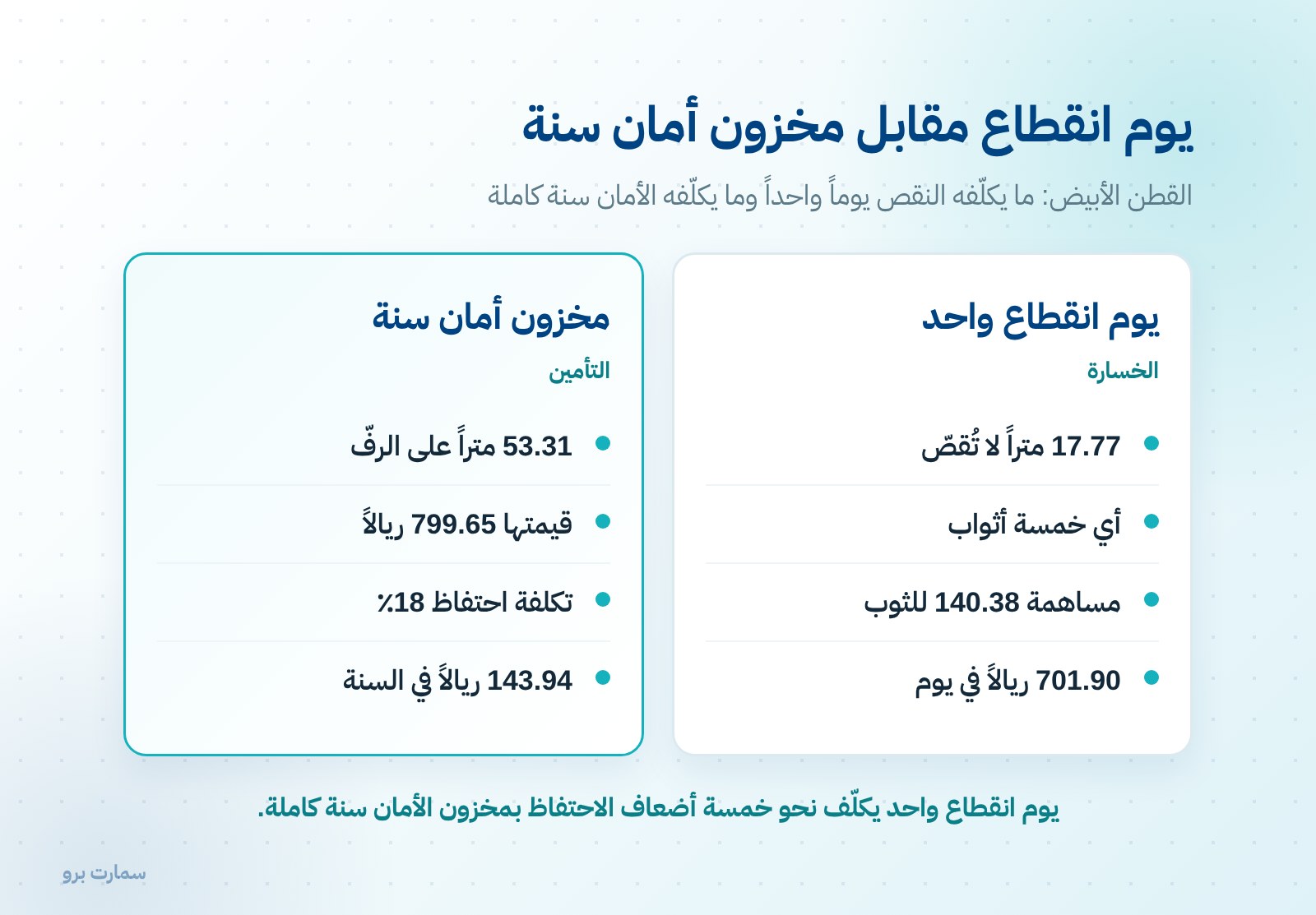
Cutting stock to zero is not an achievement. The cost of a stockout is far higher than the cost of holding, and the comparison settles it:
- One day's usage of white cotton: 17.77 metres, i.e. 17.77 ÷ 3.5 = five thobes
- Each thobe contributes SAR 140.38 in this series, so one day out of stock costs 5 × 140.38 = SAR 701.90
- Compare the entire safety stock: 53.31 metres worth SAR 799.65, with an 18% holding cost of SAR 143.94 a year
In other words, one day without white cotton costs about five times as much as holding its safety stock for a full year. That is why safety stock on fast fabrics is the cheapest insurance you can buy, and on slow fabrics the most expensive item you carry.
The per-piece contribution comes from the true cost of tailoring a thobe, and the effect of stockouts on delivery dates is covered in handling late orders.
Does the reorder point change with the season?
The reorder point is not a number you write down once. If peak-month usage is 1.6 times a normal month:
- Peak monthly usage: 462 × 1.6 = 739 metres
- Daily: 739 ÷ 26 = 28.42 metres
- Reorder point: 28.42 × 12 × 1.25 = 426.30, rounded up to 427 metres
The point rises from 267 to 427 metres, an increase of 60%. A workshop that enters the season with its normal-month point runs out of fabric at the very start.
The timing rule: raise the point before the season begins by the supplier lead time plus two weeks, i.e. 12 + 14 = 26 days. The order of the seasons and their effect on scheduling are explained in tailoring workshops in Ramadan.
How does storage space limit your stock?
The calculation above assumes space is available, and it is not unlimited. Storage areas in tailoring shops have a regulatory limit published by the Ministry of Municipalities and Housing; details are in tailoring shop requirements.
In practice, your stock is limited by square metres, not just by riyals. If one item's maximum balance reaches 747 metres, the question is not “can I afford it?” but “where does it go?”, and every roll of a dead colour takes the place of a roll that sells.
What are the three most common fabric stock mistakes?
First: one reorder point for all fabrics. White and stripe are not used at the same speed and do not share a lead time, so a single point means one runs out while the other piles up.
Second: buying on a price offer instead of usage. Ten discounted rolls are not a saving if their turnover is 1.4, because what you saved on price you pay back in holding cost over three years.
Third: taking the balance from the books, not the shelf. A book balance that has not been reconciled with a physical count makes the reorder point correct on paper but wrong in practice; the reconciliation method is in fabric stocktaking.
Where is the official reference?
Tailoring shop requirements, including storage areas, are published by the Ministry of Municipalities and Housing, which is the reference in case of any discrepancy. Invoicing and payments are covered in the simplified invoice for tailors.
Everything described here is managed in practice in SmartPro's tailoring system: orders, measurements, fabrics and invoicing in one place.
Key takeaway: Set a separate reorder point for each fabric from its own daily usage and real supplier lead time, protect fast fabrics with safety stock, and clear out anything turning less than twice a year.
Read also
- Receiving fabric and checking rolls
- Fabric stocktaking: how to reconcile the difference
- Fabric remnants: what to keep and what to write off
To see how reorder points and fabric balances work on your own data, start a free trial of SmartPro.
Article visuals
Frequently asked questions
How do I calculate the reorder point for fabric?
Multiply daily usage by the supplier lead time, then add safety stock. In the hypothetical example, 462 metres a month over 26 days gives 17.77 metres a day, a 12-day lead time gives 213.24 metres, and 25% safety stock brings it to a reorder point of 267 metres.
How do I tell fast-moving fabric from slow-moving fabric?
Use annual turnover: metres issued in the year divided by average stock in metres. In the hypothetical reading, white cotton turned 18.9 times and classic stripe 0.6 times. Fabric turning 12 times or more deserves safety stock, while anything under twice a year should be cleared and no longer bought.
What does it cost to hold a colour nobody orders?
In the hypothetical example, two slow items tied up 270 metres worth SAR 8,250, and at an 18% annual holding cost that comes to SAR 1,485 paid out of profit for nothing. Time to clear is calculated by dividing metres by monthly usage, and for one of them it reached about 18 months.
Should I cut fabric stock to the minimum?
Not for fast-moving fabrics. In the hypothetical example, one day without white cotton costs SAR 701.90 in lost contribution, against SAR 143.94 to hold its safety stock for a whole year. Reductions should target slow and dead fabrics, not fast ones.