
Fabric Receiving: Measure Every Roll Before It Enters the Store
Fabric receiving is the cheapest place to catch a mistake. Seven checks before the store, measuring length and width, a written defect limit, and the true cost per metre rather than the invoiced one.
Author:سامي الحيدري

In most tailoring workshops, fabric receiving takes two minutes. The rolls are unloaded, the invoice is signed, and everything is carried into the store. Not a single metre is measured and not a single roll is opened to check its width.
Then the problem shows up late: a roll runs out before the number of pieces planned for it, a width that is too narrow for the pattern, or a stain in the middle of the roll discovered only after the fabric has become cut pieces.
Receiving is the cheapest point in the whole workshop to catch a mistake, because an error found there is the supplier's cost, and an error found after it is yours alone.
Fabric receiving: seven steps before the roll enters the store
- Count the rolls and match them to the invoice before they go into the store, not after.
- Measure the metres with a fabric meter counter, or on a cutting table marked every 50 centimetres.
- Measure the net width excluding both selvedges (the finished edges of the fabric), at three points along the roll, not just one.
- Inspect visually by unrolling the fabric on a well-lit table and recording each defect by its position in metres.
- Match the dye lot number across all rolls in the same order; a different lot means a colour difference that only appears after sewing.
- Run a shrinkage test on 20 centimetres of every new fabric type before approving it.
- Record the roll in the roll register with its number and its actual price per metre.
The seven steps take no more than twenty minutes for an order of eight rolls. Below is what those twenty minutes give you.
Measured metres versus the invoice
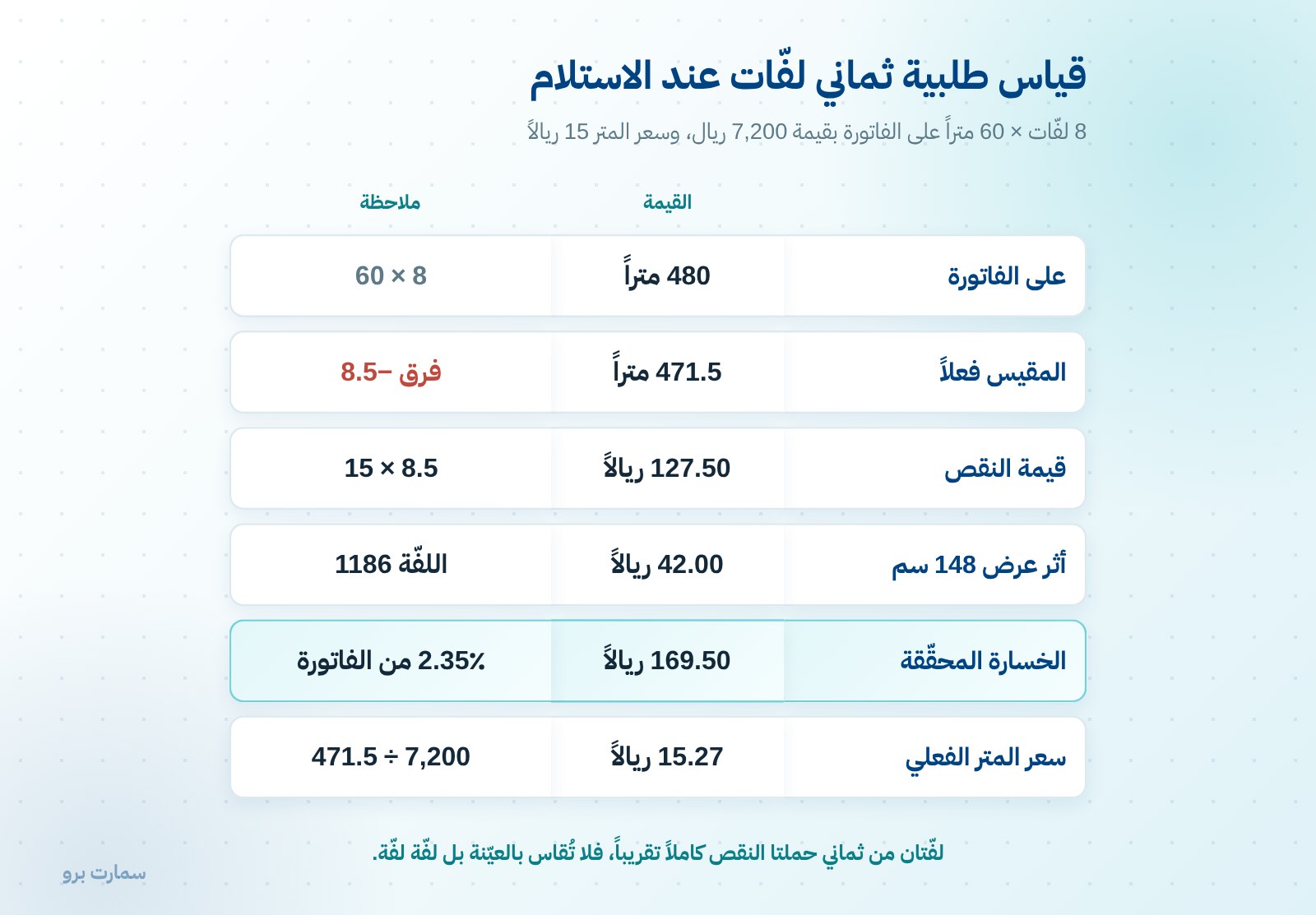
The figures below are hypothetical, used to illustrate the method, and do not represent market prices. Using this series' working figures, cotton costs SAR 15 per metre. Take an order of eight rolls, each invoiced at 60 metres: 480 metres worth SAR 7,200 before VAT.
| Roll | Invoiced (m) | Measured (m) | Difference | Stated width (cm) | Measured width (cm) | Defects |
|---|---|---|---|---|---|---|
| 1184 | 60 | 59.4 | −0.6 | 150 | 150 | — |
| 1185 | 60 | 60.1 | +0.1 | 150 | 150 | — |
| 1186 | 60 | 57.2 | −2.8 | 150 | 148 | Two knots |
| 1187 | 60 | 59.8 | −0.2 | 150 | 150 | — |
| 1188 | 60 | 60.0 | 0.0 | 150 | 150 | — |
| 1189 | 60 | 55.6 | −4.4 | 150 | 150 | 40 cm stain |
| 1190 | 60 | 59.5 | −0.5 | 150 | 150 | — |
| 1191 | 60 | 59.9 | −0.1 | 150 | 150 | — |
| Total | 480 | 471.5 | −8.5 |
The shortfall is 8.5 metres, or 1.77% of the order, worth 8.5 × 15 = SAR 127.50.
Notice that the rolls are not all bad: six are within a metre of the invoice, and two carry almost the entire shortfall. That is why every roll is measured individually rather than by sample. An average hides the faulty roll between two good ones.
Width: the point everyone overlooks
Width matters more than length, because a narrow roll never shows up as a number on the invoice. It shows up as waste, every month.
Roll 1186 is 148 centimetres wide, not 150, which means the cutting layout needs more metres for the same garment:
- Actual metres per thobe at 150 cm width: 3.85 m, as in fabric cutting waste
- At 148 cm width: 4.05 m, an extra 0.20 m worth SAR 3.00 per thobe
- The roll makes about fourteen thobes, so the extra on that roll is 14 × 0.20 = 2.8 metres, or SAR 42.00
If the whole order had been this width and nobody noticed, the extra on 120 thobes a month would be 24 metres, or SAR 360 a month, appearing in your reports as waste with no known cause.
So the loss actually incurred on this order is 127.50 + 42.00 = SAR 169.50, or 2.35% of the invoice value. Twenty minutes of measuring would have caught it.
Defects and the acceptance limit
Some natural defects exist in every fabric, so the decision needs a written limit, not an impression. A reasonable limit is one defect per ten metres; beyond that, the roll is returned or accepted at a reduced price.
| Defect type | What to do |
|---|---|
| Knot or limited weaving fault | Mark its position and avoid it in the cutting layout |
| Stain or colour variation | Deduct its metres from the measured length and claim them |
| Different dye lot numbers between rolls | Separate the rolls and never cut a single garment from both |
| Width below the stated width | Claim the price difference or return the roll |
| Shrinkage above the stated rate | Stop using that fabric before it reaches any customer |
The third row is the most expensive and the least noticed. A thobe with its sleeve cut from one roll and its body from another looks fine in the workshop, and the colour difference appears in daylight after delivery.
Why costing goes wrong without a roll register
A cost calculated on the invoice price is wrong, because the real price is the invoice value divided by the measured metres, not the invoiced ones:
- 7,200 ÷ 471.5 = SAR 15.27 per metre, not 15.00
- That is SAR 0.27 more per metre, an increase of 1.8%
- On thobe fabric: 3.85 × 0.27 = SAR 1.04 per thobe
- On 120 thobes a month: SAR 124.80, and SAR 1,497.60 a year
This figure appears in no report unless it is recorded, because it is the gap between what you paid for and what you received. Its effect carries into both the true cost of a thobe and your tailoring price list.
Twelve fields are enough for a roll register: roll number, supplier, invoice number, fabric type, colour, dye lot number, measured width, measured metres, actual price per metre, date, location and defect notes.
The roll number is what links everything afterwards: the metres issued at the cutting stage of the order path (received → cut → sewn → pressed → ready → delivered), the leftovers that come back from it as in fabric remnants, and the difference that appears in your fabric stocktake.
What to do with a short or defective roll
- Object before paying. Your strongest negotiating position is before the money is transferred; a deduction on an unpaid invoice is easier than a claim afterwards.
- Return the whole roll if its defects exceed the written limit, and do not split the claim.
- Accept it at a reduced price if it is still usable for linings, inner parts and small items.
- Document the case with photos and the defect position in metres, not a verbal description.
- Log it in the supplier performance record. A supplier whose deliveries keep coming up short is not cheaper even if the price is lower, as covered in fabric suppliers.
Any financial settlement with the supplier has its own invoicing treatment, explained in standard vs simplified invoices and the simplified invoice for tailors.
The cheapest place to catch a mistake
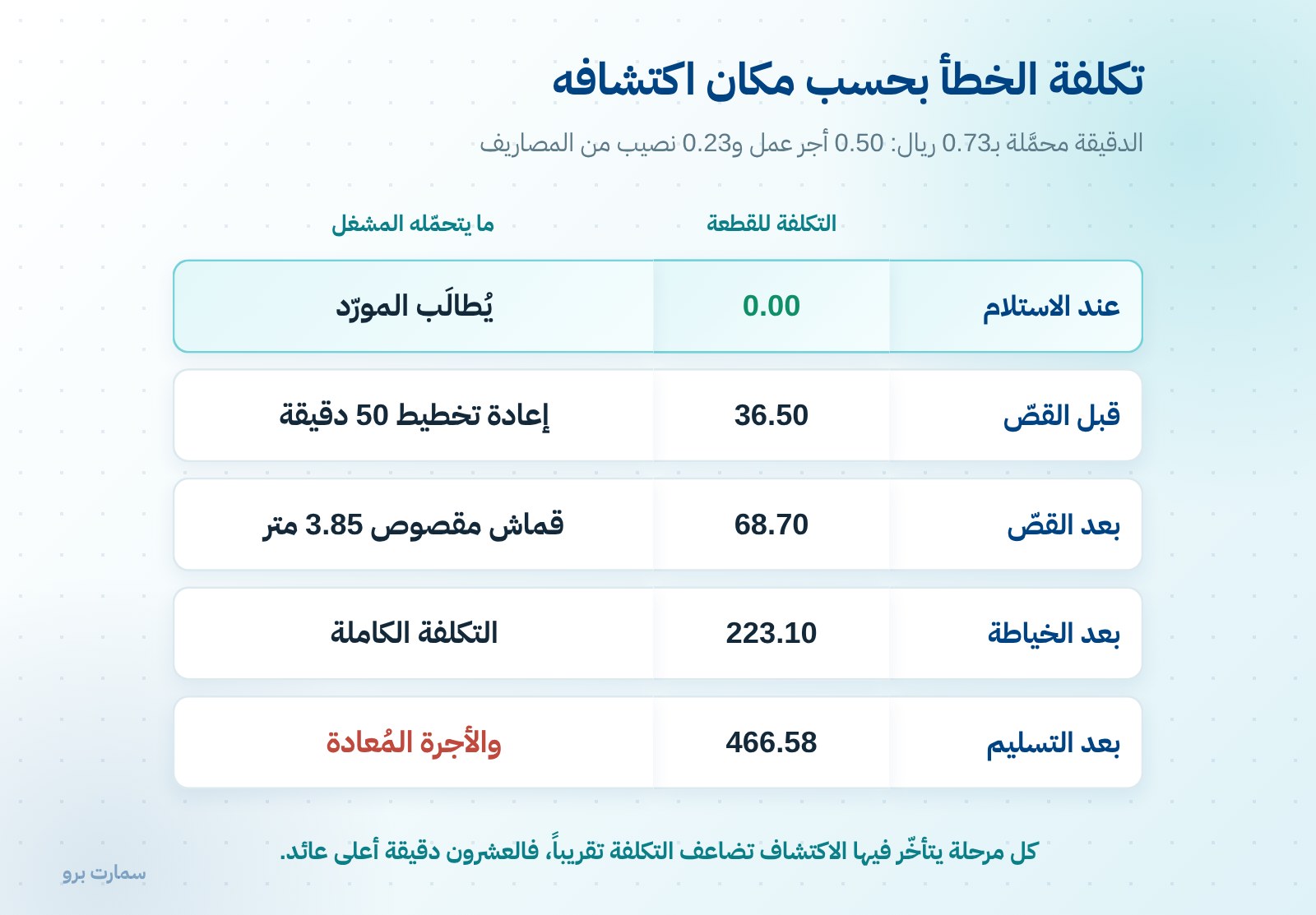
| Where it is found | What the workshop bears | Cost per piece (SAR) |
|---|---|---|
| At receiving | Nothing; the supplier is claimed | 0.00 |
| Before cutting | 50 minutes of re-planning the layout | 36.50 |
| After cutting | 3.85 m of cut fabric + cutting minutes | 68.70 |
| After sewing | The piece at its full cost | 223.10 |
| After delivery | The piece plus the remake labour | 466.58 |
Minutes are loaded at SAR 0.73 per minute: 0.50 for labour and 0.23 as a share of fixed overheads. The pattern is clear: every stage the discovery is delayed roughly doubles the cost, until it exceeds SAR 400 on a single piece.
That is why the twenty minutes at receiving are the highest return on time anywhere in the workshop. Their natural place is before everything else: no roll enters the store until it has been measured and recorded.
Three receiving mistakes
First: signing, then measuring. Signing the invoice acknowledges receipt, so any measurement afterwards becomes a claim rather than an objection.
Second: measuring a sample instead of every roll. In the example above, two rolls out of eight carried almost the entire shortfall. Had two good rolls been sampled, the order would have looked correct.
Third: ignoring width. A length shortfall is claimed once; a width shortfall is paid for in every piece cut from the roll until it runs out.
The official reference
Rules on purchase invoices, settlements and showing VAT are published by the Zakat, Tax and Customs Authority (ZATCA), which is the reference in case of any difference.
Putting this into practice is easier when orders, fabrics and invoices sit in one system, such as SmartPro's tailoring workshop solution. You can start a free trial to test it on your own receiving routine.
Key takeaway: Measure the length and net width of every roll and record its actual price per metre before signing or storing it; at receiving the supplier bears the error, after it you do.
Read also
Article visuals
Frequently asked questions
How do I check the metres on a fabric roll?
Measure every roll individually with a fabric meter counter or on a cutting table marked every 50 centimetres, before it enters the store and before you sign the invoice. In the hypothetical example, an eight-roll order measured 471.5 metres against 480 on the invoice, a shortfall of 8.5 metres worth SAR 127.50.
Why should I measure the width of a fabric roll?
Because a width shortfall is paid for in every piece you cut, not just once. In the hypothetical example, a width of 148 cm instead of 150 cm raised the fabric per thobe from 3.85 to 4.05 metres, or SAR 3 per piece. If the whole order had been that width, the extra cost would reach SAR 360 a month.
What price per metre should I base my costing on?
Use the invoice value divided by the measured metres, not the invoiced metres. In the hypothetical example, SAR 7,200 over 471.5 metres gives SAR 15.27 per metre instead of 15. That adds SAR 1.04 to the fabric in each thobe, or SAR 124.80 a month across 120 thobes.
What should I do with a short or defective fabric roll?
Object before paying, because a deduction on an unpaid invoice is easier than a claim afterwards. Return the whole roll if its defects exceed a limit of one defect per ten metres, or accept it at a reduced price for linings. Document the defect with photos and its position in metres, and log the case in the supplier performance record.