
Tax Invoice vs Simplified Invoice: Which to Issue and When
Tax invoices and simplified invoices differ in content, in their path through Fatoora and in timing. Here is a full comparison table, when to issue each one, and what the wrong choice costs your customer and you.
سامي الحيدري
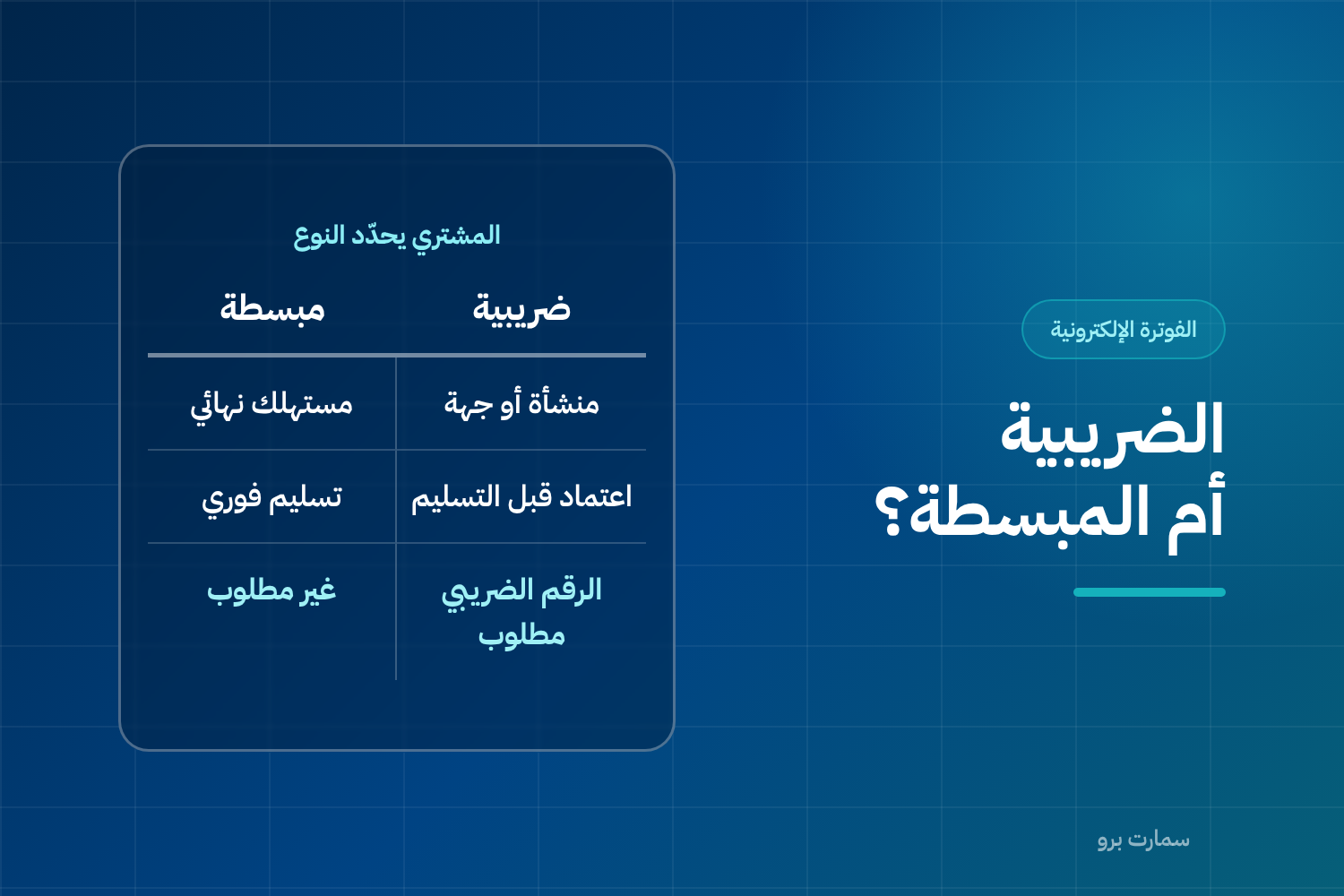
A tax invoice vs simplified invoice is not a question of layout. The two differ in the content required, in the path the invoice takes through the Fatoora platform, and in when it reaches ZATCA.
The rule in one sentence: if the buyer is a VAT-registered business or a government entity, issue a tax invoice. If the buyer is an end consumer, issue a simplified invoice.
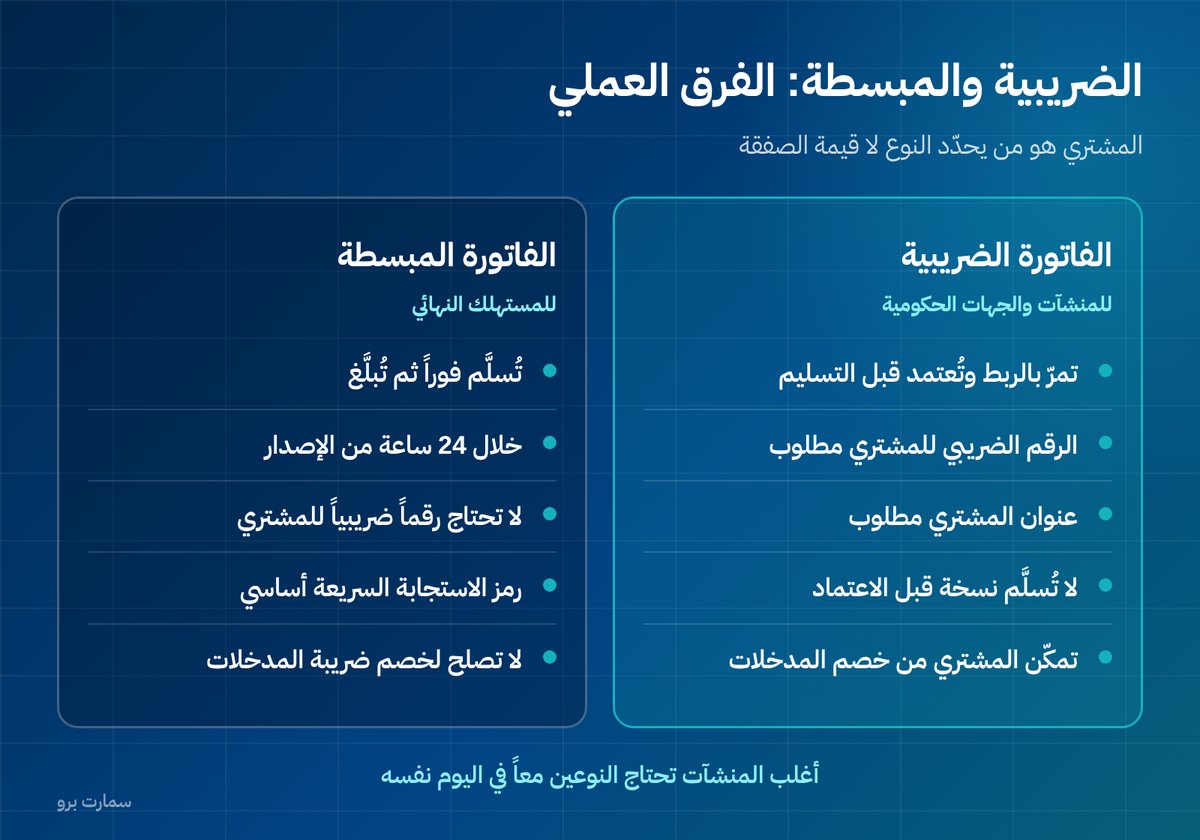
Tax invoice vs simplified invoice at a glance
| Aspect | Tax invoice | Simplified invoice |
|---|---|---|
| Buyer | Business or government entity | End consumer |
| Path | Clearance: approved before delivery | Reporting: delivered, then sent |
| Timing | At the moment of issue | Within 24 hours |
| Buyer's VAT number | Required | Not required |
| Buyer's address | Required | Not usually required |
| QR code | Required | Required and essential |
| When the customer receives it | After approval | Immediately |
| Typical use | Supply, contracting, B2B services | Retail, restaurants, services to individuals |
The most important row is "When the customer receives it". With a tax invoice, you must not hand the buyer a copy before the platform has approved it. This catches out sales teams used to printing the invoice the moment a sale closes.
Clearance means the invoice is sent to ZATCA and approved before it goes to the buyer. Reporting means the invoice goes to the buyer first and is then submitted to ZATCA.
Why does your customer care which type you issue?
A buying business recovers input VAT on the basis of a complete tax invoice that carries its VAT number. Input VAT is the VAT a business pays on its purchases and deducts from the VAT it collects on sales. If you give it a simplified invoice without its VAT number, it cannot deduct the tax and will ask you to reissue.
Under Phase 2 e-invoicing, reissuing is not an edit to the original invoice. It means a credit note that cancels the original's effect, followed by a new invoice. So a split-second mistake at the till turns into three documents, extra journal entries and a review at month end.
What must each type contain?
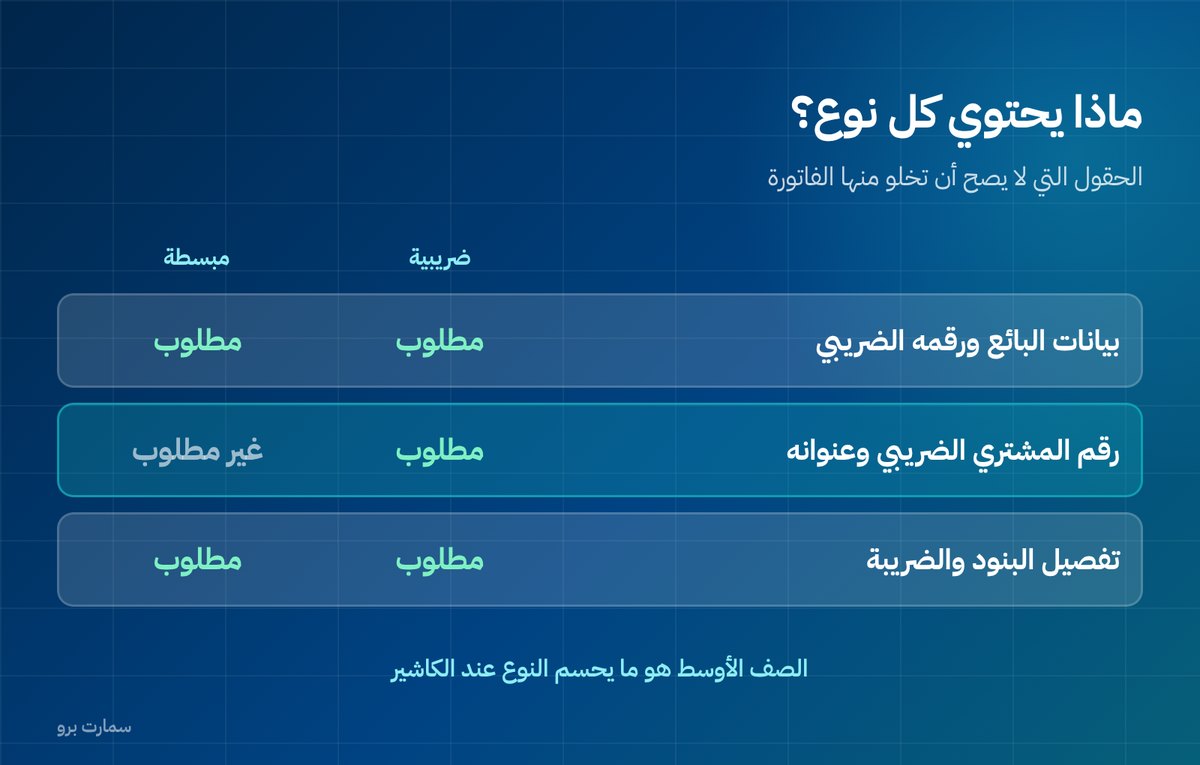
A tax invoice needs the seller's full details and VAT number; the buyer's details, VAT number and address; the issue date, and the supply date if different; a breakdown of items, quantities and prices; the VAT rate and amount for each line; and the total including VAT.
A simplified invoice needs the seller's details and VAT number, the issue date, a breakdown of items, the total VAT and total amount, and the QR code, which carries the core data encoded in a specified format.
The precise requirements for each field, and exceptions such as exempt supplies, exports and intra-GCC supplies, are published in the official guides of the Zakat, Tax and Customs Authority (ZATCA). Those guides are the reference whenever interpretations differ.
Three grey areas in the Saudi market
- A customer buys in a personal capacity, then asks for an invoice in the company's name: what counts is the actual buyer in the transaction. If the company is the buyer, the invoice is a tax invoice, and you must take its VAT number at the point of sale, not after the customer has left.
- A restaurant taking corporate orders: its activity is mostly simplified, but it needs to be able to issue a tax invoice on request. A POS that cannot handle both types becomes a commercial obstacle for catering and meeting orders.
- An online store selling to individuals and businesses: the answer is an optional VAT number field at checkout that switches the invoice type automatically, instead of handling orders manually after the sale.
What about a high-value simplified invoice?
There is no threshold that automatically turns a simplified invoice into a tax invoice; what matters is who the buyer is, not the size of the deal. Still, large amounts attributed to an end consumer deserve a second look, because in practice they are often a business's purchases issued under the wrong type.
Set an internal limit of your own choosing, SAR 5,000 for example, above which the system asks the employee to confirm before issuing a simplified invoice. This simple control prevents most later reissues.
What about buyers from outside Saudi Arabia?
Exports and supplies to non-residents have different VAT treatment, and they are often invoiced with a zero-rated tax invoice while you keep evidence that the goods left the Kingdom. Do not treat them as simplified invoices just because the buyer is an individual, and do not assume the rate before reviewing your specific case.
How do you control this through process, not just technology?
The system can issue both types, but the employee decides at the moment of sale. Three steps prevent most errors:
- Make the question part of the sale: "Is the invoice in a business's name?" is asked before the transaction is completed, not after.
- Save the VAT number in the customer record: do not ask for it every visit; link it to the customer so the type is chosen automatically next time.
- Review weekly: run a report of simplified invoices above the limit you set, and check who the buyer actually was.
In SmartPro Sales & POS, a sale produces a ZATCA Phase 2 e-invoice as it closes and flows into accounting and inventory by itself, so the type you choose at the till is reflected throughout your records.
How does the invoice type affect your books and reports?
The type does not change the sales journal entry itself, but it changes whether the other party can deduct the VAT and which documents you will need at review time. That is why the invoice type field should appear in your reports rather than stay hidden inside the system.
At month-end close, compare total tax invoices with what appears in your VAT return, and total simplified invoices with POS takings. Any gap means either invoices that were not reported or invoices that were misclassified, and both should be fixed before the return is filed, not after.
Read also
- ZATCA e-invoicing guide: Phase 2 clearance and integration waves
- Journal entries: how to write one step by step
- Debit vs credit: the golden rule with Saudi examples
Key takeaway: Decide the invoice type by who the buyer is, not by the amount: a VAT-registered business or government entity gets a tax invoice cleared before delivery, and an end consumer gets a simplified invoice reported within 24 hours.
To see how both invoice types work in a live workflow, start a free SmartPro trial or book a demo.
Frequently asked questions
What is the difference between a tax invoice and a simplified invoice?
A tax invoice is issued to a business or government entity and requires the buyer's VAT number and address; it goes through clearance, so the Fatoora platform approves it before it is delivered. A simplified invoice is issued to an end consumer and handed over immediately with a QR code, then reported to the platform within 24 hours.
When should I issue a tax invoice instead of a simplified one?
Issue a tax invoice when the buyer is a VAT-registered business or a government entity. What counts is the actual buyer in the transaction, and you should take the VAT number at the point of sale, not afterwards, because correcting the type later requires a credit note and a new invoice.
What happens if I issue the wrong invoice type?
The buyer will not be able to deduct input VAT and will ask you to reissue. Under Phase 2, the correction is a credit note that cancels the original invoice's effect followed by a new invoice, so a momentary mistake becomes three documents and extra journal entries.
Is there an amount at which a simplified invoice becomes a tax invoice?
No, the deciding factor is who the buyer is, not the value of the deal. It is still wise to set an internal limit at which the system asks the employee to confirm, because large amounts attributed to an end consumer are often a business's purchases issued under the wrong type.