
E-Invoicing for Contractors: Advance Payments and Progress Claims
E-invoicing for contractors has to handle advance payments, progress claims and retention. Here is when to issue the invoice in each case and how to record the entries.
سامي الحيدري
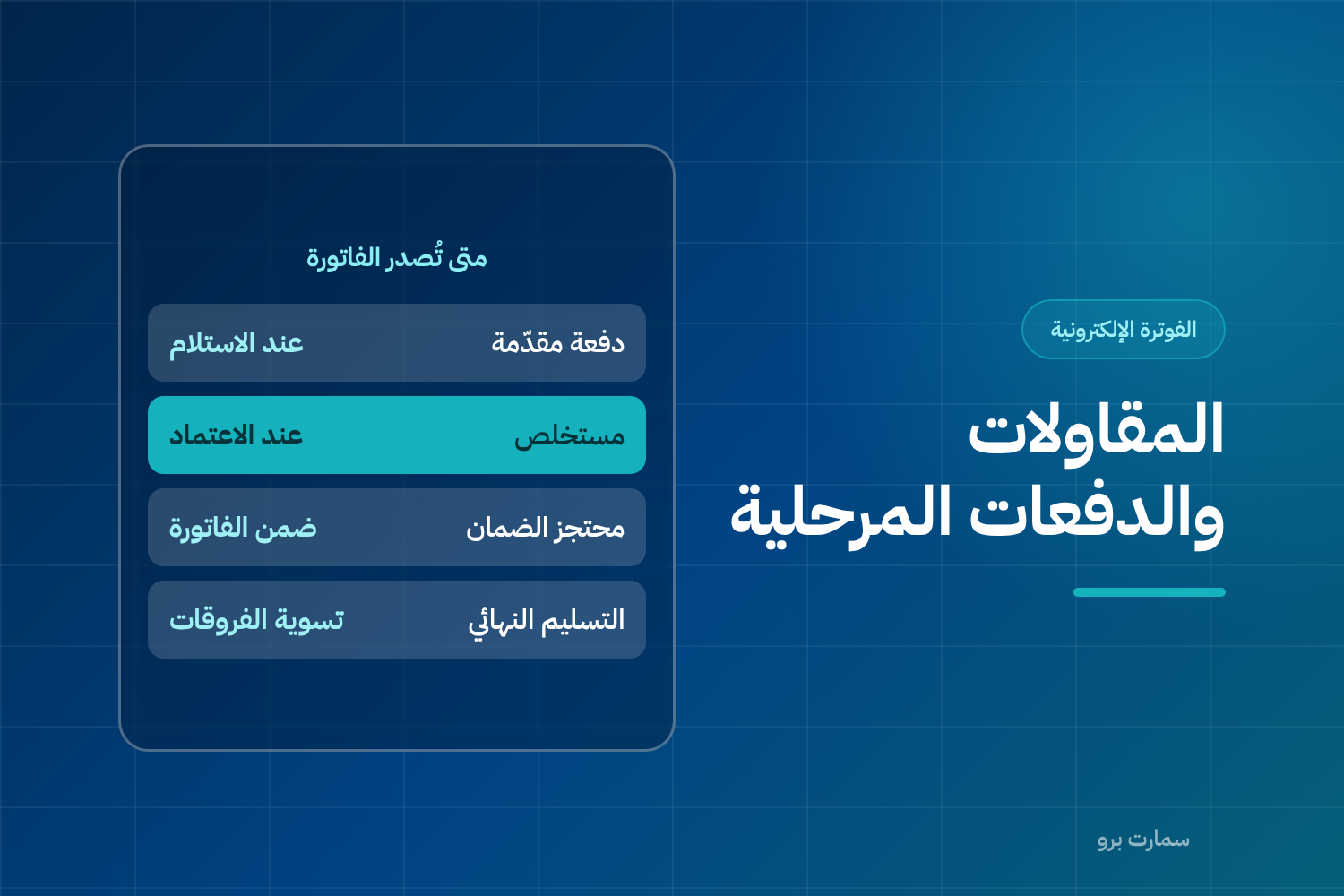
E-invoicing for contractors is harder than for retail, for the opposite reason. Contractors issue few invoices, but each one is complex and tied to a contract, a progress claim, a retention and an advance payment. A progress claim (also called a payment certificate) is the document that records the work completed in a given period.
The central question here is not "how do I issue an invoice?" but "when do I issue it?" A timing error creates a gap between your books and your VAT returns that is hard to reconcile later.
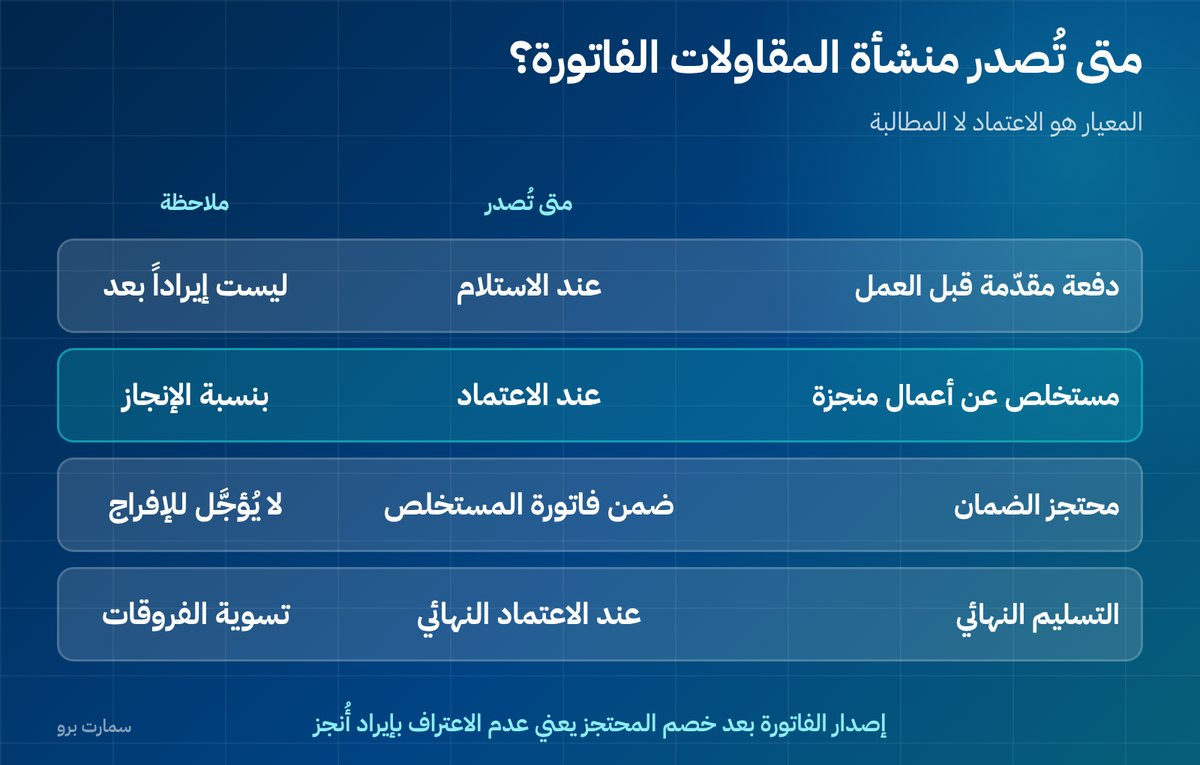
When should a contractor issue the invoice in each of the four cases?
| Case | When to issue the invoice | Note |
|---|---|---|
| Advance payment before work starts | When the payment is received | Not revenue yet, but an obligation |
| Progress claim for completed work | When the progress claim is approved | Revenue is recognised by percentage of completion |
| Retention | Within the progress-claim invoice | Not deferred until it is released |
| Final handover | On final approval | Settles any differences |
The third row is where most mistakes happen. Retention, the portion of each claim the client holds back as a guarantee, is part of the value of the completed work. It cannot be left off the invoice on the grounds that it has not been collected yet.
Is an advance payment revenue?
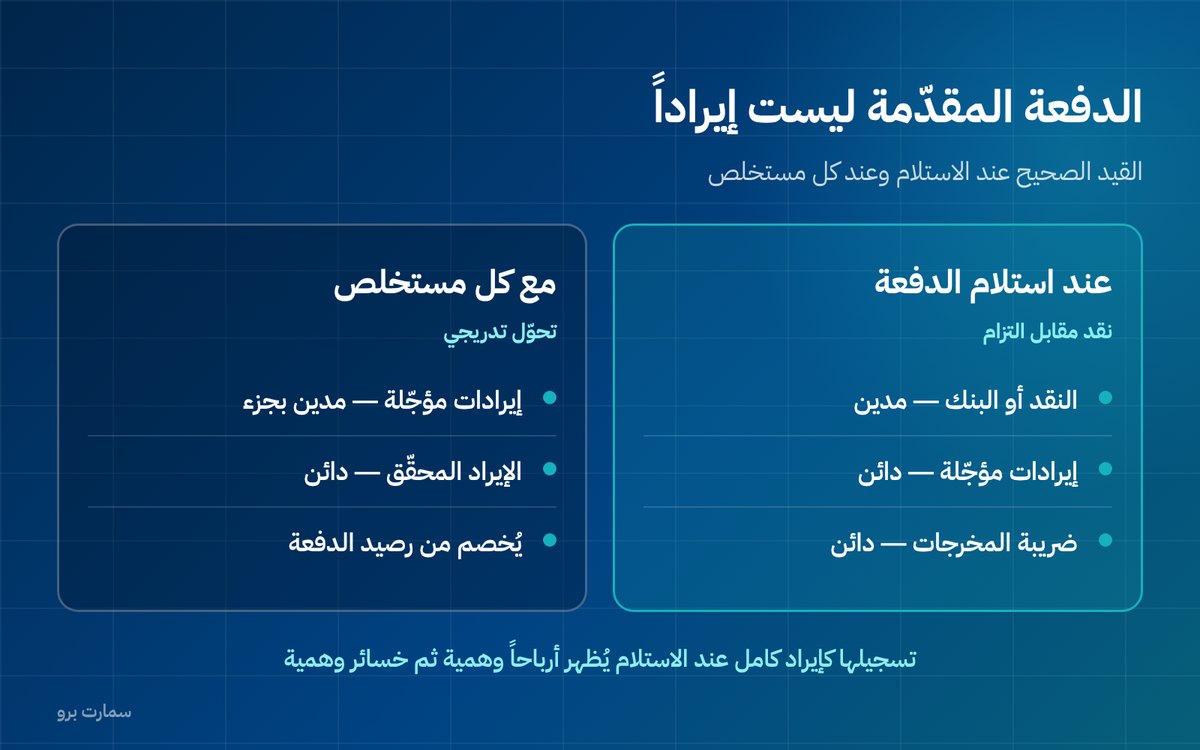
No. When you receive an advance payment before doing any work, you have received cash and taken on an obligation to perform. In the books:
- Debit cash or bank with the amount received.
- Credit deferred revenue with the value of the work.
- Credit output VAT with the VAT on the payment.
Then, with each progress claim, part of the advance payment is deducted and turned into earned revenue. The common mistake is recording the whole payment as revenue in the month it arrives, which shows phantom profit followed by phantom losses in the months after.
How do you invoice progress claims and retention?
The progress claim proves what was actually completed in a period. The invoice is issued on the basis of the claim once both parties approve it, not on what you requested before approval.
For retention: if a progress claim is worth SAR 100,000 and the retention is 10%, the invoice is issued for the full SAR 100,000. The SAR 10,000 stays in a "retentions receivable from customers" account as a long-term receivable until it is released.
Issuing the invoice for only SAR 90,000 means you have not recognised SAR 10,000 of revenue you actually earned, and you will need an extra invoice later at the wrong time.
E-invoicing for contractors: clearance, not reporting
Contracting invoices are usually tax invoices issued to businesses or government bodies, which means they are subject to clearance: the Fatoora platform must approve each invoice before you deliver it to the client. Clearance is the Phase 2 path for tax invoices, as opposed to reporting, which applies to simplified invoices sent after the fact.
In practice this means:
- Do not send the client a copy before approval, however much pressure there is to close the progress claim.
- Customer data must be accurate before the first invoice, not while you are issuing it.
- A rejected invoice delays the whole progress claim, because the client's accounts department will not accept it.
This is exactly why a contracting business needs to clean up its customer data before go-live more than any other sector: every customer represents large amounts.
How do you invoice when you use subcontractors?
On projects that rely on subcontractors, remember that you are a party to two separate transactions:
- You are the seller to the project owner: you issue them a tax invoice for the value of the approved progress claim.
- You are the buyer from the subcontractor: you receive their tax invoice and deduct its input VAT.
The common mistake is recording the net amount between the two. The correct approach is to record the full revenue and the full cost, because output VAT and input VAT are treated separately in the VAT return.
Make sure your subcontractors' invoices are actually compliant. A non-compliant invoice from them means input VAT you cannot deduct, which is an extra cost that falls on you.
How should delay penalties and contractual deductions be treated?
A delay penalty deducted by the project owner is not an automatic reduction in the invoice value. Treat it according to what the contract says and its nature: it may be compensation outside the scope of the supply, or it may require a credit note.
Review this point with your accountant before the first case arises, because getting it wrong repeats itself on every project.
What if the progress claim changes after the invoice is issued?
It happens often: a progress claim is approved, then reviewed, and some items are reduced. The fix is a credit note for the difference, not editing the invoice or cancelling it entirely.
If the approved quantities increase after the invoice, issue a debit note for the difference. Both notes must reference the original invoice number.
Why does data accuracy matter so much with government clients?
Dealing with government bodies adds another layer: purchase-order and contract numbers must appear on the invoice exactly as they do in the government entity's system. Any difference in the contract number or order reference means the accounts department will return the invoice, even if the platform has approved it.
Keep a register linking each project to its contract number, purchase-order number and the entity's reference number, and make these fields mandatory in your system before an invoice can be issued.
Five points to check before go-live
- Does your system link the invoice to the project and the progress claim by their numbers?
- Does it track the advance payment and deduct it automatically from progress claims?
- Does it separate retention into its own account automatically?
- Does it issue credit and debit notes linked to the original invoice easily?
- Are your customers' VAT numbers and national addresses complete?
The rules on supply, timing and notes for long-term contracts are published by the Zakat, Tax and Customs Authority (ZATCA). Review your own case with your accountant, because contracts differ.
If you want to see how project budgets, stages and progress billing connect to accounting in one place, take a look at SmartPro's contracting and projects features.
Key takeaway: In contracting, invoice on approval, not on request: the advance payment when received, each progress claim in full including retention, and corrections only through credit or debit notes linked to the original invoice.
Read also
- Clearance and reporting: the difference between the two paths
- Credit and debit notes: how to correct an invoice
- Cash vs accrual accounting
Try SmartPro free or book a demo to see contracting invoices, progress claims and retention handled in one connected system.
Frequently asked questions
When should a contracting business issue its invoices?
Issue an invoice when you receive an advance payment, issue an invoice for the value of completed work when each progress claim is approved, and issue a settlement invoice at final handover. The trigger is approval, not the request for payment.
Should the retention amount be left off the invoice?
No. The invoice is issued for the full value of the progress claim, and the retention stays in a "retentions receivable from customers" account as a receivable until it is released. Leaving it off the invoice means failing to recognise revenue that has actually been earned.
How is an advance payment recorded in the books?
Debit cash or bank with the amount received, credit deferred revenue with the value of the work, and credit output VAT with the VAT on the payment. It then turns into earned revenue gradually with each progress claim, and is not recorded as full revenue when received.
What should I do if a progress claim is changed after the invoice is issued?
Issue a credit note for the difference if items are reduced, and a debit note if the approved quantities increase. The original invoice is neither edited nor cancelled entirely, and the note must reference its number and date.