
Fabric Waste in the Tailoring Workshop: How to Measure Your Rate and Cost It
Fabric waste is measured as metres issued per garment delivered, not as a rate you inherited. Where it comes from, what you can recover as remnants, and how two percentage points move the cost of every garment.
Author:سامي الحيدري
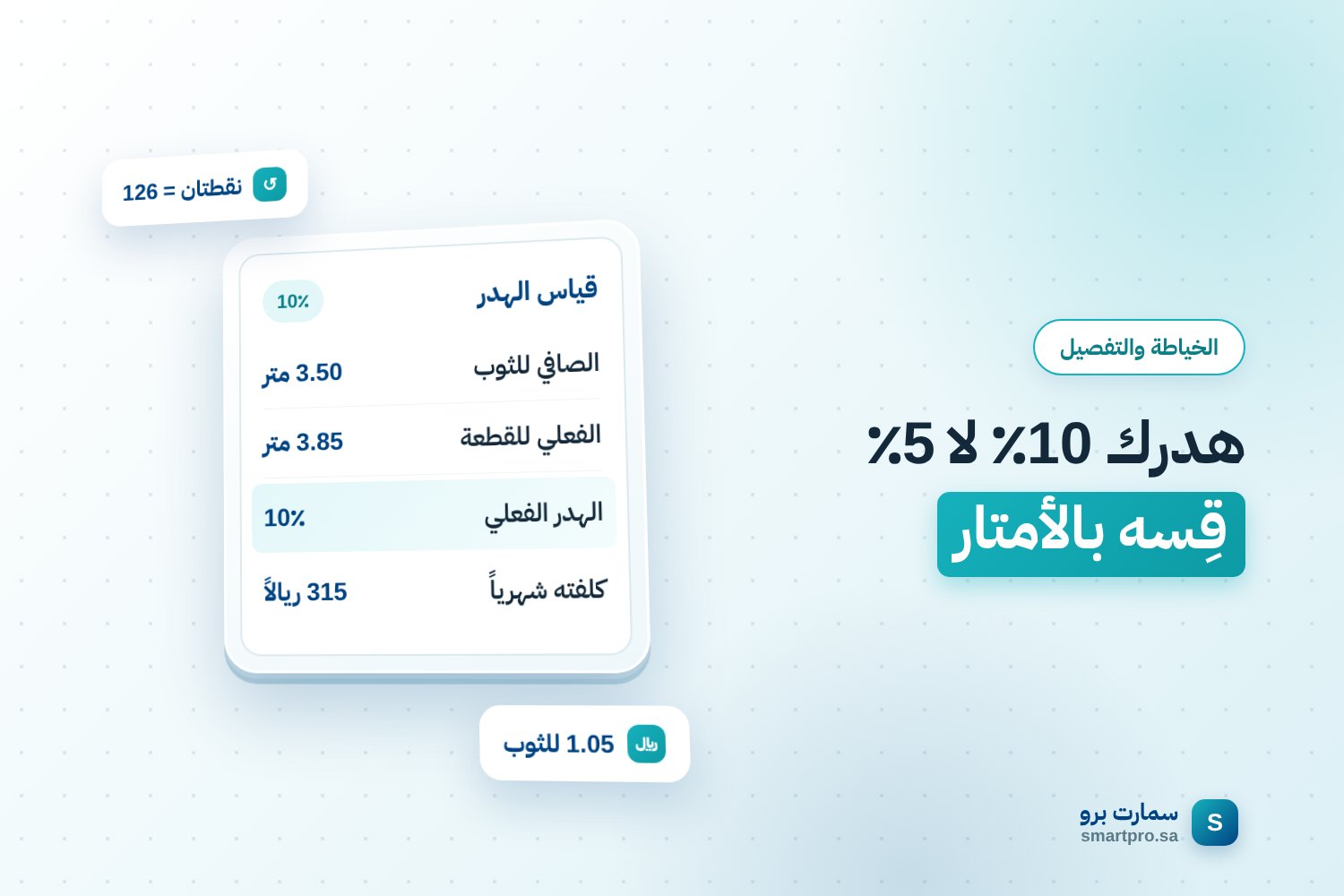
Fabric waste is the cost every tailoring workshop pays and nobody records. You measure it by dividing the metres issued from stock in a month by the garments delivered, then comparing the result with the net metres each garment needs. Fabric goes out by the metre, garments go out by the piece, and the gap between the two disappears into offcuts, remnants and recuts.
Most workshops set an assumed waste rate, such as five or eight percent, and then build their garment costs on it for years without measuring it even once.
Measuring it needs no tools and no complicated system. It needs two numbers you already have: the metres issued in the month and the number of garments delivered in that month.
Fabric waste: assumed rate vs actual rate
The assumed rate is a number you took from a tailor or from a calculation on paper. The actual rate comes out of your own stockroom, based on the width of the rolls you buy and the patterns of the garments you cut.
The difference between them is not an accounting detail. Every percentage point in this rate passes straight into the cost of every garment that leaves the workshop, and it stays there until someone measures it.
The method in one line: metres issued ÷ garments delivered, then compare the result with the assumed net metres for one garment. The difference is your real waste.
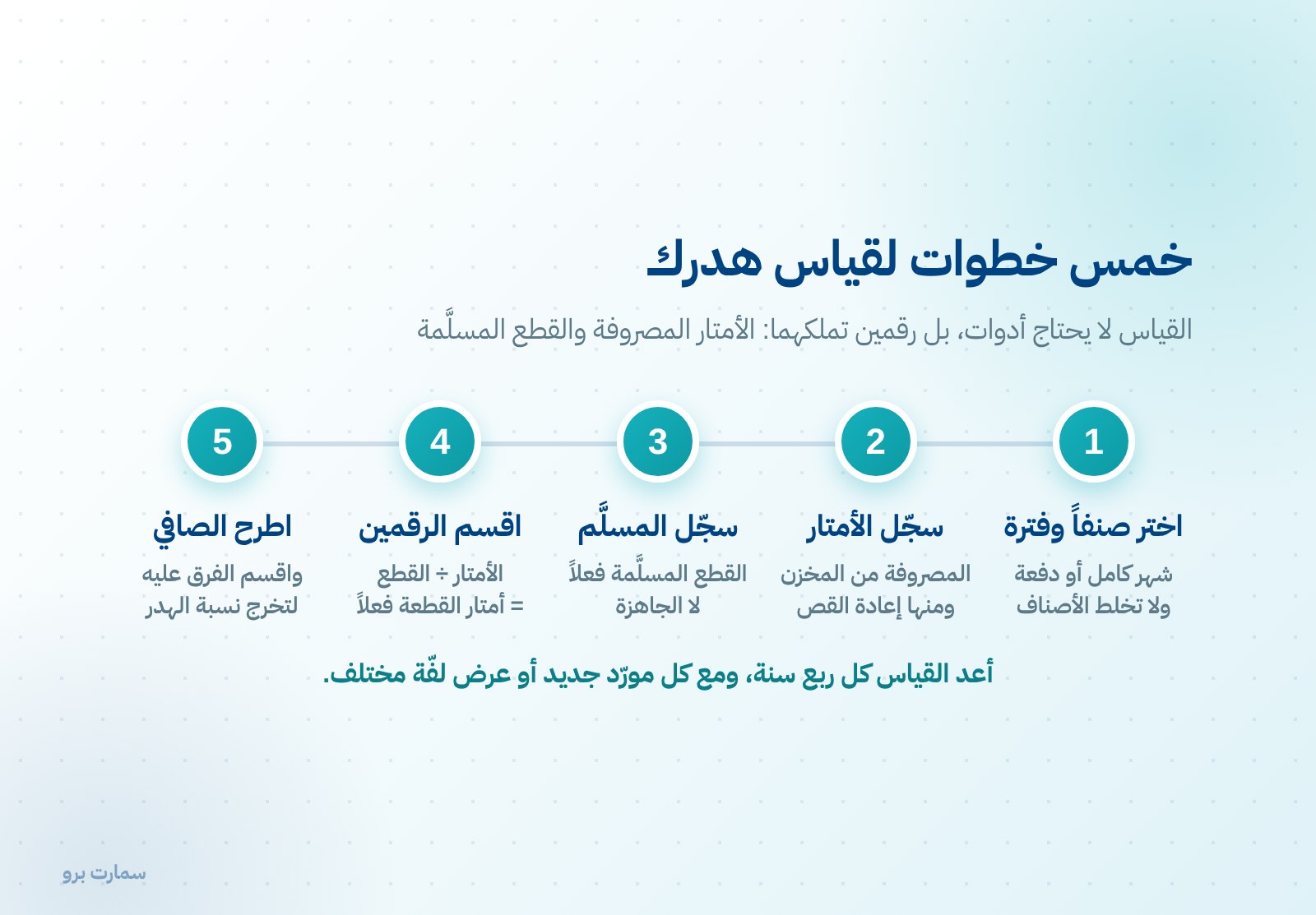
How do you measure your waste rate in five steps?
- Pick one garment type and one period: a full month or a full fabric batch. Do not mix thobes and abayas in one measurement, because their metres and patterns are different.
- Record the metres issued from stock for this garment type, including fabric issued for recuts and fabric that was issued and damaged.
- Record the garments actually delivered from the same batch, not those cut or finished but not yet handed over.
- Divide the first number by the second to get the actual metres per garment.
- Subtract the net metres and divide the difference by the net figure. The result is your waste rate, and multiplying by the price per metre turns it into riyals.
Repeat the measurement every quarter, and whenever you change supplier or roll width, because the rate changes with both.
Worked example: metres issued vs garments delivered
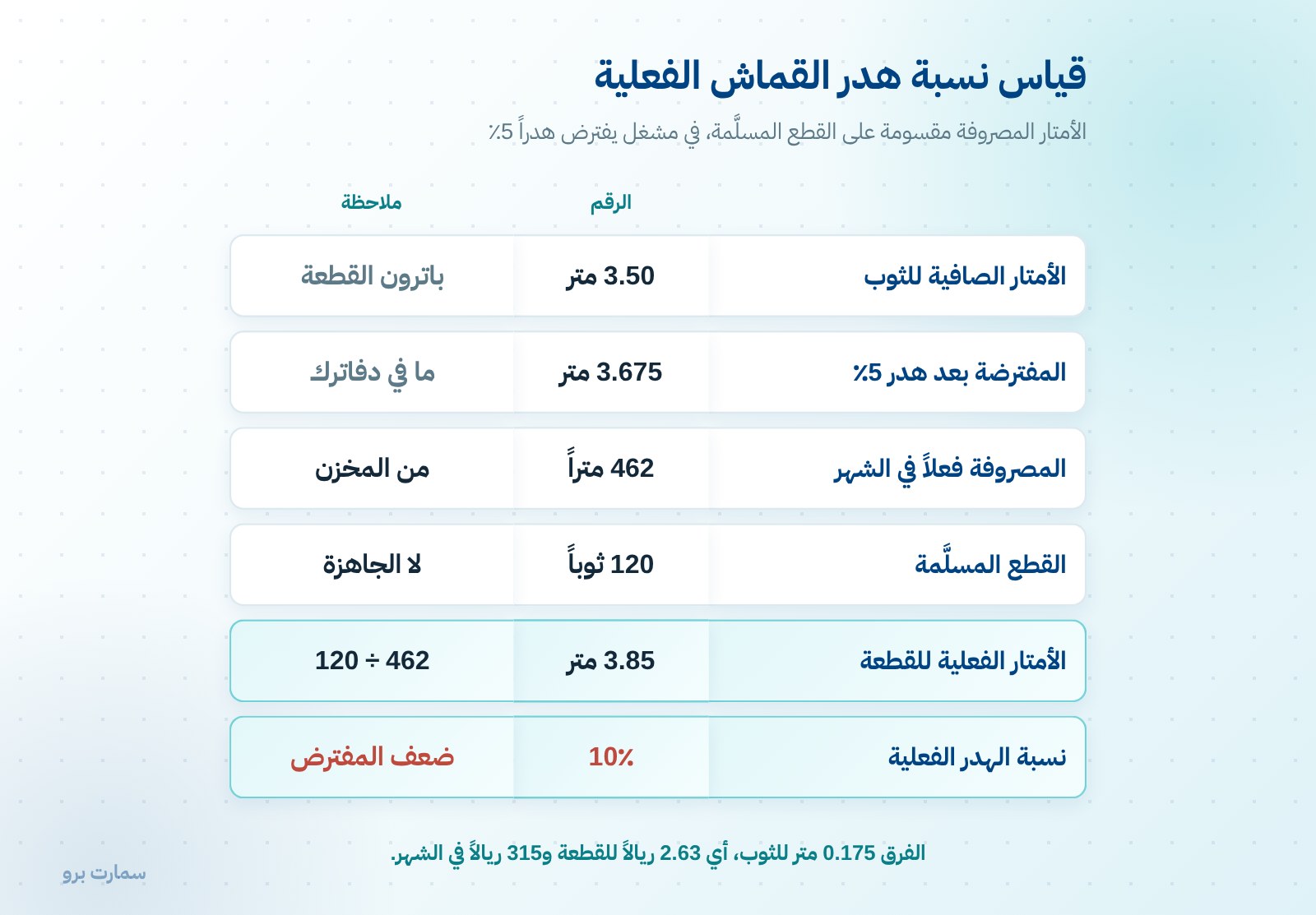
The figures below are hypothetical, used only to illustrate the method, and do not represent prevailing market prices. We build on the example published in the true cost of tailoring a thobe: a thobe uses 3.5 net metres, fabric costs SAR 15 per metre, the workshop delivers 120 thobes a month, and the assumed waste in its books is 5%.
| Item | Figure |
|---|---|
| Net metres per thobe | 3.50 m |
| Assumed metres after 5% waste | 3.675 m |
| Metres actually issued in the month | 462 m |
| Garments delivered | 120 thobes |
| Actual metres per garment | 3.85 m |
| Actual waste rate | 10% |
So the actual waste is double the assumed rate. The gap is 0.175 m per thobe, which is SAR 2.63 at the metre price, and SAR 315 a month across 120 thobes.
This money was not lost; it was loaded onto a cost you could not see. That is why the garment cost in your system looks lower than it really is, the margin looks wider than it is, and discounts get built on it that the margin cannot carry.
Where does fabric waste come from?
| Source | Nature | Can it be reduced? |
|---|---|---|
| Pattern layout (marker planning) | The largest source; depends on the cutter's skill | Yes, with a large impact |
| Roll width vs pattern width | Technical; settled at purchase | Yes, by choosing the right width |
| Grain direction and striped fabric | Matching stripes wastes edges | Only partly |
| Fabric defects and colour variation | Comes from the supplier, not from you | Yes, by inspecting on receipt |
| Recutting after a mistake | The most expensive, because it wastes fabric and time | Yes, by checking before cutting |
| Large and special sizes | Normal; priced in, not reduced | No |
Pattern layout means how the cutter arranges the pattern pieces on the fabric before cutting. It is the most important row: the layout gap between an experienced cutter and a rushed one reaches two or three points on the same roll and the same pattern, and closing it does not require buying a machine.
The second-to-last row is the one that should be recorded against a name. A recut is not ordinary waste; it is a mistake with a cause and someone responsible, and how to handle it is covered in rework: who bears the cost.
How do you record waste so it becomes visible?
Waste that is not recorded is not managed. The natural place to record it is the cutting stage of the order flow: received → cut → sewn → ironed → ready → delivered.
At cutting, one line is written down: the metres issued for this order, and the metres returned to stock as usable remnants. The difference is the waste, and it shows up in your reports instead of appearing as an unexplained gap in your fabric stocktake.
Inspecting the roll before cutting separates supplier defects from your own mistakes, and that is what makes a claim against the supplier possible. The details are in receiving fabric rolls.
What can be recovered as remnants, and what cannot?
Not everything left over is waste. Remnants fall into three categories, and lumping them into one is what makes the number misleading.
- Usable remnants: pieces big enough for a pocket, a cuff, a collar or a children's garment. They go back to stock with a description, a measurement and a roll number. These are not waste; they are inventory.
- Sample remnants: small pieces used to show colours to a customer or to test a needle and thread before the real garment. Their value is in service, not in sales.
- Net waste: edges and strips that are good for nothing. These alone are charged to the garment cost.
A workshop that returns the first category to the shelf with a clear description lowers its net waste without changing anything in the cutting. Ways to classify and use them are covered in fabric remnants.
How much do two points of waste change the cost of a garment?
The figures below are hypothetical, used only to illustrate the method, and do not represent prevailing market prices. Suppose you bring waste down from 10% to 8%: just two points, achievable through better pattern layout and checking before cutting.
| Garment | Net metres | Price per metre (SAR) | Saving per garment from two points |
|---|---|---|---|
| Thobe | 3.5 | 15 | SAR 1.05 |
| Abaya | 3.0 | 45 | SAR 2.70 |
| Uniform | 2.2 | 12 | SAR 0.53 |
The thobe saving is SAR 1.05 per garment, SAR 126 a month across 120 thobes, and SAR 1,512 a year. It looks small until you measure it against profit: the thobe in the published example makes SAR 20.38, so two points mean a five percent increase in profit without raising the price or cutting wages.
The impact varies sharply between garment types. The abaya gives more than twice the thobe's saving from the same two points, because its fabric costs three times as much per metre. So effort should go to the expensive fabric first, not to the garment you make the most of.
Which three mistakes make the number wrong?
- Measuring waste on a single garment with a tape measure after cutting. This shows the waste of one garment, on one day, by one cutter; it does not show your rate.
- Mixing garment types in one measurement, which hides the difference between a straight thobe and an abaya with a curved pattern.
- Counting usable remnants as waste and then actually throwing them away, so the high number comes true after starting as a classification error.
There is a fourth, more expensive mistake: updating the rate in the costing sheet and forgetting to update the price built on it. A rate that changes while the price does not shows up only in your tailoring margin per garment.
What should you do with the number once you know it?
Three decisions change as soon as you know your actual rate.
First: update the costing sheet for each garment type to the real rate, not the inherited one. This single step corrects every line in your tailoring price list.
Second: choose roll width at purchase based on your pattern, not on price alone. A roll that is two riyals more expensive but wider can save more than that in metres.
Third: track waste for each cutter separately. The number here is for training, not for blame, because a cutter who fears the number starts leaving a large safety margin on every piece, and waste goes up instead of down.
Where is the official reference?
Inventory valuation, and the damage and remnants you record, appear in your books and in the invoices you build on them. Related guidance is published by the Zakat, Tax and Customs Authority (ZATCA), which is the reference in case of any discrepancy.
Everything described here is handled in practice in SmartPro's tailoring system: orders, measurements, fabrics and invoicing in one place.
Key takeaway: Measure fabric waste as metres issued divided by garments delivered, per garment type, and update your costing and prices to the real rate. Two points of waste can be worth about five percent of a garment's profit.
Read also
- The true cost of tailoring a thobe
- Fabric remnants: what to keep and what to throw away
- Fabric stocktake: how to reconcile the difference
To see how cutting, remnants and garment costs fit together in your own workshop, start a free SmartPro trial.
Article visuals
Frequently asked questions
How do I calculate the fabric waste rate in my workshop?
Divide the metres issued from stock in a month by the number of garments delivered, then subtract the assumed net metres per garment and divide the difference by that net figure. In the hypothetical example, actual usage came out at 3.85 m against 3.5 net metres, so the real waste was 10%, not the 5% in the books. Use a full month or a full fabric batch, and do not mix thobes and abayas in one measurement, because their patterns differ.
What is the biggest source of fabric waste?
Pattern layout, meaning how pieces are arranged on the roll before cutting, which depends on the cutter's skill rather than the machine. It is followed by a roll width that does not suit the pattern, then grain direction and striped fabric, then supplier defects. The most expensive source is recutting, because it wastes fabric and time together. All of these can be reduced by checking before cutting and inspecting rolls on receipt, except what comes down to grain direction and special sizes.
Do fabric remnants count as waste?
Not all of them. Pieces big enough for a pocket, collar, cuff or children's garment go back to stock with a description, measurement and roll number, and they are inventory, not waste. Only the edges that are good for nothing are net waste charged to the garment cost. Mixing the two categories in one number is what makes the rate misleading and makes it look worse than it really is.
How much does cutting fabric waste by two points save?
In the hypothetical example, cutting waste from 10% to 8% saves SAR 1.05 per thobe and SAR 2.70 per abaya, because abaya fabric costs more per metre. Across 120 thobes a month the saving is SAR 126, roughly five percent of the thobe's profit, without raising prices or cutting wages. That is why the effort should start with expensive fabric, not with the garment you make in the largest numbers.