
Fabric Stocktake in the Tailoring Workshop: Procedure, Valuation and Variances
Fabric is counted in metres, not pieces. A six-step stocktake procedure, a remnant valuation table, and where the gap between the books and the shelf really comes from.
Author:سامي الحيدري
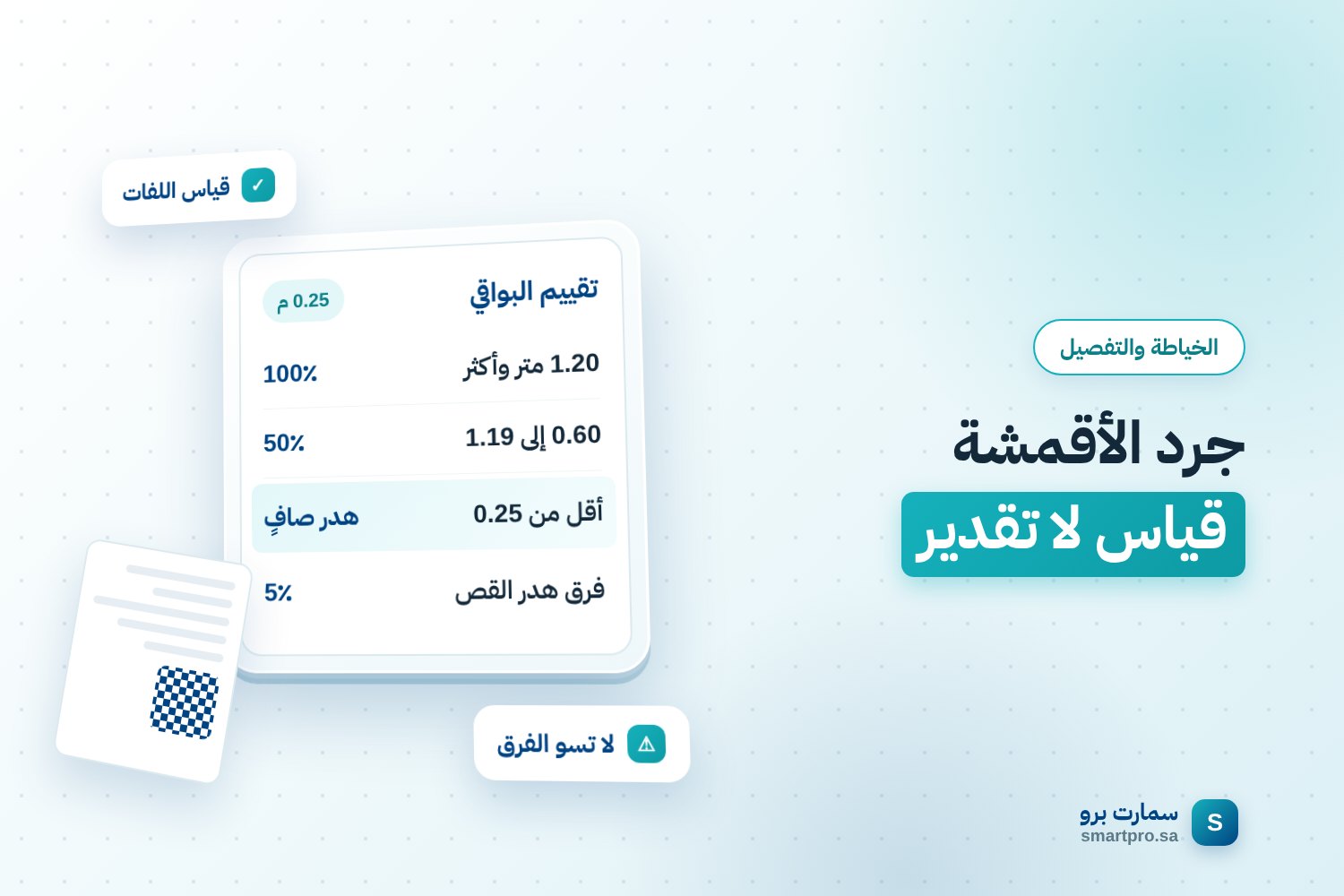
A fabric stocktake is the weakest link in a tailoring workshop's accounts, because the stock is not counted by the piece but by the metre, and in many workshops metres are cut every day without any document. The book balance then becomes a number with no connection to what is actually on the shelves.
The damage doesn't show up in the count itself but somewhere else. Cost of goods sold comes out wrong, so profit comes out wrong, and pricing decisions end up built on incorrect numbers. See the true cost of tailoring a thobe.
Fabric stocktake: what gets counted and what gets measured
Fabric stock in a workshop is three categories, not one. Each needs a different method:
| Category | How it is counted | How it is valued |
|---|---|---|
| Full rolls | By number | Roll length × price per metre |
| Opened rolls | By measuring the remaining metres | Metres × price per metre |
| Remnants (offcuts) | By measuring and sorting | At a percentage of the price per metre |
In this series' example, a roll is 60 metres. An opened roll is neither counted as a full roll nor ignored. You measure what is left on it.
Most workshops get the third category wrong. Some value every remnant at the full price per metre, which inflates stock. Others ignore remnants entirely, which throws away a real asset.
How do you value fabric remnants?
Remnants are not all equal. A metre and a half can make a complete garment. Twenty centimetres can make nothing more than a pocket.
| Length | Valuation rate |
|---|---|
| 1.20 m and above | 100% of the price per metre |
| 0.60 – 1.19 m | 50% |
| 0.25 – 0.59 m | 25% |
| Under 0.25 m | Zero |
The minimum length worth keeping is 0.25 metres. For fabrics costing more than SAR 40 per metre, it drops to 0.15 metres. Anything shorter is excluded from the count, because storing it takes shelf space costing SAR 250 per square metre per month for a value that is negligible.
The full remnant policy is covered in fabric remnants.
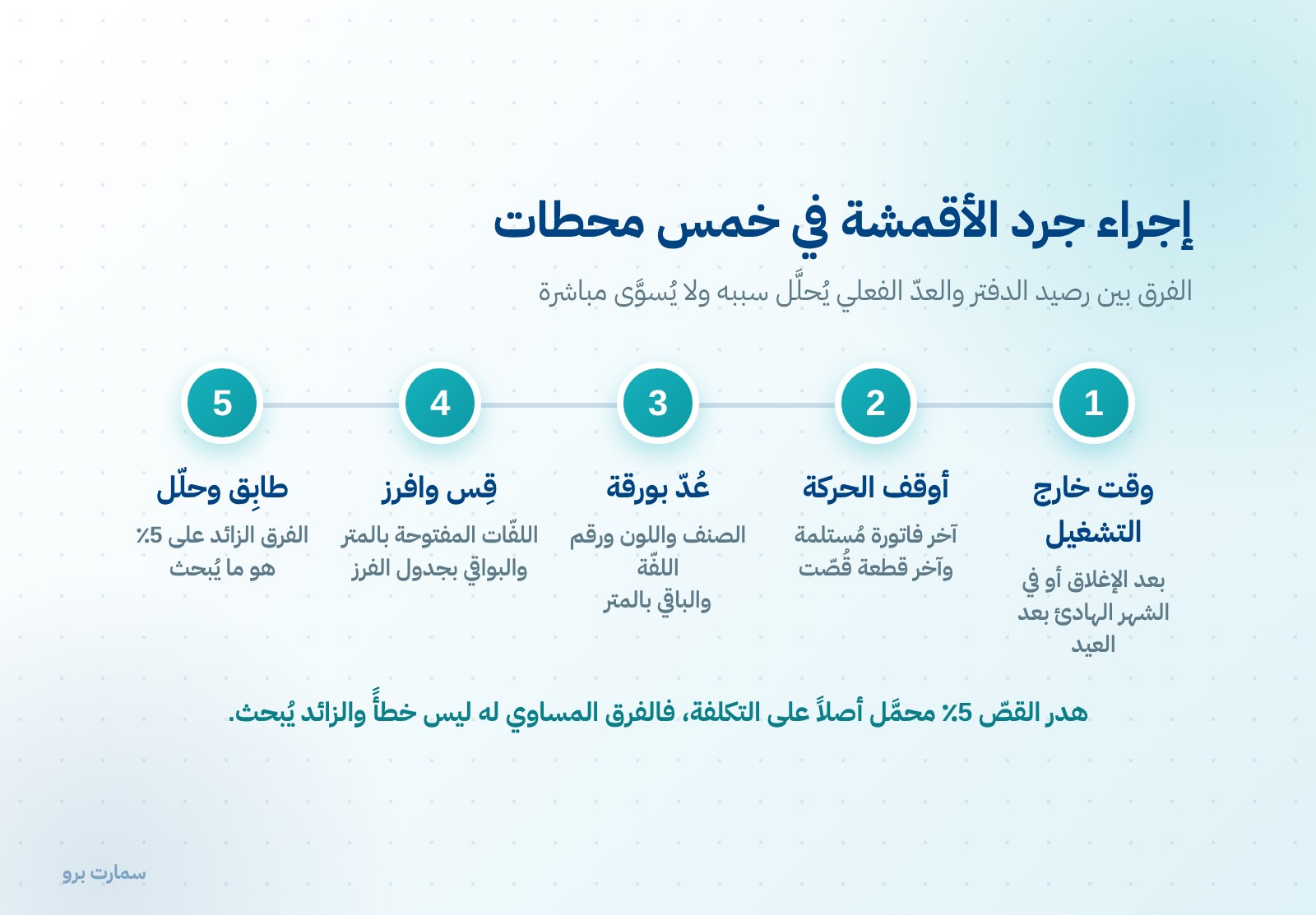
How do you run a fabric stocktake in six steps?
- Pick a time outside operating hours: after closing, or in the quiet month after Eid. Counting in the middle of a working day produces variances caused by movement, not by mistakes.
- Freeze movement and record the cut-off point: the last supplier invoice received and the last piece cut. Everything after them belongs to the next period.
- Count on a sheet, not from memory: a table with item, colour, roll number and remaining metres, filled in standing in front of the shelf.
- Measure opened rolls. Do not estimate them by eye. Eyeballing is off by about two metres per roll.
- Sort the remnants using the valuation table above, and set aside anything below the minimum length.
- Reconcile against the books and investigate the variances. Don't adjust them straight away.
The sixth step is the real stocktake. Counting is an operational task anyone can do. Reconciliation and variance analysis are what actually help the owner.
Where does the stock variance come from?
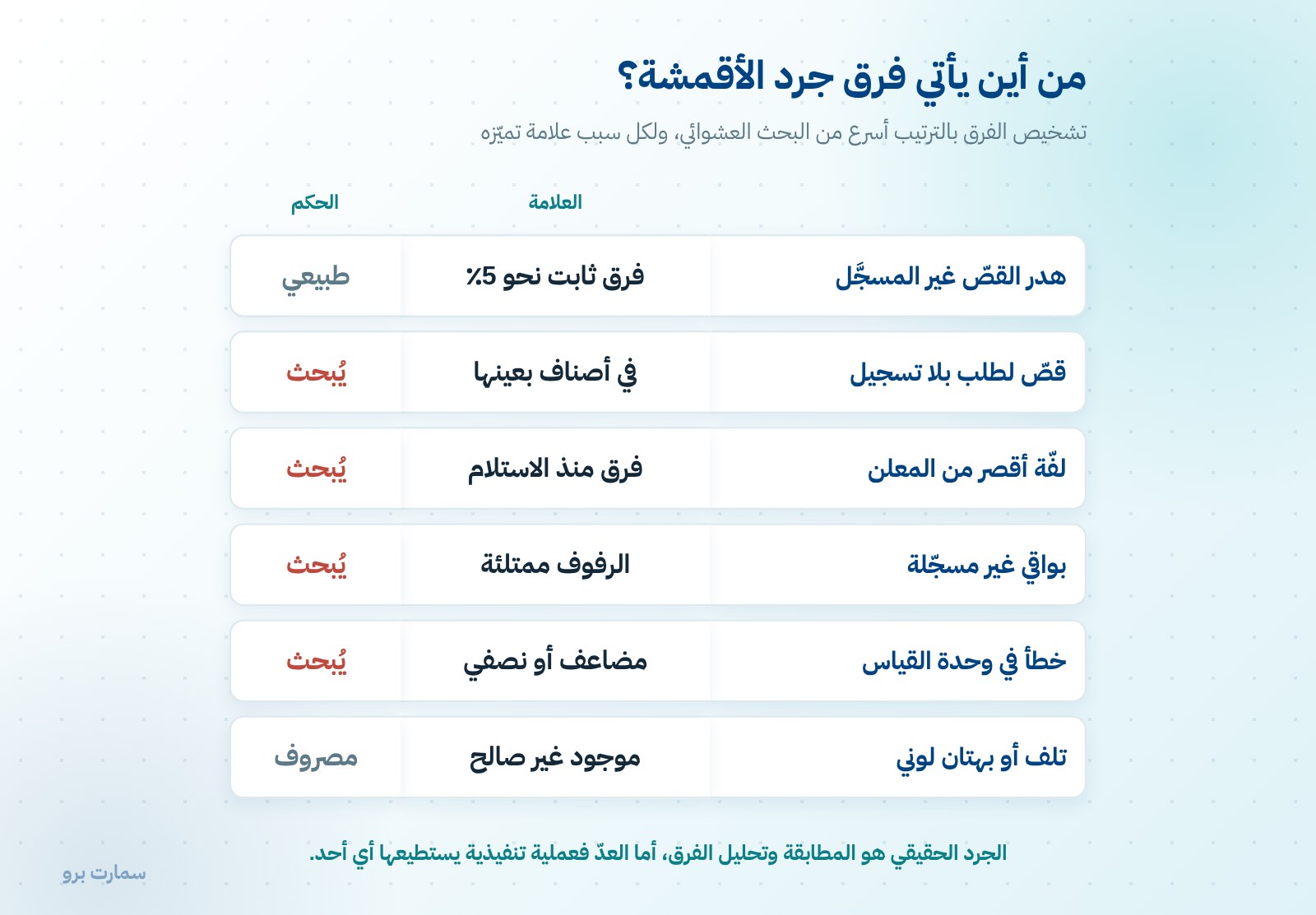
The gap between the book balance and the physical count has known causes. Diagnosing them in order is faster than searching at random:
| Cause | Sign |
|---|---|
| Unrecorded cutting waste | A steady variance at a fixed rate of around 5% |
| Cutting for an order without recording it | Variance in specific items, not across all of them |
| A roll received shorter than its stated length | Variance that appears from the day of receipt |
| Unrecorded remnants | Stock is lower in the books while the shelves are full |
| Unit-of-measure error | Variance that is double or half, not random |
| Damage or colour fading | The fabric is there but no longer usable |
The first row is the normal one. Waste in this series is 5%, and it is already built into the cost of each piece. A variance equal to that rate is not an error. The variance above it is what needs investigating. See fabric cutting waste and receiving fabric rolls.
How often should fabric stock be counted?
Use three cycles, not one:
- A full count twice a year: once at the end of the financial year and once in the quiet month after Eid.
- A monthly cycle count for fast-moving items, such as white thobe fabric, because they cause most of the variance.
- Event-driven counts: before a large supply order, after peak season, and whenever the storekeeper changes.
If you only do a full count once a year, you discover a variance twelve months after it happened. By then its cause is gone, and only its effect remains.
How does the stocktake reach the books?
The result of a stocktake is not a sheet pinned to the wall. It is a journal entry. The balance confirmed by the count is what appears as inventory, and the variance is treated according to its cause:
- Normal waste is charged to production cost.
- Damage is charged as an expense.
- An unexplained variance is recorded as an inventory shortage, with its cause documented.
The cost of holding stock in this sector is 18% a year, so excess stock is not a safety margin but a deferred expense. See the workshop chart of accounts and fabric stock levels.
Does customer-supplied fabric count as your stock?
This point is specific to tailoring. Fabric that a customer brings in is not your stock. It is not included in your count or your valuation.
It does belong in a separate customer-goods register: who brought it, when, how many metres, and for which order. Disputes over a customer's fabric are harder than disputes over the workshop's own fabric, and that fabric is a liability you carry, not an asset you own. See when the customer brings the fabric.
What are the common stocktake mistakes in tailoring workshops?
- Estimating opened rolls by eye instead of measuring them.
- Adjusting the variance straight away without analysing its cause, so it repeats every cycle.
- Valuing every remnant at the full price per metre, which inflates stock.
- Counting during working hours, so fabric already cut gets mixed up with fabric not yet cut.
- Neglecting the customer-goods register and mixing customer fabric with workshop stock.
- Relying on a single annual count that reveals a variance after its cause is gone.
The official reference
Requirements for business books and accounting records, including how costs are recorded, are published by the Zakat, Tax and Customs Authority (ZATCA), which is the reference in case of any disagreement.
If you would rather run all of this without scattered spreadsheets, that is what the tailoring system does.
Key takeaway: Count fabric in metres, value remnants by length, and investigate any variance beyond the built-in 5% waste before posting it to the books.
Read also
Article visuals
Frequently asked questions
How are fabric remnants valued in a stocktake?
By sorting them by length. Pieces of 1.20 metres or more are valued at 100% of the price per metre, 0.60 to 1.19 metres at 50%, and 0.25 to 0.59 metres at 25%. Anything shorter is valued at zero and excluded from the count.
How often should fabric stock be counted?
Use three cycles. Do a full count twice a year, once at the end of the financial year and once in the quiet month after Eid. Add a monthly cycle count for fast-moving items, and event-driven counts, such as before a large supply order or when the storekeeper changes.
What variance between the books and the physical count is acceptable?
A variance equal to the waste rate already built into the cost of each piece is not an error. In this series' examples, that rate is 5%. Anything above it needs investigating, and the usual causes are cutting for an order without recording it, a roll received shorter than its stated length, or unrecorded remnants.
Is customer-supplied fabric included in the stock count?
No. Fabric a customer brings in is not the workshop's stock and is not part of its valuation. It belongs in a separate customer-goods register showing who brought it, when, how many metres and for which order, because it is a liability the workshop carries rather than an asset it owns.