
Fabric Offcuts: What to Keep, What to Value and What to Write Off
Fabric offcuts are three categories, not one. A minimum usable length, seven fields to record, a length-based valuation policy, and the point at which writing off is cheaper than storing.
Author:سامي الحيدري
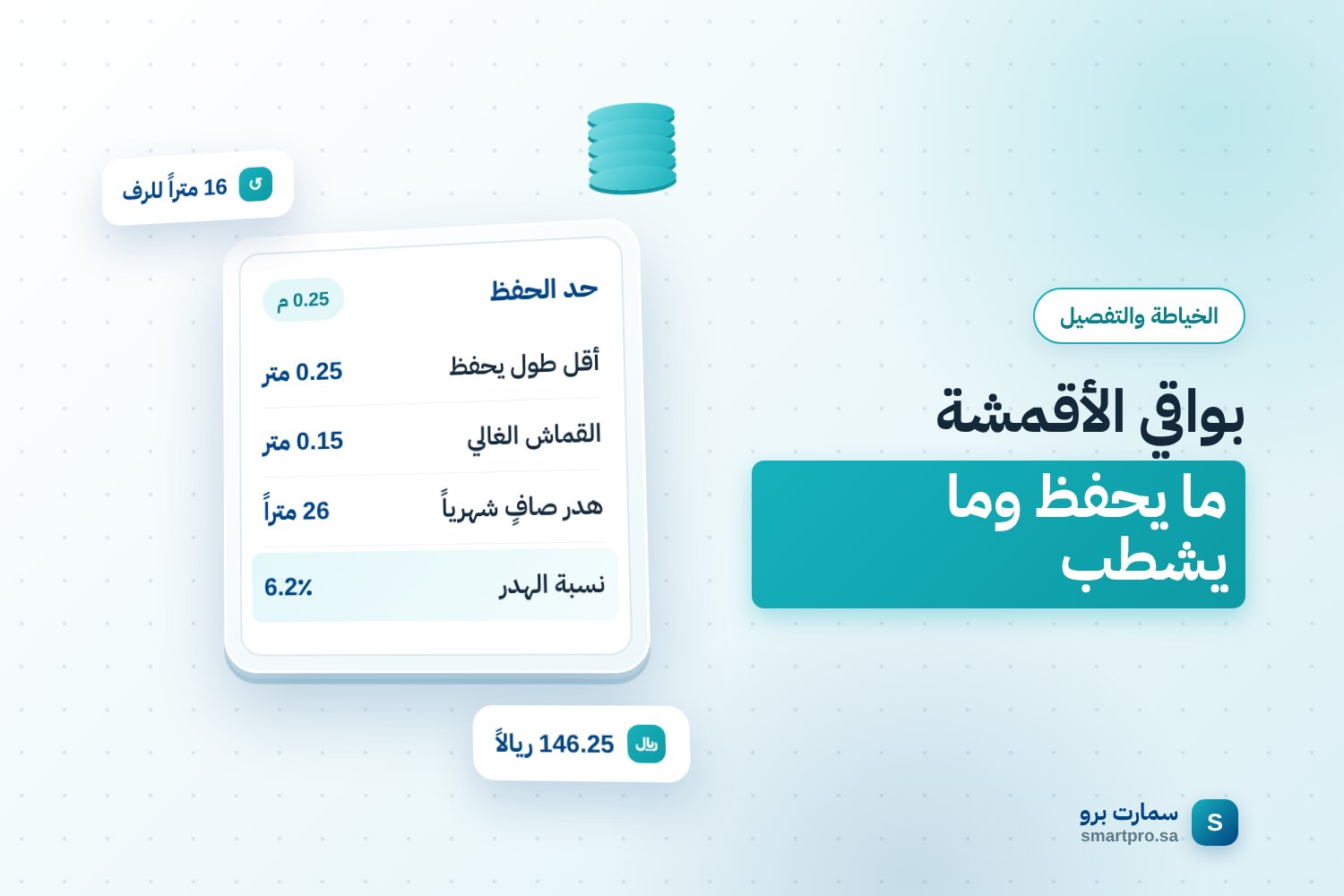
Fabric offcuts are the pieces left over after cutting that are too small for a full garment. In most workshops they end up in one of two places: a box in the corner of the storeroom that nobody opens, or a bag thrown out at the end of the day.
Both are mistakes. The first takes up space and inflates inventory in the books at a value that will never be realised. The second turns usable fabric into pure waste on a moment's decision.
The fix is not to keep everything or to throw everything away. It rests on three rules: a minimum usable length, a recording method that makes each offcut findable, and a book value lower than the value of the roll.
Fabric offcuts: three categories, not one
Lumping everything left over into a single category is the root of the problem. Separate it into three categories, each with its own decision:
| Category | What it is | Decision |
|---|---|---|
| Production offcut | Enough for a pocket, collar, cuff or children's piece | Returns to the shelf with a description and code |
| Sample | A small piece to show a colour or test needle and thread | Kept in a sample book, in limited numbers |
| Pure waste | Edges and strips that are no use for anything | Charged to the cost of the garment |
The first category is inventory, not waste, and the third is waste, not inventory. The second has service value: two pieces per colour are enough, and anything beyond that moves to the third category.
This separation is what makes the waste percentage in fabric cutting waste an honest number rather than one inflated by mixing categories.
What is the minimum usable length?
The rule in one line: anything under 0.25 metres is not kept, because the cost of storing it and searching for it exceeds what it gives back. The exception is expensive fabric costing more than SAR 40 per metre, where the threshold is 0.15 metres.
| Use | Minimum length |
|---|---|
| Colour sample for the customer | 0.10 m |
| Repair patch for the customer's own garment | 0.30 m |
| 0.25 m | |
| Cuff or collar | 0.40 m |
| Partial lining | 0.60 m |
| Children's piece | 1.20 m |
Width matters as much as length. A piece 0.50 metres long and 30 centimetres wide will not make a collar however adequate its length, so record both dimensions, not just the length.
How should offcuts be recorded so they can be found?
An offcut that cannot be found within two minutes does not get used: new fabric is cut from the roll instead and the offcut stays in the box. That is why recording is half the benefit.
Seven fields are enough: offcut code, fabric type, colour, parent roll number, width, length and location.
The code is built on the roll number, not on an independent sequence: "B-1184-03" means the third offcut from roll 1184. The value of this is that it ties the offcut to its dye lot, so a garment repaired with fabric from the same roll shows no colour difference. The roll number is recorded when receiving fabric rolls.
Location is a field you cannot skip: a numbered box for each fabric type, not one box for everything. Searching a single box holding twenty-four colours burns more minutes than the offcut itself saves.
What are offcuts actually useful for?
- A repair patch kept with the order record. A 0.30-metre piece of the customer's fabric is filed with their order, so if they need a repair months later it comes from the same dye lot. This is the highest value a small offcut can deliver.
- Internal parts: pockets, partial linings and shoulder reinforcement — places where a dye difference does not show.
- Children's pieces, if you have a line for them, since they need few metres and a slight colour difference is acceptable.
- A colour sample book to show customers instead of unrolling fabric for every enquiry.
- Needle and thread tests before the real garment, especially on delicate fabric.
They are not useful for anything else. Offcuts are not raw material for side products invented to justify keeping them, because any side product consumes sewing minutes, and a sewing minute is worth far more than the offcut itself.
How should fabric offcuts be valued in the books?
An offcut recorded at the roll's price per metre inflates inventory, because it is not fabric that can be cut freely like a full roll. A written policy ties the value to the length:
| Offcut length | Valuation as % of price per metre |
|---|---|
| 1.20 m and over | 100% |
| 0.60 to under 1.20 m | 50% |
| 0.25 to under 0.60 m | 25% |
| Under 0.25 m | Zero, pure waste |
The percentage is applied once, when the offcut goes back on the shelf, and it is not revalued at every count. The effect of this policy shows up in your fabric stocktake.
Worked example: how much returns to the shelf each month?
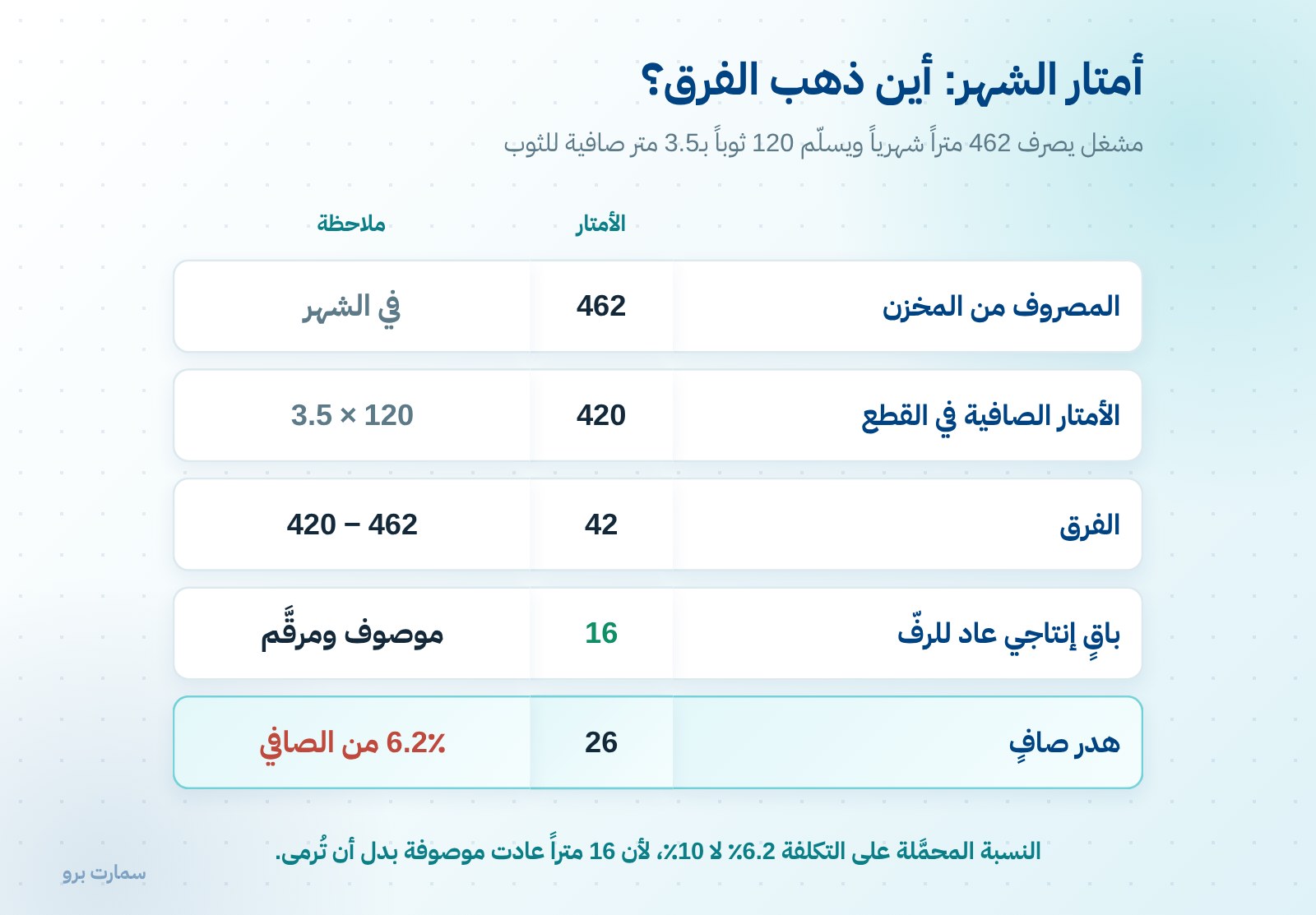
The following figures are hypothetical, to illustrate the method, and do not represent prevailing market prices. Using this series' parameters: a thobe uses 3.5 net metres at SAR 15 per metre, and the workshop issues 462 metres a month and delivers 120 thobes.
- Net metres in garments: 120 × 3.5 = 420 metres
- Difference from metres issued: 462 − 420 = 42 metres
- Returned as production offcuts: 16 metres
- Pure waste: 26 metres, i.e. 26 ÷ 420 = 6.2%
So the rate charged to cost is 6.2%, not 10%, and the whole difference comes from those sixteen metres going back on the shelf with a description instead of being thrown away. Valued under the policy above:
| Category | Metres | Valuation % | Value (SAR) |
|---|---|---|---|
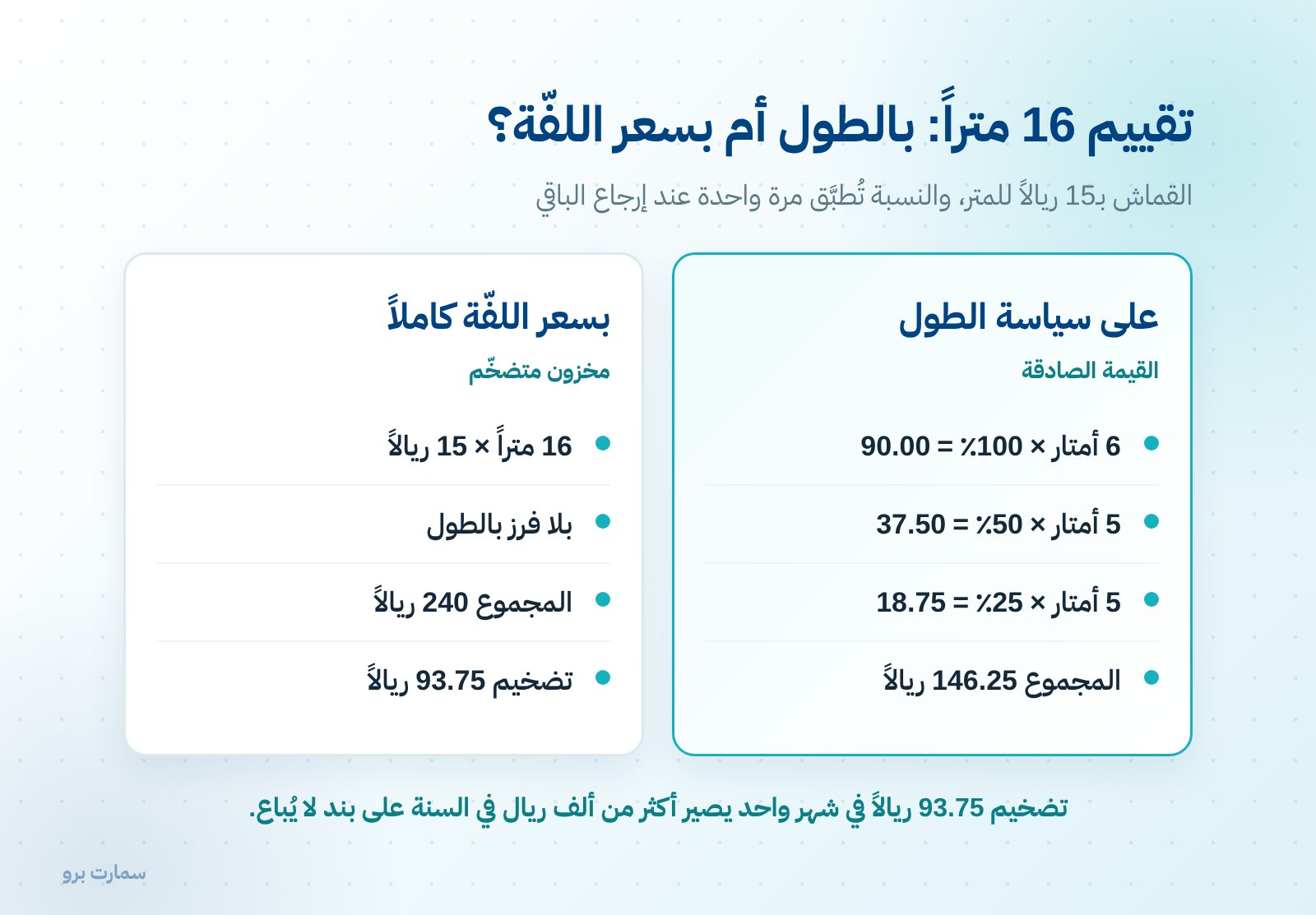
| 1.20 m and over | 6 | 100% | 90.00 |
| 0.60 to 1.19 m | 5 | 50% | 37.50 |
| 0.25 to 0.59 m | 5 | 25% | 18.75 |
| Total | 16 | 146.25 |
Had the sixteen metres been recorded at the full roll price, they would have appeared at SAR 240, an overstatement of SAR 93.75 in a single month. Over a year, the overstatement exceeds SAR 1,000 on an item that is never sold and never cut as a full length.
When should offcuts be written off instead of stored forever?
An offcut that has not moved in twelve months will not move in the thirteenth. At that point the question becomes: what does it cost to keep it?
Suppose monthly rent of SAR 6,000 for 24 square metres, i.e. SAR 250 per square metre per month. If the offcut boxes occupy 1.5 square metres, they cost SAR 375 a month.
Now suppose the boxes hold 210 metres, of which 90 metres are older than twelve months — 43% of the boxes:
- Cost of storing the slow-moving stock: 375 × 43% = SAR 161.25 a month, or SAR 1,935 a year
- Its book value under the valuation policy: SAR 806.25
In other words, storing it for a year costs more than twice its value. The financial decision is clear: allow thirty days to use it for samples or internal parts, then write it off and remove it from both the floor space and the books.
Storage areas in tailoring shops are subject to an official limit published by the Ministry of Municipalities and Housing, detailed in tailoring shop requirements. Space is a constraint, not a choice, and every square metre taken up by dead offcuts is a square metre not holding fabric that moves.
What are the three most common mistakes in managing offcuts?
First: keeping everything left over. A box that accepts everything becomes impossible to search, so nothing in it gets used. The minimum length is what protects the box from itself.
Second: counting usable offcuts as waste and then actually throwing them out. The wrong numbers become reality, and the real waste rate rises after having been merely a classification error.
Third: recording them at roll value. Inventory appears larger than it really is, and purchasing decisions get built on it, as explained in fabric stock levels.
Official reference
Inventory valuation and any damage or offcuts you record appear in your books and in everything built on them. The relevant rules are published by the Zakat, Tax and Customs Authority (ZATCA), which is the reference in case of any discrepancy. For invoicing, see the simplified tax invoice for tailors.
Workshops that keep this under control usually do it inside a single system, such as SmartPro's tailoring workshop software.
Key takeaway: Split offcuts into production offcuts, samples and pure waste, keep only pieces above a minimum length, value them by length rather than roll price, and write off anything idle for twelve months once storing it costs more than it is worth.
Read also
- Fabric cutting waste: measuring the real percentage
- Fabric stocktake: how to control the variance
- Fabric stock levels: how many metres to hold
To see how offcuts, roll numbers and order records connect in one place, start a free SmartPro trial.
Article visuals
Frequently asked questions
What is the minimum offcut length worth keeping?
Under the default policy it is 0.25 metres, or 0.15 metres for fabric costing more than SAR 40 per metre. Below that, the cost of storing and searching for the piece exceeds what it gives back. Record the width along with the length, because a long but narrow piece will not make a collar or a pocket.
How should I value fabric offcuts in the books?
Not at the full price per metre of the roll. Under the default policy, offcuts of 1.20 metres and over are valued at 100%, those between 0.60 and 1.19 metres at 50%, those between 0.25 and 0.59 metres at 25%, and anything shorter at zero. The percentage is applied once, when the offcut is returned to the shelf.
Are fabric offcuts counted as waste?
Not all of them. An offcut large enough for a pocket, collar, cuff or children's piece is inventory that goes back on the shelf with a description and its roll number. In the hypothetical example, 16 of 42 leftover metres returned to stock, bringing the pure waste charged to cost down to 6.2% instead of 10%.
When should I write off slow-moving offcuts?
After twelve months without movement, with a thirty-day grace period to use them for samples or internal parts. In the hypothetical example, storing 90 metres of idle offcuts cost SAR 1,935 a year against a book value of SAR 806.25, more than twice their value.