
The Simplified Tax Invoice in a Tailoring Shop: Fields and Timing
The simplified tax invoice is a tailor's everyday document. Here are its mandatory fields, when to issue and report it, and when you need a standard tax invoice instead.
Author:سامي الحيدري
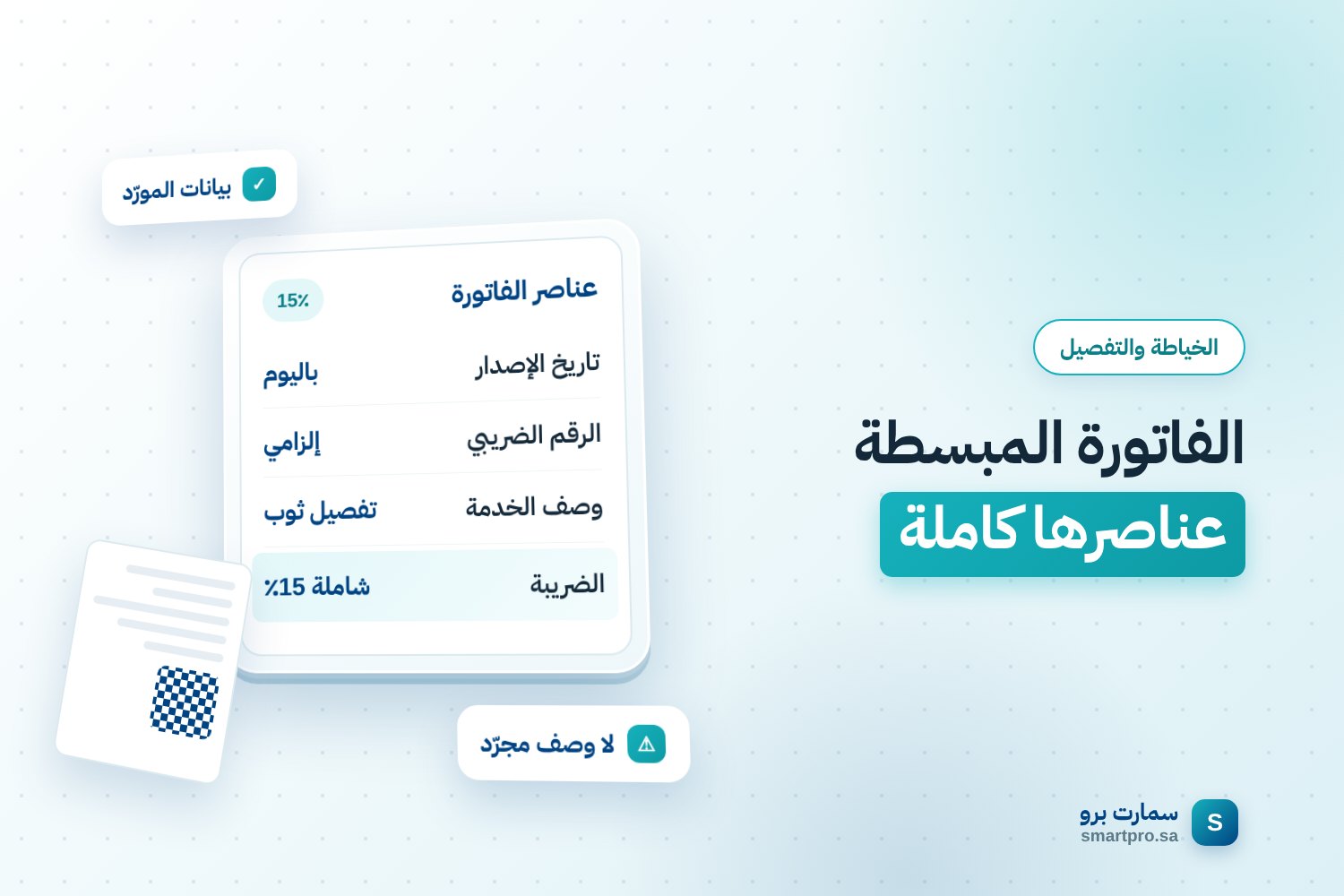
A simplified tax invoice is the document a tailoring shop issues for most of its sales, because its customers are usually end consumers, not VAT-registered businesses. It must show the issue date, the shop's name, address and VAT number, a clear service description, the amount, and the VAT or a statement that the price includes 15% VAT.
Yet it is still the document most often issued incomplete in this sector. Either it is treated as a simple receipt, or it is postponed until the garment is handed over.
The simple rule: every amount received from a customer needs a matching document, small or large, deposit or final settlement.
What are the mandatory fields of a simplified tax invoice?
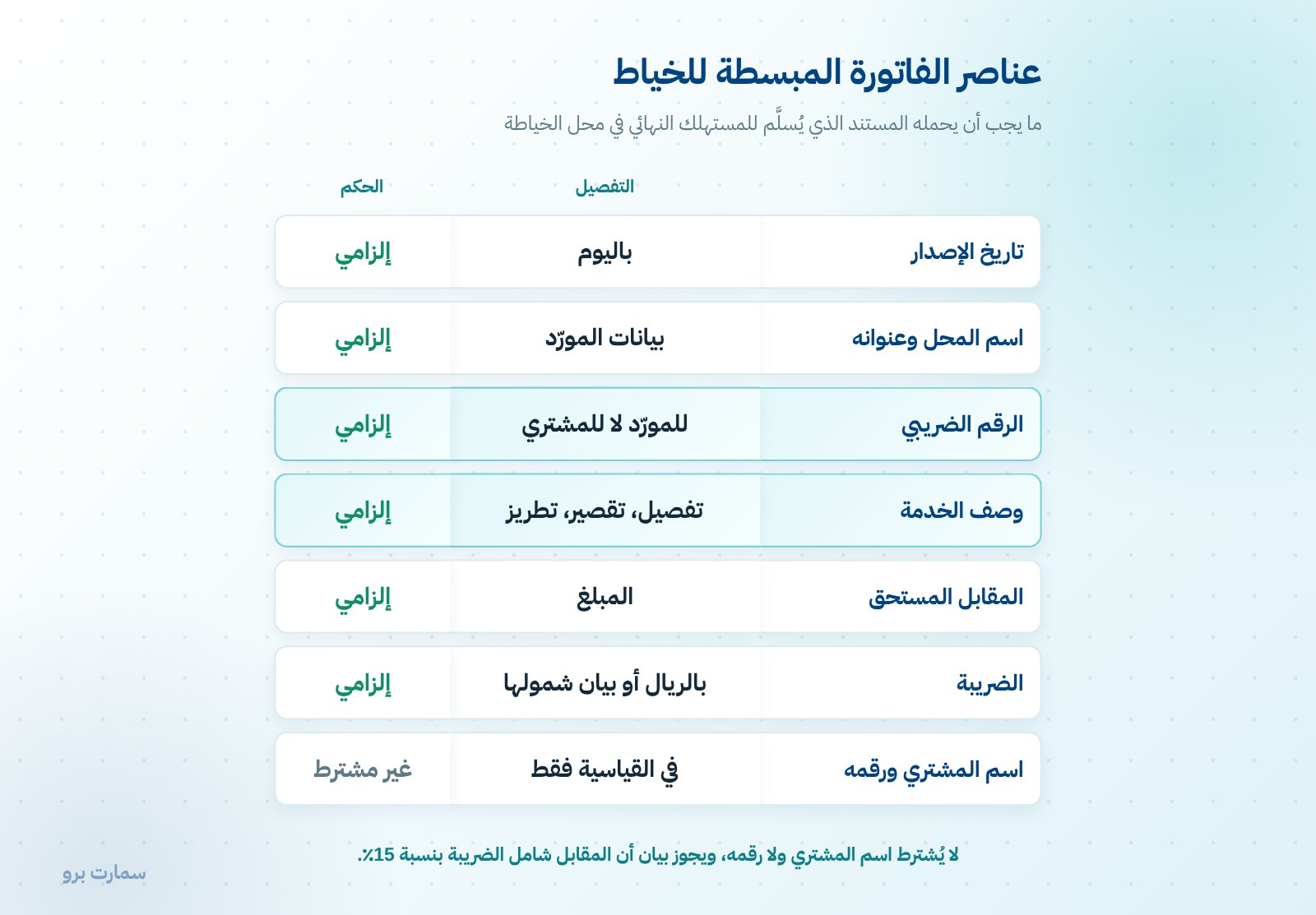
| Field | Detail |
|---|---|
| Issue date | The day, plus the time under Phase 2 |
| Supplier details | Shop name, address and VAT number |
| Service description | Thobe tailoring, shortening, taking in, embroidery — not just "service" |
| Amount due | The consideration charged |
| VAT | The amount in SAR, or an explicit statement that the price is inclusive of 15% VAT |
Unlike a standard tax invoice, a simplified tax invoice does not require the buyer's name or VAT number.
What does Phase 2 e-invoicing add?
Phase 2 e-invoicing is the ZATCA stage in which invoicing systems integrate with the Fatoora platform. It adds elements that are not all visible to the customer but are part of the document:
- Document title and its sequential reference number.
- Unique identifier (UUID) of the invoice.
- Hash of the previous invoice and the invoice counter of the issuing device.
- QR code printed on the human-readable copy.
- Cryptographic stamp.
- Date and time down to the second.
For the full list of fields, see tax invoice requirements in Saudi Arabia.
When must you issue and report a simplified invoice?
This is where much of the confusion lies:
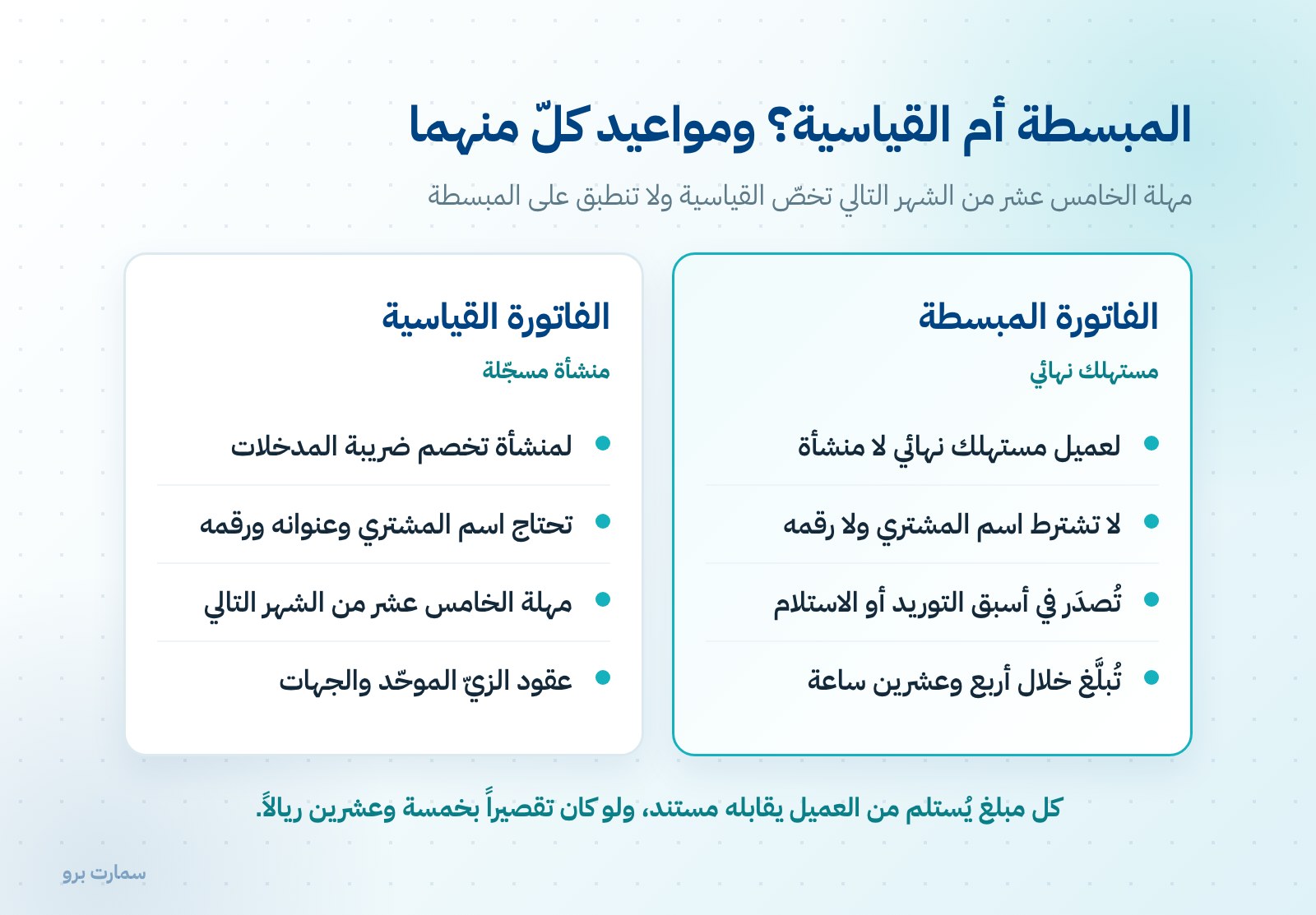
- Issuing: on the date of supply or the date payment is received, whichever comes first. So if a deposit is taken weeks before delivery, the invoice is issued on the day of the deposit.
- Reporting: simplified invoices must be reported within 24 hours of issue, and they do not need prior clearance from the platform before being given to the customer.
- Printed copy: handed to the customer, though a readable electronic format can be agreed instead.
⚠️ The "15th of the following month" deadline that many people repeat applies to the standard tax invoice issued to a registered business. It does not apply to simplified invoices.
For how deposits are handled, see advance payments in e-invoicing.
When do you need a standard invoice instead of a simplified one?
When the customer is a VAT-registered business that wants to recover input VAT. This happens in tailoring more often than people think:
- Uniform contracts for companies, schools and hospitals.
- Orders from government bodies and institutions.
- Any customer who asks for an invoice in their business name with its VAT number.
In that case the invoice needs the buyer's name, address and VAT number, and it follows a different process and timeline.
Invoices and order stages: when exactly?
An order in the workshop moves through six stages: received → cutting → sewing → ironing → ready → delivered. Documents are not tied to each stage, only to two financial movements.
The first movement is at intake, when the customer pays a deposit. The first invoice is issued for the amount received only, not the full order value. A common mistake is issuing an invoice for the full price on intake and then trying to correct it later if the customer cancels.
The second movement is at delivery, when the customer pays the balance. The second invoice is issued for the balance only.
What happens in between — cutting, sewing, ironing and the ready stage — produces no financial document, however long it takes. A workshop that issues an invoice when an order moves to "ready" creates a VAT liability on money it has not yet received.
What about multi-item orders?
A customer who orders four thobes in one order is invoiced once for the order total, not four times — as long as there is one payment and one delivery.
But if the pieces are delivered in batches, or the customer pays in instalments, each financial movement gets its own document. The invoice description should state the number of pieces and their type, so the invoice can still be matched against the job sheet.
Five common mistakes in tailoring shops
First: small alterations with no invoice
A SAR 25 shortening handed over for cash with no document. The amount is small, but it repeats dozens of times a month and becomes a large gap between actual and declared revenue.
Second: vague descriptions
Writing "service" or "tailoring" without saying what was done. The description is a mandatory field, and leaving it vague weakens the invoice and makes internal reconciliation harder later.
Third: mixing up VAT-inclusive and pre-VAT prices
Writing SAR 280 and then adding 15% on top, when the advertised price was already VAT-inclusive. The result is charging the customer more than the advertised price. See calculating VAT from a total amount.
Fourth: a receipt voucher instead of an invoice
A receipt voucher is an internal document; an invoice is a regulatory document. The first does not replace the second.
Fifth: non-sequential numbering
Breaking the sequence or reusing cancelled numbers creates gaps that need explaining.
Is the invoice only a compliance task?
No. A detailed invoice serves the workshop before it serves the authority. Written with an accurate description, it produces a report on the most-ordered items, the share of alterations versus new tailoring, and the average order value.
These numbers are the basis for pricing and capacity decisions. A shop that writes "service" on every invoice deprives itself of all this and keeps deciding on gut feeling.
Quick checklist
- Is the VAT number shown on the invoice?
- Does the description actually specify the item and the service?
- Is the VAT shown in SAR, or is the amount stated as VAT-inclusive?
- Is the QR code printed and readable with a phone camera?
- Is the numbering continuous with no gaps?
- Was an invoice issued for every deposit on the day it was received?
Six questions, checked once against a real invoice issued today, reveal most of what needs fixing.
Where is the official reference?
Invoice fields and issuing and reporting deadlines are published by the Zakat, Tax and Customs Authority (ZATCA), which is the reference whenever it differs from what a system vendor tells you.
Workshops that get this right usually do it inside one system, such as SmartPro's tailoring workshop software.
Key takeaway: Issue a simplified tax invoice for every amount you receive, on the day you receive it, with a clear description and the VAT shown, and report it within 24 hours. Switch to a standard invoice when a VAT-registered business is the buyer.
Read also
- Advance payments in e-invoicing: when to invoice
- Calculating VAT from a total amount
- Tailoring price list: building it in tiers and add-ons
To see how deposits, delivery invoices and Phase 2 reporting work in a real tailoring workflow, start a free trial or book a demo.
Article visuals
Frequently asked questions
What are the fields of a simplified tax invoice?
The issue date, the supplier's name, address and VAT number, a description of the service provided, the amount due, and the VAT amount in SAR or an explicit statement that the price includes 15% VAT. The buyer's name and VAT number are not required.
When is a simplified tax invoice issued and when is it reported?
It is issued on the date of supply or the date payment is received, whichever comes first, so if a deposit is taken before delivery, the invoice is issued on the day of the deposit. It must be reported within 24 hours of issue and does not need prior clearance before being given to the customer.
When does a tailoring shop need a standard tax invoice?
When the customer is a VAT-registered business that wants to recover input VAT, such as uniform contracts for companies, schools and institutions. In that case the invoice must include the buyer's name, address and VAT number, and it follows different deadlines.
Do small alterations need an invoice?
Yes. Every amount received from a customer needs a matching document, however small. Handing over alterations for cash without an invoice happens dozens of times a month, creating a large gap between actual and declared revenue that shows up at the first reconciliation.