
Advance Payments in E-Invoicing: When to Invoice and How to Record Them
Advance payments create a VAT liability as soon as you receive them, not when you deliver. Learn when to issue the invoice, how to record the entries and how to deduct the advance from later invoices.
سامي الحيدري
Advance payments are among the most common sources of accounting and tax errors because they split two moments that usually happen together: the moment cash arrives, and the moment the service is performed or the goods are delivered. In short, you issue a tax invoice when the money arrives, but you recognise revenue only when you deliver.
The rule that settles most cases: receiving the money creates a tax liability, but it does not create revenue. The liability is immediate. The revenue is deferred until the work is done.
Advance payments: when do you issue the invoice?
When you receive the money, not when you deliver. This surprises many people because they link the invoice to delivery.
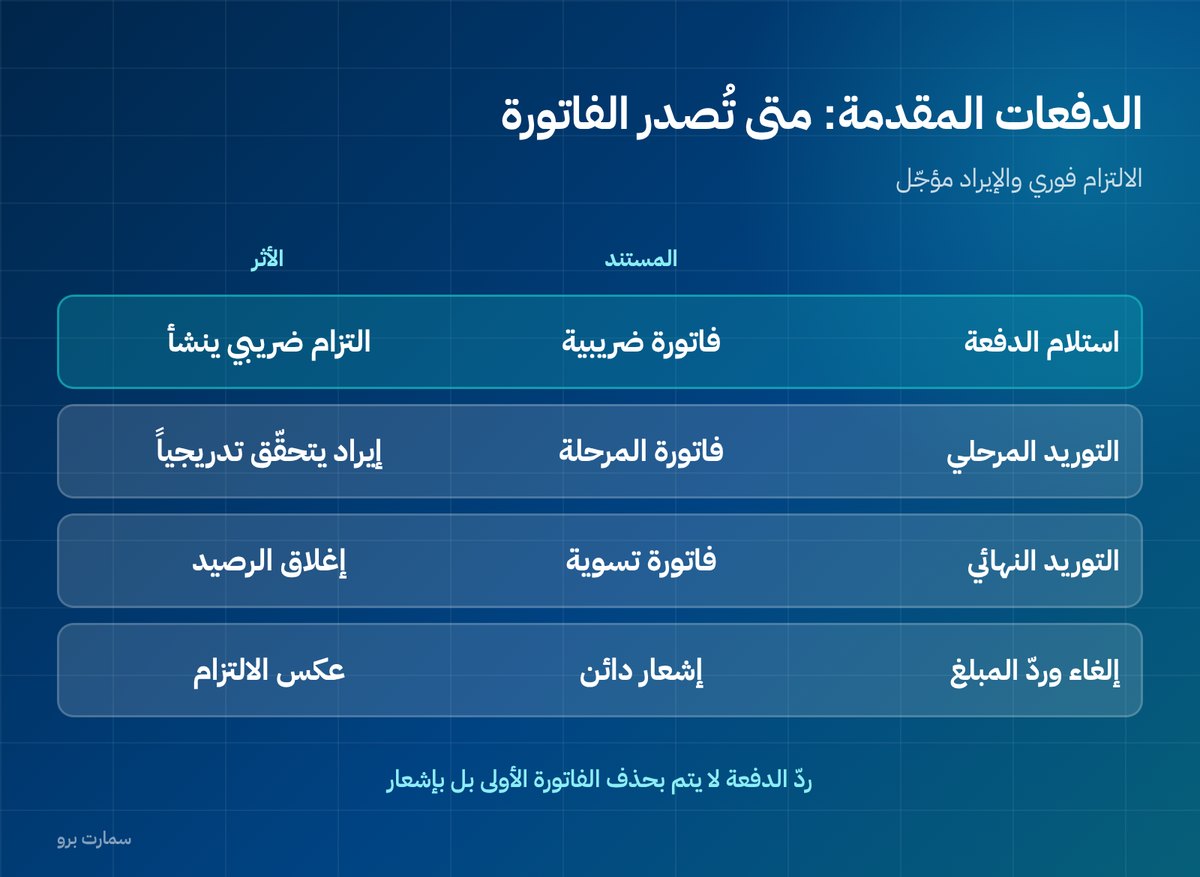
| Event | Document | Effect |
|---|---|---|
| Advance payment received | Tax invoice for the advance amount | Tax liability arises |
| Partial or stage delivery | Invoice for the stage value, deducting part of the advance | Revenue recognised gradually |
| Final delivery | Settlement invoice for the remaining balance | Balance closed |
| Agreement cancelled and money refunded | Credit note | Liability reversed |
The last row matters: refunding an advance is not done by deleting the original invoice but by issuing a credit note, as explained in Credit and Debit Notes: How to Correct an E-Invoice.
How do you record the journal entry, step by step?
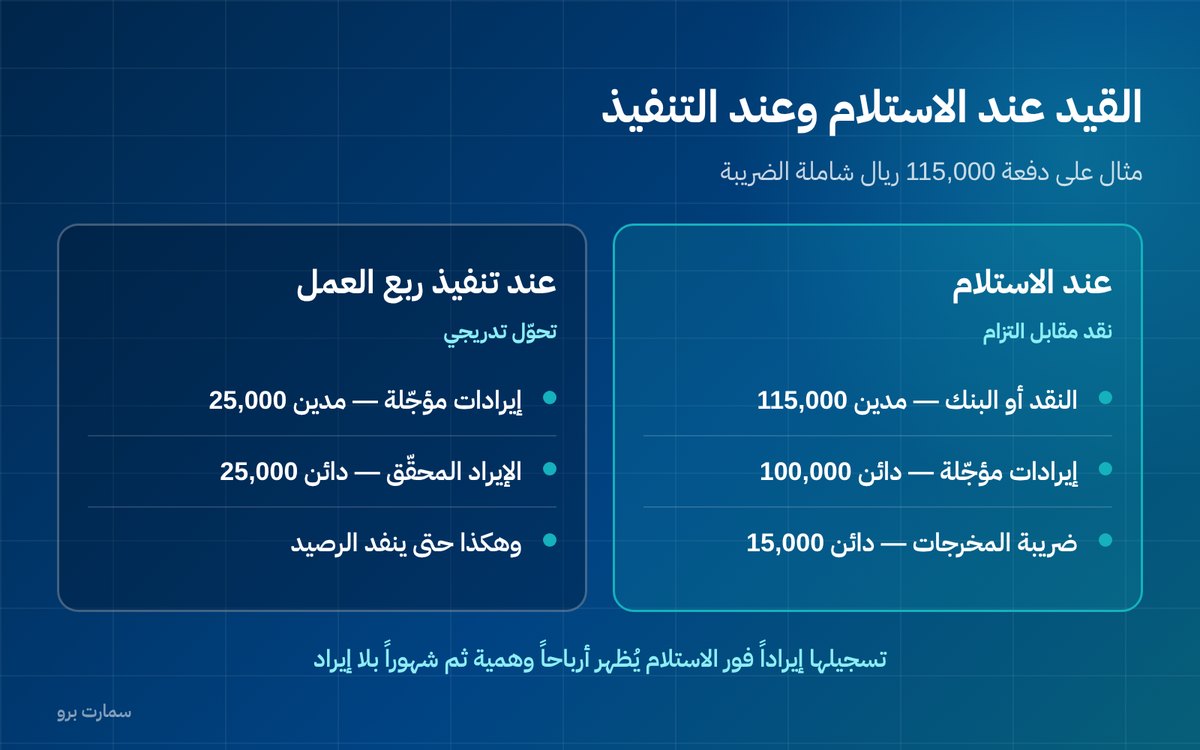
When you receive an advance payment of SAR 115,000 including VAT:
- Cash or bank — debit 115,000
- Deferred revenue — credit 100,000
- Output VAT payable — credit 15,000
Notice that no revenue has been earned yet. What you have is an obligation to perform, and it sits in liabilities, not in the income statement. Deferred revenue is money received for work you have not yet delivered.
When a quarter of the work is completed and the stage invoice is issued:
- Deferred revenue — debit 25,000
- Earned revenue — credit 25,000
Repeat this with each stage until the deferred revenue balance is used up.
What is the most common mistake? Recording it as revenue on receipt
The result is phantom profit in the month the money arrives, followed by months where costs appear with no matching revenue. The resulting statements do not reflect any month's performance correctly.
Worse, decisions get made on these numbers: hiring or expanding based on profit that has not actually been earned, or worrying about a loss in a month that was in fact productive.
This is exactly what accrual accounting fixes, and it is explained in detail in Cash vs Accrual Accounting: A Practical Guide for Saudi Businesses.
How do you deduct the advance from later invoices?
There are two common methods, and the first is clearer:
- Deduct it as a line on the stage invoice: issue the invoice for the full stage value, with a line deducting the portion of the advance being used. The customer sees the value, the deduction and the amount due.
- Net invoices: issue an invoice for the remaining amount only, without showing the advance. Simpler in form, but it hides the true value of the stage and makes reconciliation harder later.
Choose the first method and make it a fixed policy. Most importantly, keep the advance balance visible in your reports for each customer and project, rather than calculating it by hand at the end of the period.
Where do advance balances usually get lost?
- No separate account: advances get mixed with accounts payable or with the period's revenue.
- No link to the project or contract: a payment comes from a customer with three projects, and nobody knows which one it belongs to.
- Undocumented partial deductions: an amount is deducted from an invoice without recording its effect on the advance balance.
- Forgotten at closing: the deferred revenue balance stays inflated for years with no explanation.
The fix is to give every advance a row in a schedule: customer, project, original amount, amount used and remaining balance. Review it at every monthly close as part of your adjusting entries.
What about special cases?
- Non-refundable deposit: its treatment may differ from a normal advance depending on the contract terms, so review it with your accountant.
- Advance for an annual service contract: usually used up evenly each month, not all at once when the contract is signed.
- Advance from a customer outside Saudi Arabia: the VAT treatment depends on the nature of the supply.
- Contracting: the advance is deducted from progress claims at an agreed percentage, covered in detail in E-Invoicing for Contractors: Advance Payments and Progress Claims.
How should advances appear in your reports?
Three figures should be visible at any time without manual calculation:
- Total advances received per customer and project.
- Amount used through invoices issued to date.
- Remaining balance that is still a liability for you.
A fourth figure is worth watching: the age of the advance. An advance received a year ago with nothing used means a stalled project or an abandoned contract, and both need a decision, not more waiting.
How can you quickly test whether your treatment is sound?
Open the deferred revenue balance in your trial balance and ask: can I explain every riyal in it by customer, project and remaining stage?
If the answer is no, the account has turned into a bin for whatever nobody understood — and that is what most often distorts the statements of businesses that work with advances. Review it line by line at your next close, not at year end.
What changes in Phase 2?
The accounting logic does not change, but the correction method does. Previously, an advance invoice could be edited if the agreement changed; now editing is not allowed and corrections are made with a note.
This makes accuracy from the first invoice even more important: check the advance amount, the customer details and the contract reference before issuing, because every later correction produces an additional document. The official requirements for supplies and advance payments are published by ZATCA (the Zakat, Tax and Customs Authority).
Read also
- Credit and Debit Notes: How to Correct an Invoice
- E-Invoicing for Contractors and Progress Payments
- Cash vs Accrual Accounting
Key takeaway: Invoice an advance payment when the money arrives and book it as deferred revenue, then release it to revenue stage by stage while tracking each advance by customer and project.
To see how advances, stage invoices and deferred revenue flow together in one connected system, start a free SmartPro trial.
Frequently asked questions
When should you issue the invoice for an advance payment?
When you receive the money, not when you deliver. Receiving an advance creates an immediate tax liability, so you issue a tax invoice for its amount, while the revenue stays deferred until the work is performed or the goods are delivered.
What is the journal entry for an advance payment?
Debit cash or bank with the amount received, credit deferred revenue with the value of the work, and credit output VAT payable with the VAT on the advance. Then, at each stage of delivery, debit deferred revenue and credit earned revenue with the stage value.
What is the most common mistake in handling advance payments?
Recording them as revenue as soon as they are received. The result is phantom profit in the month of receipt, followed by months with costs and no matching revenue, so hiring and expansion decisions end up based on figures that do not reflect any month's real performance.
How do you deduct an advance payment from later invoices?
The best approach is to issue the stage invoice at its full value with a line deducting the portion of the advance used, so the customer sees the value, the deduction and the amount due. Keep a schedule for each advance showing the customer, project, original amount, amount used and remaining balance, and review it at every close.