
Tax Invoice Requirements in Saudi Arabia: The Complete List of Mandatory Fields
Tax invoice requirements in Saudi Arabia are not a formality. Here is every mandatory field, the fields that cause the most rejections, and how to check your own invoice in two minutes.
سامي الحيدري
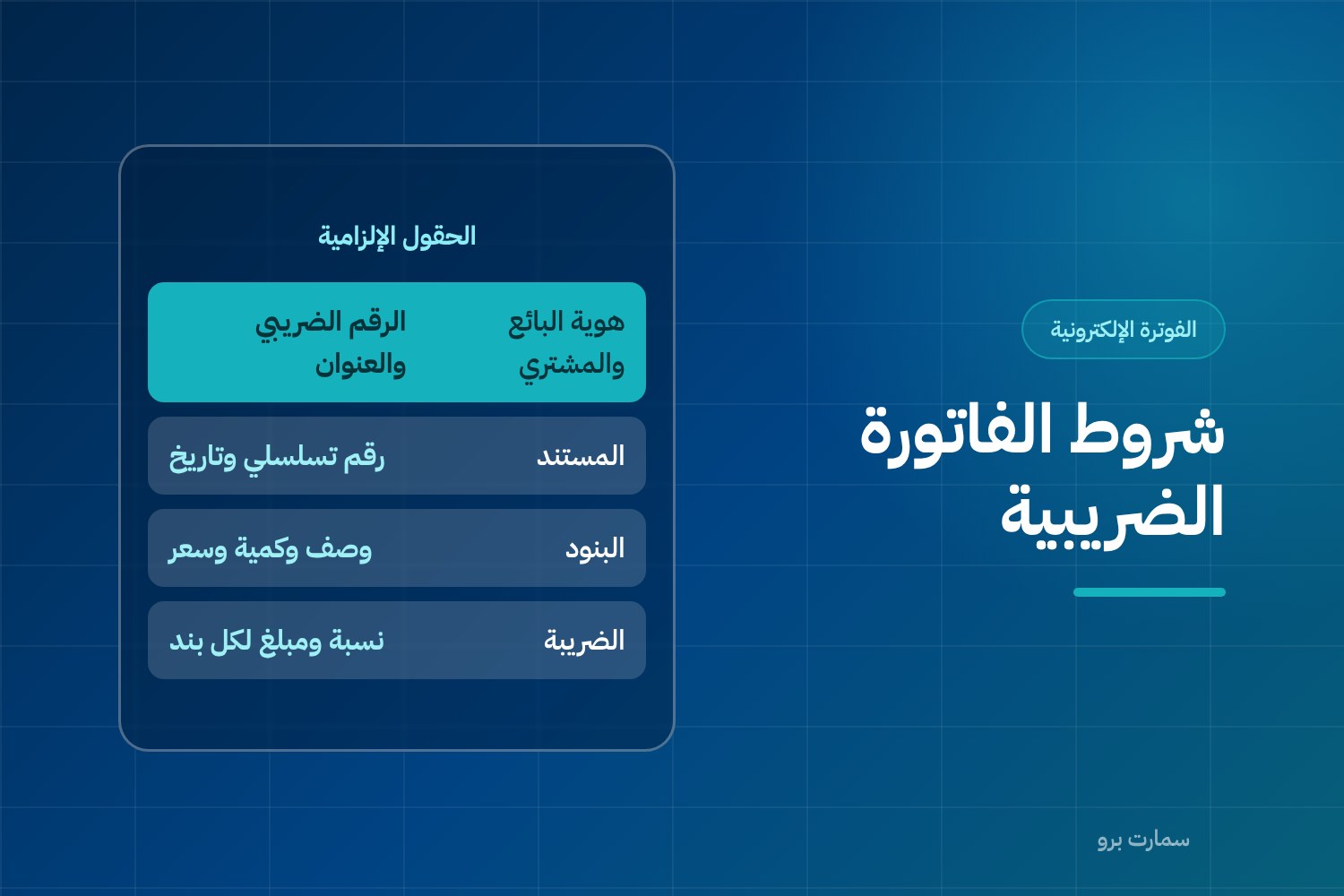
Tax invoice requirements in Saudi Arabia are not details you can be relaxed about. If a tax invoice is missing a mandatory field, the buyer cannot deduct the input VAT on it. Input VAT is the VAT a business pays on purchases and reclaims in its return. The invoice may also be rejected by the Fatoora platform before it ever reaches the buyer.
The real problem is timing. Most businesses discover the gap months later, when a customer asks them to reissue dozens of invoices at once.
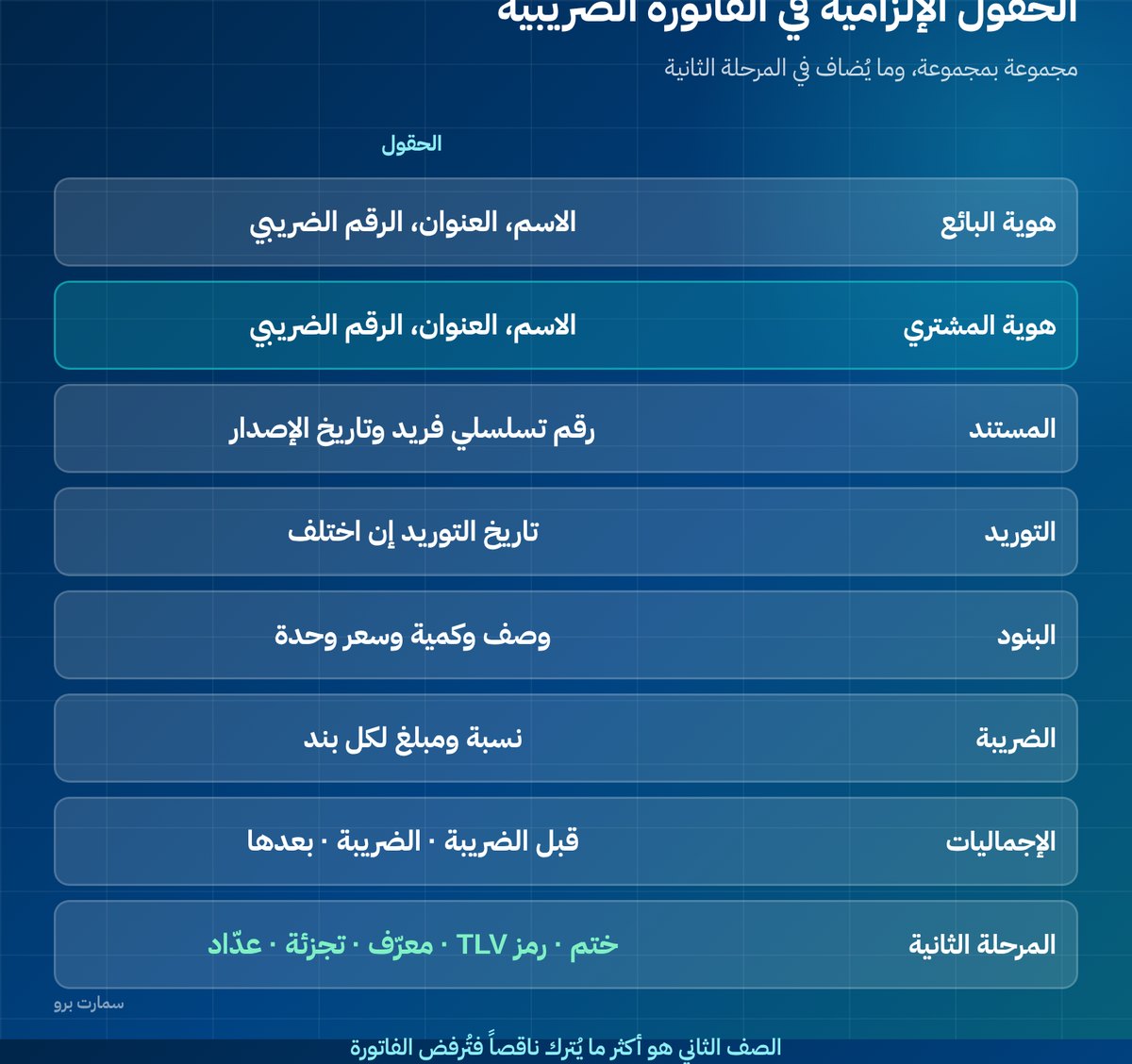
Tax invoice requirements: which fields are mandatory?
| Group | Fields |
|---|---|
| Seller identity | Full name, address, VAT number |
| Buyer identity | Name, address, VAT number if registered |
| Document | Unique sequential number, issue date |
| Supply | Supply date, if different from the issue date |
| Line items | Description, quantity and unit price of each item |
| VAT | VAT rate and VAT amount for each line |
| Totals | Before VAT, total VAT, including VAT |
| Discounts | Any discount or rebate applied before VAT is calculated |
| Currency | If not Saudi riyals, the currency and the exchange rate |
Phase 2 e-invoicing adds further elements on top of these: the cryptographic stamp, the QR code, the unique identifier (UUID), the hash of the previous invoice, and the counter of the EGS unit. An EGS unit is the device or system that generates and signs your e-invoices.
The detailed official list and its exceptions are published by the Zakat, Tax and Customs Authority (ZATCA). It is the reference whenever it differs from what a system vendor tells you.
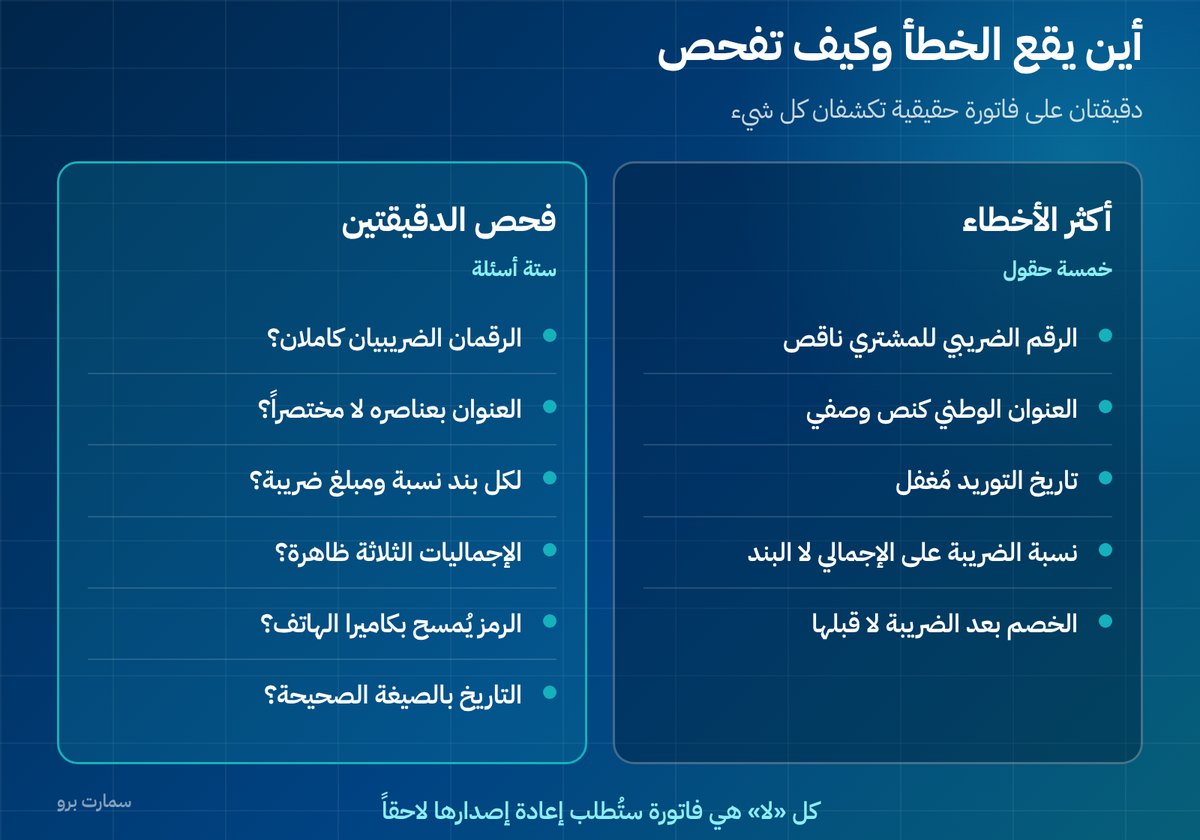
Which fields are most often filled in wrongly?
- The buyer's VAT number: left blank, entered incompletely or with spaces. This is the most common reason tax invoices are rejected.
- The national address: written as a general postal address instead of the national address with all its elements, so the invoice is rejected or accepted incomplete.
- The supply date: left out when it differs from the issue date, even though it matters for contracts and deferred supplies.
- The VAT rate per line: shown only on the total, when it must be broken down line by line, especially if rates differ.
- The discount: applied after VAT is calculated instead of before, so the VAT shown is higher than it should be.
When don't you need all these fields?
If the buyer is an end consumer, you issue a simplified invoice with fewer fields: the seller's details and VAT number, the date, the line items, the total VAT and amount, and the QR code.
For the full difference between the two types and when to issue each, see Tax Invoice vs Simplified Invoice.
How do you check your invoice in two minutes?
Take a real tax invoice you issued today and go through these questions:
- Are your VAT number and the buyer's VAT number shown in full?
- Is the national address of both parties complete rather than shortened?
- Does every line have a description, quantity, price, VAT rate and VAT amount?
- Are all three totals shown: before VAT, VAT, and after VAT?
- Is the QR code printed and readable by a phone camera?
- Is the date in the correct format, and is there a supply date where needed?
Every "no" on this list is an invoice you will be asked to reissue later.
What happens if a field is missing?
The impact builds up on three levels:
- The platform: the invoice may be rejected, so it is never approved or delivered.
- The buyer: cannot deduct the input VAT, so asks for the invoice to be reissued and delays payment.
- Your business: issuing a non-compliant invoice is a violation, handled first with a warning and a grace period, then escalating with repetition.
An issued invoice is not corrected by editing it. It is corrected with a credit note and a new invoice, as explained in Credit and Debit Notes.
What about special cases?
- Exports and supplies to non-residents: a different VAT treatment, often zero-rated, and you must keep documents proving the goods left the country.
- Exempt supplies: shown separately on the invoice and never mixed with taxable supplies, otherwise your VAT return will be off.
- Invoices in a foreign currency: state the currency and the exchange rate used, and show the VAT amount in riyals.
- Customers from other GCC countries: these have their own treatment depending on registration status, so review it with your accountant before the first invoice.
Who controls this: the system or the employee?
Both. A correctly configured system will not issue an invoice with an empty mandatory field, but it is the employee who enters the VAT number and address when creating the customer record.
The best preventive step is to make the VAT number and national address fields mandatory on the customer screen for business-type customers, with a format check on the number before saving. This stops the problem at its source instead of fixing it invoice by invoice.
How long do you keep the invoice, and where?
An invoice that is compliant today must still be producible years from now. The file you need to keep is the XML file, not an image or an ordinary PDF copy, because only the XML carries the verifiable signature and hash.
Store the platform's response for each invoice alongside it, together with the certificate of the EGS unit that signed it. Without that certificate, the signature cannot be verified later. Full details are in E-Invoice Archiving.
Common mistake: the customer's copy differs from the approved one
This happens when an employee prints the invoice and hands it over before the platform approves it, then the invoice is rejected, corrected and reissued. The result is two different versions of the same document: one in the customer's hands and another in your system.
The rule is simple: for a tax invoice, never hand over a copy before approval, however urgent it feels. Both routes are explained in Clearance and Reporting.
How do you handle returned and exchanged items?
A return is not handled by cancelling or editing the original invoice. You issue a credit note for the value of the returned items and their VAT only, referring to the original invoice's number and date.
If the customer exchanges an item for a more expensive one, issue a credit note for the return and then a new invoice for the replacement, or a debit note for the difference. The frequent mistake here is cancelling the whole invoice and issuing a new one for the remainder. That creates three documents instead of one and inflates both sales and returns figures for no reason.
Read also
- Tax Invoice vs Simplified Invoice: Which to Issue
- Invoice Rejection Errors and How to Fix Each One
- Phase 2 E-Invoicing: What Integration Means
Key takeaway: A tax invoice is only as good as its weakest field; make the buyer's VAT number and national address mandatory at the customer record and check every invoice against the list above.
To see how SmartPro issues Fatoora Phase 2 tax invoices with these fields in place, start a free trial.
Frequently asked questions
What are the tax invoice requirements in Saudi Arabia?
A tax invoice needs the seller's full details and VAT number, the buyer's details, VAT number and address, a unique sequential number, the issue and supply dates, line items with quantities and prices, and the VAT rate and amount for each line. It also needs totals before and after VAT. Phase 2 adds the cryptographic stamp, the QR code and the unique identifier.
Which field causes the most tax invoice rejections?
The buyer's VAT number. It is left blank, entered incompletely or with spaces, and the invoice is rejected. An incomplete national address comes next. The fix is to make both fields mandatory on the customer screen, with a format check on the number before saving.
Does a simplified invoice have the same requirements?
No. A simplified invoice for an end consumer needs fewer fields: the seller's details and VAT number, the date, the line items, the total VAT and amount, and the QR code. It does not need the buyer's VAT number or address.
What happens if a mandatory field is missing?
The invoice may be rejected by the platform and never delivered. If it does go through, the buyer cannot deduct the input VAT and will ask for it to be reissued. Issuing a non-compliant invoice is a violation, handled first with a warning and a grace period, then escalating with repetition.