
Tailoring Workshop Management System: Six Questions to Ask Before You Sign
You can't choose a tailoring workshop management system by its interface or its price. Six questions settle the choice, five test cases prove it before you sign, and some popular questions settle nothing.
Author:سامي الحيدري
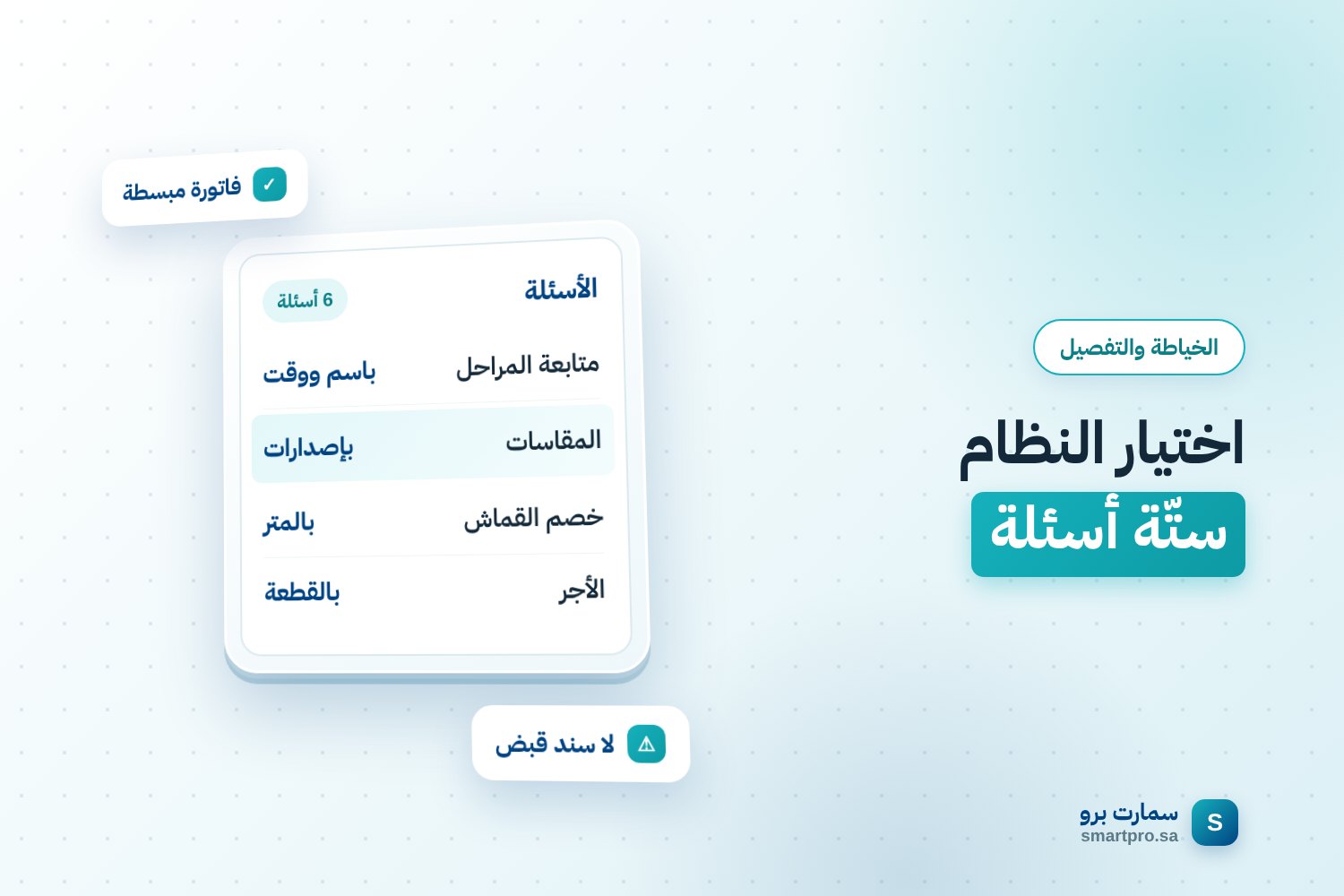
Most owners choose a tailoring workshop management system on the two worst criteria: how the screens look and what the subscription costs. A better test is six specific questions. Does it track each stage with an owner? Does it keep measurement versions? Does it deduct fabric by the metre at cutting? Does it calculate piece rates? Does it issue a compliant simplified invoice? Does it post to the accounts automatically?
The owner sits through demo after demo, the screens start to look the same, and the decision goes to the cleanest interface or the lowest price.
Two months later the problems show. The system records the order but not the stage. Or it records the stage but not who did the work. Or it deducts fabric when it is purchased, not when it is cut.
The difference between a system that works and one that doesn't never shows up in a demo. It shows up in six specific questions, each asked in the same way, where a general answer is not accepted.
Which six questions decide the choice of a tailoring workshop management system?
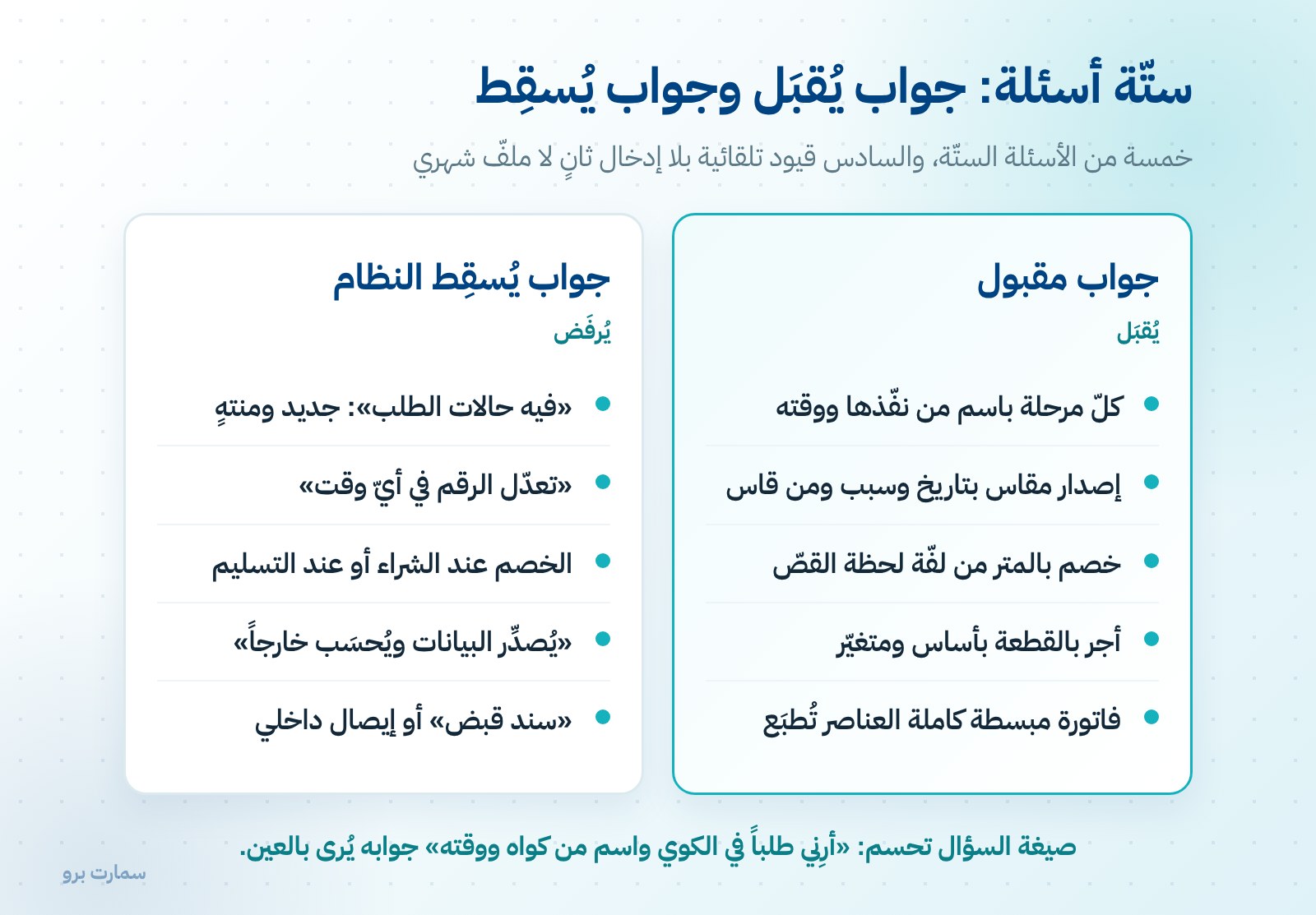
| # | Question | Acceptable answer | Answer that rules the system out |
|---|---|---|---|
| 1 | Does it track stages with an owner for each stage? | Every stage shows who did it and when | "It has order statuses": new and finished |
| 2 | Does it keep measurements as versions? | A new version with date, reason and who measured, and the old one stays | "You can edit the number any time" |
| 3 | Does it deduct fabric by the metre at cutting? | Metres deducted from a specific roll at the moment of cutting | Deduction at purchase or at delivery |
| 4 | Does it calculate piece-rate wages? | Per piece or per stage, with a fixed base and a variable part | "It exports the data and you calculate outside" |
| 5 | Does it issue a compliant simplified invoice? | A complete invoice printed for the customer | A "receipt voucher" or internal slip |
| 6 | Does it connect to the accounts? | Automatic journal entries with no second entry | A file uploaded manually every month |
How you phrase the question matters as much as what you ask. "Does it support stages?" gets a yes from every vendor. "Show me a screen with an order in the ironing stage, the name of the person who ironed it and the time" gets a yes or a no, and you can see the answer with your own eyes.
How should the system handle stages and measurements?
In a tailoring workshop, stages are not order statuses. The usual path has six stages: received → cutting → sewing → ironing → ready → delivered. Each stage has an owner, an entry time and an exit time.
A system that only knows "new" and "finished" produces nothing you can use to read productivity or find the bottleneck. The practical question is this: how many orders are sitting in ironing right now, who touched each one last, and when? If the screen can't answer, you are looking at an order log, not a workshop system.
Measurements carry even more risk. A system that lets you overwrite a number in place erases the previous measurement and the reason for the change. You then can't tell which measurement was used for the order the customer is complaining about today.
What you need is specific. Every change creates a new version with its date, reason and the name of the person who measured. The old version stays. The order keeps the version number it was made from, not a copy that changes whenever the file is edited.
Why does fabric need to be deducted by the metre at cutting?
This question alone separates systems built for workshops from systems built for retail.
A retail system deducts one item from stock when it is sold. A tailoring workshop deducts metres from a specific roll at the moment of cutting. That happens days before delivery and days before the invoice.
Three practical differences follow:
- Deducting at purchase gives you correct stock but an unknown expense, so you never see the waste.
- Deducting at delivery leaves cut fabric showing in the system after it has left the stockroom, so you buy fabric you don't need.
- Deducting without naming the roll loses track of colour and batch. That is how one order ends up with two thobes in two shades.
The test: ask the vendor to cut twenty pieces from one roll in front of you. Then ask for the roll's balance, what is left of it, and whether the leftover appears as a usable remnant. In this series, the shortest usable remnant is 0.25 metres. A system that doesn't recognise remnants writes them off in the books, and you lose the ability to compare actual fabric use against the standard.
Can the system calculate piece-rate wages?
Workshops pay tailors per piece, per stage or by monthly salary. All three are common, and many workshops combine them: a fixed base plus a variable amount per piece.
A system that records each stage with its owner already has everything it needs to calculate this automatically. A system that says "export the data and calculate it in a spreadsheet" sends you back to the ledger by another route. A manual monthly calculation is the first thing that gets dropped during the busy season.
Four precise questions apply here:
- Does the piece rate change by garment type and difficulty?
- Does it separate the fixed base from the variable part?
- Does it exclude pieces redone because of the tailor's own mistake?
- Does it produce a statement the tailor can read and sign?
To see how minutes per garment feed into cost and pricing, read our guide to tailoring profit margin per item.
What should I check about invoicing and accounting?
The invoice is not a technical detail you can leave for later. What you hand the customer is a document with specific required elements. A simplified tax invoice is the version used for sales to individual consumers. The full list of fields is in our guide to tax invoice requirements in Saudi Arabia. How to handle a customer's deposit is covered in advance payments in e-invoicing.
The test here is purely practical. Ask the system to issue an invoice for one of your own cases in front of you. Print it, then check it line by line against that list. Don't accept the word "compliant" without a printed invoice in your hand.
The sixth question is the one people forget until the last day. Do the invoice, the expense and the wage move into the accounts automatically, or is everything entered twice? Double entry works in the first month and stops in the first busy season. At year end you find two sets of books that don't agree.
How do I test the system with my own cases before buying?
A demo led by the vendor shows what the system does well. A test led by you shows what it does badly. Five cases from your own workshop are enough:
- One order number with three pieces, where two are delivered and one is still pending. Does the system know the order is one piece short?
- A repeat customer complains the sleeve is too short, so a new measurement version is opened. Did the old order stay on its old version?
- A rush order jumps the queue. Can you see the effect on the other orders' due dates, or does it move ahead with no visible impact?
- Cutting a batch from one roll, deducting the metres, and leaving a remnant shorter than a quarter of a metre.
- An order with a deposit, with the deposit settled against the final invoice without manual entry.
Four rules make the test useful:
- You do the data entry, not the vendor. Your entry speed is your staff's entry speed.
- Count the minutes. How many minutes does a full order take to enter? Multiply by your monthly order count to see how much time you are paying for.
- Ask for a report, not a screen. A screen shows you the order. A report shows you the workshop.
- Ask for an export of your data on the spot, in a file you can read yourself. A vendor who won't export your data today won't export it on the day you want to leave.
Which questions don't settle anything?
- Is there a mobile app? Useful for keeping an eye on things, but no substitute for a fixed screen at the cutting table.
- Is the design modern? A good-looking interface that doesn't record the stage owner is no use.
- How many features does it have? A feature your team doesn't use is a cost, not a benefit.
- Does it support unlimited users? Your workshop has seven people, so unlimited users don't matter to you.
- Does it include an online store? That is a completely different question. Keep it separate from running the workshop.
How much is the system worth each month? A worked example
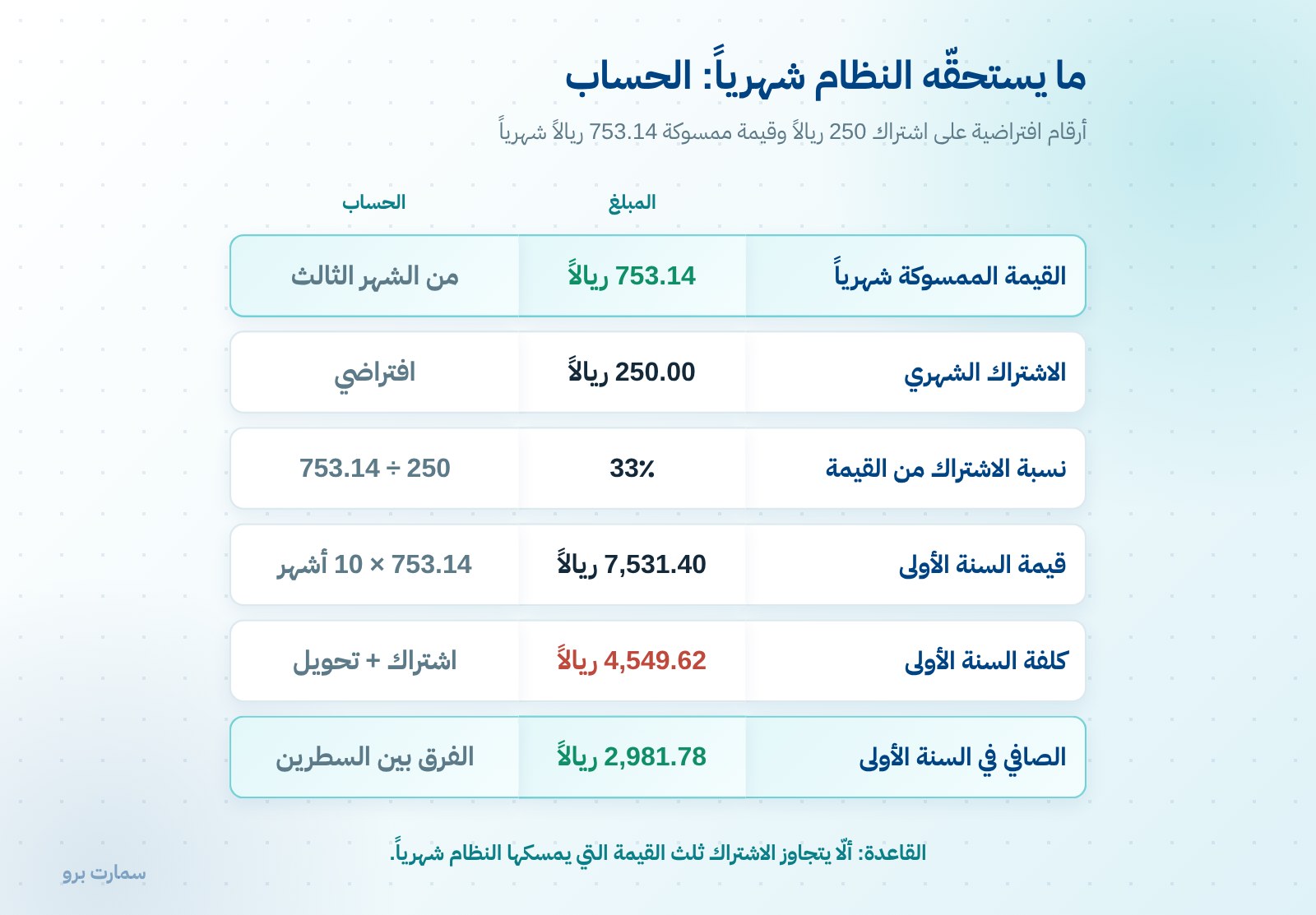
The figures below are hypothetical. They illustrate the method and do not represent typical market prices. Using the assumptions in this series, the value the system protects each month from month three onwards is SAR 753.14. The one-off switching effort is SAR 1,549.62.
Now assume a monthly subscription of SAR 250:
| Item | Calculation | Amount (SAR) |
|---|---|---|
| Value protected per month | From month three | 753.14 |
| Monthly subscription | Assumed | 250.00 |
| Subscription as a share of value | 250 ÷ 753.14 | 33% |
| Year-one value | 753.14 × 10 months | 7,531.40 |
| Year-one cost | (250 × 12) + 1,549.62 | 4,549.62 |
| Year-one net | 2,981.78 |
The practical rule: the subscription should not exceed one third of the value the system protects. Anything above that may still look profitable on paper, but it leaves no room for downtime or a weak month.
Note the switching-effort line. You pay it once with the right system. You pay it again in full for every system you abandon after a year. That alone is reason enough to test with your own cases before you sign, not after.
What should I check before signing the contract?
- Who owns the data, in writing in the contract, plus how it is exported, in what format and for what fee.
- Contract length and exit terms, and what happens to your data afterwards.
- How many users are included and the price of extra users, since busy seasons need extra hands.
- Arabic support and its hours, especially in Ramadan and before Eid.
- Backups, how often they run, who restores them and how long it takes.
- Working when the internet drops, because the workshop doesn't stop when the connection does.
- Permissions for each role, so the cutter doesn't see prices and reception can't edit wages.
What are the three most common mistakes when choosing a system?
First: choosing by demo, not by your own cases. The vendor prepares the demo to show what the system does well. Your five cases show what it does badly.
Second: a general accounting system with the workshop bolted on. It captures the invoice but misses the stage, the metre and the minute, which are everything you run a workshop with.
Third: signing during the season. Switching at peak time will make the best system fail. The quiet season is the time to switch.
Where is the official reference?
Requirements for the invoices a system issues are published by the Zakat, Tax and Customs Authority (ZATCA), which is the reference whenever there is any doubt. Licensing requirements for the shop itself are set by the relevant municipal authorities.
If you want one system that covers all six questions, SmartPro's workshop management system is built around them. Putting this into practice is easier when orders, fabric and invoices sit in one system: see our tailoring workshop management system.
Key takeaway: Choose a tailoring system by six concrete questions and five tests you run yourself, not by the interface or the price. Keep the subscription under one third of the value the system protects.
To run your own five cases, start a free trial or book a demo with a product expert.
Read also
Article visuals
Frequently asked questions
Which questions decide the choice of a tailoring workshop management system?
There are six. Does it track every stage with an owner and a time? Does it save measurements as versions instead of overwriting the number? Does it deduct fabric by the metre from a specific roll at the moment of cutting? Does it calculate piece-rate wages internally, issue a compliant simplified invoice, and post to the accounts without a second entry?
How do I test a tailoring system with my own cases before buying?
Enter five cases from your workshop yourself, not the vendor. Use a three-piece order with two pieces delivered, a customer who needs a new measurement version, and a rush order. Add a batch cut from one roll that leaves a small remnant, and an order with a deposit settled against the final invoice. Time each entry and ask for a report and a data export at the end.
Is a general accounting system enough to run a tailoring workshop?
Not on its own. A general accounting system captures the invoice and the expense, but it misses the stage and its owner, the metres deducted at cutting and the minutes behind piece-rate wages. These three are what you actually run the workshop with, and the invoice is a result of them, not a substitute. Exporting data each month doesn't solve this, because the manual calculation is the first thing dropped in the busy season.
How much is it worth paying each month for a tailoring system?
The practical rule is that the subscription should not exceed one third of the value the system protects each month. In the hypothetical example, the protected value is SAR 753.14 a month from month three. A SAR 250 subscription is roughly a third of that and leaves room for a weak month. Add the switching effort on top, which you pay only once if you choose the right system.