
Tailoring Workshop Chart of Accounts: Six Groups Are Enough
A tailoring workshop chart of accounts in six groups: service revenue kept apart from goods, fabric held as inventory rather than an expense, deposits treated as a liability rather than revenue, and a fully worked month of figures.
Author:سامي الحيدري
In most tailoring workshops, the chart of accounts has just three accounts: "Sales", "Expenses" and "Cash". Everything that comes in goes to the first, everything that goes out goes to the second, and the third is counted at the end of the month.
That chart produces one correct number: the difference between money in and money out. It produces nothing you can base a decision on.
An owner who wants to know whether alterations are worth continuing, how much of their money is sitting in the stockroom, or how much of the cash in the till isn't theirs yet, will find no answer in it. A chart of accounts that does answer those questions needs no more than six groups.
Tailoring workshop chart of accounts: six groups with four-digit codes
A chart of accounts is the structured list of every account a business records transactions in. For a workshop, this is the full set:
| Group | Accounts |
|---|---|
| 1 Assets | 1100 Cash and bank · 1200 Customers on credit · 1310 Fabric inventory · 1320 Trims and supplies inventory · 1330 Work in progress · 1400 Machines and equipment · 1410 Accumulated depreciation |
| 2 Liabilities | 2100 Fabric suppliers · 2200 Customer deposits held · 2300 VAT payable · 2400 Salaries and wages payable |
| 3 Equity | 3100 Capital · 3200 Owner's drawings · 3300 Retained earnings |
| 4 Revenue | 4100 Tailoring service revenue · 4110 Alterations revenue · 4120 Rush fees · 4130 Measurement visit fees · 4200 Fabric sales revenue · 4210 Trims sales revenue |
| 5 Direct costs | 5100 Fabric used in service · 5110 Cost of fabric sold · 5200 Direct tailor wages · 5300 Supplies used · 5400 Cutting waste · 5500 Rework cost |
| 6 Overheads | 6100 Rent · 6200 Indirect salaries · 6300 Electricity and water · 6400 Maintenance and cleaning · 6500 Subscriptions and telecoms · 6600 Machine depreciation · 6700 Other expenses |
Four-digit codes are not a luxury. They let you add an account in its proper place without renumbering the whole chart, which is exactly what happens every time you add a new line of work. The general principles for building a chart of accounts are explained in our chart of accounts guide.
Which four separations change everything?
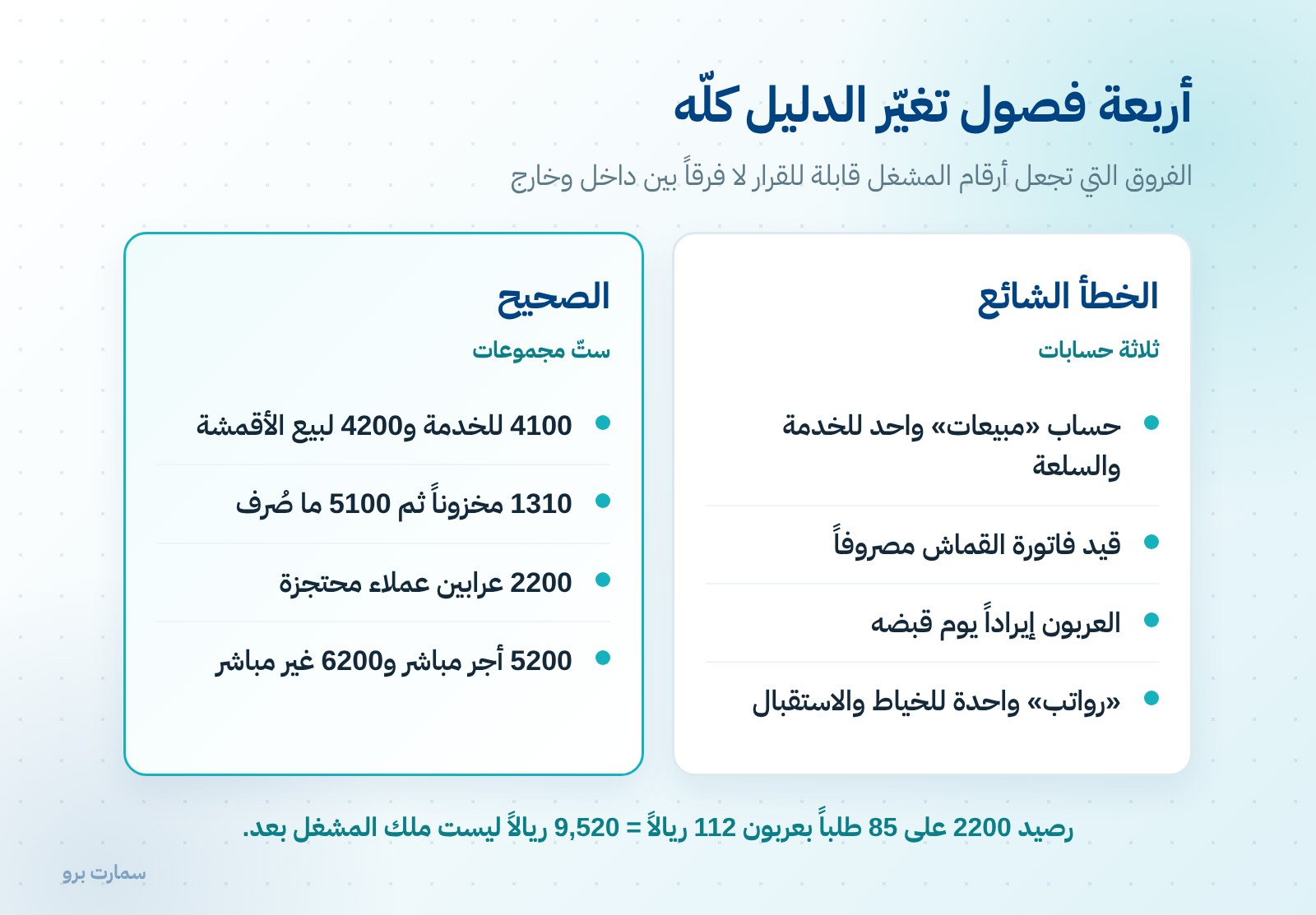
First: service revenue is kept separate from goods revenue
Tailoring and alterations are a service. Selling a metre of fabric to a customer who wants it as it is counts as goods. The difference is not cosmetic: the margin on goods is measured by the gap between purchase and selling price, while the margin on a service is measured in minutes.
Mixing them in a single "Sales" account produces a blended margin that tells you nothing. Two separate accounts, 4100 and 4200, are enough to keep them apart.
Second: fabric and trims are inventory, not an expense
The most common mistake is to record the fabric invoice in an "Expenses" account on the day of purchase. A 60-metre roll then shows up as a full expense in a single month, and is used up over the next three months with no visible cost.
The correct approach is to record the invoice in 1310 Fabric inventory on the day it is received, then move whatever is actually used on orders to 5100 Fabric used in service. That difference is what makes a fabric stocktake meaningful.
Third: a customer deposit is a liability, not revenue
The deposit collected when an order is taken is not revenue. The service has not been performed, the amount can be refunded or settled, and it belongs in 2200 Customer deposits held on the liabilities side.
When the garment is handed over, the deposit moves from 2200 to 4100 together with the balance of the price. Anyone who books the deposit as revenue on the day it is received sees revenue they have not earned, and believes the peak-season month was more profitable than it really was.
A deposit held also creates a tax obligation. That is not covered here; the detail is in our article on advance payments in e-invoicing.
Fourth: direct wages are kept separate from indirect salaries
A tailor's pay changes with the number of pieces, so it sits in 5200. A receptionist's salary does not change with output, so it sits in 6200.
Lumping them together under one "Salaries" account hides the only number pricing should be built on: the contribution per piece. Contribution is what each piece leaves after its direct costs, and it is explained in detail in tailoring profit margin per item.
What does a full month look like on this chart?
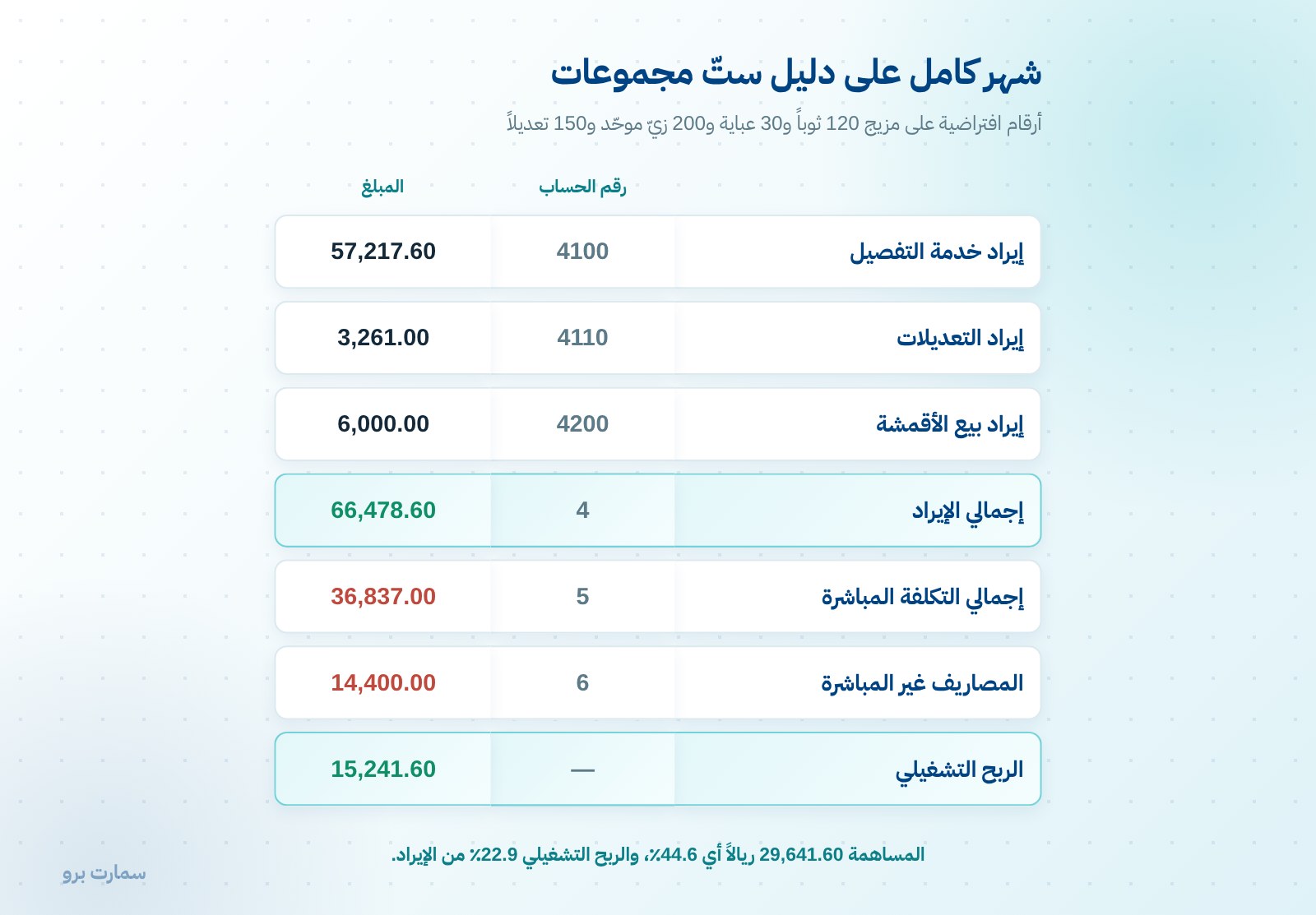
The figures below are hypothetical, to illustrate the method, and do not represent prevailing market prices. The mix used throughout this series: 120 thobes, 30 abayas, 200 uniform pieces and 150 alterations, at pre-VAT prices of 243.48, 400.00, 80.00 and 21.74 respectively. Plus 300 metres of fabric sold at SAR 20 per metre, costing SAR 15 per metre.
| Account | Account no. | Amount (SAR) |
|---|---|---|
| Tailoring service revenue | 4100 | 57,217.60 |
| Alterations revenue | 4110 | 3,261.00 |
| Fabric sales revenue | 4200 | 6,000.00 |
| Total revenue | 66,478.60 | |
| Fabric used in service | 5100 | 16,582.00 |
| Cost of fabric sold | 5110 | 4,500.00 |
| Direct tailor wages | 5200 | 13,500.00 |
| Supplies used | 5300 | 2,255.00 |
| Total direct costs | 36,837.00 | |
| Contribution | 29,641.60 | |
| Overheads | 6 | 14,400.00 |
| Operating profit | 15,241.60 |
- Service revenue: (120 × 243.48) + (30 × 400) + (200 × 80) = 29,217.60 + 12,000 + 16,000 = 57,217.60
- Contribution margin: 29,641.60 ÷ 66,478.60 = 44.6%
- Operating profit margin: 15,241.60 ÷ 66,478.60 = 22.9%
Now assume 85 orders in progress at month end, with a deposit of SAR 112 per order, as in our article on uncollected orders:
- Account 2200 Customer deposits held: 85 × 112 = SAR 9,520
This number never appears in a three-account chart. It means SAR 9,520 of the cash in the till does not yet belong to the workshop, and a month when cash looks plentiful may be a month of obligations rather than profits.
What should the owner read every month in five minutes?
- Contribution margin, 44.6% in the example. A drop means direct costs went up or the mix changed, not that revenue fell.
- The balances of 1310 and 1320. Bloated inventory is money standing still; depleted inventory means orders are about to stall.
- The balance of 2200. This is the volume of work already paid for but not yet delivered.
- The gap between 5100 and the standard. This measures actual waste, covered in detail in our article on fabric waste.
- The balance of 5500. Rework cost in its own account can be read; in a merged account it is hidden.
- Owner's drawings in 3200, kept separate from expenses. Otherwise the workshop's expenses look bigger than they really are.
Item five is what justifies a dedicated rework account in the first place: what isn't isolated can't be measured, and can't be managed.
How does the chart connect to the order record?
The chart of accounts does not track production stages. The flow received → cut → sewn → pressed → ready → delivered is managed in the order record, and an accounting entry is created at only two points: when the deposit is collected, and when the garment is delivered.
Everything in between is expressed as a single balance: 1330 Work in progress, the total direct cost of pieces not yet delivered. The reports you can read from this link are covered in our article on workshop reports.
What are the three common mistakes in a workshop chart of accounts?
First: a single "Sales" account. The difference between service and goods, and between tailoring and alterations, disappears, and you cannot tell which line deserves to grow.
Second: booking fabric as an expense. The purchase month's expenses balloon, the consumption month looks empty, and the stocktake cannot be reconciled to any figure.
Third: a chart with thirty sub-accounts for every item. Nobody records accurately in peak season. A chart of thirty accounts in total is more reliable than one of three hundred that nobody uses.
Where is the official reference?
Rules on invoices, advance payments and showing VAT on workshop documents are published by the Zakat, Tax and Customs Authority (ZATCA), which is the reference in case of any discrepancy. The elements of what you hand to the customer are covered in our article on the simplified invoice for tailors.
If you want to run all of the above without scattered spreadsheets, that is what the tailoring and dressmaking system does.
Read also
- Tailoring profit margin per item: costing by the minute
- Tailoring price list: how to build it in tiers and add-ons
- Advance payments in e-invoicing: when to invoice and how to record them
Key takeaway: Six groups with four-digit codes are enough for a tailoring workshop, as long as service is kept apart from goods, fabric is held as inventory, deposits sit in liabilities, and direct wages are separated from overheads.
To see this chart of accounts working in practice, start a free trial of SmartPro.
Article visuals
Frequently asked questions
How many accounts does a tailoring workshop need?
Six groups with four-digit codes are enough: assets, liabilities, equity, revenue, direct costs and overheads. Four-digit codes let you add an account in its proper place without renumbering the chart. A chart of thirty accounts that is actually used is more reliable than three hundred that are not.
Should I record the fabric invoice as an expense?
No. Record it as inventory in the fabric inventory account on the day it is received, then move whatever is actually used on orders to the fabric-used account. Booking it as an expense shows a whole roll as one month's expense, then it is used over three months with no visible cost, and the stocktake cannot be reconciled to any figure.
Where should a customer deposit be recorded?
On the liabilities side, in a customer deposits held account, because the service has not been performed and the amount can be refunded or settled. When the garment is delivered, the deposit moves to the revenue account together with the balance of the price. A deposit also creates a VAT obligation, which is covered in a separate article on advance payments.
What should a workshop owner read from the chart of accounts each month?
Six figures: the contribution margin, the fabric and trims inventory balances, the customer deposits held balance, the gap between fabric used and the standard, the rework cost balance, and owner's drawings kept separate from expenses. All of them can be read in five minutes if the chart is built on these separations.