
Rework in a Tailoring Shop: Who Pays and How to Record It
Rework is settled by a written policy that separates shop error from customer change. Here is what it costs in SAR, how to record it, and why its rate is a quality indicator, not an accounting tool.
Author:سامي الحيدري
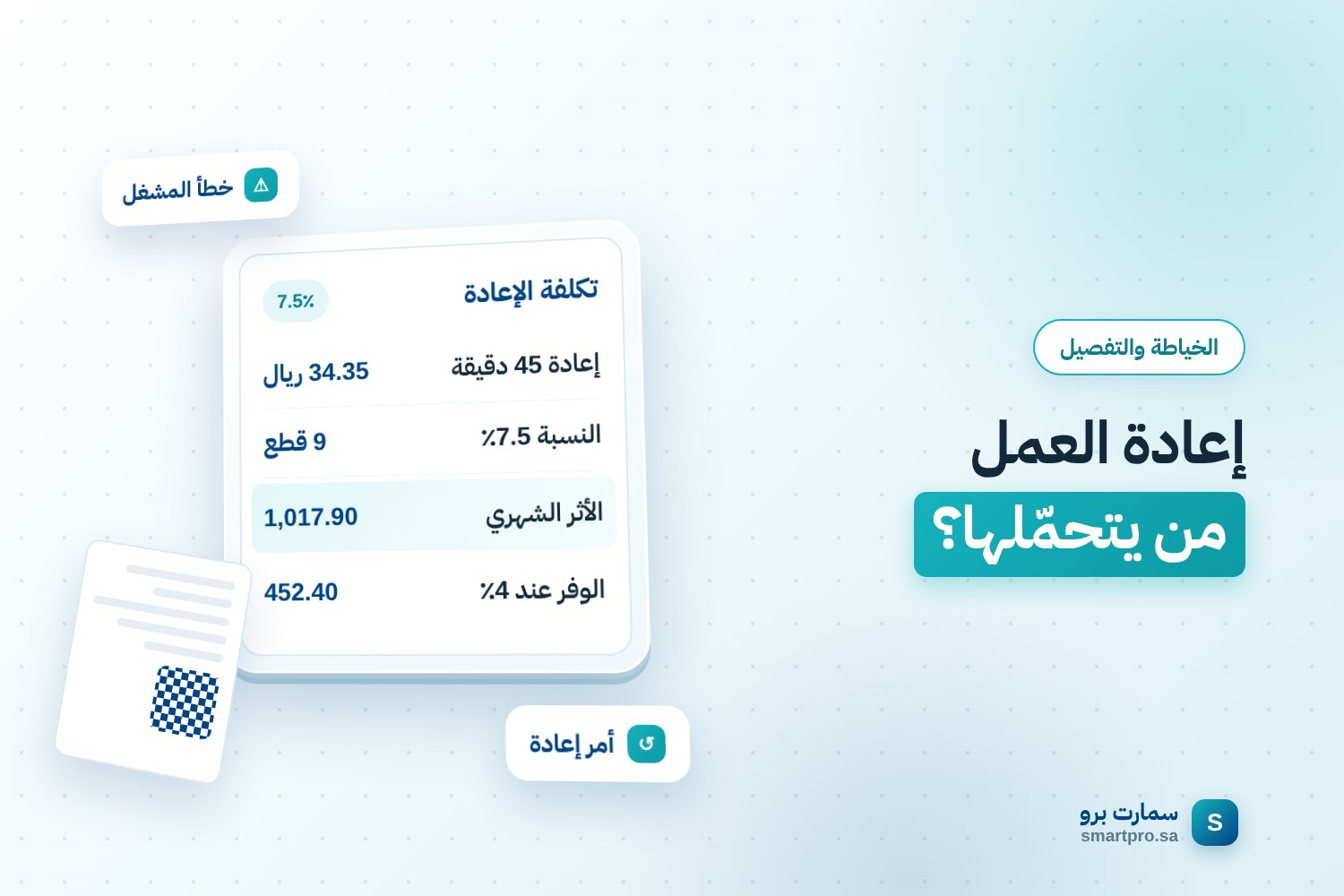
In most tailoring shops, rework is handled by mood. One garment is redone free because the customer raised their voice, another is charged because the employee felt sure of themselves, and the decision changes with whoever is standing at the reception desk.
The result is that the shop pays a cost it cannot size, and loses customers whose dispute could have been settled by one written line.
The answer is neither strictness nor leniency. It is one written policy that separates shop error from customer change, and that is explained at drop-off, not in the middle of a dispute.
Rework: the distinction the policy is built on
Every rework case comes back to one question: who caused the gap between what was delivered and what was expected?
| Case | Who bears the cost |
|---|---|
| Measurement taken wrongly in the shop | The shop |
| Wrong cut or faulty stitching | The shop |
| Written specification not followed | The shop |
| Pressing that damaged the fabric or changed its feel | The shop |
| Customer changed the specification after cutting | The customer |
| Customer's size changed after measurement | The customer |
| Hidden defect in fabric the customer brought | The customer, with proof of inspection |
| Verbal specification the two sides disagree on | The shop, and the cause is fixed, not just the case |
The last row is the one that eats the most time and causes the most argument. It is not solved in the responsibility table but on the drop-off slip: whatever was not written down falls on the party best able to write it, which is the shop.
That is why the measurement and specification sheet is the cheapest way to reduce rework. The details are in measurement records and thobe measurements.
What does rework actually cost?
The figures below are hypothetical, to illustrate the method, and do not represent typical market prices. They build on the rates published in tailoring profit margin per garment: a sewing wage of SAR 0.50 per minute, and SAR 0.23 per minute as each minute's share of fixed overheads.
| Type of rework | Minutes | Wage | Fixed | Materials | Cost |
|---|---|---|---|---|---|
| Unpick and partial re-sew | 45 | 22.50 | 10.35 | 1.50 | 34.35 |
| Full remake from new fabric | 80 | 40.00 | 18.40 | 63.10 | 121.50 |
The first figure alone wipes out the profit on one and a half thobes, because the profit per thobe in the true cost of tailoring a thobe is SAR 20.38. The second wipes out the profit on six thobes.
And that is only half the calculation. The minutes spent on rework could have produced a new garment, and the contribution of one thobe minute is SAR 1.75.
What does the rework rate mean in numbers?
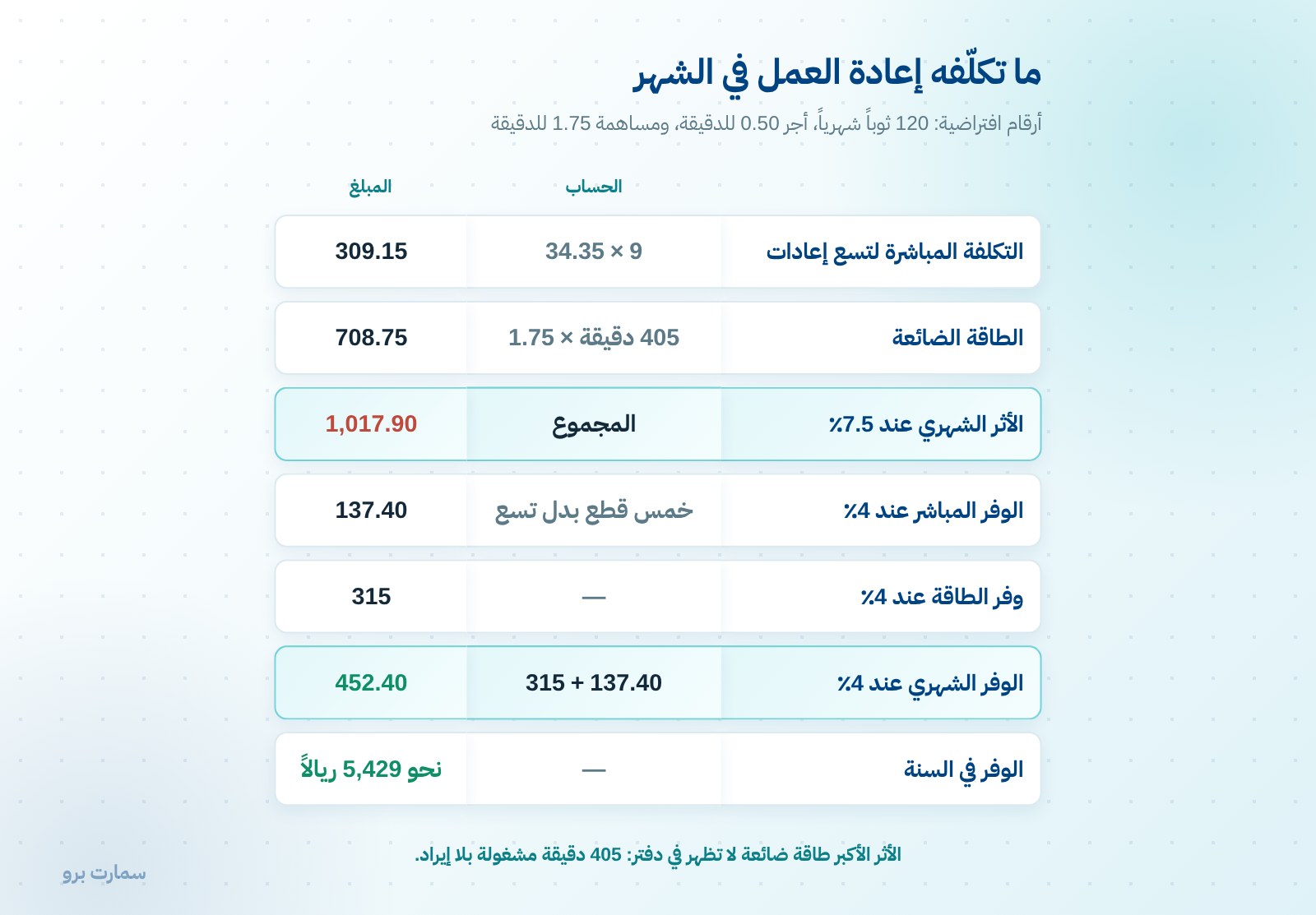
The figures below are hypothetical, to illustrate the method, and do not represent typical market prices. Assume a shop that delivers 120 thobes a month with a rework rate of 7.5%, which is nine pieces.
| Item | Calculation | Amount (SAR) |
|---|---|---|
| Direct cost of rework | 9 × 34.35 | 309.15 |
| Lost capacity | 405 minutes × 1.75 | 708.75 |
| Monthly impact | 1,017.90 |
The second impact is bigger than the first, and it is the one that never appears in any ledger. The shop sees nine pieces redone; it does not see nearly seven hours of its capacity gone with no revenue.
If the rate fell to 4%, five pieces instead of nine, the saving would be SAR 137.40 in direct cost and SAR 315 in capacity: SAR 452.40 a month, or about SAR 5,429 a year.
That saving needs no price increase, no wage cut and no new machine. It needs a clear specification sheet and an inspection gate before delivery, as described in quality check.
Should rework caused by a customer change be charged?
Yes. An alteration the customer requests after cutting is new work that consumes new minutes. Pricing it is no different from any item in alterations pricing.
A 45-minute rework costs SAR 34.35. With a 50% margin, the price is SAR 68.70 before VAT, or about SAR 80 including 15% VAT after rounding to a convenient figure.
Goodwill in this particular item is what drains a shop's margin most, because it is neither counted nor recorded, so nobody knows how much it came to by month end.
If goodwill rework were recorded as a separate line, the number of pieces and what they would have been worth if priced, its real size would show in one report, and granting it would become a decision rather than a habit.
How do you record rework so it stays visible?
The rule: rework is never buried inside the original order. If the garment is redone within the same order, its count and its minutes disappear, and the order looks as if it took twice its normal time with no explanation.
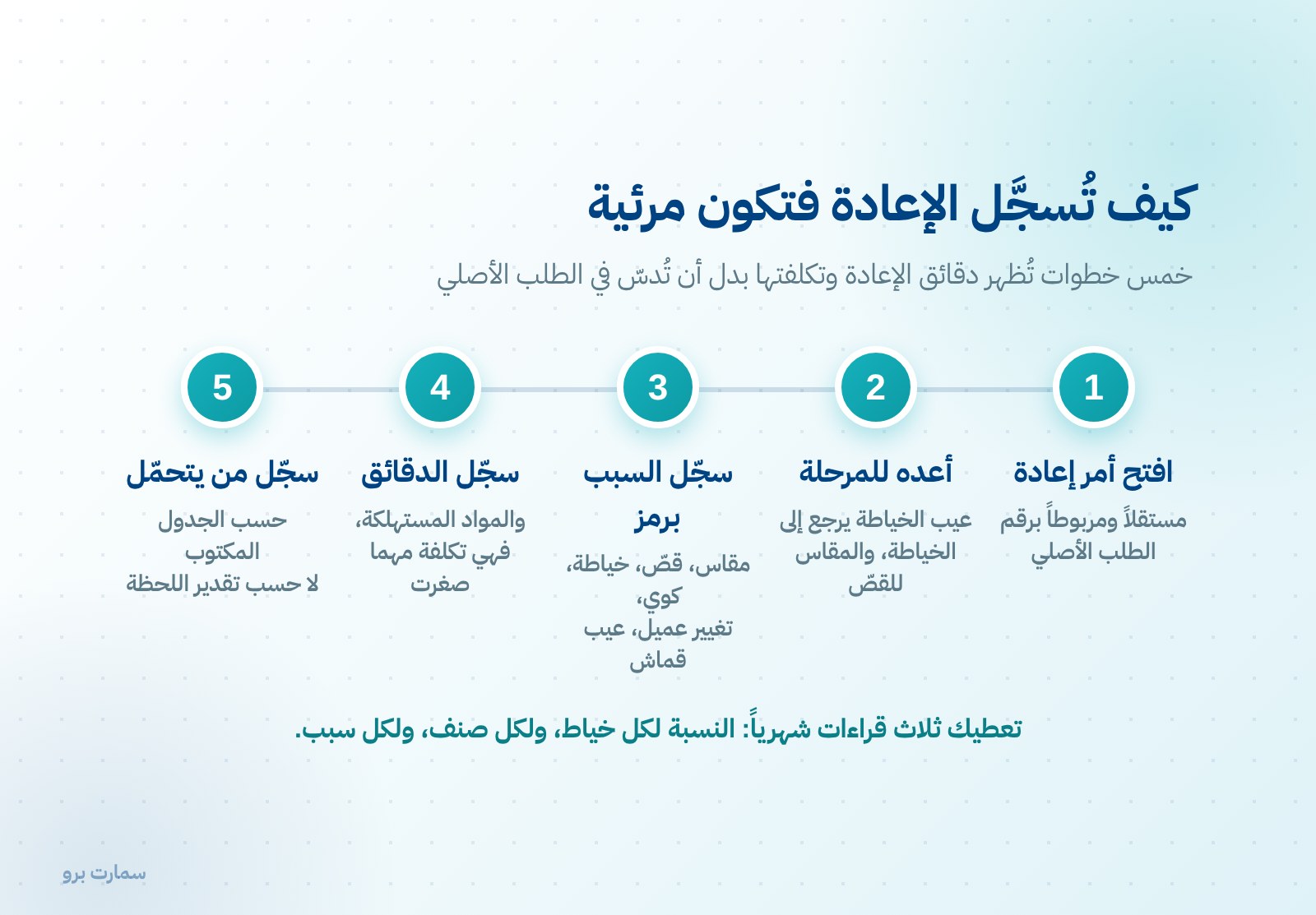
- Open a separate rework order linked to the original order number. How to link them is covered in order numbering.
- Send the order back to the right stage in the workflow: drop-off → cutting → sewing → pressing → ready → delivered. A sewing defect goes back to sewing; a measurement error goes back to cutting.
- Record the reason with a short code: measurement, cutting, sewing, pressing, unwritten specification, customer change, fabric defect.
- Record the minutes and materials used in the rework, because they are a real cost however small.
- Record who bears the cost according to the table, not the employee's judgement in the moment.
At the end of the month you then have three readings: the rate per tailor, the rate per garment type and the rate per reason. The last is the most useful, because it tells you what to fix.
How do you use the rework rate as a quality indicator?
The rate is simple to calculate: pieces reworked ÷ pieces delivered in the same period. Break it down three ways, and each breakdown tells you something different.
- Per tailor: shows who needs training, not who deserves a deduction.
- Per garment type: shows that embroidered pieces or slippery fabrics need more time in the schedule, not a faster tailor.
- Per reason: shows, for example, that most rework comes from measurements, so you fix the measurement sheet, not the machine.
There is no published benchmark for a "good" rate in this sector. The only useful reference is your own history: measure for three months, take the average as your baseline, then follow the trend rather than the absolute number.
The trend is what matters. A rate falling from 7% to 5% is good news whatever the number, and a rate rising from 3% to 5% is a warning however low the number is.
Why should the number be used for training, not monitoring?
This is the most important operational point in the whole topic. A rework rate used for blame and deductions disappears immediately: tailors fix pieces themselves without recording them, or deliver them with the defect and hope nobody notices.
A hidden number helps nobody, and a defect delivered to the customer costs far more than the rework, because it adds a complaint on top. How to handle those is covered in customer complaints.
The right approach is for each tailor to see their own number and the average, to discuss one reason at a time, and to count a piece the tailor reported themselves before delivery more lightly than one the customer found. Linking this to pay is covered in tailor productivity.
How should the policy be explained at drop-off?
The common mistake is to say it as a warning: "If you change your mind after cutting, we're not responsible." That defensive wording makes the customer expect a dispute before anything has started.
A better wording starts with what you guarantee: whatever we make to the written specification, we guarantee, and any defect in cutting, sewing or pressing we fix at our own cost.
The second part then follows naturally: anything that changes in the specification after cutting is new work with a published price, and we will tell you that price before we start.
Finish with a line on the drop-off slip that the customer reads and signs, showing the specification, the measurements and the delivery date. That written line replaces the whole argument, and it also protects the employee from being asked to make a ruling they have no authority to make.
How is each type of rework invoiced?
A free repair caused by shop error is not a new supply, so no invoice is issued for it; it is recorded internally as a cost.
A charged rework caused by a customer change is a service subject to VAT like any alteration. A simplified tax invoice is issued, because the customer is usually an end consumer; its elements are covered in the simplified invoice for tailors.
The official reference
Rules on issuing invoices, treating services and showing VAT are published by the Zakat, Tax and Customs Authority (ZATCA), which is the reference in case of any difference.
Putting all this into practice is easier when orders, fabrics and invoices sit in one system: a tailoring shop management system.
Key takeaway: Decide who pays for rework with one written policy agreed at drop-off, record every rework as its own order with a reason code, and track the rate's trend to guide training rather than deductions.
To see orders, stages and invoices connected in one place, start a free trial of SmartPro.
Read also
Article visuals
Frequently asked questions
When is rework free and when is it charged?
Rework is free when the cause lies with the shop: a measurement taken wrongly, a wrong cut, faulty stitching, a written specification not followed, or pressing that damaged the fabric. It is charged when the customer changes the specification after cutting or their size changes. A verbal specification the two sides disagree on is borne by the shop.
How much does rework cost a tailoring shop?
In the hypothetical example, a 45-minute partial re-sew costs SAR 34.35 and a full remake costs SAR 121.50. On top of that comes lost capacity: 405 minutes a month at a contribution of SAR 1.75 per minute, bringing the monthly impact to about SAR 1,018 at a 7.5% rework rate. The first figure alone wipes out the profit on one and a half thobes delivered without problems.
How do I calculate the rework rate, and what is a good rate?
Divide the pieces reworked by the pieces delivered in the same period, then break the result down per tailor, per garment type and per reason. There is no published benchmark for a good rate in this sector, so take a three-month average of your own figures as a baseline and follow the trend rather than the absolute number. A rate falling from 7% to 5% is good news whatever the number, and one rising from 3% to 5% is a warning.
How do I record rework so it shows up in reports?
Open a separate rework order linked to the original order number, send the order back to the right stage in the workflow, and record the reason with a short code, along with the minutes, materials and who bears the cost. Burying rework in the original order hides its count and minutes and leaves the order's time unexplained. You then get three monthly readings: the rate per tailor, per garment type and per reason, with the last being the most useful.