
Thobe Measurements: One Measurement Sheet Everyone Reads Exactly as Written
Thobe measurements have no official standard, so your reference is whatever you write down. Seventeen fields with exactly where each starts and ends, whether length runs from the shoulder or the neck, and ease in its own column.
Author:سامي الحيدري

Thobe measurements are the sheet a tailoring workshop writes most often, and the one it agrees on least. Two tailors read the same line, "Length 142", and cut two thobes that differ by three centimetres. One measured length from the shoulder point; the other measured from the base of the neck at the back.
Nobody made a mistake here. The number is correct. What is missing is the reference.
This sheet is an attempt to write one reference: every field by name, exactly where it is measured from and to, whether it is taken on the body or on the garment, and how much ease is added. Then it covers how to write the number so another tailor reads it exactly as you wrote it.
Thobe measurements: there is no official standard, so your written reference is the standard
This needs saying once, clearly, because everything else builds on it: there is no national or official approved standard for thobe measurements, and no authority issues a measurement sheet that settles disputes. What the market calls "the standard size" is local custom. It varies between cities, and between one workshop and its neighbour on the same street.
The practical result is that the only useful standard is an internal standard the workshop adopts, writes down and posts on the wall. A workshop that has written its standard has a reference to settle disagreements. A workshop that has not has two competing memories, and the garment pays the price.
What follows is a working standard you can adopt as it is, or adjust once and then lock. What matters is not which option you pick on each line, but that the option is single, written and posted at the measuring table.
The fields: exactly where each one starts and ends
Seventeen fields fully cover a men's thobe. The third column is the reason the table exists, because a field name on its own is never enough:
| # | Field | From where to where | Measured on |
|---|---|---|---|
| 1 | Full length | From the point where the shoulder meets the base of the neck, down the front to the top of the heel | Body |
| 2 | Back length to waist | From the prominent vertebra below the neck to the waistline | Body |
| 3 | Neck circumference | Around the base of the neck, with one finger under the tape | Body |
| 4 | Shoulder width | From the right shoulder tip to the left, across the upper back | Body |
| 5 | Shoulder slope | How far the shoulder drops from the neck to its tip, as a number and a description | Body |
| 6 | Chest circumference | Widest point under the arms, tape perfectly level at the back | Body |
| 7 | Waist circumference | Narrowest point above the navel, not where a belt sits | Body |
| 8 | Hem (hip) circumference | Widest point at the hips, including the belly if it protrudes | Body |
| 9 | Sleeve length | From the shoulder tip to the wrist bone, arm slightly relaxed | Body |
| 10 | Upper arm circumference | Widest point of the upper arm | Body |
| 11 | Wrist circumference | Around the wrist where the cuff sits | Body |
| 12 | Collar (qabba) height | From the attachment seam to the top edge | Garment |
| 13 | Collar tip width | Width of the collar's front tip | Garment |
| 14 | Cuff (aswara) width | From the attachment seam to the end of the sleeve | Garment |
| 15 | Pocket position and size | Distance from the shoulder line and from the placket, then length and width | Garment |
| 16 | Side slit length | From the hem upwards | Garment |
| 17 | Placket (wasla) width | Width of the front button strip | Garment |
The last column is the real dividing line. Whatever is measured on the body belongs to the customer and changes with weight and age. Whatever is measured on the garment belongs to the cut and changes with the customer's request and taste. Mixing the two in one box is the root of most confusion in workshops.
The field names themselves need a written glossary. The collar (qabba) and the neck opening are often confused, and the details are in thobe terminology.
Length: from the shoulder or from the base of the neck?
This is the biggest ambiguity on the sheet, and the one that produces the most remakes that cannot be fixed. Both references are genuinely used in the market, and the difference between them is usually two to three centimetres.
The recommended decision: from the point where the shoulder meets the base of the neck, for three practical reasons:
- The point can be felt with a finger on every body, so it does not need to be judged by eye.
- It does not move when the head moves, unlike the prominent vertebra at the back, which rises and drops as the customer bends.
- The tailor finds the same point on the pattern, so the number moves from the sheet to the fabric without translation.
Then there is the other end of the line, a second ambiguity that is often overlooked: where does the length end? The recommended decision: at the top of the heel, with the customer wearing their usual sandals, not barefoot, because a thobe is worn with sandals, not without them.
So the line is written like this: "Length 142, from the shoulder point to the top of the heel, in sandals." Those extra words are the difference between a number that can be read only one way and a number that can be read three ways.
If you want to change the reference from today, the rule is that the change opens a new measurement version for each customer and is never written over the old one, as explained in measurement records.
Circumferences: on the body or on the garment? And how much ease?
The second ambiguity has a bigger effect than the first, and is less visible. Some workshops record chest circumference on the body, raw. Others record it on the finished thobe, meaning after ease has been added. Ease is the extra room added to a body measurement so the garment can be worn and moved in comfortably.
Both methods work, but the second hides valuable information: the ease gets buried in the number. If the cut or the fabric changes, you do not know what to subtract and what to add. If the customer loses weight, you do not know whether the body changed or their preference for looseness changed.
The recommended decision: record the circumference on the body, raw, and record the ease in a separate column next to it. Cutting is done on the total, and the total is calculated on the tailor's worksheet, not written in the customer's record.
These are standard ease values you can adopt. They are illustrative values for the workshop, not binding figures:
| Field | Standard ease |
|---|---|
| Chest | + 12 cm |
| Waist | + 14 cm |
| Hem (hip) | + 16 cm |
| Upper arm | + 8 cm |
| Neck | + 2 cm |
| Wrist | + 4 cm |
Three things shift these values, and all of them are written down rather than guessed: the cut, since a loose cut needs more; the fabric, since fabric with little drape needs more ease to hang straight; and the customer's preference, recorded in their file from a previous order.
The common mistake here is one ease table for the whole workshop. The right approach is a table for each cut you sell, because ease is a property of the cut, not of the workshop.
Four rules make the raw measurement itself repeatable: light clothing, no layers; the tape kept level and checked from the back; one finger under the tape at the neck; and no pulling tight or letting slack. Remote measuring has its own limits, covered in taking measurements remotely.
Recommended field order
The sheet is filled in the order of movement, not the order of importance. A random order sends the tape up and down, turns the customer around and lengthens the session for no benefit.
- Lengths first, with the customer standing straight: full length, then sleeve length, then back length to waist.
- Then the upper body, top to bottom: neck circumference, shoulder width, shoulder slope.
- Then the circumferences in the same sequence: chest, waist, hem.
- Then the arm: upper arm circumference, then wrist circumference.
- Then the cut fields: collar, cuff, pocket, side slit, placket, taken from the sheet or from a previous garment the customer was happy with.
- Finally, preferences and notes: waist ease, a protruding belly, back slope and any previous complaint.
The reason for taking lengths first is purely practical: the customer stands straight for the first two minutes and then relaxes, and the length reading is the one most affected by relaxing. Measure length at the end of the session and you have measured a different customer.
What changes with the cut and what doesn't
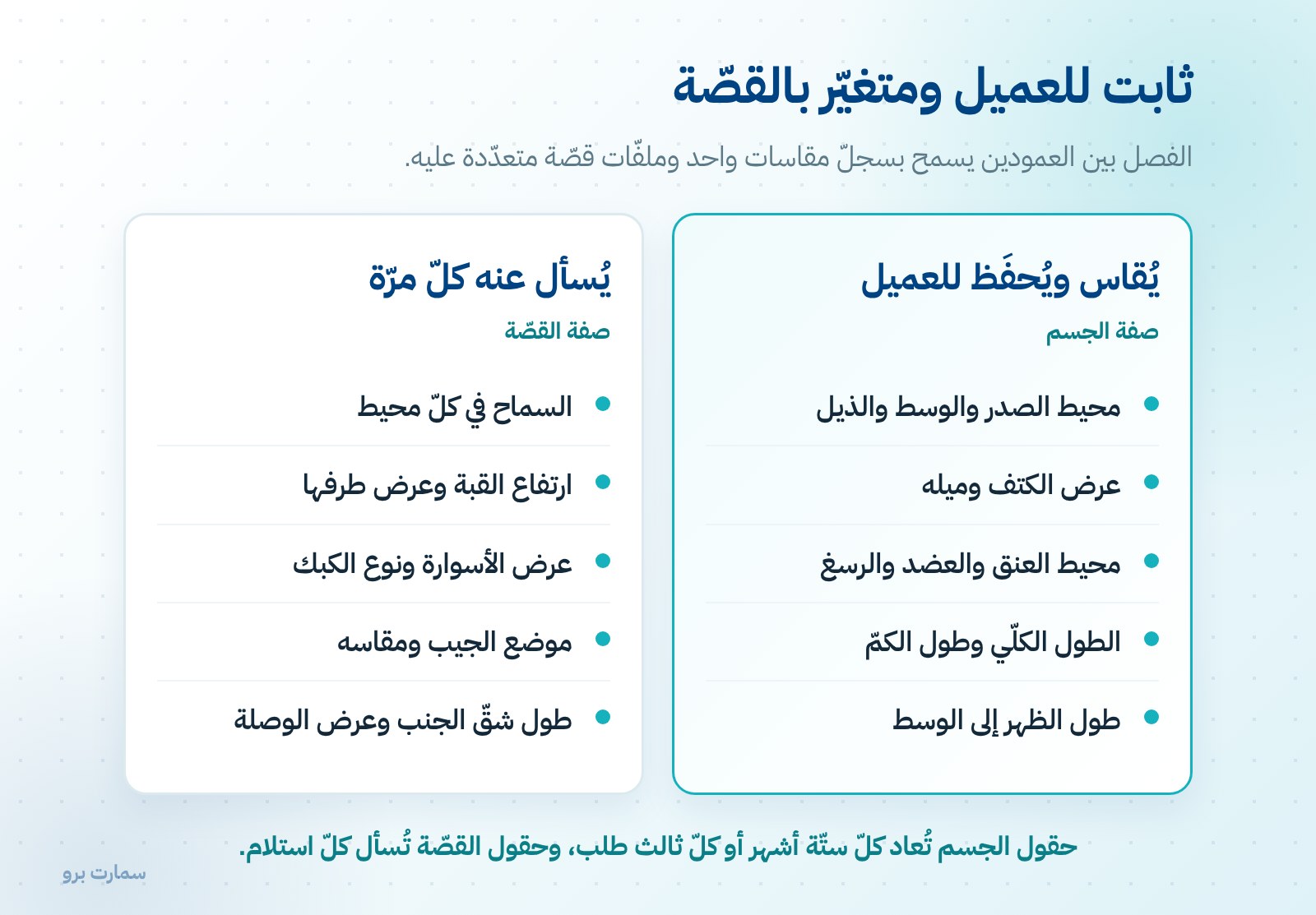
| Fixed for the customer: measured and kept | Varies with cut and order: asked every time |
|---|---|
| Chest, waist and hem circumferences | Ease on each circumference |
| Shoulder width and slope | Collar height and tip width |
| Neck, upper arm and wrist circumferences | Cuff width and cufflink type |
| Full length and sleeve length | Pocket position and size |
| Back length to waist | Side slit length and placket width |
This separation is what allows one measurement record per customer, with several cut profiles built on top of it. A customer who orders a loose thobe for work and a slimmer one for occasions does not need two records. He needs one record and two cut profiles.
The right-hand column is asked about at every order intake and never assumed to be the same as last time. The left-hand column is re-measured every six months or every third order, whichever comes first.
How to write the number so others read it exactly as you wrote it
A correct sheet in ambiguous handwriting is a wrong sheet. Seven writing rules remove most of the confusion:
- One unit. Centimetres in every field without exception, never mixed with inches, not even in one field.
- Round to half a centimetre. Anything finer cannot be executed on fabric, and writing it suggests a precision that does not exist.
- A decimal point, not words. Write 142.5, not "142 and a half".
- No totals. Raw in one column, ease in another; the total is calculated, not recorded.
- The page header carries the references. Two printed lines on every sheet: circumferences on the body in light clothing, and length from the shoulder point to the top of the heel in sandals.
- No description without a number. "Sleeve a bit longer" is not a measurement; "Sleeve length 62.5" is.
- An empty box is not zero. If a field was not measured, write "not measured" explicitly, because a blank is read as either neglect or zero.
Add three administrative fields to every sheet that are not measured with the tape: measurement version number, measurement date and name of the person who measured. Without these three, in any dispute you cannot tell which sheet the garment was made from, or who to ask.
Worked example: the cost of one field without a reference
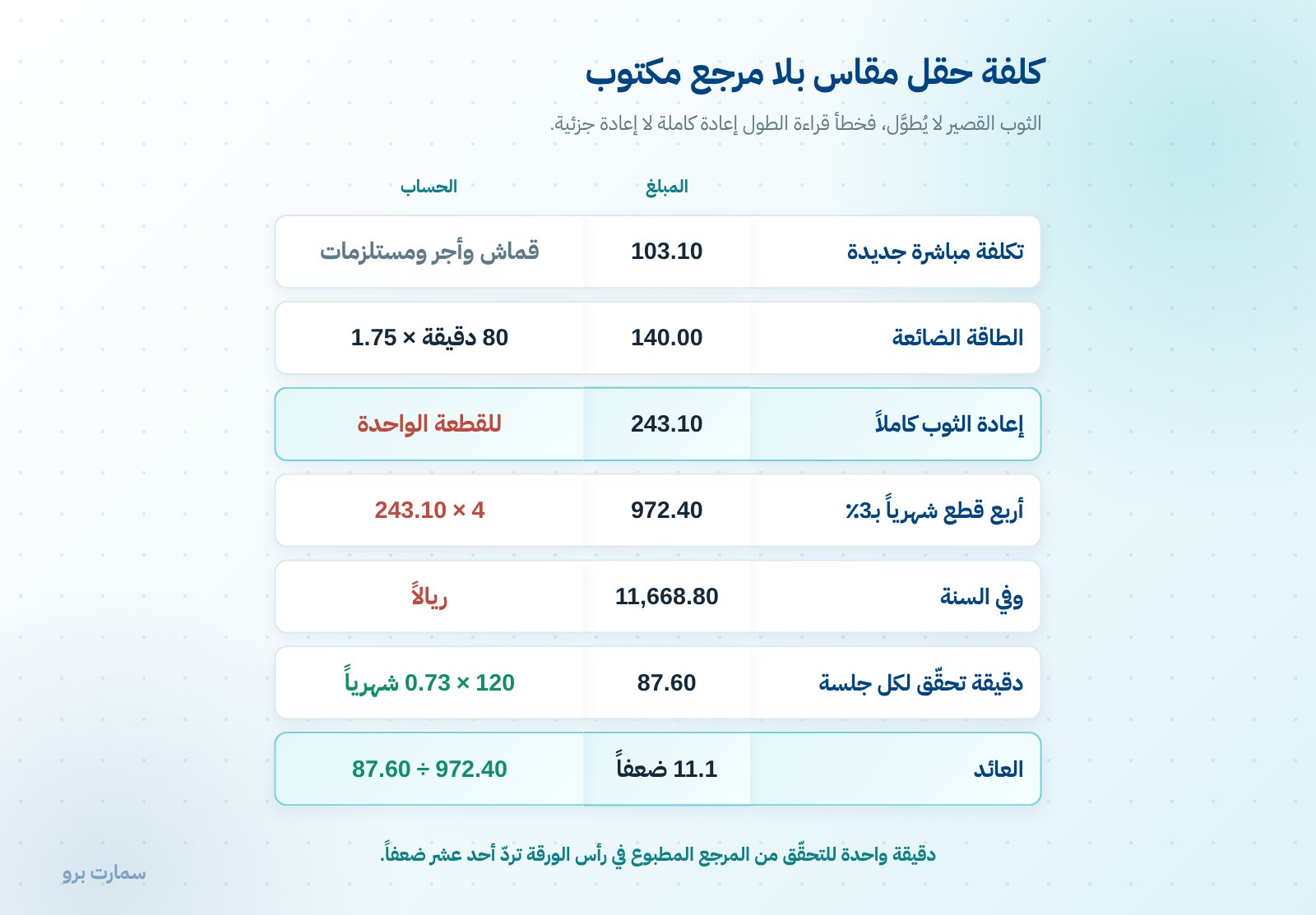
The figures below are hypothetical, to illustrate the method, and do not represent prevailing market prices. Using the parameters from this series: the direct cost of a thobe is SAR 103.10, the contribution per thobe minute is SAR 1.75, a standard thobe takes 80 minutes, and the loaded cost per minute is SAR 0.73.
A thobe that is too short cannot be lengthened, so a length error means a full remake, not a partial fix:
| Item | Calculation | Amount (SAR) |
|---|---|---|
| New direct cost | Fabric, labour and trims | 103.10 |
| Lost capacity | 80 minutes × 1.75 | 140.00 |
| Cost of a full remake | 243.10 |
Now assume a workshop delivers 120 thobes a month, and 3% of them are fully remade because the length field was read against a different reference from the one used to measure it: 120 × 3% = 3.6, or about four garments.
- Monthly cost: 4 × 243.10 = SAR 972.40
- Per year: SAR 11,668.80
What does it take to prevent that? One minute in each measuring session to confirm the reference written in the page header:
- 120 × 1 minute = 120 minutes a month
- At the loaded minute cost: 120 × 0.73 = SAR 87.60 a month
The return is roughly eleven times: 972.40 ÷ 87.60 = 11.1. And the calculation does not include thobes that reach the customer, who accepts them reluctantly and never comes back. Those cost far more and are harder to measure, as covered in customer complaints and remakes.
The measurement sheet in the order flow
The sheet is not a standalone document. A copy of the current version is attached to the order the moment it is received, and travels with it through the whole flow: received → cutting → sewing → ironing → ready → delivered.
The practical rule is that a garment does not move from received to cutting until every body field and the version number are complete. The cutter is the gate for incomplete sheets, because nothing after the scissors can be undone. The full flow is explained in order stages.
Three mistakes on the measurement sheet
First: a field without a reference. The field name is written, but "from where to where" lives in the head of whoever measured. This is the mistake that produces two different thobes from one number.
Second: one box for raw and ease. The ease gets buried in the number, and any later change of cut or fabric becomes guesswork.
Third: a sheet without a version number. In a dispute, nobody knows which measurement the garment was made from, when it was taken or who took it, and the discussion turns into two memories.
The official reference
No authority issues a standard for thobe measurements; the sheet is entirely an internal document. Requirements for fitting rooms in tailoring shops are published by the Ministry of Municipalities and Housing, which is the reference in case of any difference, with details in tailoring shop requirements.
Putting this into practice is easier when orders, fabrics and invoices sit in one system: a tailoring workshop management system.
Key takeaway: There is no official thobe measurement standard, so write your own: a defined start and end point for every field, length from the shoulder point to the top of the heel in sandals, raw body measurements with ease in a separate column, and a version number on every sheet.
Further reading
Article visuals
Frequently asked questions
What fields does a thobe measurement sheet contain?
Seventeen fields split into two groups. Fields measured on the body are full length, back length, neck circumference, shoulder width and slope, chest, waist, hem, sleeve length, upper arm and wrist. Fields measured on the garment are the collar (qabba) and its tip, the cuff (aswara), the pocket, the side slit and the placket (wasla).
Should thobe length be measured from the shoulder or from the base of the neck?
Both references are in use, and the difference between them is two to three centimetres. The recommended reference is the point where the shoulder meets the base of the neck, because it can be felt, does not move when the head moves and the tailor can find it on the pattern. Write the reference on the sheet itself rather than relying on memory.
Should I record circumferences on the body or on the finished thobe?
Record them on the body, raw, and record the ease in a separate column next to each one. Recording the total buries the ease in the number, so you cannot tell what to subtract if the cut or fabric changes. You also cannot tell whether the customer's body changed or only their preference for looseness.
Is there an official standard for thobe measurements in Saudi Arabia?
No. There is no national or official approved standard, and no authority issues a measurement sheet that settles disputes. The useful standard is an internal one that the workshop adopts, writes down and posts at the measuring table, because a written standard can settle a disagreement while a verbal one differs between two people in the same room.