
Thobe Terminology: A One-Page Glossary That Stops Half Your Rework
Thobe terminology is a cheap cause of rework: reception writes one word and the tailor understands another. Here is a one-page glossary with a numbered photo, and what an unagreed term costs in SAR.
Author:سامي الحيدري
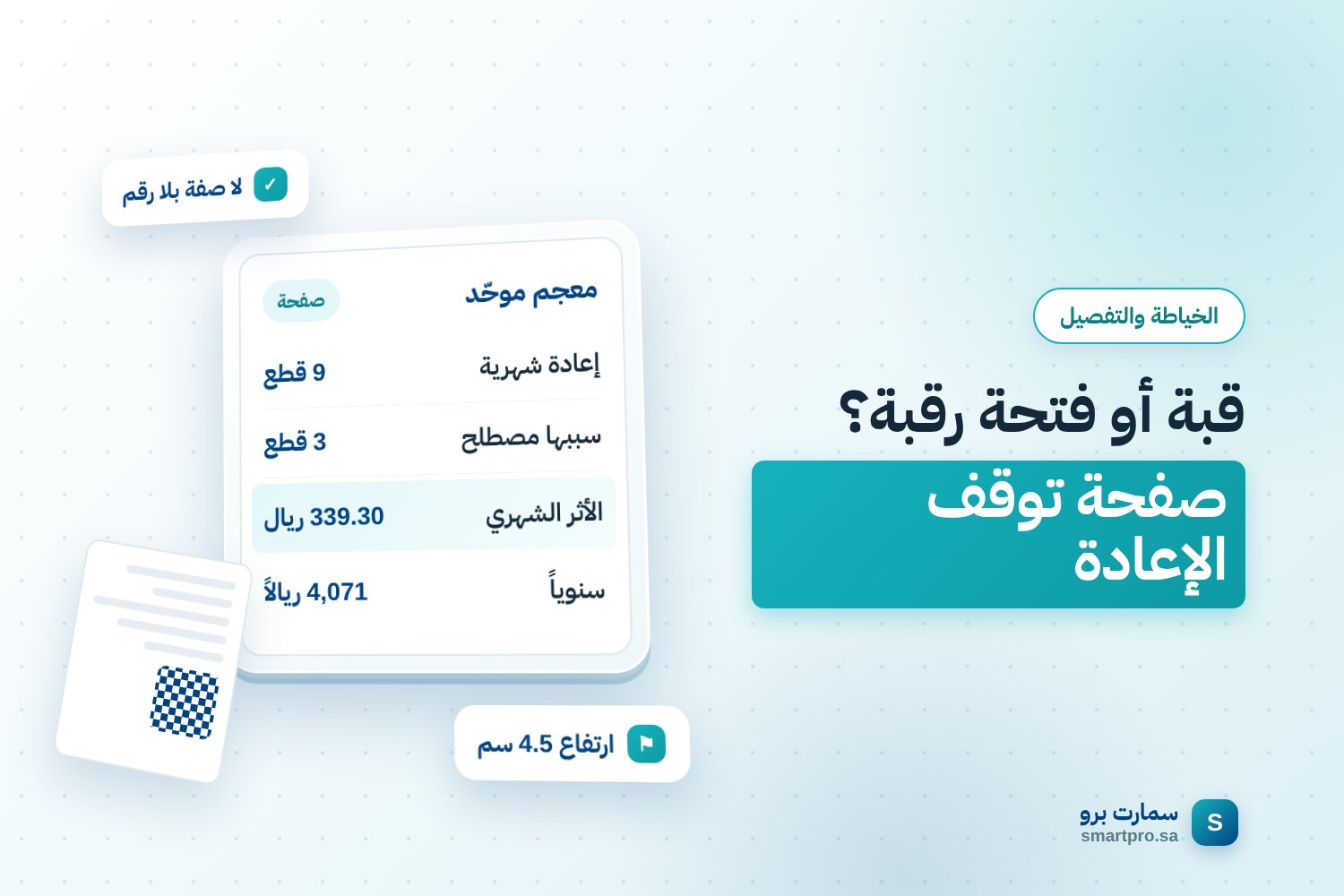
Thobe terminology is the cheapest cause of rework in a tailoring workshop, and the most neglected. A customer says "I want the qubba a bit wider," reception writes "widen qubba," and the tailor widens the neck opening. The customer actually meant the height of the collar itself.
Nobody made a mistake here. All three used the same word and understood three different things from it, and the garment alone pays the price.
The problem grows in a workshop with tailors from different countries, each carrying a vocabulary inherited from the market where he first learned the trade. A single word becomes a broken bridge between reception and the workshop floor.
Thobe terminology: the glossary that must be written down
A spoken glossary does not exist, because it differs between two people in the same room. A written one does exist, and it can settle disputes.
| Term | What it means in the unified glossary | What it gets confused with |
|---|---|---|
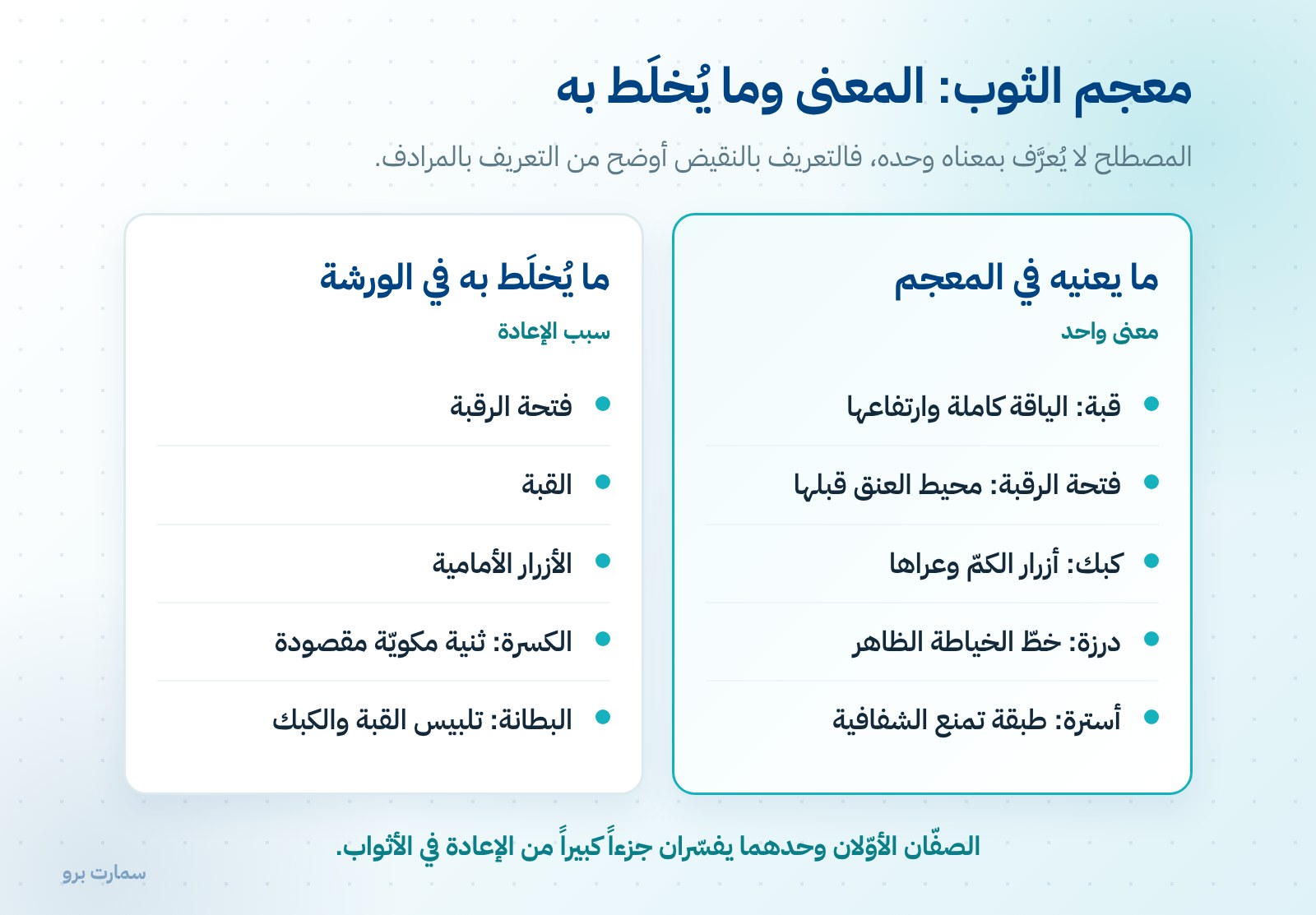
| Qubba (قبة) | The whole collar: its height, width and tip shape | The neck opening |
| Neck opening (فتحة الرقبة) | The neck circumference before the collar is attached | The qubba |
| Kabak (كبك) | Sleeve-cuff buttons and their buttonholes | The front buttons |
| Wasla (وصلة) | The front button placket | The hem |
| Jayb (جيب) | The chest pocket, with its size and position specified | The side pocket |
| Astara (أسترة) | An inner layer that stops the fabric being see-through | Full lining |
| Bitana (بطانة) | Inner interfacing for a specific part, such as the collar or cuffs | The astara |
| Darza (درزة) | The visible stitching line and its width | The crease |
| Kasra (كسرة) | A deliberate pressed fold in the fabric | The stitching line |
| Tatriz (تطريز) | Thread embroidery, with its position and density specified | Interfacing |
| Side slit (شقّ الجنب) | The opening at the lower side and its length | The side pocket |
| Asawir (أساور) | The sleeve-end hem and its width | The kabak |
The first two rows alone explain a large share of thobe rework. The third column is the reason the table exists: a term is defined not only by what it means, but by what it gets confused with.
Why do terminology differences cause rework?
Because a word passes through three stations before it becomes a garment: the customer says it, reception writes it, and the tailor reads it and carries it out. At every station there is a silent translation.
The fault does not show up at the writing stage but at pressing, when the piece has already been cut and sewn. That is the most expensive possible moment to correct it.
This is what makes a unified glossary cheaper than any other training: it needs only one page and one hour, spent once.
A worked example: the cost of an unagreed term
The figures below are hypothetical, used to illustrate the method, and do not represent typical market prices. Using this series' parameters, a partial redo of 45 minutes costs SAR 34.35, and the contribution per thobe minute is SAR 1.75, as set out in rework policy.
Assume a workshop delivers 120 thobes a month with a rework rate of 7.5%, which is nine pieces. Assume one third of them are caused by a term the tailor understood differently from what reception meant, which is three pieces:
| Item | Calculation | Amount (SAR) |
|---|---|---|
| Direct cost of rework | 3 × 34.35 | 103.05 |
| Lost capacity | 135 minutes × 1.75 | 236.25 |
| Monthly impact | 339.30 |
- And annually: 12 × 339.30 = SAR 4,071.60
And the cost of the fix? One printed page, and one hour to explain it to the tailors once. The cost only recurs when a new tailor joins.
Note that the real figure is higher than this, because it does not count the complaints that reach the customer without being reworked in the workshop; those are covered in customer complaints.
How do you build a one-page glossary?
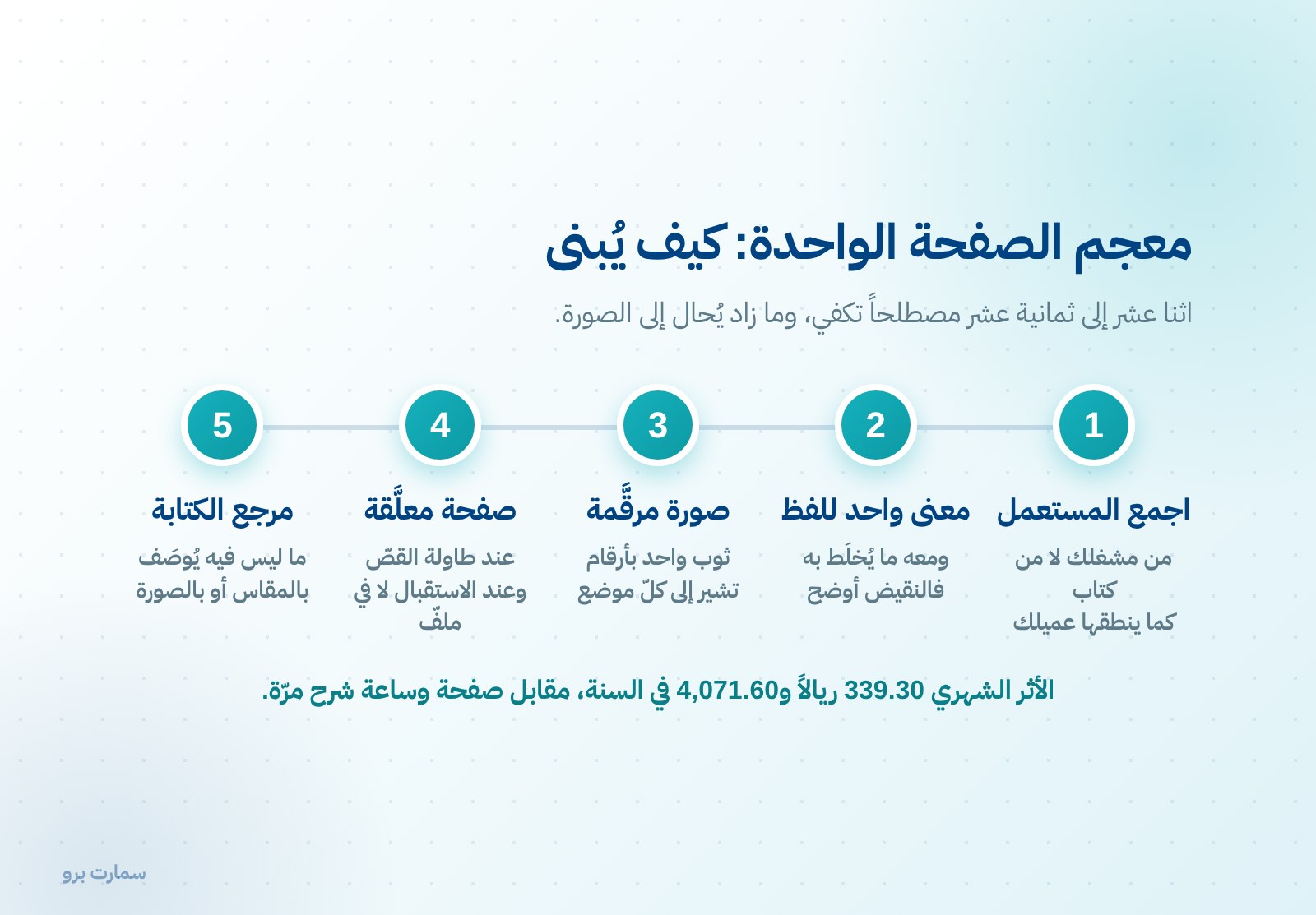
- Collect the terms actually used in your workshop, not from a book. Write them as your customers say them and as your tailors say them.
- Give each term a single meaning and record what it gets confused with, because defining by contrast is clearer than defining by synonym.
- Draw or photograph it. One photo of a thobe with numbers pointing to each part is worth a hundred words, and it is the only medium understood by someone who does not read Arabic.
- Print it on one page and hang it at the cutting table and at reception, not in a file.
- Make it the writing reference for the order form: anything not in the glossary is described by a measurement or a picture, not by a word.
- Review it every six months and add new terms that appear with each new style.
Step three matters most in practice. The numbered photo makes the glossary usable by a tailor who does not speak Arabic, with no translation and no go-between.
How do you onboard a new tailor in one hour?
A new tailor arrives with his own vocabulary and will not drop it just because he is told to. The practical approach is three steps, done on the first day:
- Walk through the numbered photo item by item, with a real thobe in hand, not on paper.
- Read three old order forms aloud, and have him explain what he understands from each line.
- Make one piece under supervision, then compare what he made with what was written.
The second step is the decisive one: it exposes a different understanding before it reaches the scissors, not after.
How should orders be written using agreed terms?
A glossary without a document that uses it is just ink on a wall. The agreed term must appear in two places: on the order form the customer signs, and on the tailor's worksheet that travels with the garment.
Three writing rules remove most of the ambiguity:
- No adjective without a number. "Wider qubba" means nothing; "collar height 4.5 cm" means exactly one thing.
- No term outside the glossary. If staff have to use one, they add a description or a picture next to it.
- No repeating from memory. "Same as last time" is replaced with the previous order number and a copy of its specifications, as described in thobe measurements.
The first rule alone turns half of all disputes into nothing, because a number cannot be read two ways.
Do order stages need agreed terms too?
The glossary does not serve reception alone. The stages themselves — received → cut → sewn → pressed → ready → delivered — need fixed names. Otherwise "ready" to the tailor means he has finished at his machine, while "ready" to reception means the customer can be called.
That disagreement over one word produces premature pickup calls; the definition of each stage is covered in order stages.
The glossary's impact is measured at inspection: if "specification mismatch" rejections in quality check fall two months after the page goes up, it has worked.
What are the three common mistakes in a workshop glossary?
First: a long glossary. Two pages do not get read. Twelve to eighteen terms are enough, and anything beyond that is referred to the photo.
Second: a glossary without a picture. It remains a barrier for anyone who does not read Arabic, and in the workshop they are usually the majority.
Third: a glossary kept in a file. Anything not hung at eye level by the cutting table does not exist, even if it is printed and signed.
Is there an official reference for thobe terms?
The glossary is an internal document that no official body regulates, and there is no approved glossary of thobe terms to refer to. Matters concerning workers and their documents are published by the Ministry of Human Resources and Social Development, which is the reference for those.
If you want to put all of this into practice without scattered spreadsheets, that is what the tailoring and measurements system does.
Key takeaway: A one-page glossary with a numbered thobe photo, used on every order form and worksheet, costs one hour to set up and removes one of the cheapest, most avoidable causes of rework.
Read also
- The tailor's worksheet: what it must carry
- Thobe measurements: the complete sheet
- The six order stages
To see how agreed specifications flow from the order form to the workshop, start a free trial of SmartPro.
Article visuals
Frequently asked questions
Why does thobe terminology cause rework?
Because a word passes through three stations before it becomes a garment: the customer says it, reception writes it, and the tailor reads it and carries it out, with a silent translation at each station. The fault does not show up when the order is written but at pressing, when the piece is already cut and sewn, which is the most expensive moment to correct it.
What is the difference between astara and bitana?
In the unified glossary suggested here, astara is a full inner layer that stops the fabric being see-through, while bitana is inner interfacing for a specific part such as the collar, the cuffs or the sleeve end. The two are often confused, which is why each term is recorded together with what it gets mixed up with, not just its meaning.
How do I build a glossary for my tailoring workshop?
Collect the terms actually used in your workshop rather than from a book, give each one a single meaning along with what it gets confused with, and add a photo of a thobe with numbers pointing to each part. Then print it on one page, hang it at the cutting table and at reception, and review it every six months.
How do I onboard a tailor who does not speak Arabic?
Start with the numbered photo, because it is the only medium understood without a go-between. Then follow three steps on the first day: walk through the photo with a real thobe in hand, read three old order forms aloud, and have him make one piece under supervision before comparing the result with what was written.