
Quality Inspection Before Delivery: A Short Checklist and a Second Pair of Eyes
Quality inspection is the entry condition for the Ready stage, not a seventh stage. A short checklist per garment, who should inspect, and how the reject rate points to the cause, not the culprit.
Author:سامي الحيدري
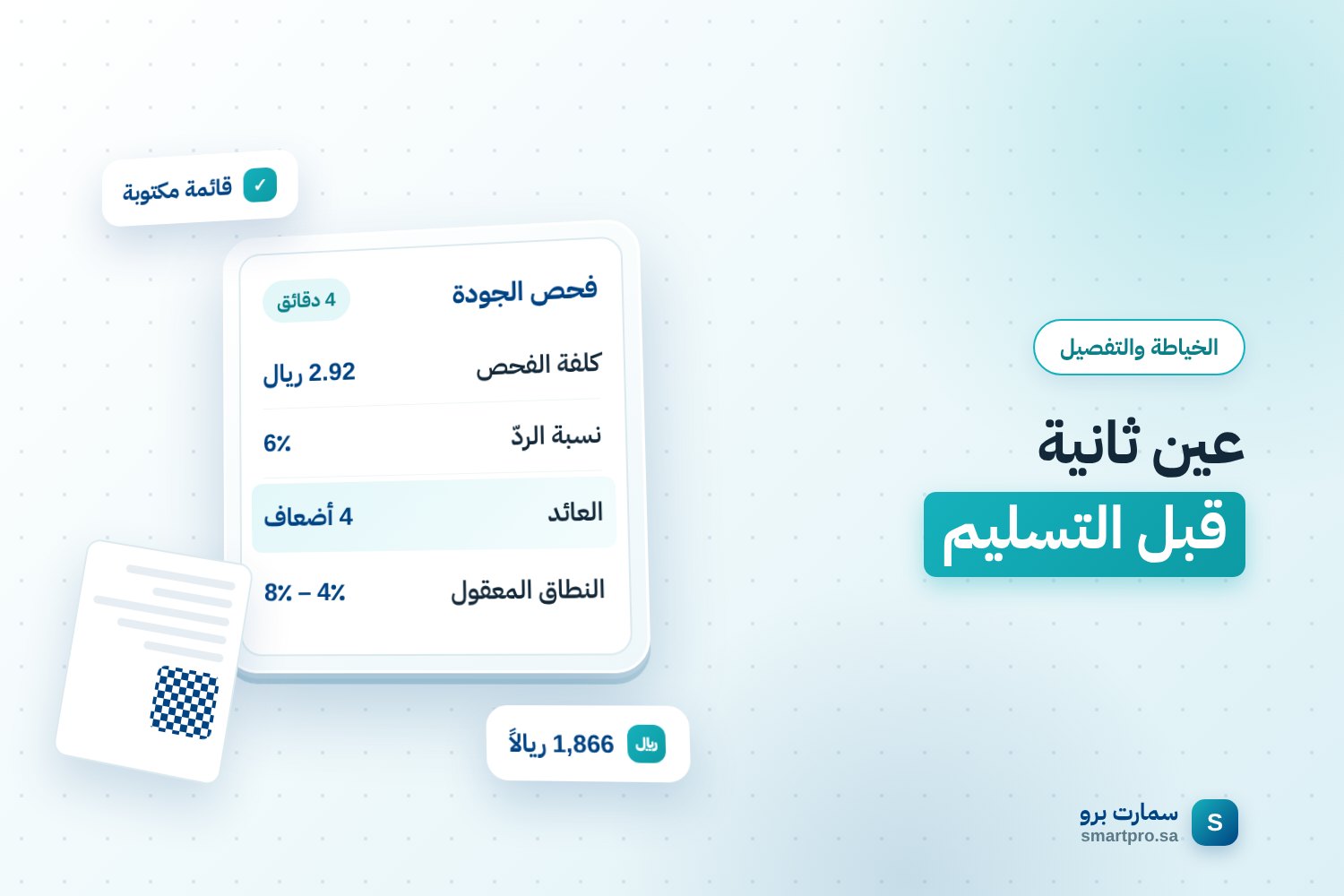
In most tailoring shops, quality inspection happens once, and in the worst possible place: in front of the customer at handover. They open the bag, find one sleeve shorter than the other, and the shop discovers its own defect through the customer's eyes.
An inspection done earlier, in the workshop, with a written checklist, by someone other than the person who sewed the garment, takes only a few minutes and prevents most of this. It is one of the best uses of time anywhere in the shop.
Its most important requirement is not precision but independence: the eye that made the mistake does not see it.
Quality inspection: an entry condition, not a seventh stage
An order still has six stages: Received → Cut → Sewn → Pressed → Ready → Delivered. Inspection is not added as a seventh stage. It is the entry condition for the Ready stage, as described in order stages.
The difference is practical, not just wording. A seventh stage becomes a new queue where garments wait. An entry condition does not wait: the garment either passes, is hung in Ready and the customer is notified, or it goes straight back to the stage responsible for the defect.
So it belongs after pressing and before notifying the customer. Not before pressing, because pressing itself creates defects. And not at handover, because anything found at handover was not inspected; it was complained about.
Who inspects: not the person who sewed it
| Shop size | Who inspects | Note |
|---|---|---|
| Five or more tailors | The pressing lead inspects work sewn by others | Independence comes naturally, with no extra role |
| Two or three tailors | Swap: each inspects the other's work | Needs a written checklist, or it turns into courtesy |
| Owner working alone | Inspect after a break of at least one hour | The break is a partial substitute for a second pair of eyes |
The last row is not a complete solution, and it does not claim to be. The same eye after an hour is better than the same eye in the moment, but weaker than a second eye. Someone working alone compensates with a written checklist, not with concentration.
The inspection checklist by garment type
The checklist has to be short. A 30-item list never gets read; a nine-item list can be read in four minutes.
Thobe: nine items
- Measurements match the measurement version number written on the tag: chest, waist and length.
- Both sleeves are the same length, measured, not eyeballed.
- The collar lies flat, not twisted, and is attached symmetrically on both sides.
- Buttons and cufflinks are complete, secure and aligned.
- Seams are straight, with no skipped stitches or broken thread.
- The pocket is in place with even edges.
- No stains, no pattern markings, no loose threads.
- Pressing leaves no shine and no press marks on the edges.
- The tag is with the garment and the order number matches, as covered in garment tagging.
Abaya: adds four items: a straight front opening, a zip that runs without catching, embroidery with no loose thread, and lining that does not show at the hem.
Alteration: only three items: the new measurement matches the request, the old stitching line is not visible, and the garment is clean with no marks from unpicking.
The log of stopped garments
Inspection without a record is an impression that fades. Six fields are enough: order number, inspection date, the item it failed on, the responsible stage, who inspected, and repair time.
The third field is the source of everything that follows, because it turns inspection from a gate into a diagnostic tool.
Worked example: the cost and return of inspection
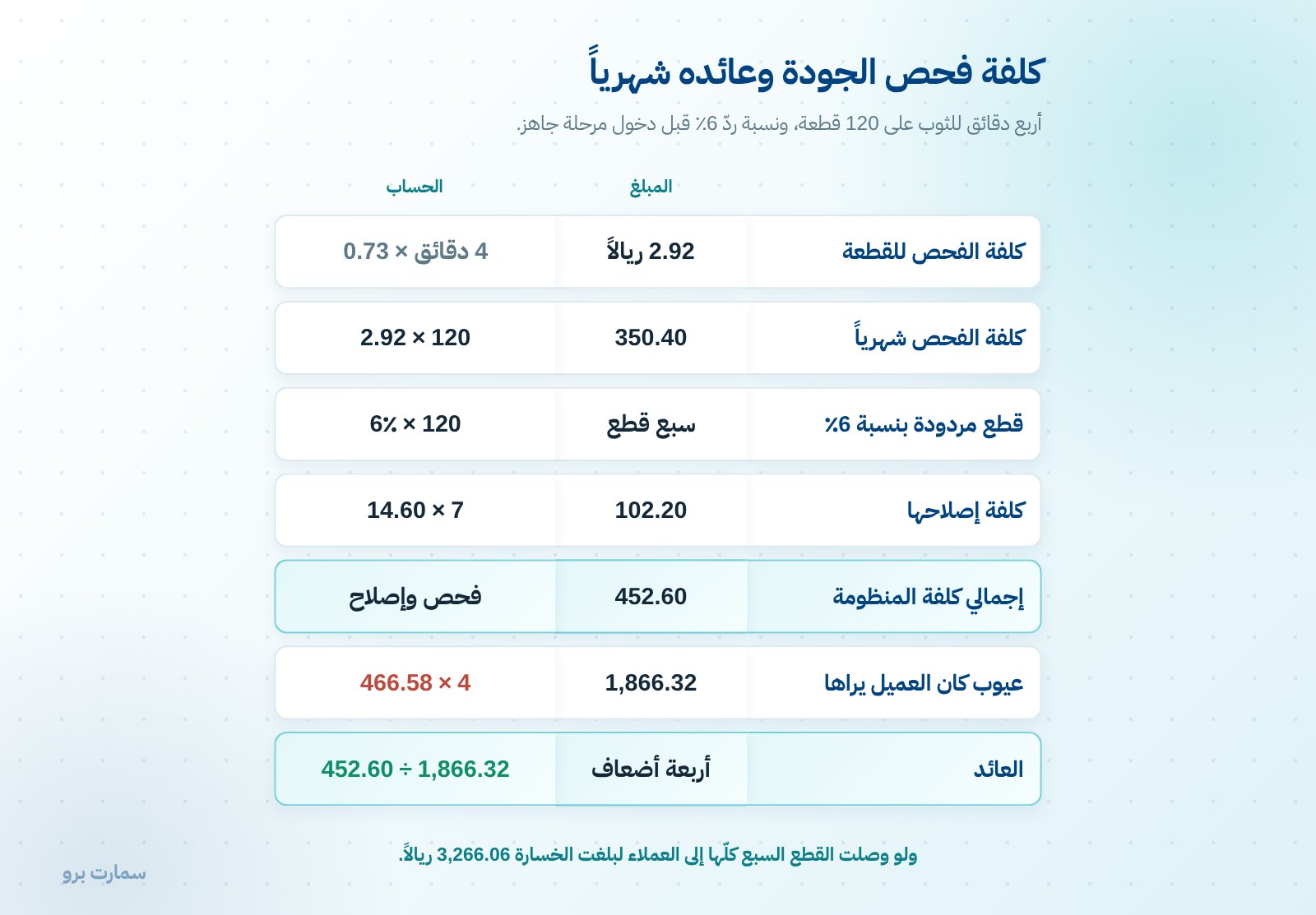
The figures below are hypothetical, used to illustrate the method, and do not represent market prices. Assume an inspection takes four minutes per thobe and six per abaya, in a shop that delivers 120 thobes a month, with a loaded cost per minute of SAR 0.73:
- Inspection cost per garment: 4 × 0.73 = SAR 2.92
- Per month: 120 × 2.92 = SAR 350.40
Now assume a 6% reject rate: 120 × 6% = 7.2, so about seven garments a month are sent back before Ready. Average repair time is 20 minutes, or SAR 14.60 per garment:
- Repair cost: 7 × 14.60 = SAR 102.20
- Total cost of the system: SAR 452.60 a month
And the return? Take a conservative estimate that the customer would have noticed half of those seven, so four garments. A garment whose defect is found after delivery costs SAR 466.58, using the figures from receiving fabric rolls: the garment at full cost plus the refunded fee.
- 4 × 466.58 = SAR 1,866.32 a month
- Return: 1,866.32 ÷ 452.60 = four times the cost of inspection
If all seven had reached customers, the loss would be 7 × 466.58 = SAR 3,266.06. Both limits are shown on purpose: the conservative estimate alone is enough to make the decision.
The reject rate points to the cause, not the culprit
This is where the real value lies. Seven returned garments a month are not seven cases of carelessness; they are patterns:
| Item it failed on | Rejects | Likely cause | Fix |
|---|---|---|---|
| Uneven sleeve length | 3 | Damaged sleeve pattern or faint cutting mark | Replace the pattern |
| Missing or loose buttons | 2 | A trim ran out during sewing | Set a reorder point in trims inventory |
| Press mark on the edge | 1 | Press temperature wrong for the fabric | A temperature chart by fabric type |
| Looser than requested | 1 | Made from an old measurement version | Check the version number in measurement records |
Look at the third column: no row says "careless tailor". Three of the seven came from a damaged cutting tool, two from inventory, one from a press setting and one from an outdated record. All of them are causes that get fixed once, and their rejects disappear.
This is what a shop misses when it uses the reject rate to rate individuals. A tailor punished for rejects learns one thing: to hide defects rather than report them. The reject rate drops to zero, complaints rise, and quality ends up measured by the worst gauge there is: the satisfaction of the person who paid.
How repair costs are split between the shop and the worker is a separate matter with its own rules in rework policy, and should not be mixed up with inspection itself.
A zero reject rate is a bad sign
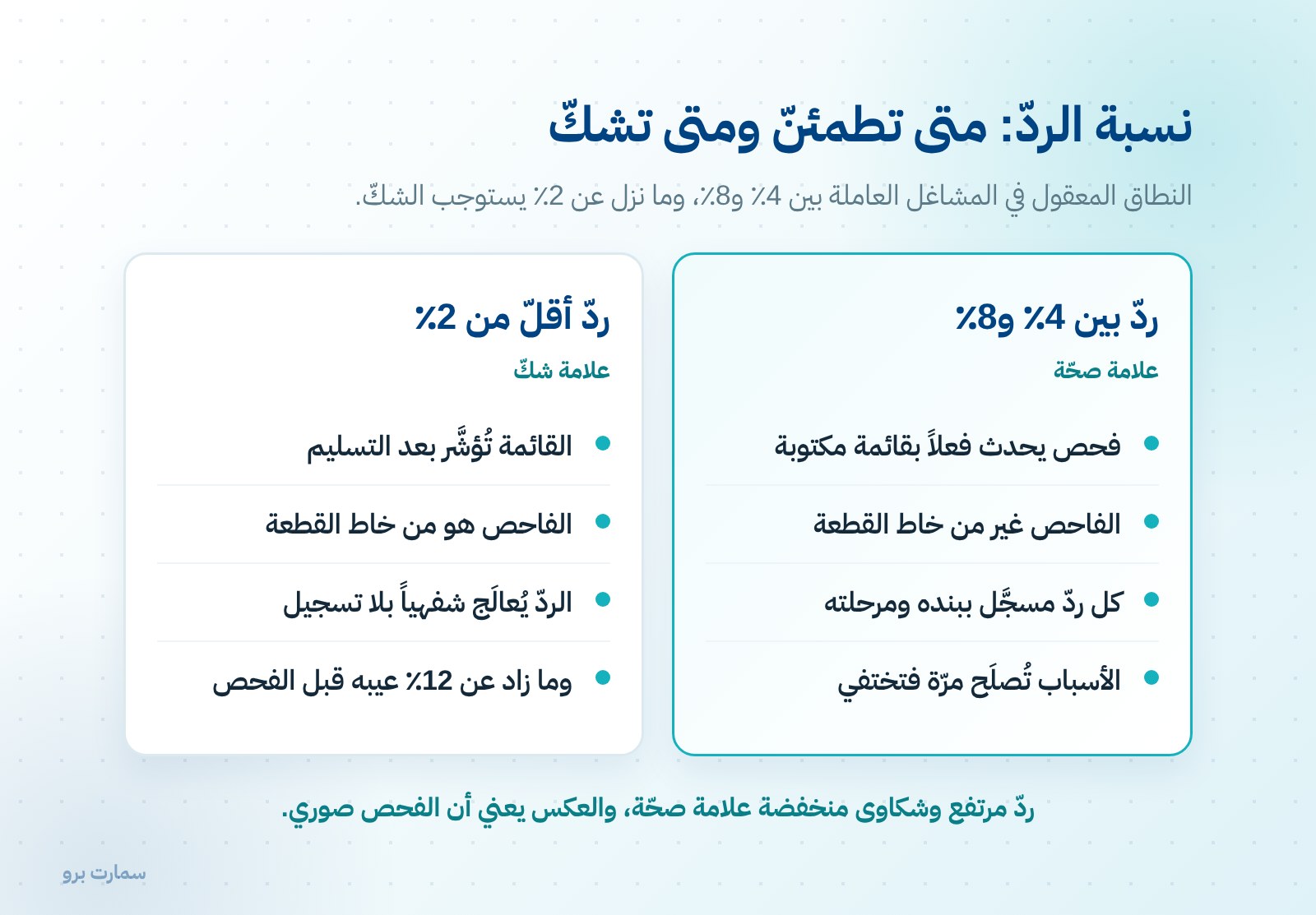
The reasonable range in working shops is 4% to 8%. Anything below 2% calls for suspicion about the inspection, not celebration of quality, because the most likely explanation is one of three:
- Inspection is not really happening; the checklist is ticked after delivery.
- The inspector is the person who sewed the garment.
- Rejects are handled verbally without being logged, so they never show up in any figure.
Above 12% means the problem lies in an earlier stage, not in inspection: inspection detects, it does not fix.
Three mistakes in quality inspection
First: inspecting without a checklist. What gets checked changes with the inspector and their mood, and no result can be compared with another.
Second: the tailor inspecting their own work. This is cancelling the inspection politely, because the eye that made the mistake does not see it.
Third: using the rate for performance reviews. Defects get hidden instead of reported, and the cost moves from minutes in the workshop to complaints from customers, covered in detail in customer complaints.
The official reference
Anything relating to invoices, and any adjustment or credit note arising from rework, is published by the Zakat, Tax and Customs Authority (ZATCA), which is the reference in case of any discrepancy. Details of the shop's invoices are in the simplified invoice.
Everything described here can be run in practice in SmartPro's tailoring system: orders, measurements, fabrics and invoicing in one place.
Key takeaway: Make inspection the entry condition for Ready, done by someone other than the tailor with a short written checklist, and read the reject log for causes to fix once, never as a score for individuals.
To see how orders, measurements and stages fit together in one system, start a free trial or book a demo.
Read also
Article visuals
Frequently asked questions
When should quality inspection be done?
After pressing and before notifying the customer that the order is ready. It is not a seventh stage but the entry condition for the Ready stage: the garment either passes, is hung and the customer is notified, or goes straight back to the stage responsible for the defect. Anything found at handover was not inspected; it was complained about.
Who should inspect the garment?
Anyone other than the person who sewed it, because the eye that made the mistake does not see it. In larger shops the pressing lead is a natural choice, and in small shops two tailors can check each other's work. Someone working alone should inspect after a break of at least one hour, using a written checklist, which is a partial rather than a complete substitute.
What is the return on quality inspection?
In the hypothetical example, inspection costs SAR 2.92 per garment, or SAR 350.40 a month, and adding the repair of seven rejected garments brings the total to SAR 452.60. If customers noticed only half of those seven, the loss would have been SAR 1,866.32, about four times the cost of inspection.
Should I use the reject rate to evaluate tailors?
No, use it to diagnose causes. In the hypothetical example, three rejects came from a damaged pattern, two from a trim running out, one from press temperature and one from an old measurement version. A tailor punished for rejects learns to hide defects, so the rate falls while complaints rise.