
Tailoring Supplies: The Cheap Item That Stops an Order
Tailoring supplies cost eight riyals per thobe, yet running out of one stops an entire garment. A breakdown of the seven items, stocktaking without counting every button, and reorder points.
Author:سامي الحيدري
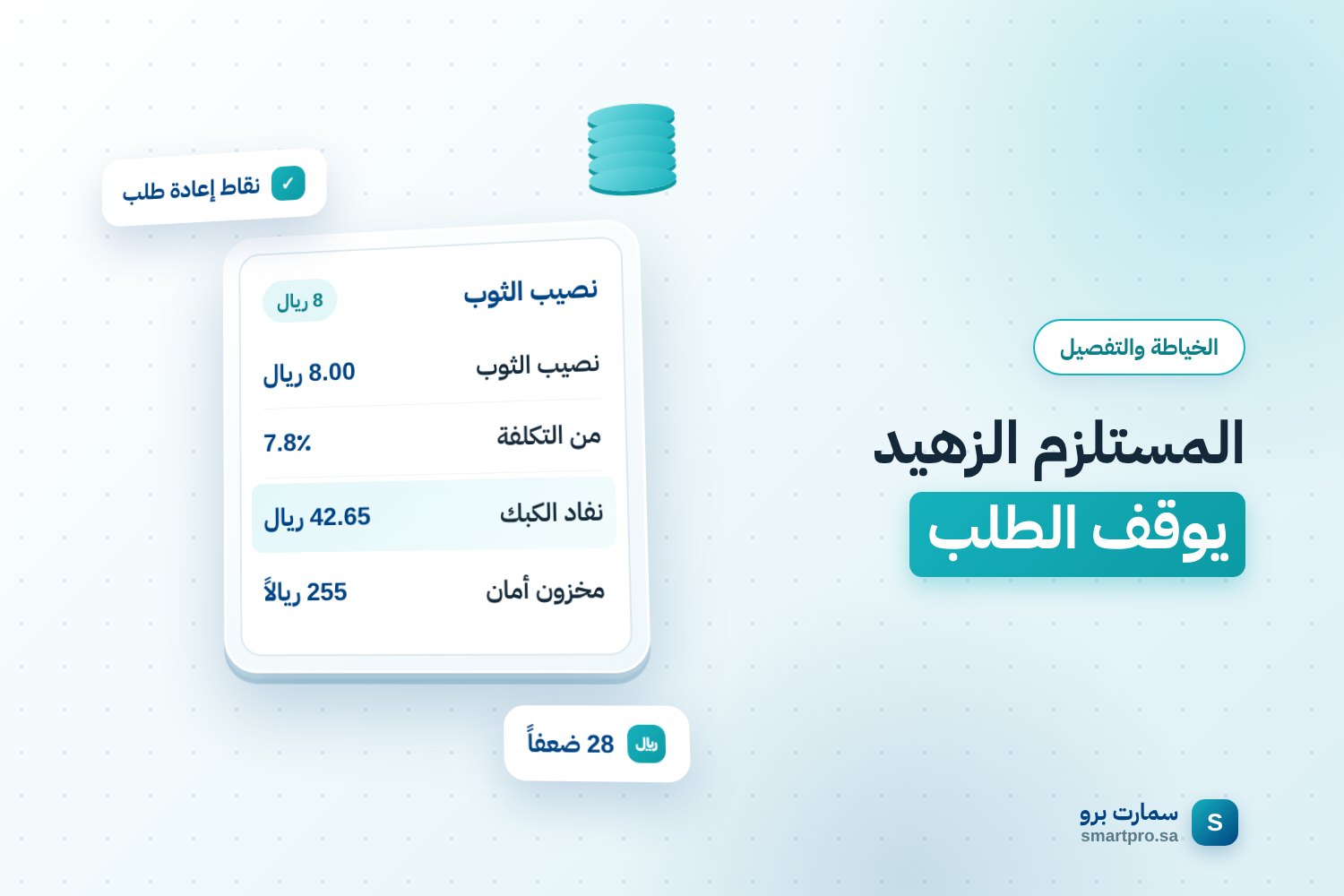
Tailoring supplies are the line nobody notices on the cost sheet and nobody can ignore on the workshop floor. Eight riyals per thobe does not merit a second look when you set prices, but a single missing item can stop a garment mid-stage and leave a whole tailor idle.
What sets supplies apart from other inputs is visibility. You notice a fabric shortage a week before it runs out, because the roll visibly shrinks on the shelf. Buttons, cufflinks and hangers run out without warning, and the shortage is discovered at the exact moment the tailor needs them, not before.
That is why managing supplies is a question of timing, not money. The amount is trivial; the timing is expensive.
Tailoring supplies: eight riyals across seven items
The figures below are hypothetical, used to illustrate the method, and do not represent prevailing market prices. They break down the SAR 8 supplies line in the true cost of tailoring a thobe:
| Item | Purchase unit | Unit price (SAR) | Covers | Cost per thobe (SAR) |
|---|---|---|---|---|
| Thread | 5,000 m spool | 24.00 | 20 thobes | 1.20 |
| Buttons | Bag of 500 | 75.00 | 83 thobes at six buttons each | 0.90 |
| Cufflinks | Pair | 1.50 | One thobe | 1.50 |
| Hanger | Piece | 1.80 | One thobe | 1.80 |
| Garment bag | Piece | 1.60 | One thobe | 1.60 |
| ID tag and label | Piece | 0.40 | One thobe | 0.40 |
| Collar and cuff interlining | Metre | 6.00 | Ten thobes | 0.60 |
| Total per thobe | 8.00 |
For a workshop delivering 120 thobes a month, total supplies come to 120 × 8 = SAR 960 a month, or 7.8% of the garment's direct cost of SAR 103.10.
That percentage is exactly why supplies get neglected: anyone who sees 7.8% turns their attention to fabric and wages. The mistake is that the value here lies not in the money spent but in the production that depends on the item being there.
Why a missing supply costs many times its price
The figures below are hypothetical, used to illustrate the method, and do not represent prevailing market prices. Suppose a thobe has reached the sewing stage, and it turns out the required cufflinks, at SAR 1.50 a pair, are out of stock:
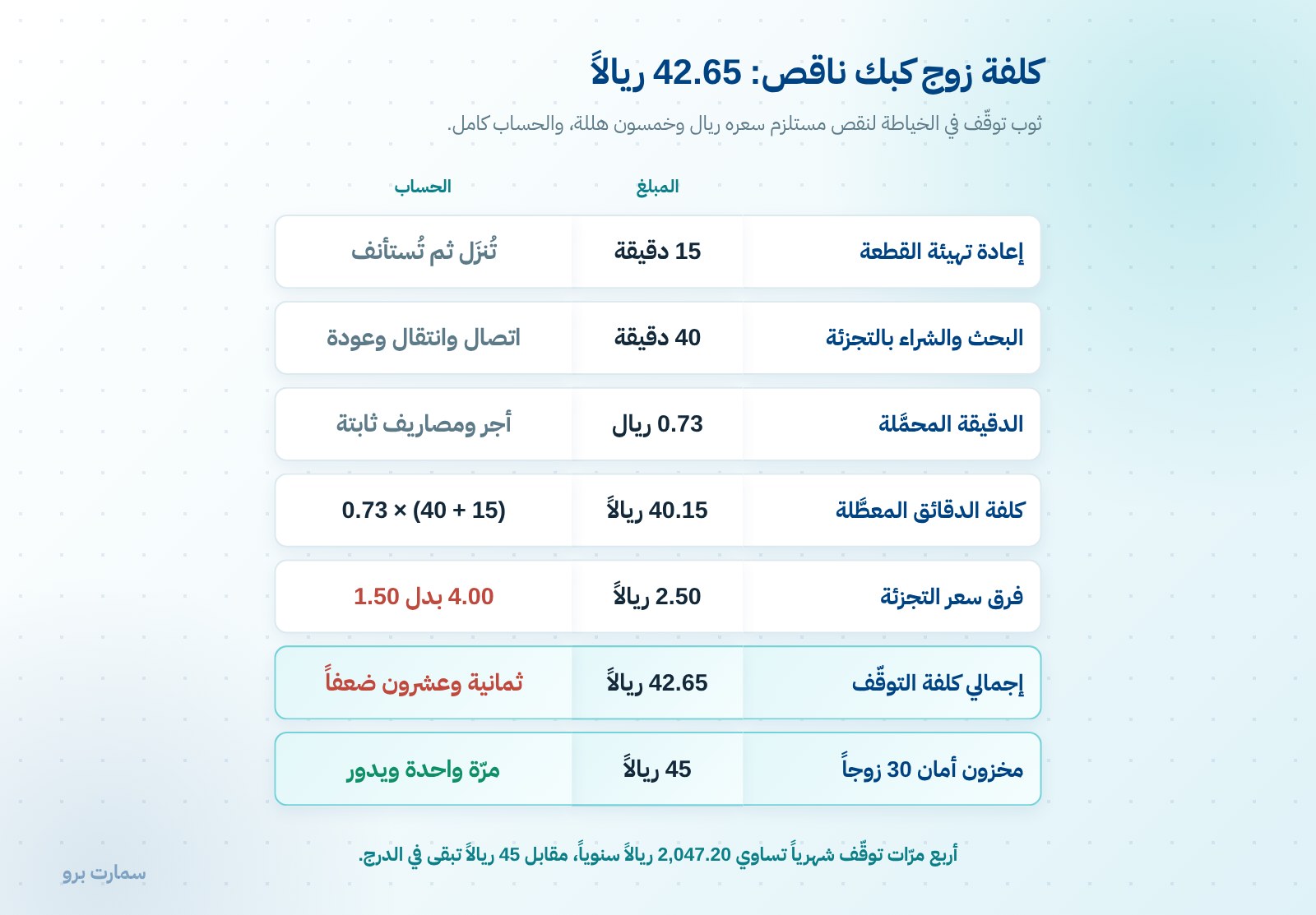
- Re-setup: the garment comes off the machine and is hung aside, then brought back later and resumed where it stopped. Fifteen minutes.
- Searching and buying retail: forty minutes between a phone call, the trip out and the trip back.
- Retail price difference: the pair costs SAR 4 instead of SAR 1.50, a difference of SAR 2.50.
In this workshop, each minute carries a loaded cost of SAR 0.73: SAR 0.50 in labour and SAR 0.23 as a share of fixed overheads, using the same parameters as in receiving fabric rolls.
The calculation: (15 + 40) × 0.73 = SAR 40.15, plus the SAR 2.50 price difference = SAR 42.65. That is twenty-eight times the price of the item.
If this happens just four times a month, a conservative estimate for a workshop without reorder points, the impact reaches SAR 170.60 a month, or SAR 2,047.20 a year.
By contrast, a full safety stock of thirty pairs of cufflinks costs 30 × 1.50 = SAR 45, once, and stays in the drawer, turning over as it is used. That is the real comparison: SAR 45 of stock against roughly SAR 2,000 a year of disruption.
And all this comes before the bigger impact: a stalled garment may miss its delivery window, turning the loss from minutes into a late order with everything that follows, as covered in handling late orders.
Stocktaking without counting every button
The first objection to counting supplies is that it means counting seven hundred buttons, and that will never happen. In reality, no one needs to count buttons one by one, because three methods make it unnecessary:
Counting by weight. Five hundred buttons weigh 250 grams, or half a gram per button. A scale accurate to one gram is enough: weigh the container empty, then full, and divide the net weight by half a gram. A container weighing 370 grams in total and 60 grams empty means 310 ÷ 0.5 = 620 buttons, in ten seconds.
The two-bin system. One open working bin, and one sealed reserve bin holding the reorder-point quantity. The day the reserve is opened, the purchase order goes out: no counting, no log, no guesswork. It is the best-suited system for cheap, high-count items.
Counting by category. Not every item is counted at the same frequency; items are ranked by monthly value:
| Category | Items | Monthly value | Counting method |
|---|---|---|---|
| A | Hangers, garment bags, cufflinks | SAR 588 (61%) | Count by piece monthly |
| B | Thread, buttons | SAR 252 (26%) | Weight or two bins monthly |
| C | Interlining, ID tags | SAR 120 (13%) | Two bins and a quarterly count |
The logic is the same as in fabric stocktaking: accuracy is bought with time, so spend it where it pays off.
A reorder point for every item
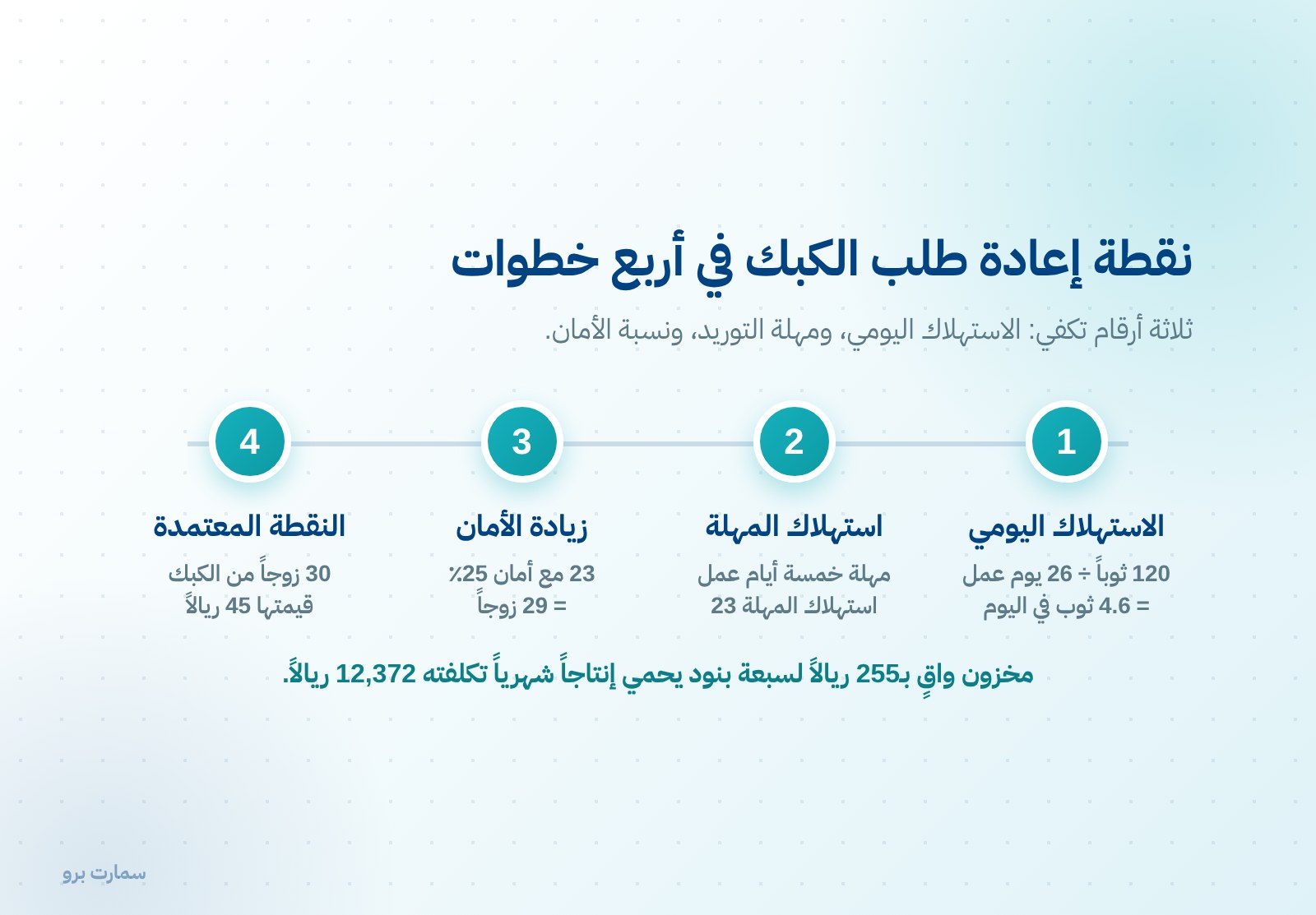
The figures below are hypothetical, used to illustrate the method, and do not represent prevailing market prices. A reorder point is not a feeling that stock is "getting low". It is a calculation from three numbers: daily consumption, supplier lead time and a safety margin.
Assume a lead time of five working days for locally sourced supplies and a safety margin of 25%, using the same parameters as in fabric stock levels. Daily consumption = 120 ÷ 26 working days = 4.6 thobes.
| Item | Daily consumption | Lead-time consumption | + 25% safety | Reorder point |
|---|---|---|---|---|
| Cufflinks | 4.6 pairs | 23 | 29 | 30 pairs |
| Hangers | 4.6 | 23 | 29 | 30 |
| Garment bags | 4.6 | 23 | 29 | 30 |
| ID tags | 4.6 | 23 | 29 | 30 |
| Buttons | 27.7 buttons | 139 | 174 | 200 buttons |
| Thread | 0.23 spool | 1.2 | 1.5 | 2 spools |
| Interlining | 0.46 m | 2.3 | 2.9 | 3 metres |
The value of this entire protective stock: 45 + 54 + 48 + 12 + 30 + 48 + 18 = SAR 255. Two hundred and fifty-five riyals protect monthly production with a direct value of SAR 12,372.
Seasons move the reorder point but don't cancel it
The points above are calculated for a normal month. At peak, daily consumption roughly doubles, so the reorder point doubles with it; otherwise the item runs out in the worst week of the year.
The practical rule: review the points once before Ramadan, once before wedding season and once before the school-uniform season, as set out in planning a tailoring workshop for Ramadan. Don't review them monthly; a review repeated for no reason gets ignored after the second time.
Who owns the supplies
A supply that everyone owns is owned by no one. The practical setup is one person responsible for all seven items, the storekeeper, or the front-desk staff member in smaller workshops, who reviews the points once a week and sends the purchase order.
One condition is added to the order path (receiving → cutting → sewing → ironing → ready → delivered): the garment's supplies are reserved at receiving, not when they are needed. Early reservation exposes a shortage before the garment is cut, not after it reaches the machine. This ties supplies directly to the tailor's worksheet.
Three mistakes that keep repeating
First: buying the minimum of every item. The workshop owner buys a single bag of buttons because it is "enough", so every item is at risk of running out at the same time. The money saved is less than the cost of one stoppage.
Second: relying on a glance at the shelf. "We have cufflinks" is not information, because what you have might be five pairs. Only a number can be compared with the reorder point.
Third: mixing the customer's supplies with the workshop's. When a customer brings their own fabric along with their own buttons, that item is recorded separately; otherwise it gets used on someone else's thobe and is lost. Details are in when the customer brings their own fabric.
The official reference
Rules on purchase invoices and showing VAT on them are published by the Zakat, Tax and Customs Authority (ZATCA), which is the reference in case of any discrepancy.
If you want to put all of this into practice without scattered spreadsheets, that is what the tailoring management system does.
Read also
Article visuals
Frequently asked questions
How do I stocktake small supplies without counting every piece?
Combine three methods. Count buttons by weight: 500 buttons weigh 250 grams, or half a gram each. Use the two-bin system for cheap items, where opening the reserve bin is itself the purchase order, and rank items by monthly value so the most valuable are counted monthly and the cheapest quarterly.
How much does running out of a small supply actually cost me?
Many times its price. In the hypothetical example, missing cufflinks priced at SAR 1.50 cost fifteen minutes of re-setup, forty minutes of searching and buying, and SAR 2.50 in retail price difference. At a loaded cost of SAR 0.73 per minute, the total came to SAR 42.65, twenty-eight times the item's price.
How do I calculate the reorder point for tailoring supplies?
Multiply daily consumption by the supplier lead time, then add a safety margin. In the hypothetical example, 120 thobes over 26 working days gives 4.6 thobes a day, a five-working-day lead time gives 23, and with a 25% safety margin the reorder point becomes thirty pairs of cufflinks.
When should an order's supplies be reserved?
At the receiving stage, not when they are needed. Early reservation exposes a shortage before the garment is cut and before it reaches the machine, leaving the full supplier lead time to source it. Late reservation turns every shortage into a stoppage in the middle of sewing and a delivery date at risk.