
Fabric Suppliers: How to Choose Them and Negotiate on Landed Cost
Fabric suppliers should not be compared on price per metre. What matters is the landed fabric cost per garment, the effect of width, shrinkage and lead time, and whether a second supplier is worth the effort of managing one.
Author:سامي الحيدري
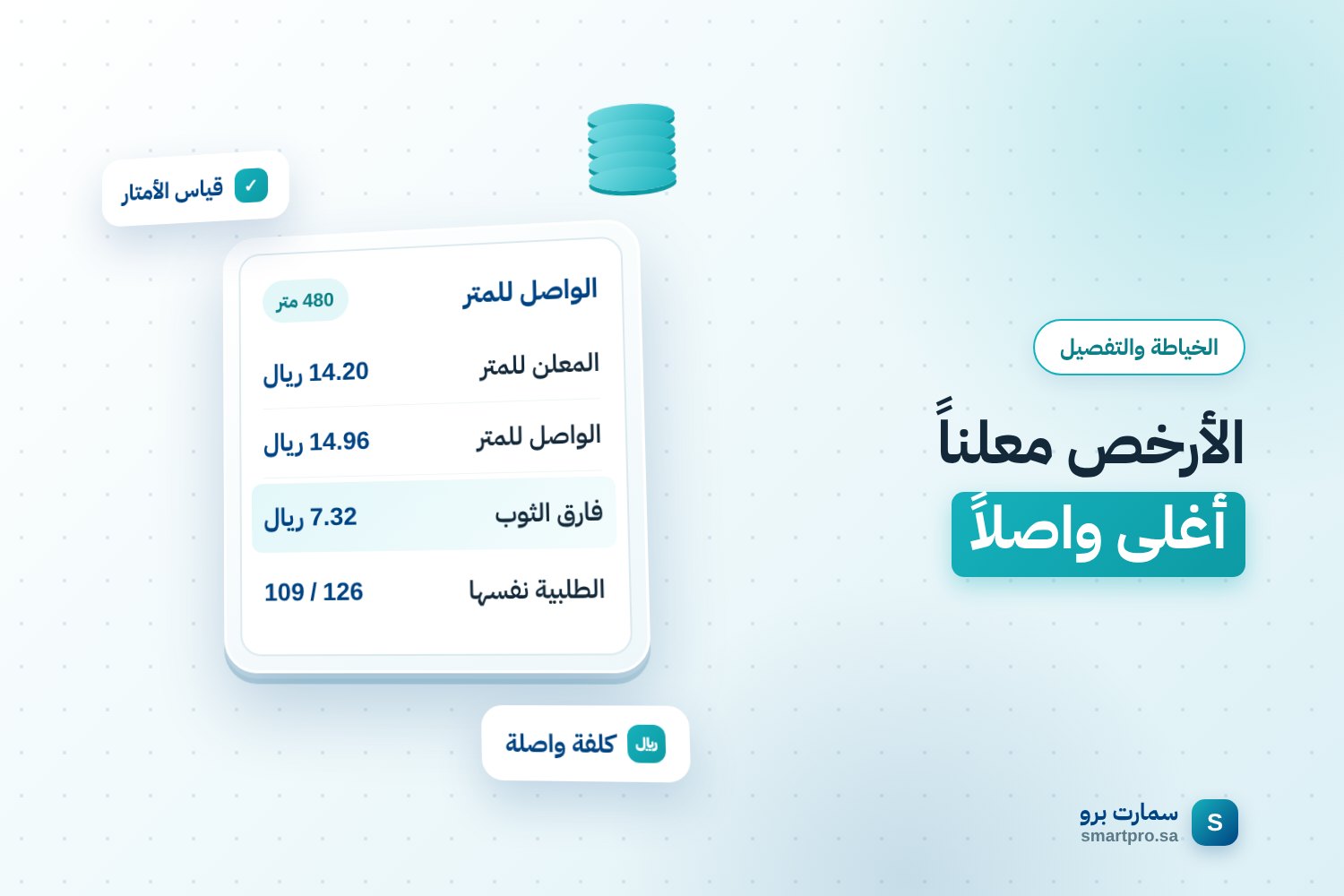
Most tailoring workshops choose fabric suppliers on a single criterion: the quoted price per metre. They ask each supplier for a price, compare the figures, and go with the cheapest.
The problem is that the quoted price per metre is not what you actually pay. You pay the invoice value for the metres you actually received. How far those metres go depends on the fabric width and its shrinkage. On top of that you carry transport, delays and dye-lot differences.
The figure to compare suppliers on is the fabric cost per garment landed at the cutting table, not the per-metre price the salesperson quotes.
Fabric suppliers: compare on landed cost, not price per metre
Landed cost is the full cost of fabric once it reaches your cutting table and is ready to use. It is built from four layers on top of the quoted price:
- Transport and handling, added to the invoice value before dividing by the metres.
- The metre gap between the metres invoiced and the metres measured, and how you measure it is covered in receiving fabric rolls.
- Net width, because a narrower fabric uses more metres for the same garment.
- Shrinkage allowance, because fabric that shrinks more has to be cut with deliberate extra length.
Each of these four layers can change how suppliers rank, which is why the ranking often shifts once you do the calculation.
Worked example: the cheapest price, the highest cost
The figures below are hypothetical, used only to illustrate the method, and do not represent current market prices. Suppose an order of eight rolls, each 60 metres long, giving 480 metres, quoted by two suppliers (amounts in SAR):
| Item | Supplier A | Supplier B |
|---|---|---|
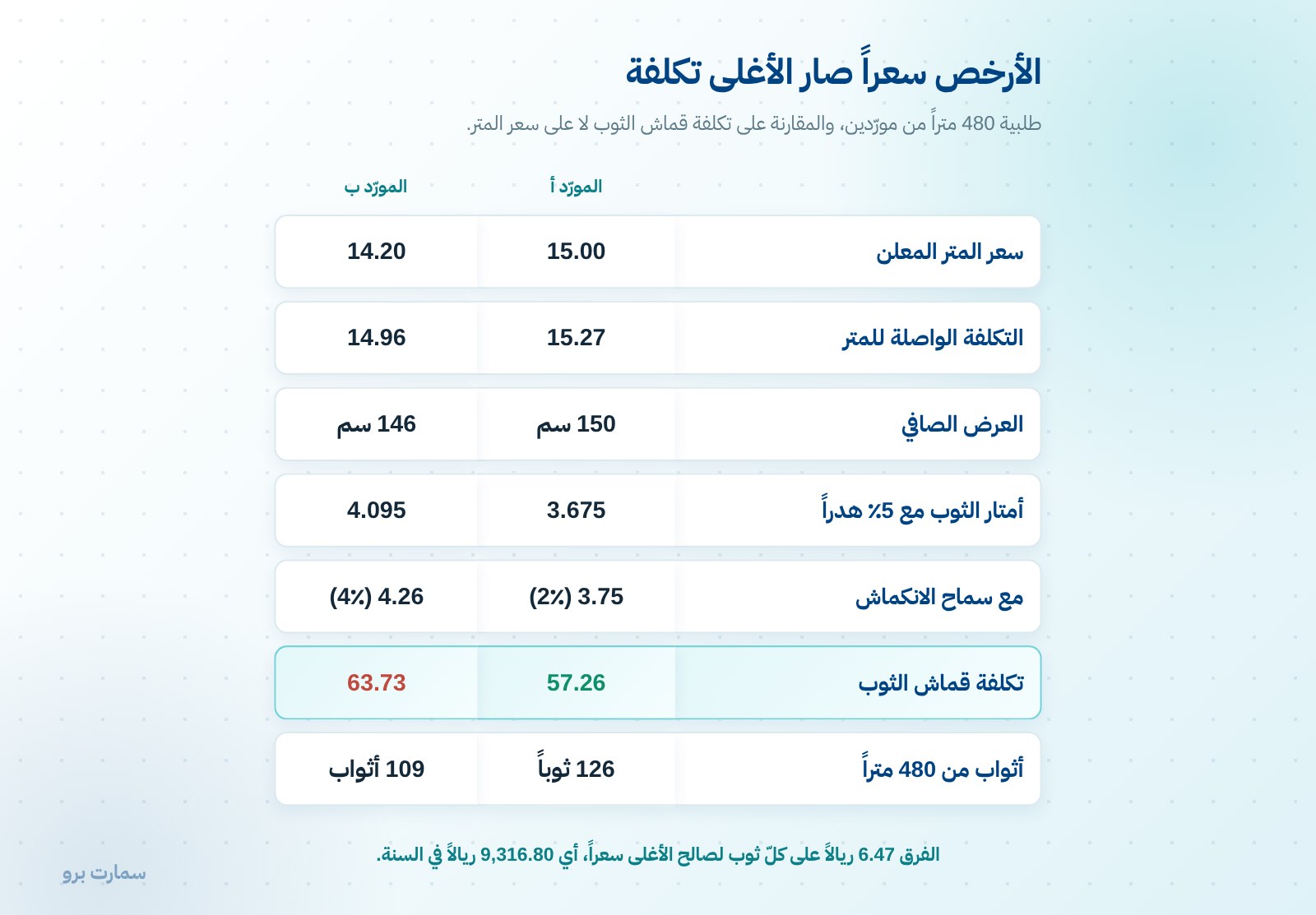
| Quoted price per metre | 15.00 | 14.20 |
| Order value | 7,200 | 6,816 |
| Transport | Included | 150 |
| Measured metres | 471.5 (1.77% short) | 465.6 (3.00% short) |
| Net width | 150 cm | 146 cm |
| Stated shrinkage | 2% | 4% |
| Payment terms | 30 days | Cash |
Step 1: Landed cost per measured metre
- Supplier A: 7,200 ÷ 471.5 = SAR 15.27
- Supplier B: (6,816 + 150) ÷ 465.6 = 6,966 ÷ 465.6 = SAR 14.96
At this point B is still cheaper. The second step is the one that turns the picture around: how many metres each fabric uses per thobe.
Step 2: Metres used per garment
Using the parameters of this series, a thobe needs 3.5 net metres plus 5% waste, or 3.675 metres on a 150 cm width. The shrinkage allowance is then added:
| Calculation | Supplier A | Supplier B |
|---|---|---|
| Net per garment on the available width | 3.50 | 3.90 |
| + 5% waste | 3.675 | 4.095 |
| + shrinkage allowance | 3.75 (2%) | 4.26 (4%) |
| × landed cost per metre | 15.27 | 14.96 |
| Fabric cost per thobe | 57.26 | 63.73 |
That is a difference of SAR 6.47 on every thobe in favour of the supplier with the higher price. At 120 thobes a month, that comes to SAR 776.40 a month and SAR 9,316.80 a year.
Put more plainly: the same 480-metre order produces 126 thobes from Supplier A's fabric and only 109 thobes from Supplier B's.
Why width and shrinkage are part of the price
The 4 centimetres by which Supplier B's fabric is narrower are not a technical detail; they are extra length consumed. Using a rough factor of 10 cm of length for every centimetre of width lost, those 4 cm become an extra 40 cm on every garment.
Shrinkage works in the same direction but without any visible sign. Fabric that shrinks 4% must be cut with deliberate extra length, or the thobe comes back shorter than its measurements after the first wash. You pay the difference either in fabric or in rework, and the second case is covered in rework.
That is why you should ask the supplier for the shrinkage rate in writing before the first order, and test 20 cm of every new fabric type. A supplier who refuses to put it in writing is pricing you a risk, not a fabric.
Lead time and reliability: what delays cost
The figures below are hypothetical, used only to illustrate the method, and do not represent current market prices. The price per metre is one figure a year; lead time is a figure that repeats with every order. Lead time is the period between placing an order and receiving it. The lead times used in this series are 12 working days for local fabric and 45 days for imported fabric, with 25% safety stock, as explained in fabric stock levels.
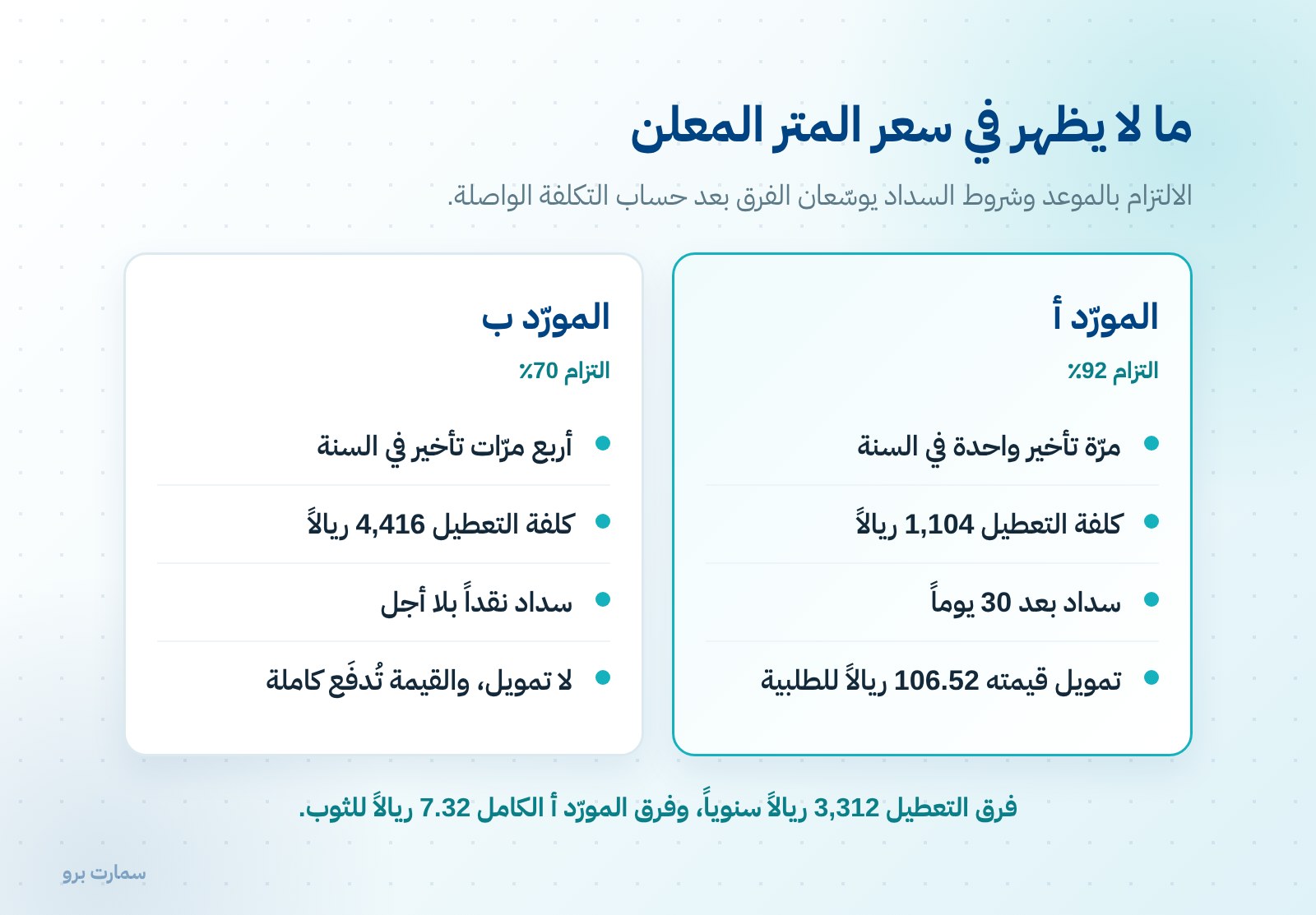
Suppose a late order stops cutting for two days. Idle minutes = 2,400 minutes a day × 2 days = 4,800 minutes, and their share of fixed overheads is 4,800 × 0.23 = SAR 1,104, spent with no production in return.
If Supplier A delivers on time 92% of the time and Supplier B 70% of the time, with one order a month:
- Supplier A: one delay a year ≈ SAR 1,104
- Supplier B: four delays a year ≈ SAR 4,416
- The difference: SAR 3,312 a year, on top of the landed-cost difference.
You do not learn a supplier's reliability by asking; you learn it by recording. Order date and arrival date in two columns, and nothing more.
Dye lot and defect tolerance belong in the agreement
Two terms must be written into the agreement rather than left to custom:
- Matching dye lot numbers across all rolls in a single order. A thobe with a sleeve cut from one roll and a body from another looks fine in the workshop, and the colour difference shows up in daylight after delivery.
- Defect acceptance tolerance, set in this series at one defect per 10 metres. Any roll beyond that is returned or accepted at a reduced price.
These two terms cost a good supplier nothing and cost a poor one a lot. That is why a supplier's reaction to them tells you more than their price does.
Payment terms have a price
The 30 days Supplier A offers are not a courtesy; they are financing. Using an annual holding cost of 18% with the same figures: 7,200 × 18% × (30 ÷ 365) = SAR 106.52 per order, or SAR 0.85 on each of the 126 thobes.
So Supplier A's full advantage becomes 6.47 + 0.85 = SAR 7.32 per thobe, or SAR 878.40 a month and SAR 10,540.80 a year.
When is a second supplier worth the effort?
A second supplier is not free: two invoices, two records, two stock counts, two dye-lot numbers, and negotiations that keep repeating. Suppose managing one costs SAR 250 a month, or SAR 3,000 a year.
The break-even point is 3,000 ÷ 1,104 = 2.7 stoppages a year. If your single supplier causes three or more stoppages a year, a second supplier pays for itself through reliability alone. If fewer, it is only worth the effort for another reason.
There are three other valid reasons: a fabric type the first supplier does not stock, a season when your volume exceeds what one supplier can handle, as in tailoring workshops during Ramadan, and negotiating leverage, which disappears entirely once a supplier knows they are your only one.
Supplier scorecard
| Criterion | Suggested weight | What is measured |
|---|---|---|
| Landed cost per garment | 40% | SAR, calculated not quoted |
| On-time delivery | 25% | Share of orders delivered on time |
| Metre and width accuracy | 15% | Measured shortfall percentage |
| Dye-lot matching and defects | 10% | Number of incidents per year |
| Payment terms | 10% | Days of credit |
Do not add these weights up into a single score. A composite score hides the fact that one criterion can be a deal-breaker on its own: a supplier who is excellent at everything but mixes dye lots is unsuitable, whatever the total.
Three mistakes in choosing a supplier
First: comparing on price per metre. As the example showed, the supplier who was 80 halalas cheaper per metre ended up SAR 6.50 more expensive per garment.
Second: agreeing width and shrinkage verbally. Both terms are forgotten until the order arrives, and by then there is nothing to base a claim on.
Third: negotiating on price alone. Price is the hardest thing to move. The easiest things to move are payment terms, a width guarantee and billing on measured metres, and they have a bigger effect.
The official reference
Rules on purchase invoices, adjustments and showing VAT on them are published by the Zakat, Tax and Customs Authority (ZATCA), which is the reference in case of any disagreement. Workshop invoicing details are covered in the simplified invoice.
Workshops that keep this under control usually do it inside a single system, such as SmartPro's tailoring workshop software.
Read also
- Receiving fabric: measuring the roll before it goes into stock
- Fabric waste: measuring the actual rate
- The true cost of tailoring a thobe
Key takeaway: Compare fabric suppliers on the landed fabric cost per garment, after transport, measured metres, width and shrinkage, then weigh reliability and payment terms. Put shrinkage, width, dye lot and defect tolerance in writing before the first order.
To see how fabric purchases, stock and tailoring orders connect in one place, start a free trial of SmartPro.
Article visuals
Frequently asked questions
How do I compare fabric suppliers?
Compare them on the landed fabric cost per garment, not the quoted price per metre. Add transport to the invoice value and divide it by the measured metres rather than the invoiced metres. Then multiply the result by the metres you actually use per garment after width, waste and shrinkage allowance.
Why does a narrower fabric width raise the cost?
A narrower width increases the length used for every garment. Using a rough factor of 10 cm of length for every centimetre of width lost, a 146 cm width instead of 150 cm raised the net fabric per thobe from 3.50 to 3.90 metres in the hypothetical example. That difference is paid on every single garment.
Which terms should be in writing with a fabric supplier?
Four terms: the stated shrinkage rate, the guaranteed net width, matching dye lot numbers across all rolls in one order, and a defect acceptance tolerance of one defect per 10 metres. How a supplier reacts to these terms tells you more about them than their price does.
When do I need a second fabric supplier?
When the benefit covers the effort of managing them. In the hypothetical example, a second supplier costs SAR 250 a month and a two-day stoppage costs SAR 1,104, so the break-even point is 2.7 stoppages a year. Other valid reasons are a fabric type the first supplier does not stock, a seasonal peak, and negotiating leverage.