
The Tailor Work Sheet: The Document That Travels with the Garment
A tailor work sheet carries twelve fields, and it is written, not spoken. What a missing sheet costs in numbers, how a printed sheet compares with a screen, and the mandatory-field rule.
Author:سامي الحيدري

A tailor work sheet is the only document that travels with a garment from the reception counter to the ready rack. In most workshops, though, it is a scrap of paper with the order number and the length, while every other detail stays in the head of whoever took the order.
Then that employee's head goes home in the evening, and the garment stays on the table.
The result is questions that interrupt the tailor, guesses he has to improvise, and a garment made to the closest likely interpretation. The cost never shows up as a line in the accounts, but it shows up in every remake.
What fields should a tailor work sheet have?
A long sheet does not get filled in, and a short one is not enough. Twelve fields is the practical limit:
| Field | Why |
|---|---|
| Order number | Links the sheet to the order and the customer record |
| Piece number out of total pieces | 2 of 3, so an order is never handed over incomplete |
| Date received | The basis for calculating lead time |
| Promised delivery date | The field that drives the whole schedule |
| Item and specification | Using the shared glossary, not workshop slang |
| Measurements with the measurement version number | Exactly which version the garment was made to |
| Fabric: type, colour and metres used | To compare actual use with the standard |
| Special trims | Zip, buttons in a specific colour, embroidery |
| Current stage | Received → Cutting → Sewing → Pressing → Ready → Delivered |
| Who completed each stage, and when | The basis for any reading of productivity |
| Measurement notes and tolerances | Especially for orders measured remotely |
| Inspection result before Ready | And what was sent back, if anything |
The sixth field is the one most often left out, and the most expensive. Making a garment to an old measurement version is a mistake that is only discovered at handover; more on this in measurement records.
The second field prevents the cheapest possible mistake: handing over two thobes out of three because the third piece stayed in the workshop and nobody knew it was missing. How to tie it to the garment tag is covered in order tagging.
Why must the specification be written, not spoken?
A spoken specification changes between the person who said it and the person who heard it, and it cannot be checked. Three reasons make writing a requirement rather than a preference:
- The garment passes through several hands. The cutter is not the tailor, who is not the presser, and spoken instructions do not follow the garment.
- Memory ends up competing with the customer. In a dispute, it is the employee's memory against the customer's, with no reference to settle it.
- What is not written cannot be measured. Metres used, minutes and who did the work are the source of every report you read later.
The second reason alone settles most complaints, because a specification that was never written down counts against the workshop, as explained in customer complaints.
Worked example: what the sheet costs, and what a missing one costs
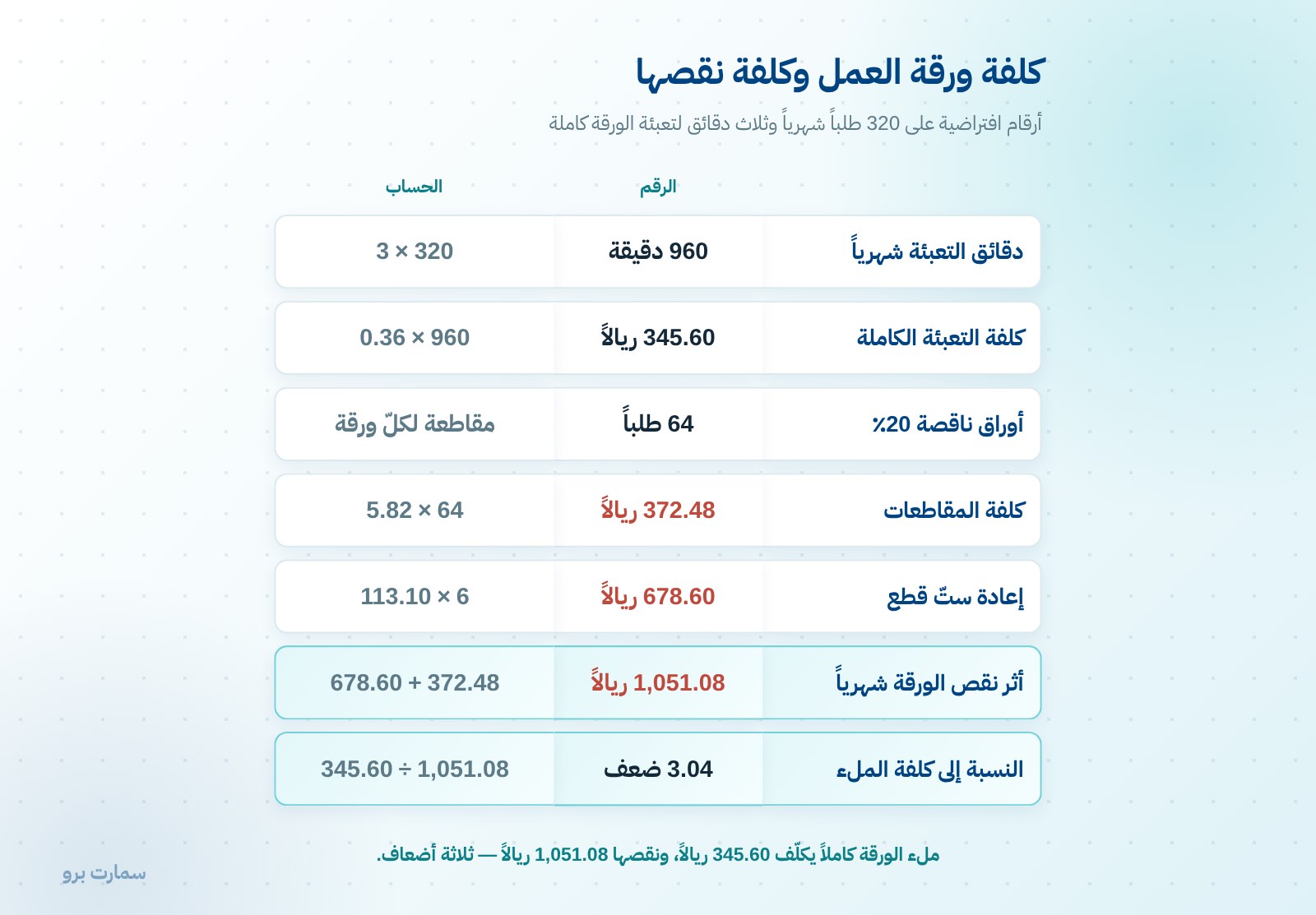
The figures below are hypothetical, to illustrate the method, and do not represent market rates. Using this series' parameters: the tailor's loaded minute is SAR 0.73, and a receptionist's salary is SAR 4,500 a month over 12,480 available minutes, or SAR 0.36 per minute.
Take a workshop that receives 320 orders a month, where filling in the full sheet takes three minutes:
| Item | Calculation | Amount |
|---|---|---|
| Monthly filling minutes | 320 × 3 | 960 minutes |
| Cost of complete filling | 960 × 0.36 | SAR 345.60 |
That is everything the sheet costs. Now the cost of leaving it incomplete. Assume 20% of sheets are handed over incomplete, or 64 orders, and each incomplete sheet causes an interruption: six minutes of the tailor's time and four of reception's:
- Cost of one interruption: (6 × 0.73) + (4 × 0.36) = 4.38 + 1.44 = SAR 5.82
- Across 64 orders: 64 × 5.82 = SAR 372.48
Assume 10% of the incomplete sheets end with a garment made on a wrong guess, or six pieces, and that one remake costs SAR 113.10 including lost capacity, as calculated in rework:
- 6 × 113.10 = SAR 678.60
- Monthly impact of incomplete sheets: 372.48 + 678.60 = SAR 1,051.08
In other words, an incomplete sheet costs three times as much as filling it in fully: 1,051.08 ÷ 345.60 = 3.04. Over a year, that is about SAR 12,613 against SAR 4,147.
Note that this calculation does not include complaints that reach the customer, or orders delayed because the tailor waited for an answer.
Printed sheet or the tailor's phone?
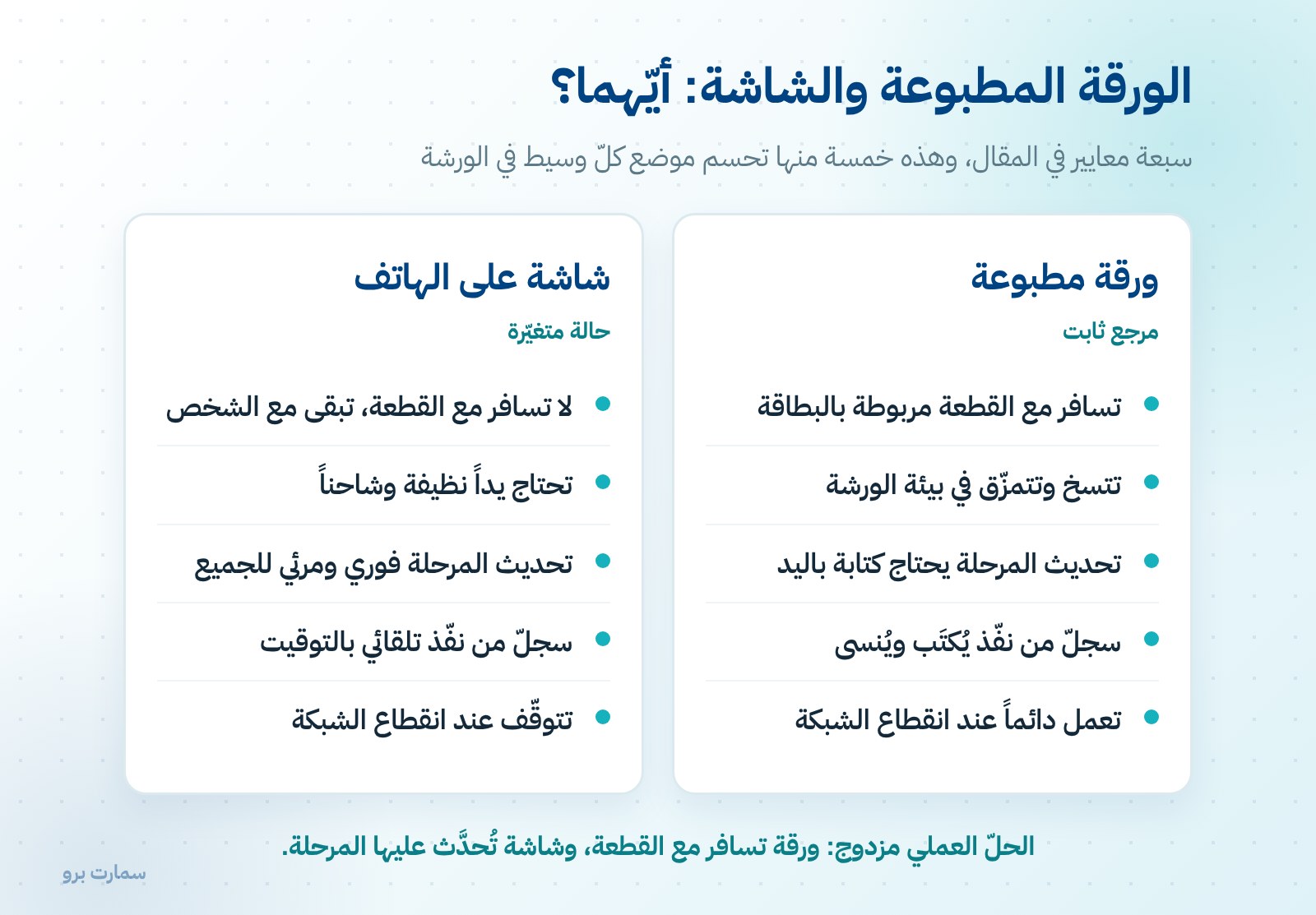
Both work, and each has its place. The mistake is choosing one because it is newer rather than because it fits better:
| Criterion | Printed sheet | Screen on a phone or tablet |
|---|---|---|
| Actually travels with the garment | Yes, attached to the tag | No, stays with the person |
| Handles the workshop environment | Gets dirty and torn | Needs clean hands and a charger |
| Instant stage updates | Needs handwriting | Instant and visible to everyone |
| Several readers at once | No | Yes |
| Record of who did what and when | Written, then forgotten | Automatic, time-stamped |
| Works when the network is down | Always works | Stops |
| Usable by staff who do not read Arabic | Pictures only | Pictures and languages |
The practical answer in most workshops is both: a printed sheet that travels with the garment, carrying the specification and measurements, and a screen where the stage is updated, so reception can read it without walking to the workshop. The sheet is a fixed reference and the screen is a changing status; mixing them into one medium is what makes both systems fail.
Using the same stage names on the sheet and the screen is essential; details in order stages.
What happens when the sheet is incomplete?
- Specification field empty: the garment is made to the standard, and a perfectly good thobe is delivered that the customer does not want.
- Measurement version not written: the garment is made to the last figures in the book, which may be two years old.
- Delivery date not written: the piece is queued by how close it is to hand, not by its due date.
- Metres used not recorded: waste is unknown and fabric cannot be counted, as covered in fabric waste.
- Stage not updated: the customer is told too early or too late, and both become a complaint.
- Terms written without a glossary: they are read two ways; details in thobe terminology.
How do you make sure the sheet is filled in?
Advice does not fill in a sheet. The practical rule is that a garment does not move from Received to Cutting until five fields are complete: order number, item and specification, measurements with the version number, fabric, and delivery date.
This is an entry condition, not an extra stage. The cutter is the one who rejects an incomplete sheet, rather than reception being expected to remember to fill it in. Whoever holds the scissors holds the strongest gate in the workshop.
The remaining fields are filled in along the way: stage, who did the work, and the inspection result before entering Ready, as described in quality check.
What are the common work sheet mistakes?
First: one sheet for several pieces. A piece goes missing and nobody knows the order is incomplete except the customer.
Second: fields with no requirement. They are left empty first during the busy season, which is the worst time to leave them empty.
Third: confusing the sheet with the invoice. The work sheet is an internal workshop document; the invoice is a customer document with specific required elements, listed in the simplified invoice.
Is there an official reference?
The work sheet is an internal document and is not regulated by any authority. What you hand the customer, the invoices and what they must contain, is published by the Zakat, Tax and Customs Authority (ZATCA), which is the reference in case of any difference.
Everything described here can be run in practice in SmartPro's tailoring system: orders, measurements, fabrics and invoicing in one place.
Key takeaway: A twelve-field work sheet costs far less to fill in than it costs to leave incomplete; make five of those fields a condition for cutting, and let the cutter enforce it.
Read also
To see how a tailoring order moves from measurement to delivery, start a free trial or book a demo for your workshop.
Article visuals
Frequently asked questions
What fields should a tailor work sheet include?
Twelve fields: order number, piece number out of total pieces, date received, promised delivery date, item and specification, measurements with the measurement version number, fabric and metres used, special trims, current stage, who completed it and when, measurement notes, and the inspection result.
Why should the specification be written rather than spoken?
Because the garment passes through several hands: the cutter is not the tailor, who is not the presser, and spoken instructions do not follow the garment. In a dispute, memory competes with the customer's and there is no reference. And what is not written cannot be measured, since metres and minutes are the source of every report you read later.
Which is better: a printed sheet or a screen on the tailor's phone?
The practical answer is both: a printed sheet that travels with the garment and carries the specification and measurements, and a screen where the stage is updated so reception can read it without walking to the workshop. The sheet is a fixed reference and the screen is a status that changes moment by moment; mixing them into one medium is what makes both systems fail.
How do I make sure work sheets are never handed over incomplete?
Use the mandatory-field rule: a garment does not move from Received to Cutting until five fields are complete, namely order number, specification, measurements with the version number, fabric, and delivery date. The cutter is the one who rejects an incomplete sheet, because whoever holds the scissors holds the strongest gate.