
Measurement Record: Versions Instead of Writing Over the Number
A measurement record is not corrected, it is versioned. One version for every change, with its date and reason, what to record besides the numbers, and what happens when the person who took the measurements leaves.
Author:سامي الحيدري

In most tailoring workshops, the measurement record is a notebook or a note on a phone, holding one number per customer. When a customer's measurement changes, the old number is erased and the new one is written over it.
Writing over the number is the biggest mistake in managing measurements, because it erases two things, not one: the previous measurement and the reason for the change. A year later, you cannot tell whether the waist was taken in because the customer lost weight, because he complained it was too loose, or because a tailor assumed the measurement was wrong.
A sound record is not corrected, it is versioned: every change becomes a new version with a date and a reason, and the old one stays.
Measurement record: why you should never write over the number
Three practical reasons, all of which have come up in real workshops:
- The change itself may be a mistake. If it was written over the original, there is nothing to go back to.
- The reason matters more than the number. A sleeve lengthened by 1.5 cm after a complaint is completely different from one lengthened on a guess.
- The trend is information. A customer whose waist has shrunk four times in two years is not a customer with a fixed size; he is a customer who needs measuring afresh every time.
How a versioned record is structured
| Field | What it holds |
|---|---|
| Customer number | Fixed, never changes |
| Version number | Goes up by one with every change |
| Version date | The date the measurement was taken, not the order date |
| Measured by | A specific name, not "one of the tailors" |
| Reason for version | New measurement, complaint, customer request or error correction |
| What changed | Only the changed fields, with their old and new values |
| Measurements | The full list, as in thobe measurements |
| Preferences | Waist ease, collar type, cufflinks or buttons, length above the heel |
| Previous problems | What the customer complained about before and what was done |
| Reference order | The number of a previous order the customer was fully happy with |
The last field is the most useful and the least used. A customer does not say "I want a 104 chest"; he says "like the last thobe". The reference order number turns that phrase into something a tailor can actually act on.
Example: three versions for one customer
| Version | Date | What changed | Reason | Measured by |
|---|---|---|---|---|
| 1 | 4 February 2025 | Full first record | New customer | Khalid |
| 2 | 18 September 2025 | Chest 108 → 104, waist 96 → 92 | Weight loss, at the customer's request | Khalid |
| 3 | 7 May 2026 | Sleeve length 61 → 62.5 | Complaint that the sleeve was short on order 2291 | Mansour |
Look at version 3. The number is 1.5 cm, but the real information is not the number: it is that this customer tends to want a longer sleeve than his measured size. That information prevents the same complaint on every future order, and it is exactly what disappears when the number is written over.
Handling the complaint itself is a separate matter, covered in detail in customer complaints.
The record belongs to the customer, not the order
The second common mistake is tying measurements to the order: they are written on the order slip, then archived with it or thrown away after delivery.
The right approach is to treat measurements as an attribute of the customer, not of the order. The order takes a copy of the version in force when it was received and keeps the number of the version it was made on. That way you have two ready answers in any dispute: what the measurement was at the time of production, and what it is now.
With a single version number on the job sheet, you know whether a garment was sewn to an old or a new measurement, and that is the first thing to check before anyone is blamed. Linking this to the order path (received → cutting → sewing → ironing → ready → delivered) makes copying the measurement part of the order stages themselves.
Worked example: the cost of an overwritten record
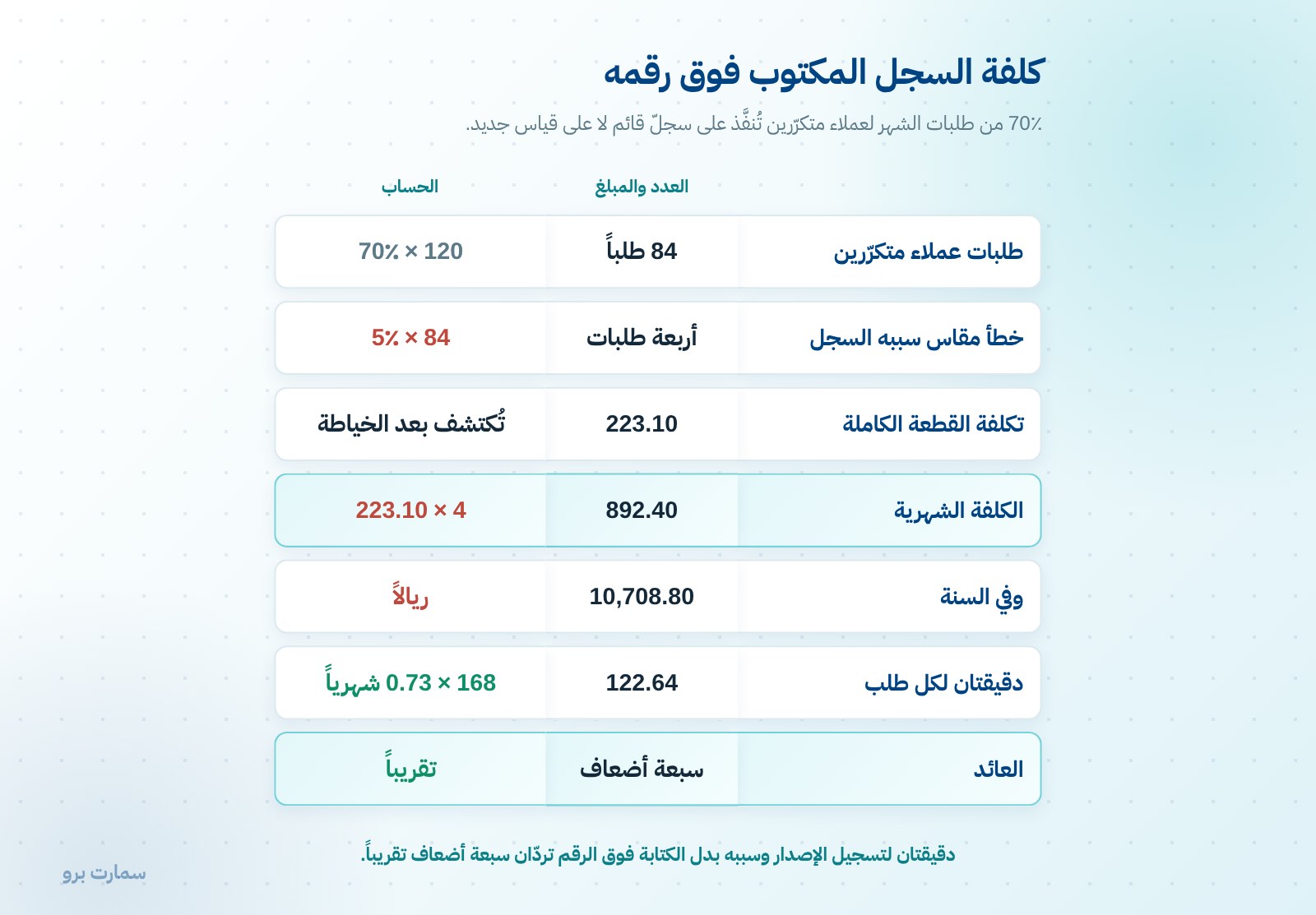
The following figures are hypothetical, to illustrate the method, and do not represent prevailing market prices. Suppose a workshop delivers 120 thobes a month, and 70% of them are for repeat customers, meaning 84 orders a month are made from an existing record rather than a fresh measurement.
Now suppose 5% of those orders show a measurement error caused by an overwritten record or one missing its reason: 84 × 5% = 4.2, so four orders a month.
- The error is usually discovered after sewing, when the full cost of the garment is SAR 223.10 using the inputs from the true cost of tailoring a thobe
- Monthly cost: 4 × 223.10 = SAR 892.40
- Yearly: SAR 10,708.80
What does it take to prevent that? Two extra minutes to record the version and the reason instead of writing over the number:
- 84 orders × 2 minutes = 168 minutes a month
- At a loaded cost of SAR 0.73 per minute: 168 × 0.73 = SAR 122.64 a month
The return is roughly seven times the cost. And that is the best case, when the error is caught before delivery. An error that reaches the customer costs far more, because it adds a second garment and the labour to remake it.
When the person who took the measurements leaves
The following figures are hypothetical, to illustrate the method, and do not represent prevailing market prices. This is the situation that separates the real record from the one you think you have. A tailor who has worked for you for three years carries in his memory what is not in your notebook: that this customer wants a longer sleeve, that one cannot tolerate a tight fit, and a third returns the thobe if the shoulder is even slightly narrow.
The day he leaves, that knowledge leaves with him. In practice, every repeat customer goes back to being a new customer:
- Re-measuring 84 repeat customers: 84 × 12 minutes = 1,008 minutes
- At the loaded cost per minute: 1,008 × 0.73 = SAR 735.84
That figure is the cheap part. The expensive part is that some customers will never come back to be re-measured, and every complaint returns, because its causes were never recorded.
Prevention is simple and starts years before anyone leaves: everything the tailor knows about a customer is written into the record at the time, not in an exit interview.
Who updates the record, and when
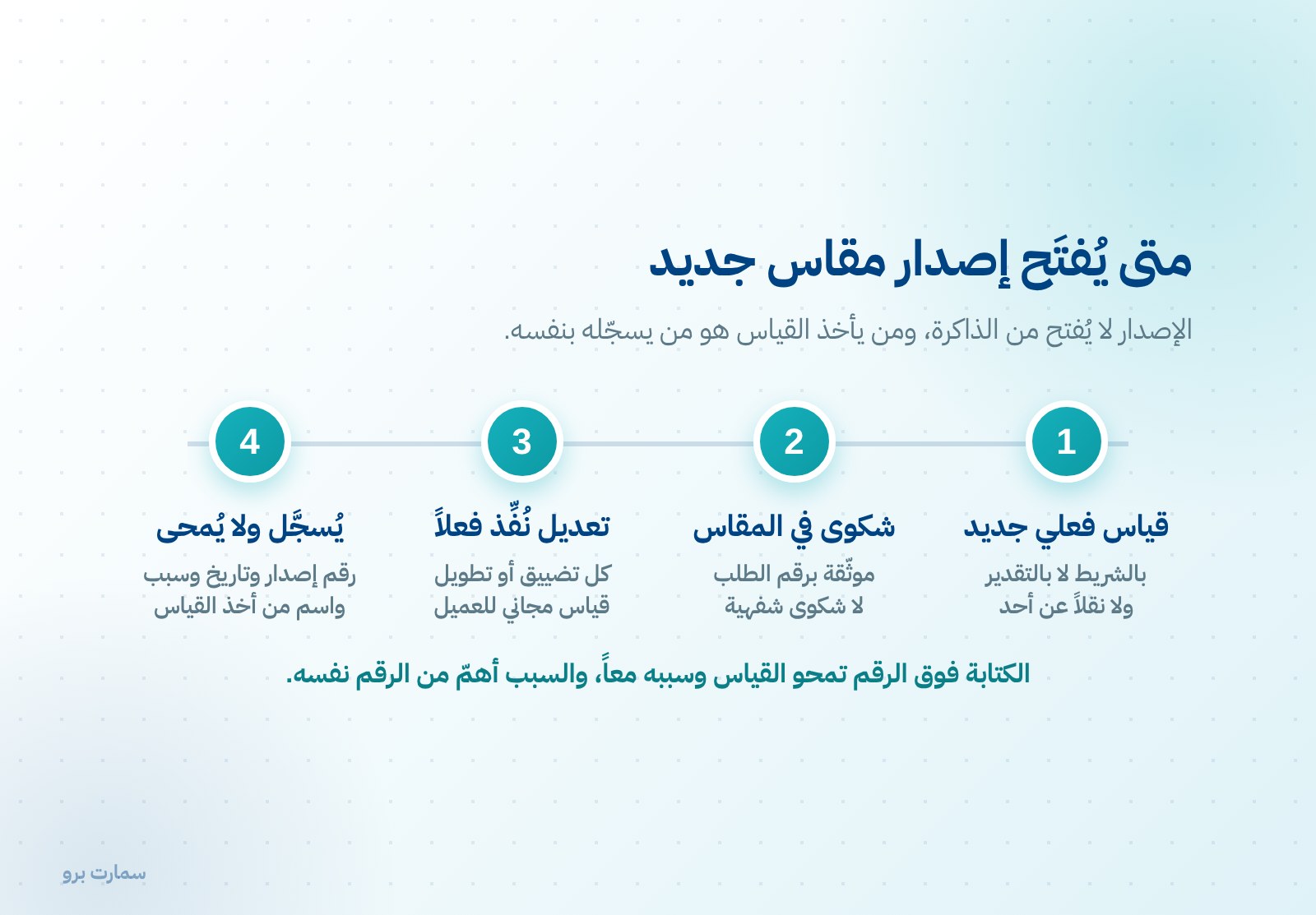
- The record is never updated from memory. A new version is opened only on an actual measurement or a documented complaint.
- One owner for updates. Whoever takes the measurement records it, not the front desk relaying it secondhand.
- Three moments to update: a new measurement, a complaint related to fit, and an alteration the workshop made to an earlier garment.
- An alteration is evidence. Every taking-in or lengthening you carried out is a free measurement of the customer, and failing to record it wastes information you have already paid for.
Remote measurement has its own conditions and is covered in taking measurements; a versioned record is a prerequisite for it to work, not just an improvement.
Three mistakes in a measurement record
First: erasing and writing over. It wipes out both the number and the reason, and makes going back impossible.
Second: recording numbers only. Numbers describe the body, not the customer. Preferences and previous problems are what prevent the second complaint.
Third: tying the record to the order. The record gets archived or thrown away with the order slip, and the repeat customer starts from zero every time.
The official reference
Requirements for fitting rooms in tailoring shops are published by the Ministry of Municipalities and Housing, which is the reference in case of any difference, with details in fitting room requirements.
If you want to run all of this without scattered spreadsheets, that is what the tailoring system does.
Key takeaway: Never write over a measurement: open a new version with its date, reason and the person who measured, keep it with the customer rather than the order, and record preferences and past problems alongside the numbers.
To see how a versioned measurement record works in practice, start a free trial or book a demo.
Read also
Article visuals
Frequently asked questions
How do I build a measurement record that holds up?
Never write over the old number. Open a new version for every change, and record with it the date, the reason, who took the measurement, and what changed with its old and new values. Keep every version, because the old one is what you go back to if the change itself was a mistake.
What should I record besides the numbers?
Record preferences such as waist ease, collar type, cufflinks or buttons, and length above the heel, along with previous problems and what was done about them. Also record the number of a previous order the customer was fully happy with. That last field turns a phrase like "like the last thobe" into something a tailor can act on.
Should measurements be linked to the customer or to the order?
To the customer, not the order. The order takes a copy of the version in force when it was received and keeps that version's number. That way, in any dispute you know what the measurement was at the time of production and what it is now, which is the first thing to check before anyone is blamed.
What happens if the tailor who took the measurements leaves?
Every piece of information that was never written down leaves with him, and repeat customers go back to being new customers. In the hypothetical example, re-measuring 84 customers takes 1,008 minutes, or SAR 735.84. That is the cheapest part, because some customers will never come back to be measured at all.