
Taking Measurements Remotely: What You Can Measure by Phone and What You Can't
Taking measurements for a customer who can't come in: what to take from a previous garment, what works by phone under conditions, and what needs a visit, with the cost of lower accuracy worked out in SAR.
Author:سامي الحيدري

Taking measurements for a customer who can't come in is now a daily request in tailoring workshops: a traveller, someone unwell, a customer in another city, or a son ordering for his father. The usual response is one of two: a flat refusal, or full acceptance with no conditions.
Both are wrong. Refusing loses profitable orders, and open-ended acceptance produces rework that the workshop pays for and gets blamed for.
The third way is to split measurements into three categories: what can be taken from a previous garment, what can be taken by phone under conditions, and what can only be taken in person.
Taking measurements remotely: three categories, not two
| Measurement | Remotely? | Method |
|---|---|---|
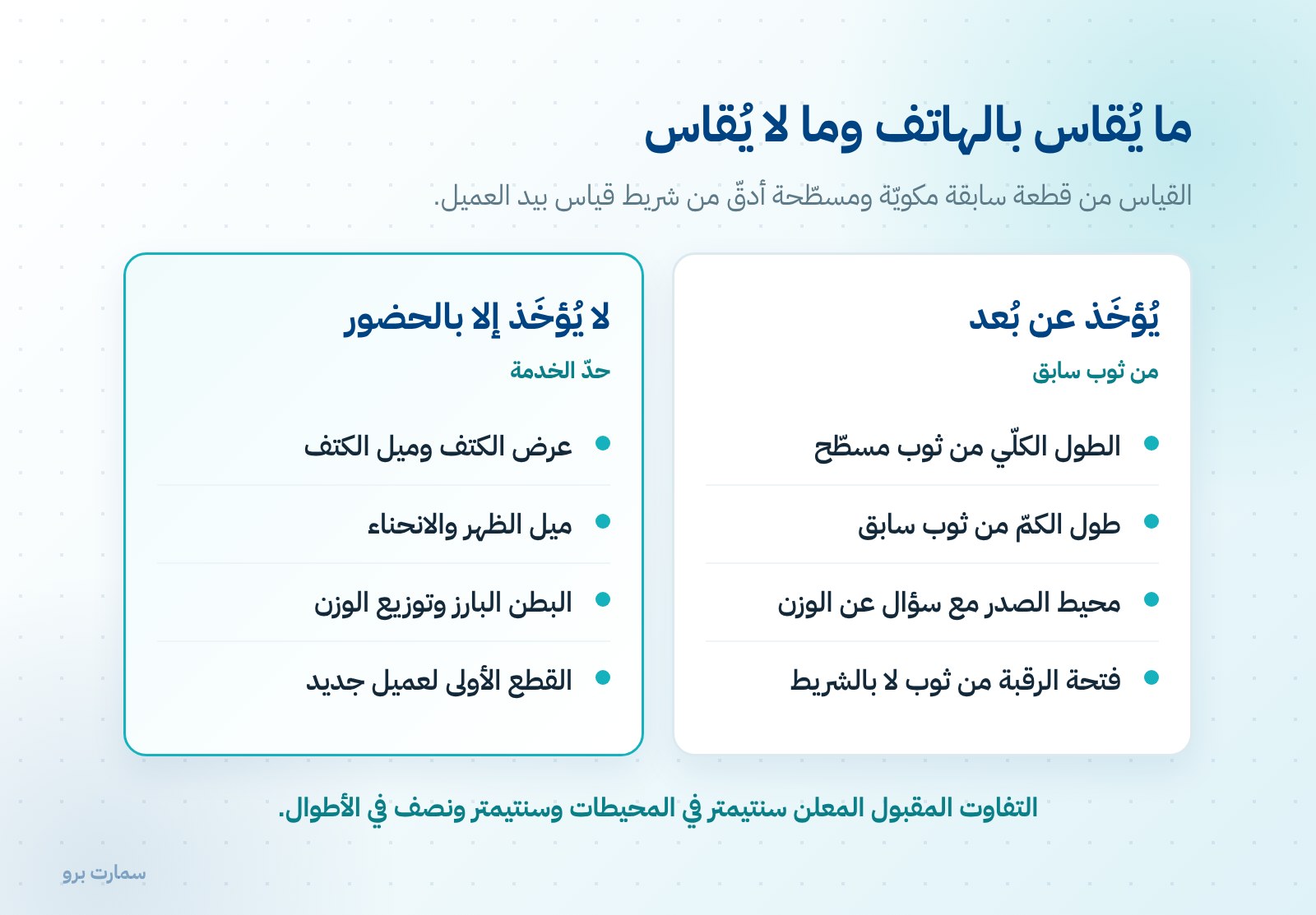
| Full length | Yes | From a previous thobe, ironed and laid on a flat surface |
| Sleeve length | Yes | From a previous thobe |
| Chest circumference | Conditionally | From a previous thobe, plus a question about weight change |
| Waist circumference | Conditionally | From a previous thobe; in person is more accurate |
| Neck opening | Conditionally | From a previous thobe, not from a tape in the customer's hand |
| Shoulder width | No | Shoulder slope can't be read from a folded garment |
| Back slope and posture | No | The customer needs to stand in front of a mirror |
| Prominent belly and weight distribution | No | Can't be described by phone or read from a thobe |
| First pieces for a new customer | No | There is no previous garment to measure from |
The last four rows are the limit of the service. Anyone who goes past them is selling risk, not a service.
Why is a previous garment more accurate than a tape in the customer's hand?
Measuring from a previous thobe is more accurate than many people think, because the garment is a fixed object that doesn't move. A customer measuring himself pulls the tape tighter or looser depending on what he hopes to see.
There are four conditions for measuring from a previous garment:
- The garment is ironed and flat on a level surface, not hanging or folded.
- The customer is genuinely happy with it, and you ask directly: does this thobe fit you perfectly, or is there something you want changed?
- Each measurement is photographed with a tape laid out next to the garment, not taken from a number read aloud.
- It is recorded as a new measurement version, not written over the old one, as explained in measurement records.
The second condition is the one people forget, and it is the most dangerous. If you measure a thobe the customer doesn't like, you copy its flaw precisely.
How do you guide a customer by phone? Five rules
- Ask for a helper. Someone measuring himself with one hand produces numbers you can't use.
- Ask for a short video, not a still photo, showing the tape and the number together.
- Name the points using the standard terminology, not colloquial words, as set out in thobe terminology.
- Ask for light clothing at the time of measuring, because layers add phantom centimetres.
- Repeat every measurement twice and ask for both numbers. If they match, that is evidence; if they differ, that is a warning.
After all that, a number taken by phone is still an estimate. That is why it gets a stated, accepted tolerance: one centimetre on circumferences and one and a half centimetres on lengths. Anything outside that counts as a defect the workshop bears.
When should you refuse and insist on a visit?
There are four cases where refusing is a sound business decision, not stubbornness:
- A new customer with no previous garment, especially for the first three pieces.
- Expensive fabric or a large quantity in a single order, where the size of a mistake outweighs the value of the convenience.
- An unusual cut or details outside the standard.
- An order for an occasion with a fixed date, such as a wedding, where there is no time for a remake.
Wording matters. "We can't" loses the customer; "We need one 15-minute visit, and then all your future orders without coming in" wins him. The refusal is temporary and one-time, and that is what you say.
Worked example: what does lower accuracy cost?
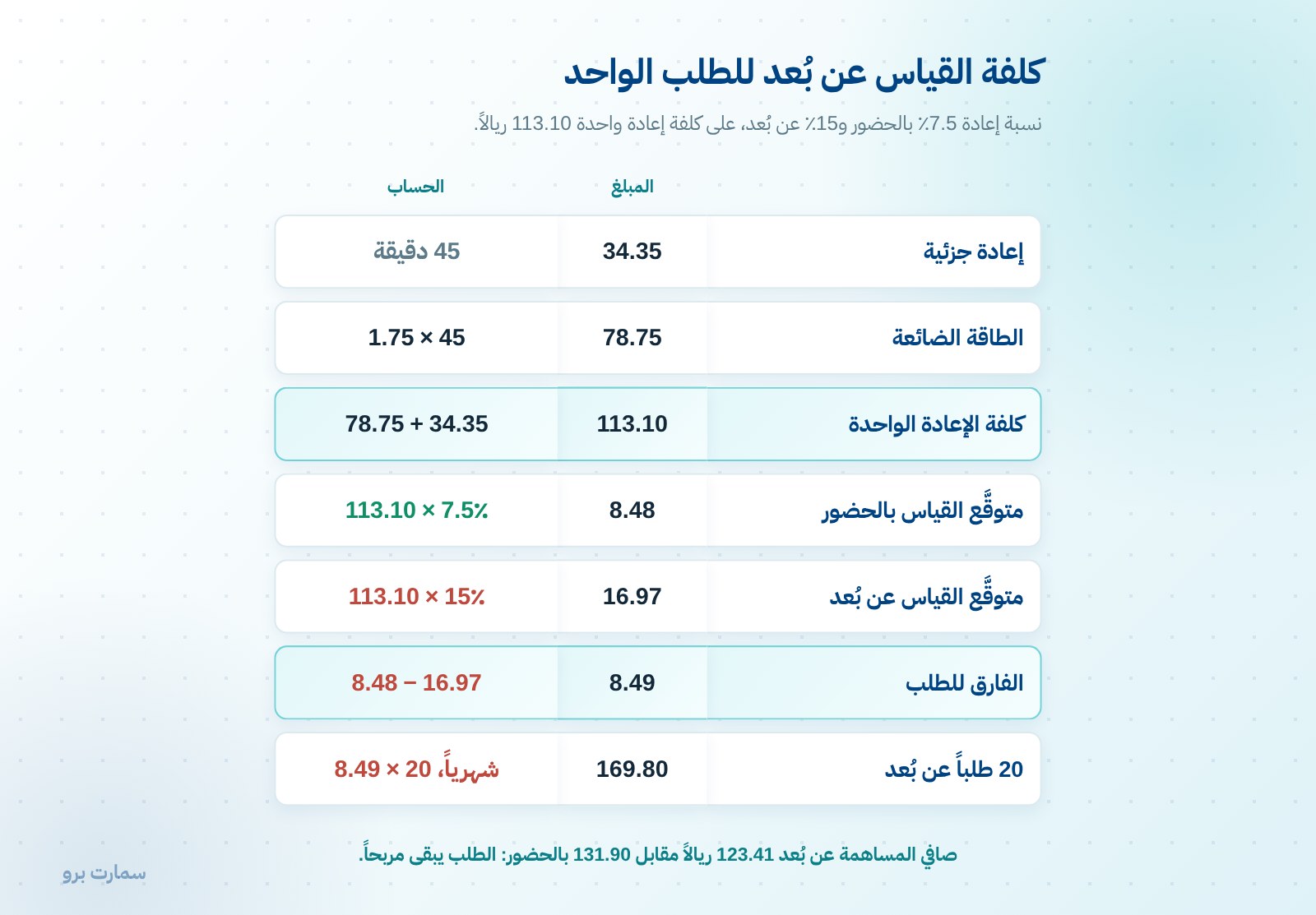
The following figures are hypothetical, to illustrate the method, and do not represent prevailing market prices. Using the parameters from this series: a partial remake of 45 minutes costs SAR 34.35, and the contribution per thobe minute is SAR 1.75, as in rework policy.
So the cost of one remake, including lost capacity, is: 34.35 + (45 × 1.75) = 34.35 + 78.75 = SAR 113.10.
Now assume a rework rate of 7.5% for orders measured in person and 15% for orders measured remotely:
| Case | Rework rate | Expected cost per order (SAR) |
|---|---|---|
| Measured in person | 7.5% | 0.075 × 113.10 = 8.48 |
| Measured remotely | 15% | 0.15 × 113.10 = 16.97 |
| Difference | SAR 8.49 per order |
Assume 20 remote orders a month: 20 × 8.49 = SAR 169.80 a month, or about SAR 2,038 a year.
The important reading is not the difference but what remains. The contribution per thobe is SAR 140.38, as in tailoring profit margin per item:
- Net contribution in person: 140.38 − 8.48 = SAR 131.90
- Net contribution remotely: 140.38 − 16.97 = SAR 123.41
In other words, a remote order stays clearly profitable and should not be refused for losing money. It is refused only in the four cases above, because a mistake there isn't measured in SAR 113.
Is a paid measuring visit a better alternative?
The cleaner alternative to measuring by phone is a paid measuring visit. Assume a fee of SAR 50 including VAT, which is SAR 43.48 before VAT, a travel-and-measuring time of 40 minutes, and a loaded cost per minute of SAR 0.73:
- Visit cost: 40 × 0.73 = SAR 29.20
- Profit: 43.48 − 29.20 = SAR 14.28
So it is neither a courtesy service nor a loss-making item, and it is recorded as a separate line in the workshop chart of accounts. It is invoiced like any other service, with the required elements covered in the simplified invoice.
How often should you re-measure a returning customer?
Measurements are not permanent. A workshop cutting to measurements that are two years old produces a thobe that matches the wrong number.
The practical rule: every six months or every third order, whichever comes first. Ask the customer one question with every order: has your weight changed since last time?
Three situations call for immediate re-measurement regardless of the date: a weight change the customer mentions, a complaint about fit on the previous order, or a new garment type that hasn't been made for him before.
The effect shows up in quality check: if "looser or tighter than ordered" keeps appearing, the problem is the age of the measurements, not the sewing.
What should you write on a remotely measured order?
An order measured remotely needs three extra lines on the order, and then on the tailor's worksheet that travels with the garment:
- Measurement source: previous thobe number X, or by phone on date Y.
- Stated accepted tolerance: one centimetre on circumferences and one and a half centimetres on lengths.
- What was not taken: and its effect on the garment, such as shoulder slope.
These lines are read at handover if there is a dispute, turning the discussion from two conflicting memories into one document, as covered in customer complaints. The garment still follows the same path: received → cut → sewn → ironed → ready → delivered.
Three mistakes in remote measuring
First: accepting numbers read aloud. A number said over the phone with no photo or video is not something to cut from.
Second: measuring a thobe the customer isn't happy with. The workshop copies the flaw precisely and delivers a second thobe with the same problem.
Third: writing over the old measurement. The reference you would rely on in a dispute is lost, and no one knows which version the garment was made to.
Where is the official reference?
Matters relating to invoices and showing VAT on workshop services are published by the Zakat, Tax and Customs Authority (ZATCA), which is the reference in any disagreement. Requirements for the shop and its measuring area are published by the Ministry of Municipalities and Housing, with the details in fitting room requirements.
Workshops that keep this under control usually do it inside one system, such as SmartPro's tailoring workshop software.
Key takeaway: Take lengths from a previous garment, take circumferences by phone only with conditions and a stated tolerance, and insist on a visit for shoulders, posture and new customers. A remote order stays profitable; it is refused only when a mistake would cost far more than a remake.
Read also
- Thobe measurements: the complete sheet
- Measurement records and measurement versions
- Customer complaints and when to remake
To see how measurement files and orders work in practice, book a demo or start a free trial.
Article visuals
Frequently asked questions
Can measurements be taken from a previous thobe?
Yes, and measuring from a previous garment is more accurate than a tape in the customer's hand, because the garment is a fixed object. There are four conditions: it must be ironed and laid flat on a level surface, the customer must genuinely be happy with it, it must be photographed with a tape laid out beside it, and it must be recorded as a new measurement version.
Which measurements can't be taken remotely?
Shoulder width and slope, back slope and posture, weight distribution and a prominent belly, and all measurements for a new customer who has no previous garment. These are the limit of the service, and going past them means selling risk rather than a service, because shoulder slope can't be read from a folded garment or described over the phone.
When should I refuse a remote order and insist on a visit?
In four cases: a new customer with no previous garment, expensive fabric or a large quantity, an unusual cut, and an order for an occasion with a fixed date that leaves no room for a remake. Wording matters: offer one 15-minute visit, after which all future orders can be placed without coming in.
How often should I re-measure a returning customer?
Every six months or every third order, whichever comes first, with one question on every order about weight change. Three situations call for immediate re-measurement regardless of the date: a weight change the customer mentions, a complaint about fit on the previous order, or a new garment type.