
Order Delay: What to Do Before the Customer Asks
An order delay is managed, not explained away. Early warning signals at each stage, a four-sentence call script, practical alternatives, a written compensation policy, and logging the cause so it doesn't happen again.
Author:سامي الحيدري

Every tailoring workshop has order delays. What separates a workshop that keeps its customers from one that loses them isn't how many delays it has, but what it does before the customer asks.
A customer who calls to ask about their thobe and is told "it's running late" loses twice: the date and their trust. A customer who gets a call two days before the due date, telling them about the delay and offering an alternative, loses only the date, and stays a customer.
This article covers four steps: telling the customer early, the alternatives you can offer, a written compensation policy, and logging the cause so a pattern shows up and can be fixed.
Order delay: telling the customer before they ask
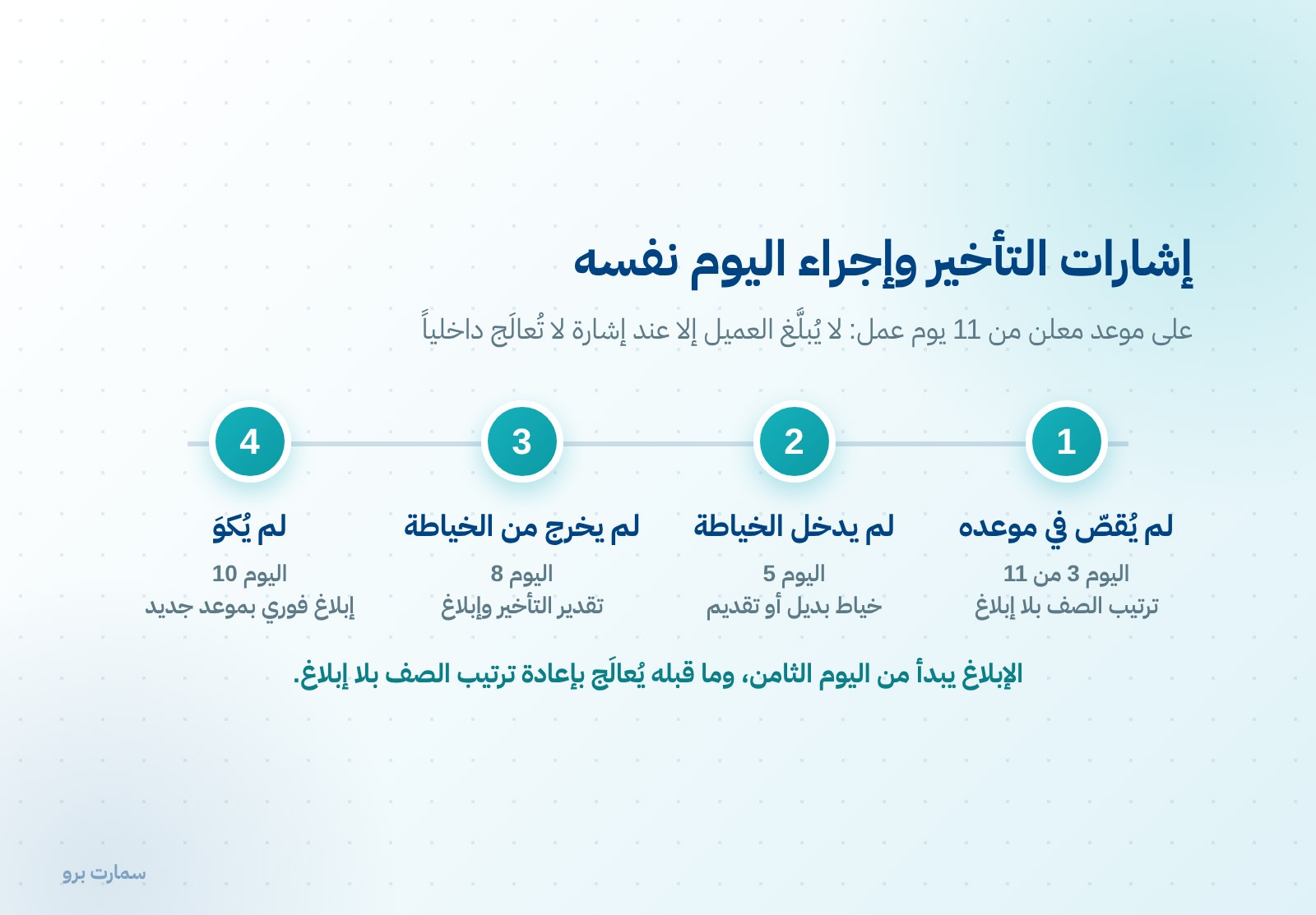
Early notice doesn't take intuition. It takes one daily report: orders that have passed their stage checkpoint without moving on. How to build these checkpoints on the order stages (received → cut → sewing → pressing → ready → delivered) is explained in setting a delivery date.
| Signal | When it appears | Same-day action |
|---|---|---|
| Not cut on time | Day 3 of 11 | Reorder the queue, no notice |
| Not started sewing | Day 5 | Assign another tailor or move the order up |
| Not finished sewing | Day 8 | Estimate the delay and inform the customer |
| Not pressed | Day 10 | Inform immediately with a new date |
The rule: don't contact the customer at every signal, only at the first one you can't fix internally. Unnecessary repeated notices use up the very trust they're meant to protect, and teach the customer that your dates are only estimates.
The call script in four sentences
- The reason in one line, with no long justification and no blaming others.
- The new date as a specific day, given once only. A second missed date is worse than the first.
- The option available now, not an open question asking what they'd like.
- What they'll be compensated with, according to the written policy, not negotiated on the phone.
What alternatives can you offer?
- Partial delivery. If the order is three pieces and one is finished, hand it over today and deliver the rest later. A customer holding a garment waits more calmly than one holding a receipt.
- Prioritise the piece they need most. Ask which piece they need first and reorder the queue around it. Their real need may be one piece, not the whole order.
- Alter a garment they already own, done the same day to cover the upcoming occasion, as described in pricing alterations.
- Deliver to them instead of making them come in twice. It costs you less than a discount and means more to the customer.
- A discount or refund of the tailoring fee under the written policy. This is the last option, not the first.
A written compensation policy
The figures below are hypothetical, used to illustrate the method. They don't represent prevailing market prices.
| Length of delay | Compensation |
|---|---|
| Up to 1 working day, with advance notice | No financial compensation |
| 2 to 3 working days | 10% off the tailoring fee |
| 4 to 6 working days | 20% off |
| More than 6 days or a missed occasion | Full refund of the fee or a replacement garment |
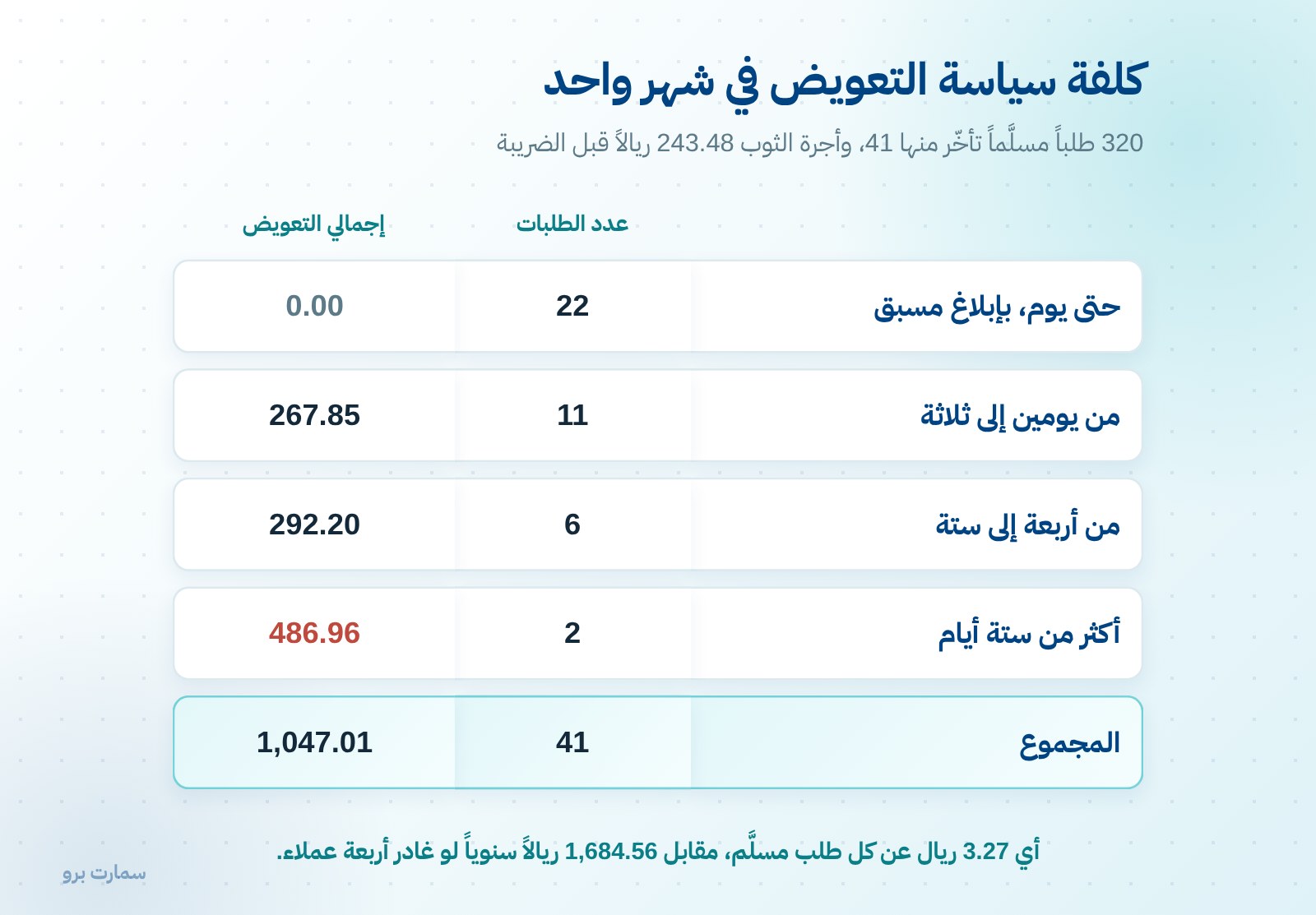
Let's estimate its cost for the month used in setting a delivery date: 320 orders delivered, 41 of them late. Take the thobe tailoring fee from that published example, SAR 243.48 before VAT, as a rough average:
| Delay category | Orders | Compensation per order (SAR) | Total (SAR) |
|---|---|---|---|
| Up to 1 day | 22 | 0.00 | 0.00 |
| 2 to 3 days | 11 | 24.35 | 267.85 |
| 4 to 6 days | 6 | 48.70 | 292.20 |
| More than 6 days | 2 | 243.48 | 486.96 |
| Total | 41 | 1,047.01 |
That is SAR 1,047.01 ÷ 320 = SAR 3.27 per order delivered that month.
That's a very small figure compared with what it protects. Without a policy, if just four of the customers with late orders left, and each had three thobes made a year at a contribution of SAR 140.38 per thobe (as in the true cost of tailoring a thobe), the loss would be 4 × 3 × 140.38 = SAR 1,684.56 a year in contribution alone, plus whatever those customers tell others about you.
Three rules make the policy work:
- Written and displayed at reception. Written compensation reads as policy; negotiated compensation reads as admitting a bigger mistake.
- Clear authority for reception staff to grant compensation up to the second category without approval. Compensation that comes late fixes nothing.
- A clear cap: the tailoring fee only, not the value of the customer's fabric or any consequential damages.
If the discount comes after the invoice has been issued, it needs specific invoicing treatment. Details are available from the Zakat, Tax and Customs Authority (ZATCA) and in the simplified invoice for tailors.
How do you log the cause so a pattern shows up?
One delay is an incident; forty delays are a pattern. The difference between them is a single line written for every delay: the stage, the cause, the number of days and the item type.
Here is the distribution of causes in the hypothetical month:
| Cause | Orders | Share |
|---|---|---|
| Accepted beyond capacity | 14 | 34% |
| Rework after quality check | 9 | 22% |
| Late fabric or trims | 7 | 17% |
| Tailor absence | 6 | 15% |
| Error in measurements or notes | 3 | 7% |
| Machine breakdown | 2 | 5% |
| Total | 41 | 100% |
The reading is clear: more than a third of the delays didn't happen in the sewing room but at reception, with orders accepted that had no minutes left for them in the queue. Fixing that is a capacity decision, not a production decision, as covered in calculating workshop capacity and when to stop taking orders.
The second row, rework, costs twice: minutes spent twice on the same piece, and other orders delayed because of it. A policy for deciding who bears that cost is in rework policy, and documenting what comes back from customers is in customer complaints and remakes.
How do you stop the same cause from repeating?
- Accepted beyond capacity: a weekly intake cap tied to the minutes remaining, not to how busy staff feel it is.
- Rework: a check point after cutting, not only before delivery, because a cutting error found late costs a whole garment, not a repair. Details are in quality check.
- Fabric and trims: a reorder level for every recurring item, as in fabric stock levels and tailoring trims inventory.
- Tailor absence: a buffer built into weekly capacity, not a spare tailor sitting idle.
- Measurements and notes: one worksheet that any tailor can read, as in the tailor worksheet.
Reviewing the table above once a month is enough. If the top row changes from month to month, you're treating the symptoms in good order. If the same top row holds for three months in a row, the fix hasn't started yet.
What about an order that was late and then never collected?
Sometimes an order runs late and the customer loses interest. It then sits ready on the shelf for months, taking up space and tying up capital, and stays in the books as an open order.
This case has its own policy: how long to keep the item, how many contact attempts to make, and what happens after that. It's explained in uncollected orders.
Official reference
Rules on issuing and amending invoices and showing VAT are published by the Zakat, Tax and Customs Authority (ZATCA), which is the authority whenever there's any discrepancy.
If you want to run all of the above without scattered spreadsheets, that's what the tailoring and dressmaking system does.
Key takeaway: Tell the customer at the first signal you can't fix internally, offer a concrete alternative and compensate by a written policy. Then log every delay's cause so the most common one gets fixed, not just apologised for.
Further reading
Article visuals
Frequently asked questions
When should I tell a customer their order is delayed?
At the first signal you can't fix internally, not at every signal. An order that hasn't finished sewing on schedule should be reported to the customer the same day. Unnecessary repeated notices use up the very trust they're meant to protect, and teach the customer that your dates are only estimates.
What alternatives can I offer a customer whose order is late?
You can hand over the pieces that are finished, prioritise the piece they need most after asking them, quickly alter a garment they already own to cover the upcoming occasion, or deliver to them instead of making them come in twice. A discount or refund of the tailoring fee is the last option, not the first.
How much does a delay compensation policy cost?
Less than it seems. In the hypothetical example, compensation came to SAR 1,047.01 for 41 late orders out of 320, or SAR 3.27 per order delivered. Losing just four customers would cost SAR 1,684.56 a year in contribution alone.
What are the most common causes of late orders?
In the hypothetical distribution, more than a third of delays came from accepting orders beyond capacity at reception, followed by rework after quality checks, late fabric or trims, and tailor absence. The top cause is a capacity decision rather than a production one, and it's fixed with a weekly intake cap tied to the minutes remaining.