
Uncollected Orders: The Rack That Holds Your Cash Hostage
Uncollected orders tie up cash, rack space and an open balance in your books. Here is how to measure them every month, a six-step follow-up rhythm, and a storage policy you announce at drop-off.
Author:سامي الحيدري
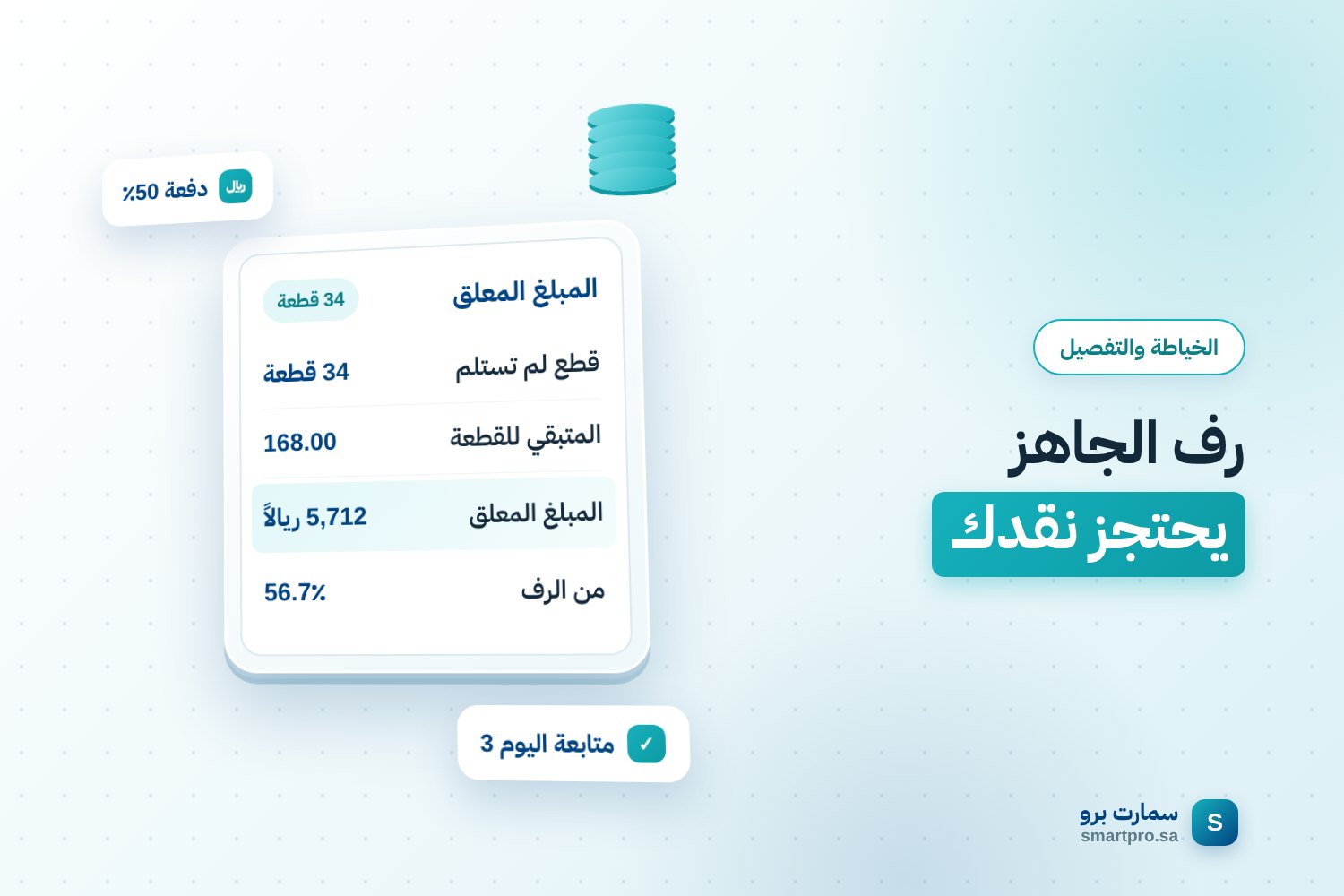
Uncollected orders are garments that have been finished, ironed and placed on the ready rack, but whose owners never came back for them. They rarely show up in any report, because most workshops track what runs late and what gets returned, not what is ready but never handed over.
They weigh more than they appear to. Every piece ties up three things at once: cash already spent on its fabric and labour, space on the rack, and an open line in the books that never closes.
This article covers four things: how to measure the size of the problem each month, what your follow-up rhythm should be, what your storage policy should say when you take the order, and how to size the deposit so the problem does not keep repeating.
Uncollected orders: counting the rack in numbers
The figures below are hypothetical and only illustrate the method; they do not represent typical market prices. The parameters used across this series: a listed thobe price of SAR 280 including VAT, and a 40% deposit of SAR 112, which leaves SAR 168 for the customer to pay on collection.
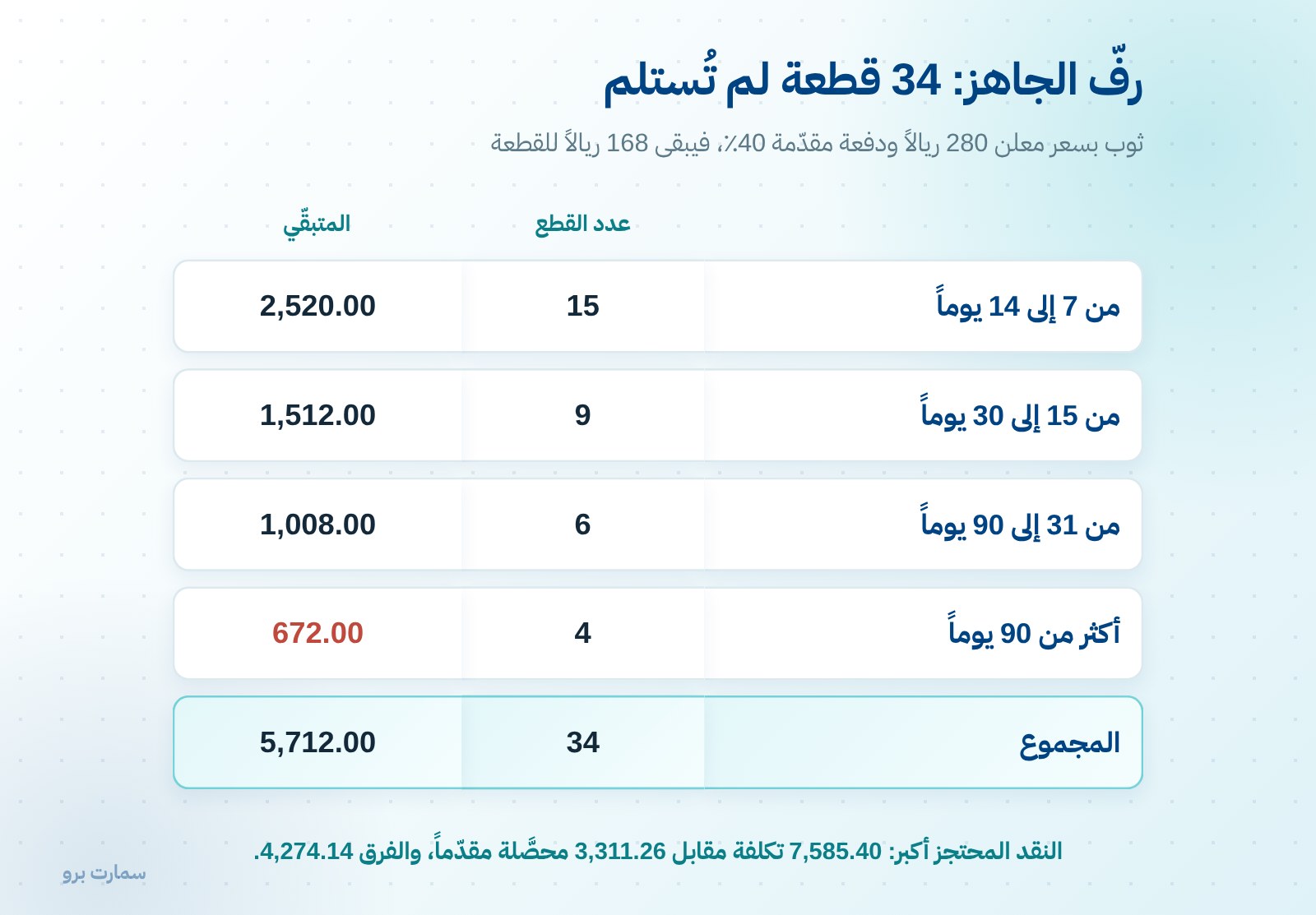
Now take a workshop that completes about 320 orders a month. At month end it counts the ready rack and finds 34 pieces that have not been collected:
| Time on the rack since ready | Pieces | Balance per piece (SAR) | Total balance (SAR) |
|---|---|---|---|
| 7 to 14 days | 15 | 168.00 | 2,520.00 |
| 15 to 30 days | 9 | 168.00 | 1,512.00 |
| 31 to 90 days | 6 | 168.00 | 1,008.00 |
| More than 90 days | 4 | 168.00 | 672.00 |
| Total | 34 | 5,712.00 |
So the outstanding amount is SAR 5,712 including VAT, or SAR 4,966.96 before VAT. And that is only half the story.
Why the cash tied up is bigger than the outstanding balance
The outstanding balance is revenue you have not yet collected. The cash tied up is money that has actually left your pocket and not come back:
- Full cost per piece in this series: SAR 223.10, so across 34 pieces = SAR 7,585.40
- Deposit collected before VAT: 112 ÷ 1.15 = SAR 97.39 per piece, so across 34 pieces = SAR 3,311.26
- The gap: SAR 4,274.14 spent on garments waiting on the rack
That money could have been fabric in the store room, a tailor's wages or advertising. And it grows every month unless the last row of the table gets cleared.
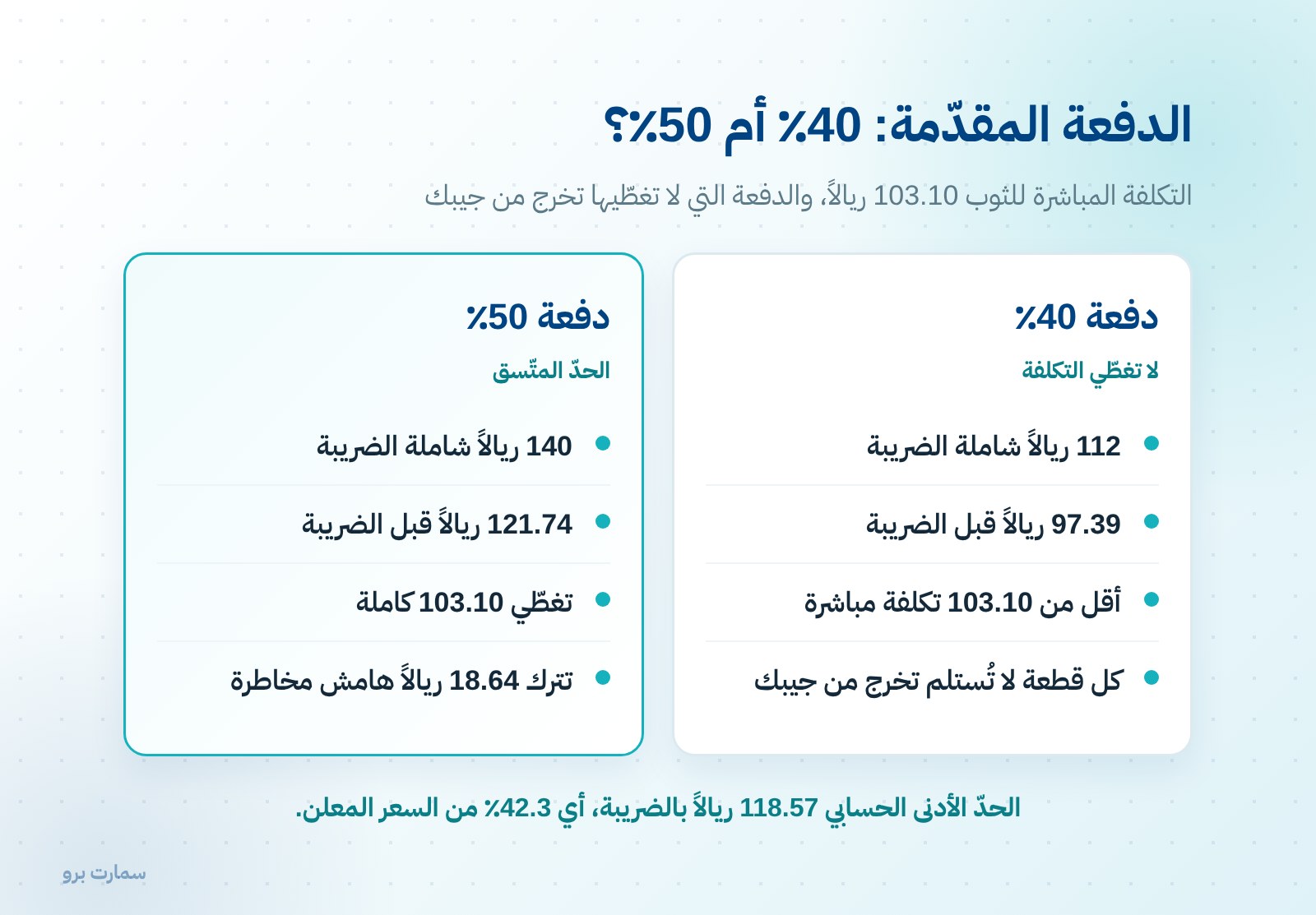
Notice the most important figure: the deposit is SAR 97.39 before VAT, while the direct cost of the thobe is SAR 103.10, as shown in the true cost of tailoring a thobe. In other words, a 40% deposit does not even cover fabric and labour, so every uncollected piece comes out of your pocket before it ever leaves the rack.
How big should the deposit be to prevent the problem?
The rule in one line: the deposit should at least equal the direct cost, not a percentage chosen out of habit.
- Direct cost of the thobe: SAR 103.10
- Adding VAT: 103.10 × 1.15 = SAR 118.57
- That is 118.57 ÷ 280 = 42.3% of the listed price as a minimum
This is why a 50% deposit, SAR 140 including VAT or SAR 121.74 before it, is a consistent choice: it covers the SAR 103.10 and leaves SAR 18.64 as a risk margin.
Raise the deposit in three specific cases: the customer's own fabric, which cannot be sold to anyone else; unusual measurements; and orders tied to a particular occasion. How deposits are treated on invoices is explained in deposits and VAT and the simplified invoice for tailors.
What should a written follow-up rhythm look like?
Follow-up that works is not a call whenever a staff member remembers. It is a fixed rhythm tied to the date the order became ready, starting from the "Ready" stage in the order path: Received → Cut → Sewn → Ironed → Ready → Delivered.
| Day | Action | Content |
|---|---|---|
| Ready day | Message | Order number, balance due and free storage period |
| Day 3 | Call | Confirm collection and set a day |
| Day 7 | Second message | Reminder of the storage period and its end date |
| Day 14 | Final call | Offer delivery instead of a visit |
| Day 30 | Written notice | Free storage period has ended |
| Day 90 | Apply the policy | As stated on the receipt at drop-off |
Three rules make the rhythm work. First: send the first message on the same day, not the next, because a customer told late treats the date as an estimate. Second: state the balance in every message, because a customer who does not know the amount puts off coming in. Third: offer delivery on the fourth attempt, because it costs less than keeping the piece on the rack for two months.
Linking messages to the order number and to the garment itself is covered in order and garment tagging.
Why announce the storage policy at drop-off, not a month later?
A policy mentioned three months after the order is ready reads like a demand; one mentioned at drop-off reads like an agreed condition. The whole difference is timing, not wording.
What goes on the receipt, in four short lines:
- A free storage period, stated in days from the ready date.
- What happens after it: a written notice, then a second grace period.
- A maximum storage limit, and what is done with the garment after it.
- What happens to the deposit in that case.
Because the legal wording of this clause varies with each business's situation and type of work, the safest approach is to have it reviewed once by a specialist, then print it on the receipt and post it at the reception desk. Do not leave it as a verbal agreement, because verbal terms are forgotten at the first dispute.
No clause should be applied until the full follow-up rhythm has been completed and every attempt has been recorded with its date, because a written policy does not protect you from poor execution.
How much rack space do uncollected orders take?
The ready rack is limited space, and the Ministry of Municipalities and Housing has set a cap on the storage area in tailoring shops, published on the ministry's website. So space is both a regulatory and a physical constraint, not just a matter of tidiness.
Suppose the rack holds 60 pieces. The 34 uncollected pieces then occupy 34 ÷ 60 = 56.7% of the rack.
In practice, more than half the space meant for pieces leaving today is taken by pieces that have not left in months. New pieces get crammed in, finding a garment at collection takes longer, and the risk of handing over the wrong item, or creasing an ironed one, goes up.
That is why the rack should be split into two sections from day one: pieces older than fourteen days move to a separate location with their own list, so they do not compete with today's ready pieces for space or attention.
Which three numbers should you measure every month?
You do not need a long report. Three numbers at the end of each month are enough:
- The number of pieces ready for more than seven days, and their share of everything completed that month. In the example: 34 pieces.
- The balance outstanding on them, because it is earned revenue not yet collected: SAR 5,712.
- The age of the oldest piece on the rack in days, which says more about follow-up discipline than the count itself.
Read the trend, not the single figure. A count that stays steady month to month means regular follow-up and a normal rate; a count that rises every month means the rhythm is not being applied or the deposit is too small.
Measuring these numbers starts with recording the "Ready" stage with its date, which is explained in order stages.
Which three mistakes make the rack grow?
First: telling the customer late. A piece finished on Tuesday whose owner is told on Sunday has lost five days from the period when collection is most likely.
Second: confusing late orders with uncollected ones. The first is a production failure, handled through capacity and scheduling as in handling late orders; the second is a follow-up and collection failure. Measuring both in one number hides both causes.
Third: offering a discount to encourage collection. The customer did not delay because the price was high, but because the visit was never scheduled. A discount teaches them that putting things off pays.
The official reference
Requirements for tailoring shops, including those on storage areas, are published by the Ministry of Municipalities and Housing, and are detailed in tailoring shop requirements. Invoicing and deposit matters are covered in the simplified invoice for tailors.
Workshops that keep this under control usually do it inside one system, such as SmartPro's tailoring workshop software.
Key takeaway: Uncollected orders cost you the cash already spent on them, not just the unpaid balance. Size the deposit to at least cover direct cost, follow up on a fixed written rhythm from the ready date, and announce your storage policy on the receipt at drop-off.
Read also
To see how ready dates, balances and follow-up work together in one system, start a free trial or book a demo.
Article visuals
Frequently asked questions
How do I calculate the cost of uncollected orders?
Count the ready rack, group the pieces by how long they have been waiting, then add up the balance due on each one. In the hypothetical example, the balance on 34 pieces came to SAR 5,712 including VAT. Then add the cash tied up: the full cost spent minus the deposits collected, which was SAR 4,274.14 in the same example.
How large should a deposit be to protect against uncollected orders?
At minimum, the deposit should cover the direct cost of the garment. In the hypothetical example the thobe's direct cost is SAR 103.10, so you need SAR 118.57 including VAT, or 42.3% of the listed price as a floor. That is why a 50% deposit is a consistent choice, raised further for orders tied to an occasion or unusual measurements.
What follow-up rhythm should a tailoring shop use for ready garments?
Send a message on the ready day with the balance and the storage period, call on day 3, send a second message on day 7, make a final call on day 14 offering delivery, then send a written notice on day 30. The most important point is that the first message goes out the same day, not the next.
Should I put a storage policy on the receipt?
Yes, and announce it at drop-off rather than months later, because a late clause reads as a demand while one stated upfront reads as an agreed condition. Write it in four lines: the free storage period, what follows it, the maximum limit, and what happens to the deposit. Have the legal wording reviewed once by a specialist, then print it.