
Stop Accepting Orders: When to Decide and How to Manage It
Stopping new orders is a decision made by a number, not a feeling. Set a queue-weeks threshold, close one item rather than the whole workshop, run a waitlist and advance booking, and learn how to say no without losing the customer.
Author:سامي الحيدري
Stopping new orders is a decision most tailoring workshops make almost every year, in the middle of the season. Most of them make it too late, once the queue has already ballooned and delays are a fact rather than a risk.
The difference between a managed pause and a late one is the difference between a workshop that protects its delivery dates and one that spends two weeks apologising to its customers.
This article is about the first kind: the threshold that triggers the decision, how to apply it to one item rather than the whole workshop, how to say no without losing the customer, and when to reopen.
Stop accepting orders: the threshold that triggers the decision
The threshold is not a feeling or a crowded front counter. It is one number: weeks of waiting in the queue.
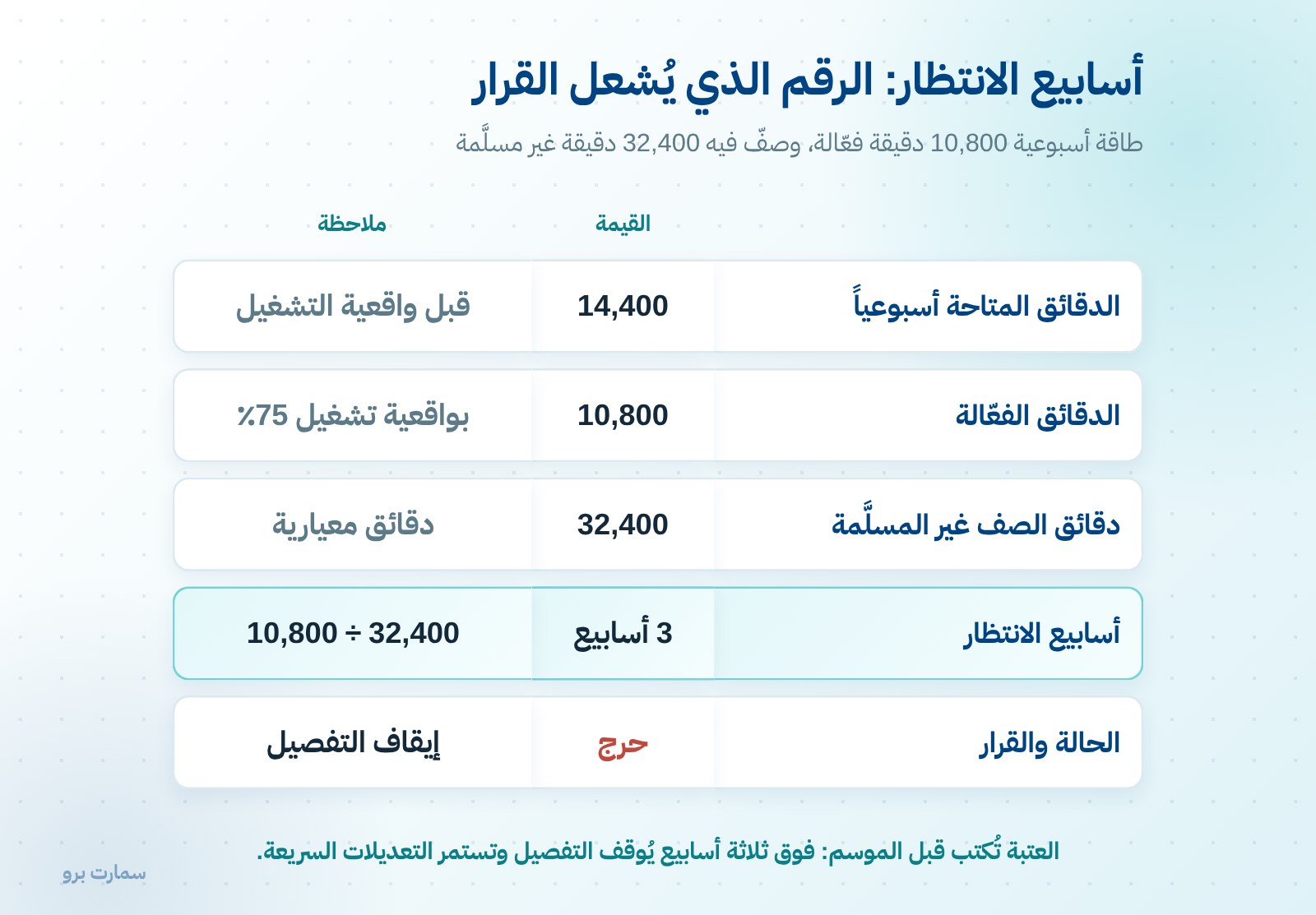
The figures below are hypothetical, used to illustrate the method, and do not represent prevailing market prices. Using the parameters from this series: five tailors × eight hours × six days = 14,400 available minutes a week, and at a realistic 75% utilisation that becomes 10,800 effective minutes.
If the standard minutes of all undelivered orders add up to 32,400 minutes, the waiting time is 32,400 ÷ 10,800 = 3 weeks.
| Weeks of waiting | Status | Decision |
|---|---|---|
| Up to 2 | Normal | Full intake |
| 2 to 3 | High | Stop the items with the lowest contribution per minute |
| 3 to 4 | Critical | Stop made-to-measure orders, keep quick alterations |
| More than 4 | Closed | Waitlist and advance booking only |
Write these thresholds down once, before the season, and announce them internally, because a decision made under pressure is made on emotion. How to calculate capacity and booked minutes is covered in workshop capacity calculation.
Stop an item, not the workshop
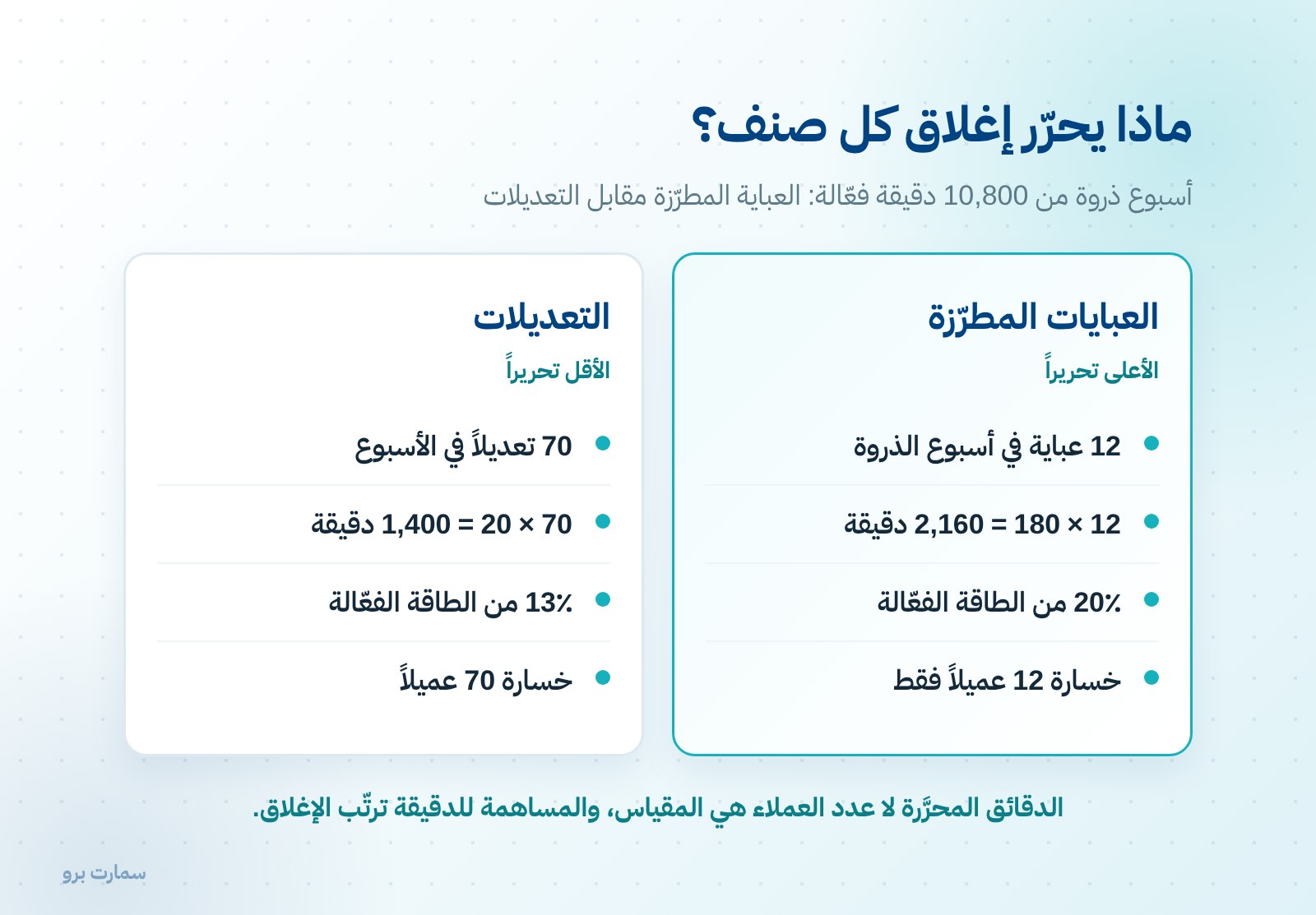
Closing completely is an unjustified loss, because some items use only a few minutes and go out the same day. The right decision is to close the items that buy the most minutes for the least contribution.
Suppose a peak week brings in 12 embroidered abayas. Closing them frees 12 × 180 = 2,160 minutes a week, or 20% of effective capacity, at the cost of only 12 customers.
By contrast, closing all alterations, say 70 alterations a week averaging 20 minutes each, frees 1,400 minutes, only 13%, at the cost of 70 customers.
The right measure: contribution per minute
When minutes are the constraint, an item is not judged by its percentage margin or its profit in riyals, but by what it earns for every minute it occupies.
The figures below are hypothetical, used to illustrate the method, and do not represent prevailing market prices.
| Item | Contribution per piece (SAR) | Minutes | Contribution per minute (SAR) |
|---|---|---|---|
| Plain abaya | 160.50 | 70 | 2.29 |
| Plain thobe | 140.38 | 80 | 1.75 |
| Embroidered abaya | 282.00 | 180 | 1.57 |
| Thobe shortening | 15.24 | 12 | 1.27 |
Contribution here means the price before VAT minus direct cost, before allocating any share of fixed overheads. The thobe figures come from the true cost of tailoring a thobe, and the shortening figures from alterations pricing.
The ranking turns intuition upside down. The embroidered abaya has the highest contribution per piece of the four (SAR 282) but ranks third per minute. Shortening has the highest percentage margin, about 57% of the price before VAT, yet the lowest contribution per minute.
So the closing order at peak starts from the bottom: non-urgent alterations first, then the embroidered abaya, with the plain abaya and the thobe the last to close.
This order applies to the peak only. In the quiet season the priority flips completely, because an unused minute earns nothing at all. An alteration that fills a gap in the schedule beats an empty gap that still carries its share of fixed overheads with no revenue.
Waitlist and advance booking
Stopping without an alternative pushes the customer to the workshop next door, and they may not come back. The alternative is two tools:
A waitlist with a known opening date. Record the name, mobile number, item and the date of the nearest open slot, and call the customer on that date, not before and not after. Its value is that it turns "no" into "not now, and here is our date".
Advance booking for the next season. Open it a few weeks before the season, with a limited number tied to capacity rather than demand, and with an advance payment that confirms commitment and covers the fabric.
The rule for how many to open: effective minutes for the week allocated to the item ÷ the item's average minutes. In a peak week with 10,800 effective minutes, if half is allocated to the plain thobe: 5,400 ÷ 80 = 67 thobes open for booking, no more, however strong the demand.
Advance payments have their own invoicing treatment, explained in deposits and VAT and the simplified invoice for tailors. The reference authority is the Zakat, Tax and Customs Authority (ZATCA).
How do you say no without losing the customer?
The refusal that loses the customer is the one with no reason and no end date: "We can't, the queue is long."
The refusal that keeps them is three sentences in order:
- A number, not an apology: "Our queue is three weeks today, and the thobe won't be ready before this date."
- An option now: a quick alteration, an item that is still open, or an early fitting appointment that secures their place.
- A specific return date: "We reopen made-to-measure orders on this day. I'll take your number and contact you."
Three mistakes lose the customer even when the refusal itself is right: accepting the order and then apologising three days later, giving a date you know you won't meet, or turning them down after they have already left their fabric with you. The decision is made at the counter, before any fabric or payment is received.
If the customer is in a hurry and you have genuine flexibility, the right route is a published rush fee, not a free promise, as explained in rush order fees. A rush fee buys the customer a place in the queue and buys you the extra minutes needed. A free promise delays other orders that were promised their own dates.
The stop notice itself
- One message, not several. A single message at the counter and on every channel, with the same wording, so no two customers hear two different answers.
- Specific to the item. "Embroidered abaya orders are closed", not "The shop isn't taking orders", because the second also costs you your alterations.
- With an opening date. An open-ended stop reads as a permanent closure; a dated one reads as good organisation.
- With staff who know the answer. Whoever stands at the counter should know today's waiting weeks, not go back to the owner with every customer.
When should you reopen?
The most common mistake after stopping is reopening because the front of the shop has gone quiet while the queue at the back is still full. A quiet counter is the result of the stop, not proof that it is no longer needed.
Reopening is decided by the same number that triggered the closure: when the waiting weeks fall below the threshold and stay there for two consecutive days.
- Reopen gradually: bring back the item with the highest contribution per minute first.
- Reopen with a daily cap on the number of orders accepted, not an unlimited reopening that rebuilds the queue to where it was.
- Start with the waitlist before general intake, because these customers have actually waited for you and deserve priority.
- Watch the queue daily for the first two weeks, because a hasty reopening sends you back to closing faster than you got out of it.
Recording each stop and reopen decision with its date, reason and queue figure at the time makes next season easier, because you start it with measured thresholds rather than guesswork. Setting delivery dates after reopening follows the same formula in setting delivery dates, and handling orders that ran late before the stop is covered in late order handling.
The official reference
Rules on issuing invoices when advance payments are received and showing VAT are published by the Zakat, Tax and Customs Authority (ZATCA), which is the reference in case of any difference.
Everything described here is managed in practice in SmartPro's tailoring system: orders, measurements, fabrics and invoicing in one place.
Key takeaway: Stop accepting orders when your queue in weeks crosses a threshold you wrote down before the season, close the items with the lowest contribution per minute first, and always give the customer a number, an option and a return date.
Read also
- Calculating workshop capacity in minutes
- Tailoring workshops in Ramadan
- Delivery dates: how to set a date that holds
To see how orders, queues and invoicing come together, start a free trial or book a demo with our team.
Article visuals
Frequently asked questions
When should I stop accepting orders at a tailoring workshop?
When your waiting weeks exceed the threshold you have written down. You calculate them by dividing the total standard minutes of undelivered orders by your weekly effective minutes. For example, 32,400 booked minutes against 10,800 effective minutes means three weeks of waiting, which is a partial-stop threshold in the hypothetical example.
Which item should I stop first?
The item with the lowest contribution per minute, not the one with the lowest percentage margin. In the hypothetical example, thobe shortening had the highest percentage margin of all items but the lowest contribution per minute, so it is closed first at peak. In the quiet season the rule reverses, because an empty minute earns nothing.
How do I turn down an order without losing the customer?
Use three sentences: today's waiting weeks as a number instead of a vague apology, an option available now from an item that is still open, and a specific reopening date with their number recorded on the waitlist. The fatal mistake is accepting the order and then apologising days later, or after you have already received their fabric.
How many orders should I open for advance booking?
Divide the effective minutes allocated to the item by its average minutes. If half of a peak week, 5,400 minutes, is allocated to the plain thobe and a thobe takes eighty minutes, the cap is 67 thobes. The number is tied to capacity, not demand, however strong the interest, and is secured by an advance payment invoiced on the day it is received.