
Piece Rate or Salary: Which Pay Model Fits Your Tailoring Workshop, by the Numbers
Piece rate or salary comes down to how your orders are spread across the year. Here is where the two models cross, how a salary behaves in the dead season, and the hybrid that suits most workshops.
Author:سامي الحيدري

In most tailoring workshops, piece rate or salary is decided by habit, or by whatever the tailor accepts when signing on. It is rarely decided by a calculation that shows what each model does to your costs.
Three models are genuinely used in the sector: piece rate, stage rate and a monthly salary. A fourth model sits between them. It is less common but suits many workshops better: the hybrid.
The difference between them is not the amount paid. It is how that amount behaves when orders surge and when they disappear, and that is what decides which model suits whom.
Piece rate or salary: what changes in your cost structure?
A salary is a fixed cost. It is paid in full, at the same level, in Ramadan and in the dead month. Piece rate is a variable cost. It rises and falls with the number of pieces.
| Aspect | Piece rate | Monthly salary |
|---|---|---|
| Cost behaviour | Varies with output | Fixed, unaffected |
| Effect on break-even point | Does not raise it | Raises it |
| Dead season | Cost falls with you | Cost stays in full |
| Peak season | Cost climbs with no ceiling | Cost does not change |
| Incentive for speed | Strong | Weak |
| Incentive for quality | Weak unless controlled | Moderate |
| Tailor stays with you | Less likely | More likely |
| Non-productive tasks | Not done voluntarily | Done |
The third row is the heart of the decision. A salary turns part of your cost into a fixed burden, which raises the number of pieces you need to cover your expenses, as the break-even point calculation shows.
The last row is often overlooked. A tailor paid by the piece will not volunteer to tidy the storeroom, train a new hire or quality-check someone else's piece, because none of those minutes count towards his pay.
Where do the two models meet?
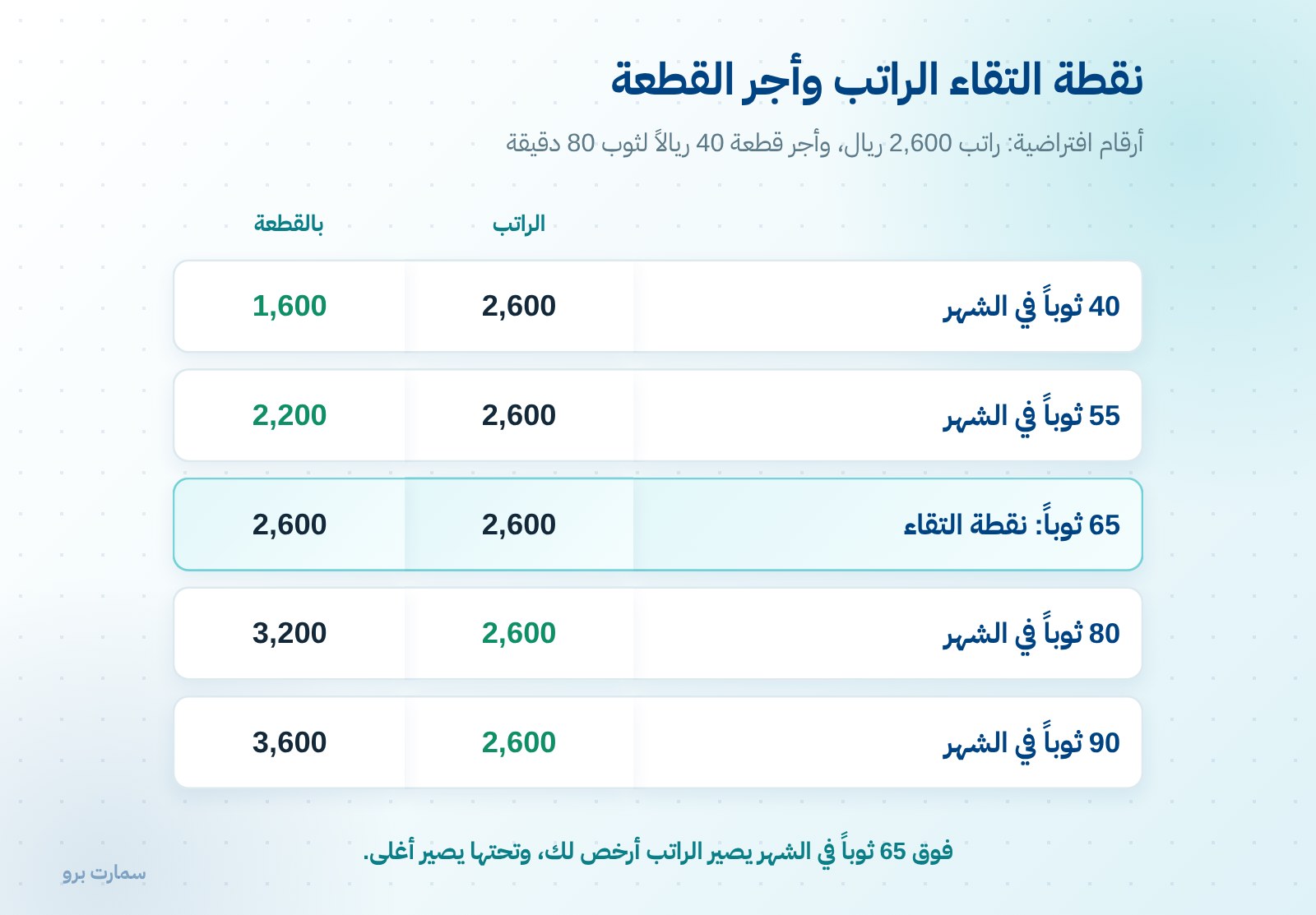
The figures below are hypothetical, to illustrate the method, and do not represent prevailing market rates. They build on the factors published in alterations pricing: a thobe takes 80 minutes and the tailoring labour rate is SAR 0.50 per minute, so the piece rate is SAR 40. Assume a monthly salary of SAR 2,600.
The crossover point of the two models is: 2,600 ÷ 40 = 65 thobes a month. At that volume, both models cost exactly the same in riyals.
| Thobes per month | Salary (SAR) | Piece rate (SAR) | Salary per piece | Piece rate per piece |
|---|---|---|---|---|
| 40 | 2,600 | 1,600 | 65.00 | 40.00 |
| 55 | 2,600 | 2,200 | 47.27 | 40.00 |
| 65 | 2,600 | 2,600 | 40.00 | 40.00 |
| 80 | 2,600 | 3,200 | 32.50 | 40.00 |
| 90 | 2,600 | 3,600 | 28.89 | 40.00 |
Above 65 pieces, the salary is cheaper for you; below it, the salary is more expensive. A workshop that stays above this line all year comes out ahead on salary. One that swings around it loses in the quiet half of the year what it gains in the busy half.
How does a salary behave in the dead season?
The quiet month is what really separates the two models. Take a month in which the tailor's share drops to 40 thobes.
- On salary: you pay SAR 2,600 for 40 pieces, or SAR 65 per piece, which is SAR 25 more than the piece rate.
- On piece rate: you pay only SAR 1,600, a difference of SAR 1,000 in a single month.
That difference hits at the weakest moment of the year. Each piece's share of fixed overheads already rises in the dead season, as shown in the true cost of tailoring a thobe, so you face two increases in the same month.
The other side is just as real. In a peak month of 90 pieces, a salary costs SAR 2,600 instead of SAR 3,600, saving you the same thousand. So the question is not which model is cheaper, but which one fits how your orders are spread across the year.
The hybrid: a fixed base plus a piece rate above a threshold
The hybrid takes from each model what both sides need: a floor that reassures the tailor, and a cost that moves with you.
The figures below are hypothetical, to illustrate the method, and do not represent prevailing market rates. Assume a monthly base of SAR 1,800, covering attendance and non-productive work, plus SAR 25 for every thobe above 36 thobes.
| Thobes per month | Salary (SAR) | Piece rate (SAR) | Hybrid (SAR) | Hybrid per piece |
|---|---|---|---|---|
| 40 | 2,600 | 1,600 | 1,900 | 47.50 |
| 55 | 2,600 | 2,200 | 2,275 | 41.36 |
| 65 | 2,600 | 2,600 | 2,525 | 38.85 |
| 80 | 2,600 | 3,200 | 2,900 | 36.25 |
| 90 | 2,600 | 3,600 | 3,150 | 35.00 |
Read it from both sides. For the workshop owner, the hybrid is SAR 700 cheaper than a salary in the quiet month, and SAR 450 cheaper than piece rate at peak.
For the tailor, the floor is SAR 1,900 in the quiet month instead of SAR 1,600 on piece rate, but the ceiling at peak is SAR 3,150 instead of SAR 3,600. He gives up part of his highest income in exchange for security at his lowest. It is an explicit trade-off he can understand, then accept or decline.
The base is not an arbitrary number. It is the price of what you want and cannot measure by the piece: turning up on time, helping with pressing and tidying, checking other people's pieces and training new hires.
Which pay model suits which workshop?
| Situation | Best fit | Why |
|---|---|---|
| Small workshop with one or two tailors | Salary or hybrid | Orders are irregular and the work involves many tasks |
| Mid-sized workshop with steady orders | Hybrid | A floor for retention and an incentive for output |
| Large workshop with high, steady orders | Salary | Output stays above the crossover point all year |
| Sharply seasonal workshop | Piece rate | Cost falls with orders in the dead months |
| Workshop relying on embroidery and special pieces | Stage rate or hybrid | Difficulty varies and a single piece rate cannot reflect it |
The practical rule: the more your orders fluctuate, the more valuable it is for labour cost to be variable. The steadier you are, the more valuable it is for that cost to be fixed and known in advance.
Measuring fluctuation needs nothing more than the number of pieces delivered in each month of the past year. If your highest month is double your lowest or more, you are a sharply seasonal workshop in financial terms, which is what the workshop capacity calculation reveals.
How does each model affect quality?
Piece rate pushes for speed, and speed without a quality gate produces rework. The cost of rework shows up elsewhere in the accounts, so the model looks cheaper than it really is.
A salary removes the incentive for speed, so the minutes per piece quietly stretch and nobody notices, because the cost does not move.
The remedy is the same for both: measure what is not visible. Track the rework rate, as in rework: who bears the cost, and the actual minutes per piece, as in tailor productivity.
Under piece rate, add one explicit rule: a piece redone because of the tailor's own mistake is not counted twice. This rule alone changes speed-driven behaviour more than any warning.
What should be written down before you implement it?
- The base, the rate and the threshold in figures, and when each one is reviewed.
- The definition of a counted piece: when it is considered finished, and whether that is after pressing or after the quality check.
- Difficulty factors, because a heavy piece is not counted like a standard one; the detail is in piece rates by difficulty.
- How rework is treated in the count.
- The non-productive tasks covered by the base.
Payment mechanics, payroll sheets and deductions have their own place: the payroll run guide, GOSI contribution rates and workshop payroll. Anyone running a women's tailoring workshop should also review batch production.
Where is the official reference?
Rules on employment arrangements, work and wages are published by the Ministry of Human Resources and Social Development, which is the reference in case of any discrepancy. Review its text before drafting any contract.
Workshops that get this under control usually do so inside a single system, such as SmartPro's tailoring workshop management software.
Read also
Article visuals

Frequently asked questions
Is piece rate or salary better for a tailoring workshop?
It depends on how much your orders fluctuate. A salary is a fixed cost that raises your break-even point and suits high, steady demand, while piece rate is variable, falls with you in quiet months and suits sharply seasonal workshops. Measure fluctuation using the number of pieces delivered each month over the past year. If your highest month is double your lowest or more, you are sharply seasonal in financial terms, and a variable labour cost suits you better.
How do I find the crossover point between a salary and piece rate?
Divide the monthly salary by the piece rate. In the hypothetical example, a salary of SAR 2,600 and a piece rate of SAR 40 give a crossover point of 65 thobes a month. Above that volume the salary is cheaper for the workshop, below it the salary is more expensive, and at 40 pieces the difference reaches SAR 1,000 in a single month.
What is a hybrid pay model and how is it calculated?
It is a fixed monthly base plus an amount for every piece above a set threshold. In the hypothetical example, a base of SAR 1,800 plus SAR 25 per thobe above 36 thobes is SAR 700 cheaper than a salary in a quiet month and SAR 450 cheaper than piece rate at peak.
How do I protect quality under piece rate?
Use a written rule: a piece redone because of the tailor's own mistake is not counted twice, and a piece counts as finished after the quality check, not after sewing. Then measure the rework rate and the actual minutes per piece every month, because a cost that is not measured shifts to another line without being traced to its cause.